

Nov 4, 2026
What Makes Liposomal Resveratrol a Next-Generation Antioxidant Ingredient?
Liposomal resveratrol powder is often introduced as an upgrade, but "upgrade" is not a specification anyone can release against. This article takes the phrase next-generation antioxidant ingredient apart and rebuilds it from four properties a buyer can confirm: isomer purity, encapsulation efficiency, load band, and dispersibility. Each one appears in a certificate of analysis, a method statement, or a bench sample, and each can be written into a purchase specification. The liposomal resveratrol powder specification from EmerWell is the reference set throughout.
"Antioxidant" Has Two Meanings, and Only One Belongs on an Ingredient Datasheet
That division determines what belongs in a technical agreement. A structure or function statement is substantiated by the brand; evidence that the powder in the drum matches the sample sits with the supplier. Mixing the two produces a specification nobody can enforce. Wider context on positioning and documentation is in the complete guide for supplement brands.
Next-Generation, Restated as Four Measurable Properties
Used honestly, the term describes a material that has moved past the limits of unencapsulated resveratrol powder: chemical instability under light and heat, poor wetting in cold water, and a load range too narrow for different formats. Four properties carry that argument, and the rest of this article elaborates them.
| Property | What it fixes in the material | How it is verified | Question to put to a supplier |
|---|---|---|---|
| Trans-isomer purity ≥99%, zero cis degradation | Chemical identity, and the crystallisation and flow behaviour that follow from it | Isomer-resolved HPLC, both peaks reported | What is the basis of the 99%, and what is the detection limit for cis? |
| Encapsulation efficiency 85%–92% | Share of active associated with the lipid phase rather than free in the powder | Free/encapsulated separation, total assay, mass balance | Which separation method, and was it run on dried powder or liquid intermediate? |
| Load band 10%–50% | How much carrier a formulator carries per unit of active | Assay, EE, and particle size at the offered load | Is EE at 50% the same as at 10%, and can both be shown? |
| Cold-water dispersibility | Whether the powder can enter stick packs and ready-to-mix formats | Ambient dispersion trial, turbidity, particle size on the suspension | Dispersion time, and sediment after thirty and sixty minutes? |
Property One: Trans-Isomer Purity ≥99% and Zero Cis Degradation
The isomer ratio is the first of the four, and the one most often reported loosely.
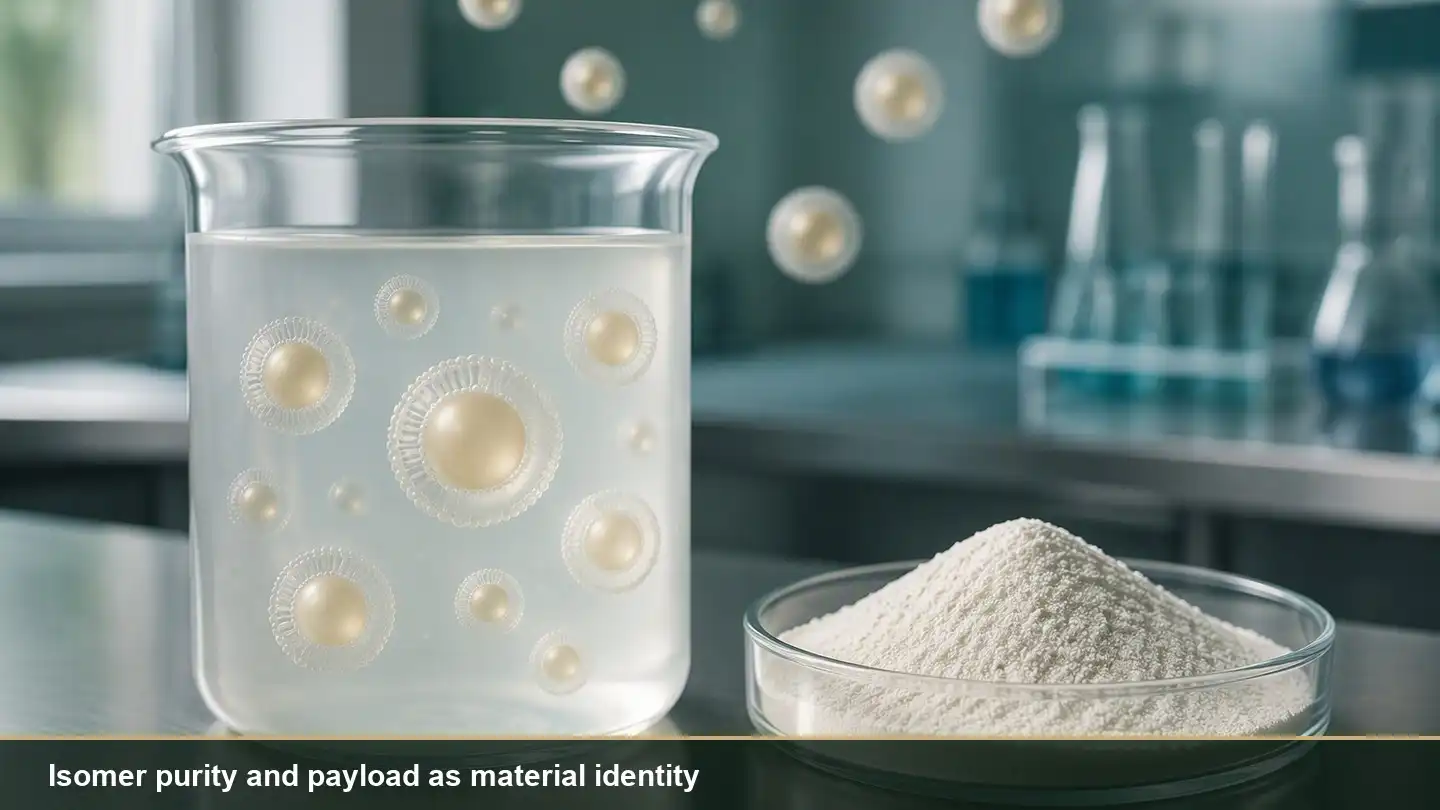
The chemistry that makes the number meaningful
Resveratrol exists as two geometric isomers around the central double bond between its two aromatic rings. The trans (E) form defines the commercial ingredient; the cis (Z) form differs in shape, packing behaviour, and solubility. Ultraviolet light and heat push trans toward cis, and the reaction proceeds during drying, milling, and any storage that lets light or warmth reach the powder. Because the isomers absorb at different ultraviolet wavelengths, a developed HPLC method resolves them and reports each separately.
Why this is an identity question, not a purity decimal
A certificate reading "resveratrol 99.5%" without an isomer breakdown does not say what a buyer thinks. That figure can be reached by 92% trans plus 7.5% cis. The total is high; the identity is not what was ordered. Under normal handling the cis fraction does not revert, and it grows if light protection fails. Shape changes what the solid does: crystal habit, melting behaviour, compaction, and flow all shift, and those are what a capsule filler depends on. Purity asks how much non-resveratrol material is present; the isomer ratio asks whether the resveratrol present is the material that was qualified. The second question comes first. See the criteria for judging a high-quality resveratrol ingredient.
What to ask for
- An isomer-resolved assay reporting trans and cis separately, with integration basis and limit of quantification.
- Forced-degradation or photostability data showing how the ratio moves, not only the release value.
- Confirmation that "zero cis" means below a stated detection limit, and what that limit is.
- Light-blocking packaging and a storage instruction that matches the stability data.
Property Two: Encapsulation Efficiency of 85%–92% Means Little Without the Method
Encapsulation efficiency is a ratio: active associated with the lipid phase divided by total active. Both halves must be measured, and the measurement needs a separation step that isolates free active without stripping the vesicle. Ultracentrifugation, dialysis, and size-exclusion separation give different numbers on the same material, and each depends on pre-dilution. A specification line without a method is half a specification.
The 85%–92% band is credible precisely because it is not 99%. Very high figures usually indicate a different definition — active in the lipid phase of a liquid concentrate rather than in dried powder — or a separation step that never removed the free fraction. Ask whether the value was obtained on the powder as shipped, since drying is where encapsulation is most often lost, and ask for the total assay beside it. Efficiency without absolute content can be arithmetically consistent and commercially meaningless. Background on carrier chemistry is in the discussion of resveratrol solubility in liposomal systems.
Property Three: A 10%–50% Load Band Is a Formulation Tool, Not a Brochure Range
The trap is a supplier who quotes a band but tests at one end. Efficiency and particle size tend to deteriorate as load rises, because there is less carrier per unit of active. An "up to 50%" supported by an EE figure measured at 10% is not transferable. Ask for assay, EE, and particle size at the specific load, and regard a supplier who can produce all three as one who understands the product. Blends with companion actives such as liposomal NMN powder raise the same question: which grade keeps the blend homogeneous at the target fill weight. Constraints for contract development are in the formulation notes for OEM and ODM teams.
Property Four: Cold-Water Dispersibility into a Translucent Suspension
For stick packs and ready-to-mix products this decides whether a format is feasible, because no consumer will heat a sachet. It also predicts filling-line behaviour, where powder must wet out consistently from one sachet to the next. Ask for a trial at a stated concentration in ambient water, visual grading at five and thirty minutes, turbidity, and a particle size distribution measured on the reconstituted suspension, not the dry powder alone. Sediment after standing is worth recording separately, since it reveals the tail that a mean size hides. See the manufacturer perspective on liposomal resveratrol ingredients.
Reading Peroxide Value and Colour as One Signal
Colour supplies the second half. This grade is specified as an off-white to pale yellow free-flowing powder, and a shift toward deeper yellow or brown is a change in the material, not a cosmetic variation. Read together, peroxide value catches the early phase, and colour and odour catch the later one. Ask for both at release and at each stability interval, with method and units named, and ask how the trend behaved rather than only the release value. The same reasoning applied to another lipid system is in the analysis of lipid stability in powder formulations.
The Specification Sheet, Line by Line
The table below reproduces the parameters that matter for release and for incoming inspection. It is deliberately short: a specification earns its keep when every line can be tested and the method behind it is named.
| Parameter | Specification | How it is established |
|---|---|---|
| Active identity | Trans-resveratrol, ≥99% trans-isomer purity, zero cis-isomer degradation | Isomer-resolved HPLC |
| Encapsulation efficiency | 85%–92% | Free/encapsulated separation plus total assay |
| Concentration | 10%–50%, customizable | Assay at the declared load |
| Appearance | Off-white to pale yellow, free-flowing fine powder | Visual inspection against a reference |
| Dispersion | Cold-water dispersion to a stable translucent suspension | Ambient trial, turbidity, particle size |
| Peroxide value | Controlled at release, monitored through shelf life | Iodometric titration |
| Heavy metals | Pb < 0.5 ppm | Elemental analysis on the batch |
| Microbiology | TPC < 1,000 cfu/g | Total plate count |
| Shelf life | 24 months | Stability data under the declared condition |
| Analytical methods | HPLC for content, DLS for particle size, TEM for morphology, iodometric titration for peroxide value | Method statements on request |
| Certification | cGMP, ISO 9001, ISO 22000, Kosher, Halal, Non-GMO, Vegan | Certificates and scope statements |
| Clean label options | Gluten-free and soy-free options | Declared on the selected grade |
Two reading habits make the table more useful. Check that the method column is populated, because a specification without methods cannot be verified at goods-in. Then check that the certificate of analysis for the delivered lot reports the same parameters at the same limits; a certificate covering eight of twelve lines is a partial document. What such documents should contain is set out in this guide to reading a liposomal powder COA.
Claims That Sound Newer Than They Are
Because next-generation has no legal definition, the phrase attracts language that cannot be tested. The table lists what a technical reviewer is most likely to meet, and the document that either supports the phrase or retires it.
| Claim as written | Why it cannot be checked as written | What to request instead |
|---|---|---|
| "Next-generation delivery performance" | No property, unit, or method is named | EE, particle size, and dispersion data at the load being purchased |
| "Multiple-fold higher levels than standard powder" | No matrix, time point, or study design is referenced | The underlying report, or removal of the number |
| "Pharmaceutical-grade" or "nano-grade" | Neither term has a fixed specification | Particle size distribution by DLS, plus a written grade definition |
| "100% encapsulated" | Contradicts the mass balance of any real encapsulation process | A measured EE with the separation method named |
| "Patented process, specifications confidential" | Confidentiality is replacing data | Release specifications and a COA, plus the patent number if one exists |
| "High antioxidant score" | A single index obtained outside any agreed method | Peroxide value, colour, and isomer data on the delivered lot |
What Next-Generation Should Mean Across Lots
The adjective is earned only if it holds on the tenth shipment. Assay, EE, particle size, and peroxide value should sit inside the same limits lot after lot, and the trend across three consecutive certificates says more than any single document. Ask how process changes are notified, whether specification changes need written agreement, and which parameters are tracked as trends rather than as pass or fail. A supplier who answers those questions has a quality system behind the product; one who cannot is selling a sample. Commercial structure and lot tracking are covered in the notes on bulk liposomal resveratrol supply.
Format development moves the same way. The interesting work is not a new adjective but extending one material into more formats without changing its identity: higher-load grades for capsules, lower-load grades for semi-transparent drinks, blends that stay homogeneous through filling. That trajectory is described in the outlook for liposomal resveratrol formats.
Request the Specification, a COA, and a Sample
For a technical evaluation, the useful package is the current specification, a batch certificate of analysis with the methods named, and a sample large enough for a dispersion trial and an isomer check in your own laboratory. EmerWell supplies liposomal resveratrol powder across the 10%–50% load band with trans-isomer purity of ≥99%, encapsulation efficiency of 85%–92%, and a documented 24-month shelf life, and can discuss which grade fits a given format. Start from the liposomal resveratrol powder product page or send your requirements to info@emerwell-bio.com.
References
- National Center for Biotechnology Information. PubChem Compound Summary for CID 445154, Resveratrol. https://pubchem.ncbi.nlm.nih.gov/compound/445154
- Effect of Natural Deep Eutectic Solvents on trans-Resveratrol Photo-Chemical Induced Isomerization and 2,4,6-Trihydroxyphenanthrene Electro-Cyclic Formation. PMC9000676. https://pmc.ncbi.nlm.nih.gov/articles/PMC9000676/
- U.S. Food and Drug Administration. Structure/Function Claims. https://www.fda.gov/food/food-labeling-nutrition/structurefunction-claims
- AOCS. Approved Methods and Laboratory Services (peroxide value methods, including Cd 8b-90). https://www.aocs.org/attain-lab-services/methods
Disclaimer: This article is written for ingredient buyers and formulation professionals and describes material specifications and analytical methods only. It is not medical or nutritional advice and makes no statement about the effects of any ingredient on human health. Finished-product claims are the responsibility of the brand owner and must comply with the regulations of each market where the product is sold.
Online Message