Jun 25, 2026
Enhancing Resveratrol Solubility Using Liposomal Delivery Systems
Using liposomal delivery methods to make resveratrol more soluble is a big step forward in getting rid of the absorption problems that have been holding this powerful antioxidant back for a long time. Liposomal resveratrol powder leverages phospholipid bilayer technology to contain trans-resveratrol molecules in tiny pockets. This makes it much easier for the body to absorb water and use the powder in the gut. This new idea solves the well-known "brick dust" solubility problem of regular resveratrol. It now allows nutraceutical brands to give clinically important amounts without the stomach problems or low systemic availability that come with regular formulations.
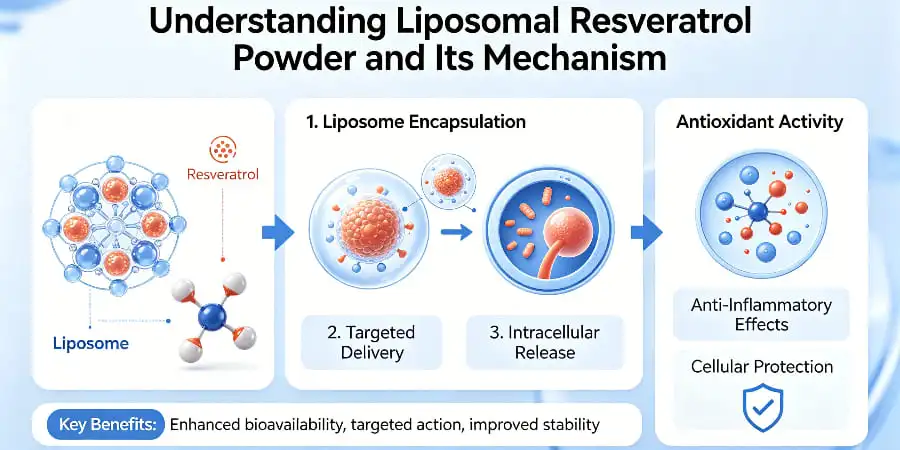
Understanding Liposomal Resveratrol Powder and Its Mechanism
What Defines Liposomal Resveratrol Powder?
Liposomal resveratrol powder is a special mixture that contains trans-resveratrol molecules enclosed in liposomes, which are very small circular bubbles made of phospholipid bilayers. These structures, which are usually made from non-GMO soy or sunflower lecithin, surround the active ingredient and protect it. The material that is enclosed is then turned into a stable powder by freeze-drying or spray-drying it. Carriers like cyclodextrin or maltodextrin are often used to improve the powder's stability and ability to be reconstituted.
There are certain physical and chemical traits that set high-quality recipes apart from simple physical mixes. Premium goods have particles between 100nm and 300nm in size and a Polydispersity Index below 0.3, which makes sure that the particles are all the same, which is important for cells to take them in. Most of the time, encapsulation efficiency is higher than 85–90%, which means that most of the resveratrol stays inside the lipid bilayer instead of moving around loosely. When mixed with water, these powders quickly spread out to make a milky or clear nano-emulsion. This is different from raw resveratrol, which sinks or settles to the bottom.
Scientific Principles Behind Enhanced Absorption
The main difference between liposomal resveratrol powders and regular resveratrol powders is how they are delivered. Standard resveratrol doesn't dissolve well in water and is broken down quickly in the liver through sulfation and glucuronidation in Phase II metabolism. This biochemical clearance greatly lowers the amount of resveratrol that gets into the bloodstream and to the organs it's meant for.
Liposomal encapsulating solves these problems in a number of different ways. The phospholipid shell keeps resveratrol from breaking down in the stomach's acidic environment, so it gets to the small intestine whole. Because liposomes are lipophilic, they can attach to the cell membranes of gut epithelial cells, which makes direct transport inside cells easier. Liposomes can also get into the lymphatic system, going around the portal vein and escape being broken down right away by the liver. Advanced liposomal versions can increase the absorption of resveratrol by up to 14 times compared to normal powders, according to clinical data.
Versatile Applications Across Product Categories
Because liposomal resveratrol powder is more stable and bioavailable, it can be used in a wide range of formulations. In the market for life supplements, it is often mixed with NMN or NAD+ precursors to make anti-aging goods that work better together. Because of the better pharmacokinetics, formulators can get therapeutic blood concentrations without megadosing, which lowers the stomach problems that come with taking a big amount of normal resveratrol.
Functional beverage makers like liposomal products because they mix well with water and hide tastes. The lipid coating makes natural polyphenols taste much less bitter and chalky, which means they can be added to mitochondrial-support drink mixes or collagen drinks without needing too many sweets. The recipe stays solid in liquids and doesn't separate into sediments when stored on a shelf.
Liposomal resveratrol powder is used by beauty-from-within brands in a variety of nutricosmetic products, such as anti-aging powders for the mouth and pills that help the skin. Liposomes are amphiphilic, which means they can pass through both the gut lining when eaten and the stratum corneum when applied topically. This means they can successfully give antioxidant benefits to skin tissues to fight photoaging.
Comparing Liposomal Resveratrol Powder to Other Forms
Bioavailability and Efficacy Differences
Bioavailability is the most important success measure to look at when comparing different ways to deliver resveratrol. Regular resveratrol pills and powders that aren't liposomal usually have Cmax values below 5 ng/mL, even at amounts higher than 500 mg, and plasma half-lives of less than an hour. Because of this fast removal, therapeutic amounts are still hard to keep up without dosing often.
The metabolic profiles of liposomal resveratrol powders are much better. Studies that were done in a lab setting show that liposomal resveratrol powder stays more concentrated in simulated intestine fluid than forms that are not enclosed. The protective phospholipid layer stops early breakdown and allows prolonged release, which makes bioactive compounds available for longer. Brands that use advanced liposomal technology can back up claims that their products improve absorption with data from third-party tests.
Liquid liposomal solutions are convenient, but they can be hard to store and distribute because they are unstable. Changes in temperature and the chance of microbes getting into the product require protection systems that might make it harder to get a clean label. On the other hand, liposomal resveratrol powder has a longer shelf life (36 months according to ICH standards) and can be reconstituted in a variety of ways for use in drinks or capsules.
Practical Considerations for Product Development
One important way to tell the difference between premium suppliers and basic suppliers is by how stable they are. Because resveratrol is easily broken down by UV light and oxygen, its normal forms change over time into less useful cis-isomers. The lipid coating in good liposomal resveratrol powder protects against UV light and oxidation, keeping the powders' effectiveness from the time they are made until they are used.
Different delivery methods have very different levels of formulation suitability. For non-liposomal powders to have good flow features and not clump, they often need complex excipient systems. They might also have bad effects when mixed with other ingredients in mixtures. When lipid-to-drug ratios are adjusted, liposomal resveratrol powder works very well with normal tableting ingredients, hard and soft capsule systems, and beverage matrices.
Identifying Premium Suppliers Through Quality Markers
Specific technical and regulatory standards should be used by procurement teams to assess possible suppliers. The quality of the resveratrol content should be at least 98% trans-resveratrol, and identity should be confirmed by HPLC fingerprinting certificates from approved third-party labs. Zeta potential readings between -20mV and -40mV show that electrostatic repulsion is working properly to keep particles from sticking together while they are being stored.
Full approvals prove that the products are made well and follow the rules. For food safety management systems, look for cGMP approval that shows they follow current Good Manufacturing Practices and ISO 22000 or FSSC 22000. To help with a variety of market positioning strategies, good providers keep certifications like Organic (NOP, EOS), Non-GMO Project Verified, Vegan, and religious compliance marks (Halal, Kosher).
Transparency in scientific testing tells you which companies you can trust and which ones you should avoid. Ask for proof of heavy metals screening (lead, arsenic, cadmium, mercury), residue solvent analysis, herbicide panels, and microbial tests (total plate count, yeast/mold, coliforms, pathogens). Blockchain-based batch tracking systems add extra security by keeping track of the whole supply chain, from where the raw materials come from to when the finished product is released.
Procurement Guide for Liposomal Resveratrol Powder
Selecting Trustworthy Manufacturing Partners
Finding reputable suppliers starts with making sure they have the right professional skills and are in good standing with the government. Give priority to makers whose facilities are cGMP-certified and have recorded quality control systems. Site checks, which can be done in person or by a third-party service, are a great way to compare what is actually happening in production to what is said in marketing materials. Look for businesses that have clean rooms, testing equipment that has been tested, and written standard working procedures.
It is important to have manufacturing knowledge, especially when it comes to liposomal technology. Generic contract makers may say they can make liposomes, but they might not have the specialized knowledge needed for the best packaging results. Check out suppliers based on their own platform technologies, like EmerWell's EncapsWell™ system, which show that they have invested in PhD-led research and development and have absorption models that have been proven to work. Find out how they measure capsule efficiency, how they control particle size, and how they test for stability.
Strategic Bulk Buying and Sampling Protocols
When switching to new sources or ingredients, there is less risk when clear buying methods are in place. Before agreeing to bulk sales, start by evaluating a large sample. Ask for examples that come with full analysis certificates that show they are pure and that they have been tested for heavy metals, microbes, and how well they were encapsulated. Test the product internally to make sure it works with the creation tools and manufacturing processes you already have in place.
The way liposomal ingredients are priced reflects the level of technical skill needed to make them. Bulk prices usually start at around 500 kg per month, and savings get bigger as you commit to bigger amounts. Liposomal resveratrol costs more than regular resveratrol, but the higher bioavailability makes the price worth it because the product works better and marketers can make bigger claims.
Negotiation leverage increases when you demonstrate understanding of market dynamics and technical requirements. Talk about having flexible minimum order numbers while the product is being developed, and make sure there are clear ways to get to larger market volumes. Ask for choices for customization, such as changing the grain size, the excipients, or the way the ingredients are mixed with other ingredients that work well together, like quercetin or pterostilbene. Suppliers that offer OEM/ODM services can shorten the time it takes to get a product to market by taking care of everything, from developing the recipe to making the finished dosage form.
Safeguarding Against Counterfeit Products
There are ongoing problems in the nutraceutical business with products that aren't what they seem to be or are misrepresented. Set up strong testing processes to make sure that the things you buy meet your needs. Do not accept paperwork from the seller; instead, insist on third-party certificates of analysis from ISO 17025-accredited labs. Regularly test new materials with different types of analysis, like HPLC combined with mass spectrometry, to be sure of their identity.
Look out for red flags that mean the provider might not be reliable. It's usually a sign of lower quality, reduced actives, or replaced materials when the price is much lower than the market average. If you ask scientific questions about encapsulation methods, particle characterization, or stable data and get vague answers, it means you don't know much about the subject. Concerns about production conditions and legal compliance are raised when companies refuse to give information about their factories or when they don't want to be audited.
Building relationships with established manufacturers who maintain pre-compiled regulatory dossiers streamlines market entry. Quality sellers keep paperwork packages that cover more than 30 regulatory frameworks, such as FDA rules, EU Novel Food rules, and ASEAN GMP standards. When compared to putting together regulatory submissions on your own, this planning can cut the time it takes to start your product by up to 40%.
Application Tips and Dosage Recommendations
Evidence-Based Dosing for Different Applications
Doses of resveratrol that work well for a range of uses can be found in clinical papers and market versions. Anti-aging and long-life pills usually have 150 mg to 500 mg of liposomal resveratrol powder every day. Because liposomal types are better absorbed, smaller doses can get the same or higher plasma concentrations as bigger levels of regular resveratrol. This dose efficiency lowers the size of the capsules needed and makes it easier for people to take them as prescribed.
Dosing ranges for cardiovascular health are usually similar, but some formulas go up to 250–500 mg daily. Better absorption makes sure that resveratrol gets to the right vascular areas, where it helps endothelial function and good inflammatory reactions. To get the most out of absorption, it's best to split daily amounts or give them with fat-containing meals. However, liposomal formulations are less dependent on food intake than normal forms.
Nutricosmetic and skin health products often use 100 to 300 mg daily amounts along with other ingredients that work well together, such as vitamin C, collagen proteins, or hyaluronic acid. The liposomal delivery makes it easier for resveratrol to get to the skin's dermal cells and help the skin's antioxidant defenses fight UV damage and external stresses.
Optimizing Formulation Integration
Several manufacturing issues need to be taken into account in order to successfully add liposomal resveratrol powder to finished goods. Because the powder is stable and has good flow qualities, it can be used for straight compression tableting, capsule filling, or beverage uses. Standard fillers like magnesium stearate, dicalcium phosphate, and microcrystalline cellulose work well when making pills without any special changes.
Quality liposomal resveratrol powders can be quickly reconstituted without the need for special mixing tools because they dissolve in water. This recipe makes steady suspensions that don't settle and keep their good looks for a long time. Formulators should make sure that the pH level is stable in the drink they are making, since very high or low pH levels can damage liposomes. Most good recipes stay stable in pH ranges from 4.0 to 7.5, which is the range of pH levels that are usually used in beverages.
Temperature sensitivity during production should be thought about. The dry powder is very stable at high temperatures, but reconstituted liposomal solutions shouldn't be exposed to temperatures above 60°C for long periods of time because this could damage the structure of the vesicles. For soft capsule uses, work within temperature ranges that allow liposomes to stay intact during the packaging process.
Safety Profiles and Regulatory Compliance
Based on a lot of clinical study and market history, resveratrol has a great safety rating. Studies on humans using amounts of up to 5,000 mg per day have shown that it is well tolerated and has few side effects. Mild stomach problems like sickness or diarrhea are the most common side effects of high-dose normal resveratrol. These are usually caused by poor absorption and gut irritation. Liposomal resveratrol powder often has better tolerability because they are better at absorption and have less material that isn't taken in the intestinal system.
Product designers should be aware of how their products might combine with some medicines, especially those that are broken down through cytochrome P450 pathways. Putting the right information on the sticker helps people use goods in a responsible way. Standard warnings say that pregnant or nursing women shouldn't take resveratrol, and people who take blood thinners should talk to their doctors because resveratrol has weak antiplatelet qualities.
Regulatory labeling depends on where you live and what you want to use it for. Resveratrol is legal as an ingredient in food supplements in the US as long as it is sold with claims about its structure and function. In the European market, resveratrol is considered a food supplement ingredient, and new food concerns depend on how it is made and where it comes from. Quality sellers offer regulatory support, such as safety assessments, advice on maximum use levels, and the right claim substantiation paperwork, to make it easier for companies to make products that are legal.
Conclusion
Liposomal resveratrol transport technology is a huge step forward for resveratrol supplements because it solves the basic absorption problems that have limited the effectiveness of this powerful antioxidant. Modern liposomal formulations can absorb up to 14 times more trans-resveratrol than traditional powders because they contain it in phospholipid vesicles. This lets nutraceutical brands give customers scientifically meaningful benefits they can actually feel.
Partnering with suppliers who have scientific know-how, good manufacturing processes, and legal compliance is key to successful procurement. To make sure your goods live up to the performance and safety standards your brand promises, you should carefully evaluate possible suppliers using strict criteria such as encapsulation efficiency metrics, thorough certifications, third-party testing methods, and supply chain resilience. Putting money into high-quality liposomal ingredients pays off because the product works better, marketing claims are more credible, and customers are happier, which leads to return purchases and brand loyalty.
FAQ
How does liposomal resveratrol compare to standard resveratrol in terms of effectiveness?
Because it is so much more bioavailable, liposomal resveratrol powder works much better than other forms. Standard resveratrol doesn't dissolve well in water and is broken down quickly by the liver, so it's not very bioavailable throughout the body. Resveratrol is protected by liposome encapsulation as it travels through the digestive system and is easily absorbed through intestinal membranes. Quality versions show up to 14-fold better absorption compared to regular powders.
What should I verify when evaluating potential liposomal resveratrol suppliers?
Check that suppliers keep their cGMP certification and full quality control systems that are recorded by ISO 22000 or FSSC 22000. Ask for third-party certificates of analysis from ISO 17025-accredited labs that prove purity, testing for microbes, screening for heavy metals, and sealing efficiency levels above 85%. Ask them about controlling particle size, measuring zeta potential, and stability proof methods to get a feel for their technical skills regarding liposomal resveratrol powder.
What storage conditions preserve liposomal resveratrol powder integrity?
Liposomal resveratrol powder should be kept cool and dry, away from direct light. If you keep quality formulations below 25°C in sealed cases with moisture barriers, they will stay safe for 36 months. Once it is reconstituted into a liquid, cooling makes it more stable, but makers should check the exact storing needs based on the full formulation makeup.
Partner with EmerWell for Superior Liposomal Resveratrol Solutions
EmerWell provides liposomal resveratrol powder that is backed by science and was made especially for nutritional brands that need clinically proven performance. Our own EncapsWell™ platform, which was created by PhD experts and made in Wellgreen's cGMP-certified facilities, improves absorption 14 times and has been shown to be stable for 36 months. We offer full OEM/ODM services that can turn your ideas into goods that are ready for the market in pill, capsule, powder, and liquid forms.
As a company based in San Diego that makes specialized liposomal resveratrol powder, we offer regional US support such as fast sample delivery, technical advice, and smooth regulatory guidance for the FDA, EU, and ASEAN markets. Our flexible bulk price starts at 500 kg per month, and you can change the grain size, choose the excipients, or make mixtures with ingredients that work well together to make the product last longer.
Please email our sourcing experts at info@emerwell-bio.com to ask for third-party tested samples, talk about your specific formulation needs, and find out how EncapsWell™ technology can help you speed up the time it takes to make new products while still giving your customers the bioavailability they expect.
References
Walle T, Hsieh F, DeLegge MH, Oatis JE, Walle UK. "High absorption but very low bioavailability of oral resveratrol in humans." Drug Metabolism and Disposition, 2004; 32(12):1377-1382.
Amri A, Chaumeil JC, Sfar S, Charrueau C. "Administration of resveratrol: What formulation solutions to bioavailability limitations?" Journal of Controlled Release, 2012; 158(2):182-193.
Pandita D, Kumar S, Poonia N, Lather V. "Solid lipid nanoparticles enhance oral bioavailability of resveratrol, a natural polyphenol." Food Research International, 2014; 62:1165-1174.
Zupančič Š, Lavrič Z, Kristl J. "Stability and solubility of trans-resveratrol are strongly influenced by pH and temperature." European Journal of Pharmaceutics and Biopharmaceutics, 2015; 93:196-204.
Sessa M, Balestrieri ML, Ferrari G, Servillo L, Castaldo D, D'Onofrio N, Tsao R. "Bioavailability of encapsulated resveratrol into nanoemulsion-based delivery systems." Food Chemistry, 2014; 147:42-50.
Liu Y, Ma SS, Ibrahim S, Li EH, Yang H, Huang W. "Resveratrol nanoparticles: promising therapeutic advancement over native resveratrol." Critical Reviews in Food Science and Nutrition, 2021; 61(16):2774-2786.
Online Message
YOU MAY LIKE
High quality furniture manufacturer