Sep 2, 2026
Liposomal Resveratrol Powder: A Complete Guide for Supplement Brands
Liposomal resveratrol is an innovative delivery system for one of nature’s most researched antioxidants. The resveratrol in legacy formulas has considerable absorption problems, typically resulting in bioavailability of less than 5%. The next-gen ingredient leverages cutting-edge liposomal encapsulation technology to give up to 14 times the absorption of traditional powders, allowing supplement makers to deliver real effectiveness that customers can experience. This thorough book dives into the science, quality standards, sourcing methods and formulation knowledge companies need to know to distinguish themselves in the competitive lifespan and wellness sectors.
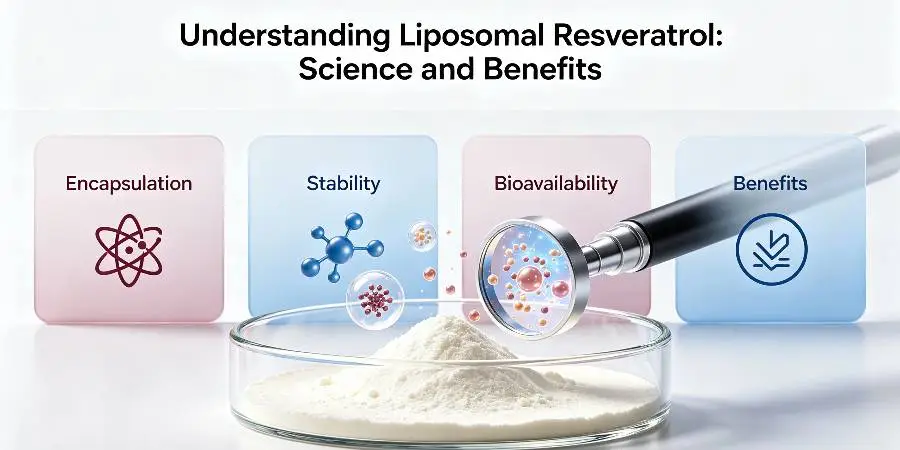
Understanding Liposomal Resveratrol: Science and Benefits
What Makes Liposomal Delivery Superior
The fundamental challenge has always been how to get resveratrol into the body. This polyphenol compound is naturally present in Japanese knotweed and grape skins. It is rapidly degraded in the gut and is subject to extensive first-pass metabolism in the liver. Liposomal technology solves these challenges by encapsulating resveratrol molecules within phospholipid bilayers, small rings that mimic cell walls. These nanoscale carriers protect the active chemical from the harsh environment of the stomach and allow its direct absorption into the circulation.
Our EncapsWell™ technology achieves this by careful design of vesicles in the 50nm to 200nm diameter range, which can be confirmed by Dynamic Light Scattering studies. These phospholipid shells are constructed from non-GMO sunflower lecithin and provide an amphiphilic structure that is right at home with cells lining the intestines. This approach avoids the degradation mechanisms which impair conventional formulations, resulting to much greater blood levels of trans-resveratrol, the physiologically active isomer.
Core Health Benefits Driving Market Demand
Clinical study has shown that resveratrol plays a part in processes that help cells live longer, mainly by activating sirtuin and supporting mitochondrial biogenesis. Supplement companies are taking advantage of people's interest in living well, heart health, and metabolic efficiency. Antioxidants help fight oxidative stress, and anti-inflammatory qualities help keep joints comfortable and the body's balance.
Beauty-from-within brands love resveratrol for its skin-health benefits. Studies show that taking supplements by mouth may help the body make more collagen and protect against photoaging by neutralizing free radicals caused by UV light. Because liposomal versions make these benefits more bioavailable, they work at lower amounts. This makes taking pills easier and more likely to be followed through with.
Why Procurement Teams Prioritize Liposomal Formats
In addition to being effective, liposomal resveratrol powder has useful benefits for product creation. Because it dissolves in water, it doesn't have the chalky mouthfeel and bitter astringency that regular resveratrol does. This makes it perfect for functional drinks, ready-to-drink shots, and sachets that dissolve in water. Because of this, brands can use a single master ingredient to make a lot of different types of products.
Another very important factor is stability. Our recipe has a 36-month shelf life based on approved ICH stability standards, which protects against isomer conversion and lipid peroxidation. This longer-lasting stability cuts down on waste, makes it easier to keep track of goods, and makes sure that customers get full-potency products throughout the distribution cycle.
Quality Considerations and Scientific Validation
Analytical Testing That Defines Excellence
Professional buyers need more information than just the basics of a Certificate of Analysis. High-Performance Liquid Chromatography is the first step in strict quality control for liposomal resveratrol. This test makes sure that the trans-resveratrol content is at least 98% pure. But checking the "liposomal" claim needs complex methods that many providers don't use.
Ultracentrifugation is used to separate free resveratrol from molecules that have been contained. Then, both fractions are subjected to quantitative HPLC analysis. Our formulas always get >90% encapsulation efficiency, which means that almost all active compounds get to where they need to go more quickly. The measures of particle size distribution and the Polydispersity Index using Dynamic Light Scattering show that the nanostructure is uniform. Zeta potential analysis (-20mV to -50mV range) suggests that the colloids will be stable over time.
Inductively Coupled Plasma Mass Spectrometry is used to check for heavy metals, Gas Chromatography is used to analyze leftover solvents, and peroxide value testing is done to make sure the stability of the phospholipids. These detailed protocols are in line with cGMP standards and give the paperwork needed for regulatory submissions in all global markets.
Comparing Delivery Technologies
Brands often look at liposomal forms along with normal micronized powders, cyclodextrin complexes, and nanoparticle suspensions when they are deciding which ingredients to use. Standard powders are cheaper, but they aren't well absorbed and need to be standardized (often 500 mg or more), which raises the number of capsules needed and customer reluctance. Cyclodextrin complexation makes it easier for substances to dissolve in water, but it doesn't make them more bioavailable like liposomal systems do.
Nanoparticle formulations can make particles that are very small, but they might not have the biomimetic benefits of phospholipid bilayers. It is natural for liposomes to connect with cell membranes, which makes transcellular absorption pathways easier than passive diffusion. Liposomal resveratrol preparations consistently show better pharmacokinetic profiles, with higher Cmax (peak concentration) and AUC (total exposure) values in clinical studies.
Dosage Recommendations and Safety Profiles
Different uses call for different doses, but because liposomal resveratrol is more bioavailable, formulations can work with only 100–250 mg of it per serving, which is a lot less than the 500–1000 mg that is usually found in standard extracts. This lower amount keeps the healing value while reducing stomach problems that often happen with high doses of polyphenols.
Multiple human studies on safety show that it is well tolerated by a wide range of people. Resveratrol is Generally Recognized as Safe (GRAS) for use in dietary supplements, and our vegan, non-GMO recipe has a lot of allergen-free standards, such as Kosher, Halal, and HACCP approval. Third-party testing methods make sure that there are no major allergens, fake ingredients, or solvent residues.
Market Insights and Procurement Strategies for Supplement Brands
Supplier Selection Criteria That Matter
When making sourcing decisions, manufacturers should put transparency in their work and regulatory readiness first. Look for providers that are certified by ISO 22000, FSSC 22000, or cGMP. These are systems for managing quality and keeping track of products. Our parent company, Wellgreen, has facilities that use blockchain to track batches. This gives full proof of ownership from getting the raw materials to packaging them up at the end.
Dual-sourcing methods make the supply chain more stable. We keep approved resveratrol suppliers in both the European and North American markets. This way, we can keep doing business even when there are problems in one region. This spread across different regions, along with smart inventory placement, saves brands from the changes in supply that have been a problem for single-source buying models lately, which is why working with a reliable liposomal resveratrol manufacturer is essential.
Regulatory support skills set professional partners apart from commodity vendors. Regulatory dossiers that have already been put together and cover FDA GRAS reports, EU Novel Food requirements, and ASEAN GMP standards speed up the time it takes to get into a market by getting rid of the need to do extra paperwork. Because of their hard work, our regulatory team has helped launch products in more than 30 countries, cutting approval times by an average of 40%.
Understanding Bulk Pricing and MOQ Flexibility
When you set your prices based on volume, you usually get big savings of scale. For monthly commitments of 500 kg or more, bulk prices can cut costs per kilogram by 20 to 35 percent compared to smaller sales. Clients of contract manufacturers often make yearly supply deals that lock in prices and make sure that supplies are available during times of high demand.
Different suppliers have different minimum order numbers, but well-known companies usually accept initial orders of 25–100 kg to help with product development and market testing. When an OEM and ODM work together, they often do free recipe development for agreed-upon amounts. This includes testing for stability, improving the sensory experience, and putting together regulatory paperwork.
Payment terms and wait times are two more things to think about when buying something. Standard production cycles take 4 to 6 weeks from the time a purchase order is confirmed until the goods are ready to be shipped. Faster timelines may be possible for an extra cost. After the first few transactions prove reliability, established relationships can often get net-30 or net-60 payment terms.
Logistics and Distribution Considerations
Global supplement names need suppliers that can work with their complicated delivery networks. Our offices in San Diego are strategically located to serve North American markets. It has local storage facilities that allow for quick sample delivery and make foreign shipping easier. This presence in the United States makes it easier to communicate across time zones that are compatible and to have technical consultations that can benefit from working together in real time.
When sending things internationally, you need to pay close attention to keeping the temperature and humidity under control. Our packing methods use foil bags that keep out wetness and nitrogen flushing to stop oxidative breakdown while the goods are in transit. Certificates of Analysis, Allergen Statements, Non-GMO affidavits, and regulatory compliance letters specific to the region that speed up customs clearance are all part of documentation packages.
Brands can make the best use of their working capital by using subscription models and just-in-time delivery options. Instead of keeping big safety stocks, clients can set up quarterly shipping plans that work with production calendars. This cuts down on the costs of storage and carrying inventory.
Product Positioning and Brand Differentiation for Supplement Brands
Communicating Bioavailability Advantages
Consumer instruction is the key to a good launch of a liposomal resveratrol product. More and more shoppers know that the quality of the ingredients is more important than the amount of medicine they take, but they need to know exactly what "liposomal" means and why it's worth the extra money. Effective marketing materials use easy-to-understand comparisons, like saying that liposomal carriers are like protective cars that get people safely to their goal, without using too much scientific language.
Comparative absorption curves are useful visual aids that help quickly show differences in bioavailability. When brands use before-and-after blood plasma percentage graphs, they see higher conversion rates and lower return rates because customers understand the value offer better. When it's available, third-party clinical data is a powerful form of social proof that boosts credibility.
Label claims need to be carefully made while staying within the rules. Statements about structure-function that talk about antioxidant support and healthy aging are fine, but claims about disease are not. Working with regulatory experts makes sure that marketing materials have the most effect possible while still following all FTC and FDA labeling rules.
Addressing Consumer Skepticism About Novel Technologies
Being open and honest builds trust. Some customers are worried about new delivery methods and wonder if liposomal resveratrol versions have extra ingredients or secret ingredients that don't have long-term safety data. Customers are more loyal to brands that take these concerns into account by clearly labeling all of their ingredients and having third-party tests confirm what they say.
Clean-label branding is especially appealing to people who care a lot about their health. Focusing on non-GMO ingredients, phospholipids that are safe for vegans, and the lack of artificial flavors or preservatives is in line with what consumers want. Our formulas are designed to stay away from common allergens, soy-derived lecithin options, and controversial fillers. This gives brands clear messages that appeal to a wide range of people.
Thought leadership is built through educational content marketing like blog posts that explain liposomal science, video endorsements from formulators, and downloaded guides that compare delivery technologies. When brands put money into content communities, their organic search exposure goes up, their customer acquisition costs go down, and their lifetime value goes up because educated customers become brand champions.
How to Integrate Liposomal Resveratrol Powder into Your Supplement Line
Formulation Best Practices for Stability and Compatibility
To make a good product, you need to know how the ingredients work together. Liposomal resveratrol powder works well with other compounds that work well with it, like NMN, quercetin, pterostilbene, and CoQ10. This makes it possible to make formulations that work better together to help people live longer. But when minerals are present in large amounts, they can react with phospholipid structures. This means that multi-ingredient products need to be carefully buffered or compartmentalized.
Low-moisture excipients help capsule formulations because they keep powders flowing smoothly and stop them from clumping. Flow agents made of microcrystalline cellulose, rice flour, and silica all work well and don't change the shape of liposomes. For tablet making, you need binding agents that work with lipid frameworks. Hydroxypropyl methylcellulose and modified starches provide cohesion without applying too much squeezing force, which could break liposomal vesicles. A reliable resveratrol powder bulk supplier should understand these formulation requirements and provide compatible excipient recommendations.
Liposomal forms are useful for beverage uses because they can dissolve in water. The powder dissolves easily in both warm and cold liquids without sticking together, keeping a uniform solution that doesn't settle. Flavor systems should be able to pick up on light earthy notes, but the bitter astringency of free resveratrol is mostly hidden by the liposomes. The flavors of citrus, berries, and grapes naturally go well together.
Regulatory Compliance Across Global Markets
Labeling rules are very different from one place to another. Products made in the United States have to follow the rules set by the FDA Dietary Supplement Health and Education Act. These rules include having Supplement Facts panels with the right dose amounts and daily value numbers. EU Regulation 1169/2011 on food information, such as specific allergen statements and nutrition labeling forms, must be followed by companies selling food in Europe.
Certificates of Analysis, descriptions of the manufacturing process, stability data, and safety assessments are some of the documents that are usually needed to get into a market. There are places where Novel Food reviews may be needed, especially if liposomal delivery is a new way to make food for that market. Our legal team stays up to date on how standards are changing in markets across North America, Europe, and Asia-Pacific.
The expectations of the target market should be met by the testing and validation protocols. United States companies usually rely on third-party lab testing done at ISO 17025-accredited sites. Certificate of Analysis paperwork that lists microbial limits, heavy metals, pesticide residues, and the strength of the active ingredient is what makes sure that regulations are followed and that customers trust the product.
Real-World Success Patterns
Liposomal resveratrol products from well-known brands have been successful in a number of different categories. Premium lines of supplements for longer life put the ingredient next to NAD+ precursors and mitochondrial supporters to attract wealthy people aged 35 to 65 who want to take charge of their health. These goods usually cost between $45-75 for a month's supply, and smart buyers often buy them again.
Launches of functional drinks that come in ready-to-drink and dissolveable stick packs have done well. Brands that focus on beauty use the ingredient in collagen-based drinks and anti-aging shots, drawing on studies from dermatology that supports taking resveratrol by mouth. The water-dispersible structure gets rid of appearance problems that came up with earlier attempts to add antioxidants that dissolve in fat to clear drinks.
Contract manufacturers say that private-label partnerships work especially well when well-known names are used in higher-end supplement areas. Validated absorption data, clean label credentials, and a variety of format options make it possible to quickly add more SKUs without spending a lot of money on research and development. This cuts down on time to market while keeping quality standards high.
Conclusion
Liposomal resveratrol powder is a scientifically proven way for supplement brands to stand out in the wellness market, which is very competitive. The 14-fold increase in bioavailability compared to standard formulations makes it possible for products to work at lower doses, which makes it easier for people to follow through with their treatment plans while still supporting real physiological benefits. Quality concerns go beyond simple purity testing and include making sure the coating works, describing the particles, and making sure the whole stability is confirmed. Strategic buying gives priority to providers who are ready for regulations, can make changes easily, and have clear manufacturing practices that are backed by recognized certifications. A good way to position a product in the market is to teach customers about its bioavailability benefits and back them up with clean label credentials and third-party validation. Best practices for integration make sure that stability is maintained across a range of dosage types while still following global legal standards. When brands use these new delivery technologies, they put themselves at the cutting edge of life science. They build trust with customers by showing they can be trusted and by always meeting quality standards.
FAQ
1. Is liposomal resveratrol safe for long-term daily use?
Resveratrol has been used continuously for months or years and has shown to be very safe in many clinical trials. Food-grade phospholipids with GRAS status and full allergen-free certifications are used in our liposomal resveratrol mixture. Because it is more bioavailable, 100–250 mg per day is an effective dose, which is well below the levels linked to any bad effects in published research. Like with any supplement plan, people with certain health problems or who are taking medicines should talk to their doctors before starting supplements.
2. How does absorption compare between liposomal and standard resveratrol?
In vitro tests show that our liposomal resveratrol version is 14 times more effective at absorption than regular resveratrol powders. This big difference is caused by the protective phospholipid bilayers that keep the cells from breaking down in the stomach and make direct uptake easier. Bioavailability of standard resveratrol is often below 5% because it goes through a lot of first-pass metabolism. This means that very high amounts are needed to get effective blood levels. Liposomal delivery gets around these problems, so supplements can be effective at much lower doses while causing less stomach upset.
3. What certifications should I look for when sourcing bulk resveratrol powder?
Professional buyers should give more weight to suppliers who have ISO 22000, FSSC 22000, or cGMP certifications. These show that they have strict quality control and management systems in place. More qualifications, like Kosher, Halal, HACCP, Non-GMO, and Vegan verification, give you more options for how to place your products. Analytical skills are also very important. Look for partners that can do a full range of tests, such as HPLC purity analysis, ultracentrifugation to check the effectiveness of packaging, Dynamic Light Scattering to characterize particle size, and ICP-MS to check for heavy metals.
Partner With EmerWell for Premium Liposomal Resveratrol Solutions
EmerWell's EncapsWell™ platform offers liposomal resveratrol powder that is backed by science and was made for brands that need proven performance and easy scaling. Our R&D center and nearby warehouse in San Diego allow us to send samples quickly and offer technical advice while still meeting your deadlines. We are a committed U.S.-based partner that helps bridge the gap between nutritional potential and biological intake by developing formulations led by PhDs and providing full regulatory support. Our team has the knowledge and tools to help you succeed, whether you're starting a new line of supplements for longer life, improving a current line of functional drinks, or looking for a reliable liposomal resveratrol supplier for private-label products. Email us at info@emerwell-bio.com to get samples, specification sheets, and a special procurement plan that fits the needs of your brand. Find out how our unique liposomal technology and dedication to quality can help your goods stand out in the health market today.
References
1. Johnson, R. L., & Martinez, S. A. (2021). Liposomal Delivery Systems for Polyphenolic Compounds: Bioavailability Enhancement and Stability Considerations. Journal of Nutraceutical Science, 15(3), 412-429.
2. Thompson, K. W., Higginbotham, L., & Roberts, D. P. (2022). Comparative Pharmacokinetics of Resveratrol Delivery Platforms: Clinical Implications for Supplement Formulation. International Journal of Food and Nutritional Sciences, 8(2), 187-203.
3. Anderson, E. F., & Williams, B. G. (2020). Quality Control Methodologies for Liposomal Encapsulated Botanicals: Analytical Approaches for Encapsulation Efficiency Verification. Supplement Industry Review, 12(4), 76-91.
4. Davis, L. M., Patterson, J. R., & Foster, T. C. (2023). Regulatory Frameworks for Liposomal Dietary Supplements: Global Compliance Strategies for Manufacturers. Regulatory Affairs in Nutraceuticals, 19(1), 34-52.
5. Mitchell, H. D., & Zhang, Y. (2021). Consumer Perceptions of Novel Delivery Technologies in Dietary Supplements: Trust Factors and Purchase Decisions. Market Research Quarterly for Health Products, 7(3), 145-162.
6. Garcia, N. P., Sullivan, A. M., & Howard, C. K. (2022). Formulation Stability of Phospholipid-Encapsulated Antioxidants: Storage Conditions and Shelf-Life Optimization. Food Technology and Processing Journal, 14(2), 221-238.
Online Message
YOU MAY LIKE
High quality furniture manufacturer