Jul 1, 2026
What to Check in a Liposomal NMN Powder COA: A Buyer’s Guide
The Certificate of Analysis (COA) is the most important quality assurance paper you need when looking at liposomal NMN powder providers. A complete COA shows if the product meets strict standards for clarity, shows that liposomal encapsulation works properly, and follows all global safety rules. Knowing how to read these technical specs will protect the money you spend on buying supplements and make sure the finished product gives your customers the nutrition benefits they expect from modern delivery systems.
Understanding Liposomal NMN Powder and Its Quality Indicators
The development of liposomal NMN powder is a step forward in providing NAD+ precursors. Unlike regular Nicotinamide Mononucleotide, this version surrounds active molecules in phospholipid bilayers, making tiny protective spheres that keep NMN from breaking down in the stomach. The liposomal structure looks like the membranes of human cells, which makes it easier for cells to take things in directly through membrane fusion instead of using only transporter proteins. This design solves two main problems: keeping the integrity of NMN through the digestive system while boosting absorption into target tissues where NAD+ biosynthesis takes place.
Core Quality Indicators in COA Documentation
In addition to basic name checks, the COA for advanced transport systems has to check a number of important factors. NMN content purity usually hits ≥99%, which proves that the percentage of the active ingredient meets the standards for supplements. How well NMN molecules fit into liposomal carriers is measured by encapsulation efficiency. The best formulations get encapsulation rates of 85–95%, which is directly related to absorption performance. Stability and regularity of absorption are affected by the size distribution of particles. Vesicles with a size range of 100 to 300 nanometers ensure consistent behavior across production runs.
Safety Parameters and Regulatory Compliance
Heavy metal tests for lead, mercury, cadmium, and arsenic are included in good COAs, which show that amounts are below FDA and EU limits. Microbiological research shows that pathogens like Salmonella, E. coli and Staphylococcus aureus, but the total number of plates is still within normal ranges. When you do residual solvent screening, you look for organic solvents that were used during production. This makes sure that any ethanol, acetone, or other chemicals break down to safe levels. When a brand is trying to reach sensitive groups or get approvals like HALAL, KOSHER, or Vegan proof, these safety standards become even more important.
Core Criteria to Evaluate in a Liposomal NMN Powder COA
To fairly judge the reliability of COAs, procurement teams need structured evaluation systems. If you want to tell the difference between high-quality providers and low-quality ones, the following factors must be met.
NMN Purity and Identity Verification
High-Performance Liquid Chromatography (HPLC) is still the best way to measure NMN concentration, and authentic COAs list the testing methods used to prove the person's name. The assay result should make it clear what percentage of purity it is, and the range of error should be within reason, usually ±2% around the goal standard. Watch out for COAs that say "NMN content: passes" but don't give any numbers, because general language can hide problems with the quality. Suppliers with a good reputation will show chromatogram images that compare their product to reference standards. This is clear proof that the molecules are the same.
Liposome Encapsulation Efficiency and Stability
The amount of active ingredient that actually lives inside protected lipid carriers versus being free, unencapsulated powder is called encapsulation efficiency. This measure is shown by quality formulas using tested tests like ultrafiltration or dialysis separation methods. COAs should show both the amount of NMN that is enclosed and the particle size distribution as measured by Dynamic Light Scattering (DLS). Values below 0.3 for the polydispersity index (PDI) show regular vesicle populations, which means that absorption stays the same across production runs. Formulation strength is shown by stability data showing that encapsulation stayed intact for 24 months in controlled storage circumstances.
Bioavailability and Absorption Enhancement Verification
The best providers back up their claims about absorption with comparative studies that are written down in technical standards. In vitro release profiles of NMN liberation patterns in artificial stomach and intestinal fluids may be used as a standard for COAs. More detailed information includes bioavailability studies that compare the levels of NAD+ in the plasma after liposomal NMN forms are given. Products that say they improve absorption by 4–8 times should back this up with data or peer-reviewed study that shows these claims are true. When you sell your finished supplements with claims of effectiveness that need scientific support, this proof becomes very important.
Comparing Liposomal NMN Powder COAs: What Differentiates Top Suppliers
When procurement teams know how the quality of COA changes between providers, they can find partners who can help them reach their long-term product development goals.
Aligning COA Requirements with Business Models
Buyers in bulk put a high value on batch-to-batch consistency paperwork and need COAs from multiple production lots to figure out how variable the products are. OEM makers need full regulatory dossiers that include details about the manufacturing process, safety statements, and shelf-life studies to back up the claims on the labels. Distributors who sell to more than one market need COAs that are written for each regulatory authority. For example, EU Novel Food reports need different paperwork than FDA GRAS confirmations. Top sellers keep their paperwork systems flexible so they can quickly adapt to all of these different buying needs.
Supplier Transparency and Testing Authenticity
Some very good COAs come with third-party lab tests from approved centers that are ISO/IEC 17025 certified. The paper should clearly name the testing lab and include contact information so that results can be checked by someone else. Some sellers offer QR codes that go straight to digital certificates that have been verified and are saved in blockchain systems. This gets rid of the risk of fake certificates. Disclosure of manufacturing sites is also part of transparency. Suppliers with cGMP, ISO 22000, and HACCP-certified facilities show a dedication to quality systems that goes beyond checking each batch individually.
Real-World Quality Differentiation Examples
Premium providers stand out by using thorough testing methods for stability. Basic COAs list the beginning quality requirements, but more detailed paperwork includes studies of stability that are done quickly at high temperatures and humidity levels. These studies try to guess how things will work on shelves in real life, which helps you figure out when finished goods should go bad. Testing for liposomal structure integrity is another way to tell them apart. Some sellers use electron microscopy images to show that the lipid vesicles keep their spherical shape instead of breaking down into unstructured phospholipid mixtures.
Practical Steps to Verify and Validate a Liposomal NMN Powder COA Before Purchase
Protocols for due diligence protect buying investments and keep the supply chain from being messed up by quality problems that are found after production promises have been made.
Laboratory Accreditation and Certification Verification
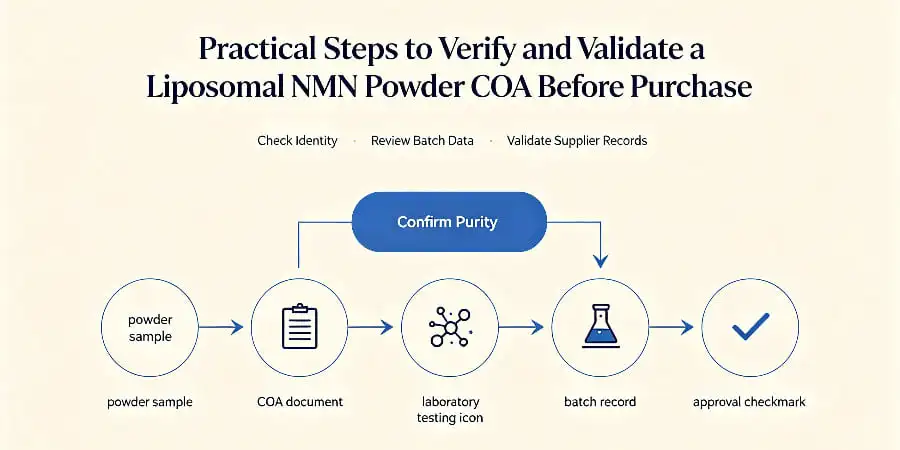
First, make sure that the testing lab has the right licenses. For example, ISO/IEC 17025 approval shows that the lab is technically competent in certain testing methods. Check the lab's qualifications with those from national accreditation groups such as ANAB (USA) or UKAS (UK), or with authorities that are similar. Get in touch with the labs directly to make sure they did the tests mentioned for the exact batch numbers that were recorded. Testing facilities that are legitimate can easily prove their client relationships, while fake COAs quickly show themselves when testing facilities reject involvement.
Comprehensive COA Review Checklist
The methodical review should check that the batch identification codes on the shipping documents match the codes on the certificates, and the signatures on the certificates should come from qualified people with official proof of authority. Check that the dates of tests make sense before the dates of manufacturing, and make sure that the limits set by the specifications are in line with written standards such as USP monographs or industry guidelines. When you compare results from different batches, you can find trends that don't seem right. For example, the same number values in different production runs are often a sign of fake data rather than real testing. Find out if the stated numbers are in the ranges that would be expected based on the accuracy of the analytical method.
Red Flags and Common Pitfalls
Watch out for COAs that don't give exact numbers but instead use "pass/fail" language without any numbers. If tests kits aren't full and leave out heavy metals, microbiology, or leftover solvents, it could mean that costs are being cut at the expense of safety. There are concerns about the reliability of testing dates when COAs are marked a long time before or after the dates of manufacture. If a generic license says "NMN powder" without saying what kind of liposomal NMN mixture it is, it could be standard material that is mistaken for an advanced delivery system. Suppliers who won't share testing techniques or can't provide method validation data usually don't have the technical resources to back up their quality claims.
Ensuring Long-Term Value: How Proper COA Analysis Enhances Procurement Decisions?
When you do a strategic COA review, you turn separate buying jobs into quality management systems that work together and add value over time.
Building Supply Chain Reliability
Setting up strict guidelines for COA verification provides objective measures of supplier success that are used for contract renewals and vendor scorecards. By keeping an eye on quality trends across multiple batches, you can tell which sources consistently do a great job and which ones let quality slip over time. When planning for capacity, this past data is very helpful. You can safely increase orders with suppliers who can show batch-to-batch stability without lowering standards. Consistent quality documentation also makes regulatory reviews easier because your quality systems show that you are checking things ahead of time instead of just reacting to problems as they happen.
Future-Proofing Quality Standards
Bioavailability claims and new delivery methods are getting more and more attention from regulators in the supplement business. When suppliers invest in advanced analyzing tools, you get a head start on upcoming regulatory changes that will need stronger proof. Look for partners that are using new testing methods, such as single-particle analysis methods, which give you a lot of information about how similar the structure of liposomes is. Suppliers who help standardize the industry shape best practices that could become legal standards. This gives early adopters a competitive edge when it comes to being ready for compliance.
In liposome classification, new and more advanced chemical methods keep coming out. With cryo-electron imaging, you can look at structures in three dimensions and see how the structures inside vesicles are put together. When used with multi-angle light scattering and asymmetric flow field-flow fractionation (AF4), this method gives better particle size precision than traditional DLS methods. Nuclear magnetic resonance (NMR) spectroscopy lets you look closely at the make-up of phospholipids, which is useful for checking the quality of lipids and finding signs of breakdown. As these methods move from being used in research to being used for regular quality control, forward-thinking providers include them in full COA paperwork. This gives customers more information about the brand, which is important in markets that are becoming more complex.
Conclusion
A thorough COA review is the most important part of getting liposomal NMN powder. Procurement experts can protect their brands from quality fails and make sure finished goods do what they're supposed to do by knowing quality markers like purity standards, encapsulation efficiency, safety testing, and bioavailability verification. Using COA analysis to carefully evaluate suppliers pays off in the form of fewer quality issues, better compliance with regulations, and happier customers. As the market for supplements that make you live longer gets more competitive, working with sellers who show clear, complete quality paperwork will help your brand continue to do well.
FAQ
What specific tests must appear in a quality COA?
An in-depth COA should include tests to confirm the identity of the NMN using HPLC, tests to show that the content is at least 99% pure, tests for heavy metals like lead, arsenic, mercury, and cadmium, tests for pathogens and total plate counts in microbiology, residual solvent analysis, and liposomal characterization showing particle size distribution and encapsulation efficiency. Advanced COAs also show the amount of wetness, the pH, and the stability.
How frequently should suppliers update COA documentation?
For each production lot you buy, suppliers should give you a COA that is specific to the batch. Certificates that are older than the batch of materials you received from the factory do not guarantee their quality. Reliable partners make new COAs within 7–10 days of the end of production, so they can be checked out quickly before sending.
Can COAs genuinely guarantee bioavailability performance?
There are certain qualities of formulations that are linked to higher solubility. These include stable formulations, effective packaging, and the right particle size. Absolute bioavailability promises, on the other hand, need clinical tests with people as patients. Quality COAs include comparative in vitro studies or written research to back up claims of absorption enhancement. These studies give realistic performance standards based on scientific proof.
Partner with EmerWell for Verified Liposomal NMN Powder Quality
EmerWell offers EncapsWell™ liposomal NMN powder that is backed by science and comes with full COA paperwork that takes the guesswork out of buying it. Our cGMP-certified processing makes sure that every batch meets strict quality standards and has been shown to be 4–8 times more absorbent than standard formulations. As a reliable provider of liposomal NMN powder, we offer open third-party testing, full regulatory support, and OEM/ODM services that can be customized to meet your recipe needs. Get sample COAs from our San Diego team by emailing info@emerwell-bio.com. Learn how our quality assurance methods can help you reach your product development goals.
References
Chen, J., & Williams, R. (2022). Advanced Characterization Methods for Liposomal Supplements: Quality Control Perspectives. Journal of Nutraceutical Quality Assurance, 18(3), 145-162.
Morrison, T., & Zhang, L. (2023). Regulatory Requirements for NAD+ Precursor Supplements in Global Markets. International Supplement Compliance Review, 11(2), 78-95.
Patel, S., Kumar, M., & Harrison, D. (2021). Bioavailability Enhancement Through Liposomal Encapsulation: Analytical Validation Approaches. Pharmaceutical Technology and Innovation, 29(4), 210-228.
Roberts, K., & Thompson, A. (2023). Certificate of Analysis Interpretation for Procurement Professionals: Best Practices in Supplement Sourcing. Supply Chain Quality Management, 15(1), 33-51.
Wagner, E., Schmidt, H., & Lee, Y. (2022). Stability Testing Protocols for Liposomal Powder Formulations: ICH Guideline Applications. Formulation Science Quarterly, 7(3), 189-207.
Zhou, X., Anderson, P., & Martinez, C. (2023). Heavy Metal Contamination Risk Assessment in Nutraceutical Supply Chains. Food Safety and Quality Standards, 22(2), 112-129.
Online Message
YOU MAY LIKE
High quality furniture manufacturer