

Oct 28, 2026
What Makes Liposomal NAD+ Powder Suitable for Next-Generation Nutraceutical Formulations?
Liposomal NAD+ powder is a raw material, so "next-generation" is best read as a short list of engineering conditions rather than as a description of what the ingredient does. The conditions are checkable before a formula is locked: the 10%–70% loading bandwidth and the dosage forms it allows, dispersion and anti-caking behaviour on the line, compatibility inside a blend, what the pack has to hold back, how shelf life and sampling are evidenced, and what a liposomal NAD+ powder specification and document set should contain. This page is about process fit, specification and paperwork. It is not a health statement, and it is not an intake recommendation.
Why "Next-Generation" Is a Set of Conditions, Not a Claim
Buyers usually meet the phrase in a positioning deck. A supplier can only use it meaningfully when three things hold up under review: the ingredient can be included at the level the formula calls for without breaking the format, the powder behaves in the mixer the way it behaved in the pilot, and the document trail proves both. Formulators working on sachets, two-piece capsules, tablet or ready-to-drink powder formats tend to raise the same three questions in the same order, which is the sequence followed below. Typical format choices are summarised in where liposomal NAD+ powder is used across wellness formats.
The Loading Bandwidth: What 10%–70% Actually Decides
The loading figure decides most of the rest of the specification: how much powder a unit carries, which formats are mechanically realistic, and which attributes are measured on every batch. Two materials can both be described as liposomal NAD+ powder, yet behave like different ingredients, because carrier share changes flow, segregation and hydration.
The arithmetic behind the number
The percentage on a specification is not a strength rating. It is the ratio of NAD+ to carrier solids in the powder. One gram of a 20% grade carries 0.2 g of NAD+; one gram at 50% carries 0.5 g. Everything downstream follows from that ratio: the gram weight of a sachet, how many capsules a given fill weight permits, whether a tablet is mechanically reachable, and how much carrier enters the blend. A higher figure does not make an ingredient better. It means the same target inclusion level needs less powder, and it usually makes blend uniformity harder to hold. Process stages that set that ratio are described in how liposomal NAD+ powder is manufactured.
Where each band usually lands
The table below is a starting point for format selection rather than a substitute for a trial, so use it to narrow the options before bench work begins.
| Loading band | What the figure fixes | Formats it usually suits | Specification items to pin down |
|---|---|---|---|
| 10%–20% | Grams of powder per unit; carrier share is high | Multi-active blends, stick packs, powdered drinks | Blend uniformity, dispersibility, moisture content |
| 25%–40% | Balance between carrier share and fill weight | Two-piece capsules, sachets, granulated blends | Fill weight, flow behaviour, encapsulation efficiency |
| 50% | Lower gram weight for the same target level | High-load capsules, compact sachets, tablets | Blend uniformity, free versus encapsulated NAD+, anti-caking |
| 60%–70% | Smallest powder weight per unit | Concentrates, low-fill formats, development lots | Encapsulation efficiency retention, particle size distribution, moisture |
Positioning the 50% band
The 50% band is the one most often selected for premium formats, and the reason is arithmetic rather than marketing. At 50%, a formula needs roughly half the powder weight a 25% grade requires to reach the same inclusion level, which matters when the unit is a two-piece capsule, a compact sachet or a tablet with a fixed fill weight. What that band does not do is remove formulation work. As carrier share falls, the powder becomes a larger fraction of the blend, so segregation, flow and dispersion have to be re-checked rather than assumed. Format trade-offs between powder and capsules are set out in choosing between NAD+ powder and capsules.
Dispersion and Anti-Caking Behaviour on the Line
A powder that disperses cleanly in a beaker can still underperform on a filling line. The difference is usually mechanical: how the material is fed, how much shear it sees, and how long it sits in a hopper between blending and filling.
What "highly dispersible in water" has to mean
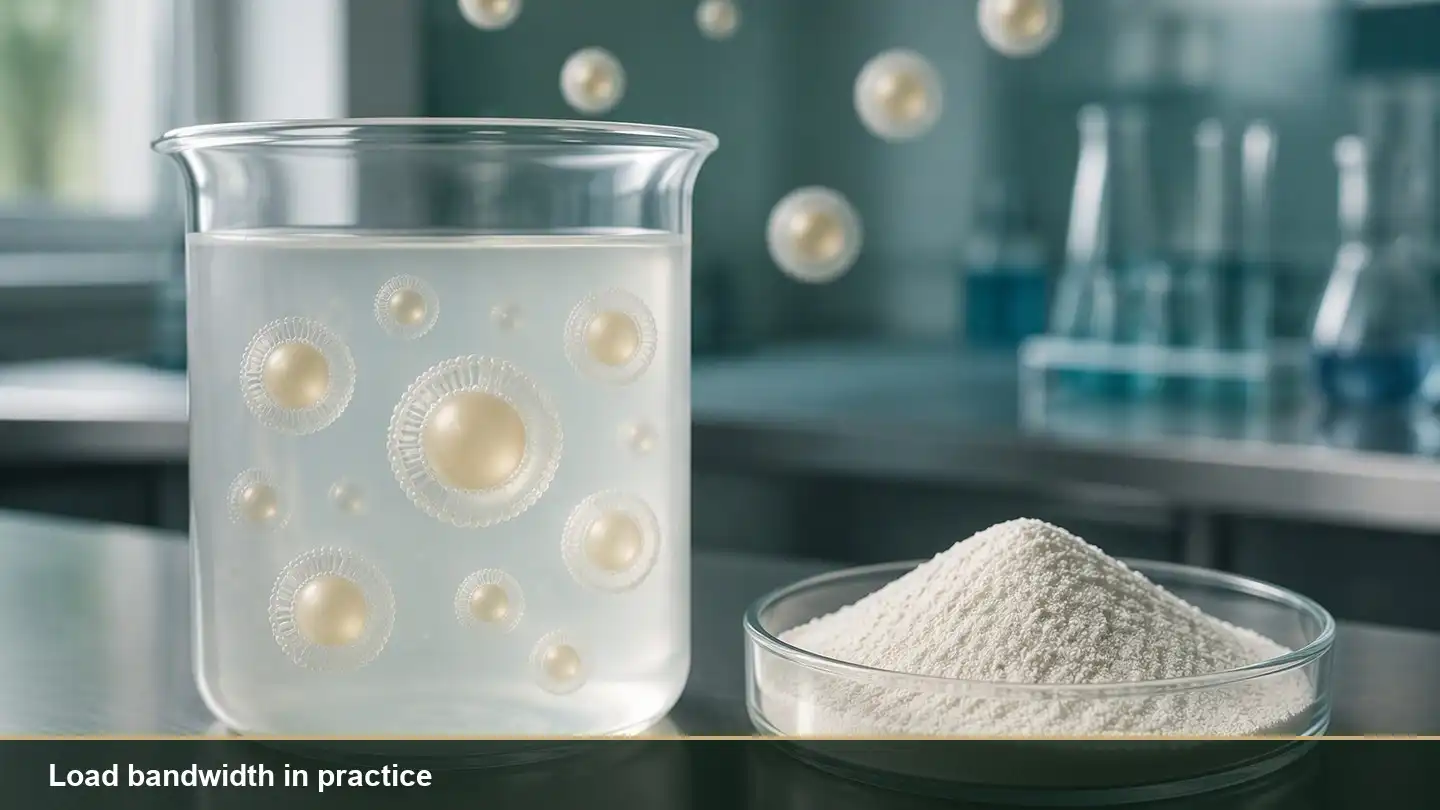
This material is a pale yellow to white free-flowing powder that disperses readily in water and forms a stable colloidal suspension. On a specification that is a claim; in a plant it is a procedure. Order of addition, water temperature, agitation rate and time to full hydration all belong in the batch record, and the same suspension has to be reproducible at pilot and at production scale. A short dispersion trial at the intended solids loading, run in the actual process water, resolves most of the questions a formulator has. The analytical panel that backs the statement is listed in testing methods used to verify liposomal NAD+ powder quality.
Anti-caking is a moisture and pressure problem
Caking is rarely caused by the active alone. It follows moisture migration, compaction under stacking load and temperature cycling in transit, so anti-caking behaviour is specified together with moisture content, pack format and storage conditions rather than as one powder property.
Confirming that drying did not cost the structure
A dried powder has to re-form intact vesicles when it is dispersed. That is verifiable rather than assumed, and three items carry the evidence: encapsulation efficiency of 85%–95% measured by HPLC, a particle size distribution measured by DLS, and structural imaging by TEM. The gap between total NAD+ and free NAD+ is what separates an encapsulated material from a dry blend of carrier and active, and it is the first number a formulator should look at. How those values are protected through processing and storage is covered in improving liposomal NAD+ powder stability.
Compatibility Inside a Co-Formulated System
Very few NAD+ formats are single-ingredient. Once the powder sits in a blend with minerals, acids, flavours or a second liposomal material, the questions change from what the ingredient is to how the mixture behaves on the line.
Compatibility is a list of interactions, not a yes-or-no answer
Blend behaviour depends on the whole matrix, not on the ingredient in isolation. The variables that decide whether a blend holds are water activity, the pH band of the reconstituted matrix, ionic strength from mineral salts and buffers, competing surfactants and emulsifiers, shear and temperature history during mixing, particle size mismatch that allows segregation, and hygroscopic partners that pull moisture into the blend during storage. None of these can be answered from a single-ingredient specification, so a compatibility statement should always name the matrix and the inclusion level it refers to. The same screening logic applies when liposomal materials are blended with each other, as in combining liposomal powders in one formula.
A screening order that saves pilot time
Working through the checks in this order keeps the inexpensive experiments first, so a matrix problem usually surfaces on the bench rather than after a pilot lot.
| Co-ingredient class | Main interaction risk | First check | Evidence to request |
|---|---|---|---|
| Mineral salts and buffer systems | Ionic strength shift during hydration | Dispersion trial in the finished matrix at target pH | Matrix-specific dispersion note; specification limits |
| Acidic actives | Local pH drop changing hydration behaviour | pH of the reconstituted blend over time | pH band the material was tested in |
| Oils, emulsifiers and surfactants | Competition for the carrier interface | Visual and DLS check on the blend dispersion | Method summary for the size measurement |
| Fibrous or bulking agents | Segregation and blend uniformity drift | Blend uniformity sampling across the lot | Sampling plan and acceptance range |
| Flavours and hygroscopic carriers | Moisture migration and caking | Moisture and water activity at day 0 and after storage | Storage condition used for the data |
Packaging, Moisture and Light: What the Pack Has to Hold Back
After delivery, moisture and light are the two variables a buyer controls most directly. A multilayer foil pack flushed with nitrogen, combined with an opaque outer barrier and a desiccant where the climate calls for one, limits headspace humidity and light exposure during transport and storage. Appearance is the earliest visible indicator of change: the material is specified as a pale yellow to white powder, so any drift toward a deeper tone in a retained sample is worth investigating before release. Storage conditions for liposomal powders are broadly consistent across the format, as described for storing liposomal glutathione powder effectively.
Shelf Life, Sampling and Retest Discipline
The shelf life for this material is stated as up to 24 months, and a stated shelf life is only as strong as the study behind it. Buyers should expect defined storage conditions, defined test intervals, and a panel of attributes that is measured at every interval rather than only at release. Established stability testing frameworks give the vocabulary for those conditions and intervals, and a supplier should be able to name the framework used. Attributes tracked over time are shown below. The factors that move these numbers fastest are discussed in what affects the shelf life of liposomal NAD+ powder.
| Attribute | Method | Specification or target |
|---|---|---|
| Total NAD+ content | HPLC | Within the declared loading band (10%–70%) |
| Encapsulation efficiency | HPLC, total versus free NAD+ | 85%–95% |
| Particle size distribution | DLS | Reported per batch; consistent across batches |
| Vesicle structure | TEM | Intact vesicles after dispersion; visual record retained |
| Appearance | Visual | Pale yellow to white, free-flowing |
| Lead | Elemental analysis | Below 0.1 ppm |
| Total plate count | Microbiological assay | Below 1,000 cfu/g |
What the Document Package Should Contain
- A specification sheet stating the loading band, encapsulation efficiency range, appearance, moisture, lead limit and microbiological limit.
- A batch certificate of analysis showing measured values against those limits, with the test methods named.
- Method summaries for the HPLC, DLS and TEM procedures used to produce the certificate.
- Stability data covering the storage conditions and intervals behind the shelf life statement.
- Certification evidence for cGMP, ISO 22000, ISO 9001, HALAL, KOSHER, Non-GMO, Vegan and Gluten-Free status.
- A change-notification commitment covering specification, process and source changes.
- Safety and handling documentation, including storage and repacking guidance.
The parameters a certificate should carry, and the questions worth asking when one is incomplete, are broken down in what belongs in a liposomal NAD+ powder certificate of analysis.
Where the Compliance Boundary Sits
Everything on this page is written at ingredient level: loading, dispersion, compatibility, packaging, shelf life and documentation. Those are the statements a supplier can support with data. Marketing language about effects on a person sits on the other side of the line and belongs to the brand that sells the finished product, in the market where it sells it. A specification sheet should therefore never be read as a claim source. The same separation between technical documentation and market-facing copy is the working assumption in OEM ingredient programmes, including the approach described in an OEM guide for supplement brands.
Requesting Samples and Documentation
If you are selecting a loading band, screening a blend or building a launch timeline, the fastest route is to describe the intended format and the target inclusion level, then ask for the matching specification, batch certificate, stability summary and a sample of the candidate grade. EmerWell supplies liposomal NAD+ powder from 10% to 70% and can share the document package alongside the sample so the evaluation happens against real numbers: start from the liposomal NAD+ powder product page, or write to info@emerwell-bio.com with the format you have in mind.
References
1. U.S. Food and Drug Administration. Guidance for Industry: Liposome Drug Products — Chemistry, Manufacturing, and Controls; Human Pharmacokinetics and Bioavailability; and Labeling Documentation. https://www.fda.gov/media/70837/download
2. International Council for Harmonisation. ICH Q1A(R2) Stability Testing of New Drug Substances and Products. https://database.ich.org/sites/default/files/Q1A(R2)%20Guideline.pdf
3. Franzé, S., Selmin, F., Samaritani, E., Minghetti, P., & Cilurzo, F. Lyophilization of Liposomal Formulations: Still Necessary, Still Challenging. Pharmaceutics, 10(3), 139. https://pmc.ncbi.nlm.nih.gov/articles/PMC6161153/
4. U.S. Code of Federal Regulations. 21 CFR Part 111 — Current Good Manufacturing Practice in Manufacturing, Packaging, Labeling, or Holding Operations for Dietary Supplements. https://www.ecfr.gov/current/title-21/chapter-I/subchapter-B/part-111
Disclaimer: This article is written for formulators, procurement teams and quality managers evaluating a liposomal NAD+ ingredient supplied by EmerWell. It describes loading bands, powder behaviour, packaging, stability documentation and quality files only. It is not medical or nutritional advice, it makes no statement about health effects, and any product claim for a finished good is the responsibility of the brand that markets it.
Online Message