Sep 16, 2026
What Testing Methods Are Used to Verify Liposomal NAD+ Powder Quality?
When sourcing encapsulated NAD+ ingredients at scale, quality verification is not a formality—it is the foundation of every reliable procurement decision. Liposomal NAD+ powder undergoes a fundamentally different manufacturing process than conventional NAD+ supplements, which means standard certificates alone rarely tell the full story. Rigorous analytical testing across physicochemical, chemical, and biological dimensions is required to confirm that true liposomal encapsulation exists, that NAD+ purity meets label claims, and that each batch is safe and shelf-stable. This guide walks through the core methods procurement teams and formulation scientists should understand before committing to any supplier.
Why Quality Testing for Liposomal NAD+ Powder Demands a Different Standard?
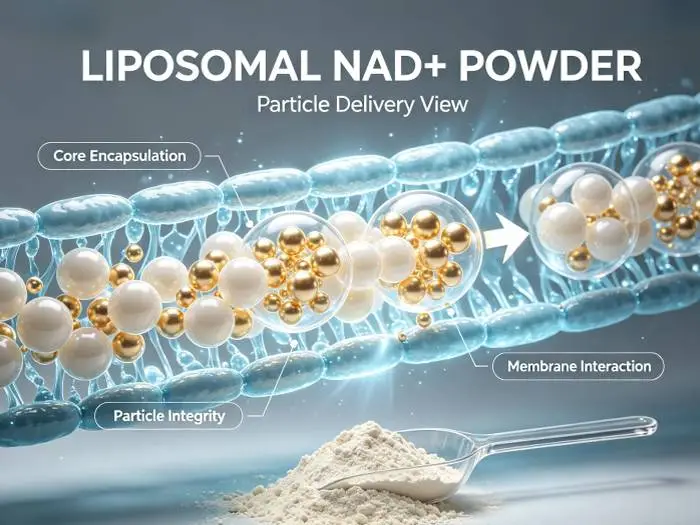
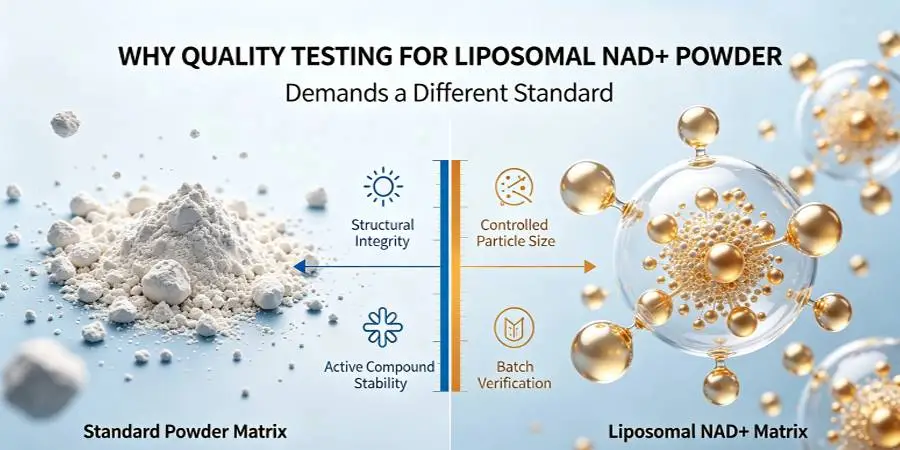
Usually, conventional NAD+ powders are judged mostly by how pure they are and how much heavy metal they contain. A completely different lens is needed for liposomal NAD+ powder. The phospholipid bilayer that surrounds each NAD+ molecule needs to be whole, uniform, and measurably stable. If it isn't, there is no absorption benefit that justifies the higher price. If a product is called "liposomal" but doesn't have confirmed encapsulation data, it's really just a mix of NAD+ and lecithin that doesn't do anything useful for absorption.
The Procurement Risk of Skipping Structural Verification
Bad encapsulated ingredients can lead to real problems for brands, like not being able to back up their claims of effectiveness, losing customers, and being closely watched by regulators. One batch that hasn't been checked can put an entire line of products at risk for OEM makers and nutraceutical brands that are moving from test to commercial levels. When looking at liposomal NAD+ powder suppliers, you must make sure that they can track batches and provide proof of structural testing.
Core Analytical Testing Methods Used to Verify Liposomal NAD+ Quality
A reliable provider doesn't just give you a certificate; they show you a layered testing procedure. Here is a list of the tried-and-true methods that make up real quality assurance in this category of ingredients.
Physicochemical Methods: Confirming Structural Integrity
Characterizing the particles is the most important part of controlling the quality of liposomes. This rating is based on three tools:
- Dynamic Light Scattering (DLS): Finds out how big liposome particles are when they're floating in water. A Polydispersity Index (PDI) value below 0.3 and a Z-average particle size between 50 and 300 nm show a well-formed liposomal population that is uniform. PDI numbers above 0.3 mean that there is aggregation or group inconsistency, which slows down the absorption process.
- Zeta Potential Analysis: Measures the amount of electrical charge on the surface of each particle. If the zeta potential is less than -20 mV or more than +20 mV, it means that the particles don't stick together when they're being stored or reconstituted.
- Transmission Electron Microscopy (TEM): This method directly shows that spherical bilayer structures are real. TEM imaging is the best way to tell the difference between real liposomal NAD+ powder and unstructured lipid-drug aggregates. As normal paperwork, procurement teams should ask for TEM pictures.
When looked at together, these three factors show that the structure that allows for better cell entry is actually there.
Chemical Assays: Confirming Purity and Potency
If the NAD+ level isn't checked, structural stability doesn't mean much. There are two main ways to look at this analytically:
- High-Performance Liquid Chromatography (HPLC): Is the standard way to measure the total amount of NAD+ and make sure that the encapsulated load matches what the label says it is. Premium-grade material keeps the purity of NAD+ at or above 98%, which is the level that separates clinical-grade material from regular powders. HPLC can also find byproducts of degradation, like nicotinamide mononucleotide (NMN) or nicotinamide riboside (NR), which show that something is breaking down due to oxidation.
- UV-Vis Spectroscopy: Is an additional technique used for quick screening of concentrations and proof of identity. It is especially useful for quality control checks that happen during the manufacturing process.
In addition to substance analysis, the chemistry profile also includes moisture tests and leftover solvent analysis. To keep phospholipids from breaking down during storage, the moisture level must stay below 4%. Any ethanol or solvents that are left over from making the liposomes must be below the limits set by USP and EP.
Encapsulation Efficiency and In Vitro Release
How much NAD+ is actually inside the liposomes can be found by measuring the encapsulation efficiency (EE). The standard method uses ultracentrifugation or dialysis to separate free NAD+ from encapsulated NAD+. It then uses HPLC to analyze both fractions. EE (%) = [(Total NAD+ - Free NAD+) / Total NAD+] × 100. This is a simple formula. Premium content aims for EE levels above 85–90%.
In vitro release testing mimics the gastrointestinal environment in two steps: first at pH 1.2 in the stomach, and then at pH 6.8 in the intestines. This is done to make sure that the liposomes stay together as they go through the stomach and release the NAD+ payload of liposomal NAD+ powder at the surface of the intestines that can absorb it. This information is very helpful for companies that want to back up promises about solubility in marketing materials or regulatory paperwork.
Advanced Testing Technologies That Raise the Bar Further
In addition to the basic techniques, the best providers use extra analysis tools that show data at the molecular level.
NMR and Mass Spectrometry for Molecular Verification
Nuclear Magnetic Resonance (NMR) research shows that NAD+ is the same structure at the molecular level and finds any positional isomers or breakdown products that HPLC might miss. Mass spectrometry (MS) adds a new way to find contaminants and is very good at finding small amounts of impurities. All of these methods work together to support the tracking documents that buyers who care about quality need in the medical nutrition and longevity supplement categories.
Stability and Microbial Safety Testing
Following ICH Q1A guidelines, accelerated stability testing at controlled temperature and humidity levels predicts the shelf life in real life and proves that liposomal design stays intact for 24 months at room temperature. The safety profile is finished with microbial limit testing and endotoxin assays (using Limulus Amebocyte Lysate methods), which make sure that the product meets USP <61>, <62>, and <85> standards.
How Liposomal NAD+ Testing Differs From Other NAD+ Supplement Forms
Standard NAD+ pills or NMN powders don't need to be structurally analyzed nearly as much. There is no way to measure the size of the particles, figure out how well they are encapsulated, or confirm the bilayer shape. The fact that liposomal forms need more testing shows how complicated the delivery system is and how useful it is when made correctly.
When buying teams know this difference, they can ask better questions. A supplier who gives you a Certificate of Analysis but not DLS data, TEM images, or EE results is not giving you all the information you need about a liposomal product. The above testing method is the bare minimum that any trustworthy liposomal NAD+ powder provider working with nutraceutical, functional food, or OEM markets must meet.
Best Practices for Evaluating Supplier Quality Credentials
It takes more than reading one document to find the right ingredient partner. Here are the most important checks that buying teams should always do:
- Request batch-level COAs that include particle size (DLS), zeta potential, EE, HPLC purity (≥98% NAD+), moisture content, heavy metals, and microbe limits. Do not settle for a simple specification sheet.
- Verify third-party testing: Test results are not self-reported when they are checked by independent laboratories that are ISO 17025-certified.
- Confirm certification scope: cGMP, ISO 22000, FSSC22000, HACCP, Non-GMO, KOSHER, HALAL, and Vegan status are all relevant certifications that each cover a different aspect of compliance.
- Evaluate stability documentation: For regulatory submissions and store dating choices, you need accelerated shelf-life data that follows ICH standards.
- Assess co-development capability: Check if the seller has in-house research and development (R&D) support. A supplier with this can help with custom encapsulation loads, dosage form development, and formulation problems, which will cut the time it takes to get the product to market by a large amount.
These criteria, applied regularly to all possible sellers, greatly lower the risk of procurement and help ensure the long-term reliability of the supply chain.
Conclusion
The process of checking the quality of liposomal NAD+ powder includes checks on its structure, chemicals, biology, and safety. If a buyer knows about DLS, TEM, HPLC, EE methods, and stability routines, they can ask the right questions and find providers who really do what they say they will do for bioavailability. The most common and expensive mistake people make when they source encapsulated actives is skipping structural verification. Choosing a supplier that has documented batch-level testing across all relevant parameters is the single most effective way to protect formulation integrity, brand credibility, and end-user confidence.
FAQ
How can I confirm a product is truly liposomal and not just a NAD+ and lecithin blend?
Ask for TEM pictures and information on how well the enclosure works. Under an electron microscope, real liposomal NAD+ powder looks like spherical bilayer structures. If the EE value is above 85%, it means that NAD+ is really enclosed and not just mixed with phospholipids.
What NAD+ purity level should I expect in a premium liposomal ingredient?
By HPLC analysis, high-quality material keeps the NAD+ level at ≥98%. Anything below this level makes me wonder about the quality of the raw materials or the control of the manufacturing process.
Is microbial testing mandatory for liposomal NAD+ powders?
Yes. The phospholipid messenger system makes it possible for microbes to get into the system. In line with USP guidelines, suppliers should give bacteria limit test results and endotoxin data.
How does encapsulation efficiency impact the formulation dosage calculation?
If a product has a 20% active NAD+ load, then 1,000 mg of liposomal powder is needed to get 200 mg of elemental NAD+ per serving. Before setting final formulation goals, you should always ask your supplier for the active load specification.
Partner With EmerWell for Verified, High-Purity Liposomal NAD+ Powder
EmerWell is based in San Diego, California, and has US-based lab facilities, local storage, and an R&D team led by a PhD. They offer liposomal NAD+ powder that meets strict B2B purchasing standards. Each batch comes with full analytical paperwork, including DLS, TEM, HPLC, EE, and third-party safety tests. It also comes with certifications for cGMP, ISO 22000, FSSC22000, Non-GMO, and KOSHER. We can help you with your next product because we are a reliable provider of liposomal NAD+ powder that can be customized for OEM/ODM orders and comes in a variety of dosage forms. You can email us at info@emerwell-bio.com or go to emerwelllabs.com to ask for samples and group records.
References
1. Akbarzadeh, A., Rezaei-Sadabady, R., Davaran, S., et al. (2013). Liposome: Classification, preparation, and applications. Nanoscale Research Letters.
2. Bhosale, R. R., & Osmani, R. A. (2014). Liposomal drug delivery: A review. Journal of Drug Delivery and Therapeutics.
3. Rajabi, M., & Mousa, S. A. (2016). Liposomal delivery systems: A review. Pharmacology & Pharmacy.
4. United States Pharmacopeia. (2023). General chapters on microbiological testing: USP <61>, <62>, <85>. USP–NF.
5. ICH Harmonised Guideline Q1A(R2). (2003). Stability testing of new drug substances and products. International Council for Harmonisation of Technical Requirements for Pharmaceuticals for Human Use.
6. Mozafari, M. R. (2005). Liposomes: An overview of manufacturing techniques. Cellular & Molecular Biology Letters.
Online Message
YOU MAY LIKE
High quality furniture manufacturer