Sep 15, 2026
How Is Liposomal NAD+ Powder Made? A Step-by-Step Look at the Manufacturing Process
Liposomal NAD+ powder is produced by encapsulating Nicotinamide Adenine Dinucleotide (NAD+) molecules within phospholipid bilayer structures—called liposomes—through a series of controlled, precision-driven manufacturing stages. The result is a water-soluble, shelf-stable powder that delivers NAD+ directly to cells with significantly higher efficiency than conventional supplements. For nutraceutical brands, functional beverage companies, and OEM/ODM producers, understanding exactly how this ingredient is made is the foundation of smart sourcing decisions.
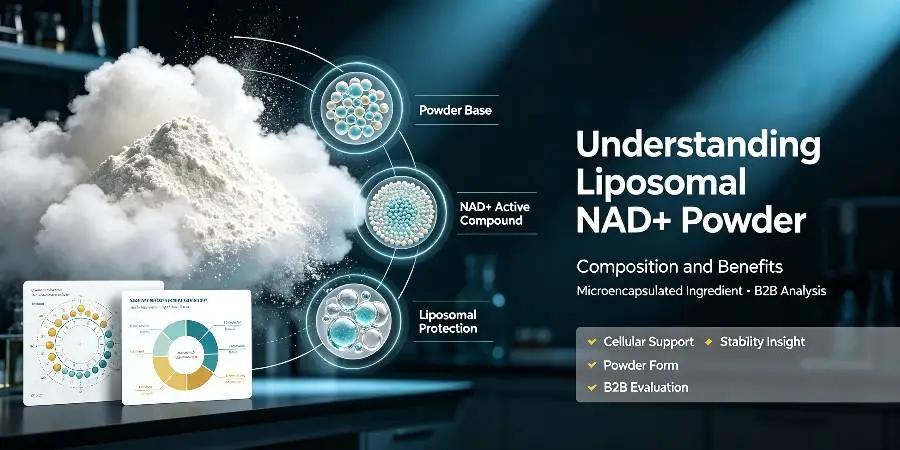
Understanding Liposomal NAD+ Powder: Composition and Benefits
What Makes This Form Different From Standard NAD+?
In the digestive tract, standard NAD+ powder breaks down very quickly. Before it gets to the bloodstream, stomach acid and first-pass processing in the liver break down a lot of the active molecule. This problem can be fixed by encapsulating NAD+ in a phospholipid bilayer, which is usually made from non-GMO sunflower or soy phosphatidylcholine and has the same structure as human cell membranes. It's this "biological shield" that keeps NAD+ whole in the stomach and makes it easier for it to be absorbed directly at the level of the intestinal tract.
It's possible to measure the performance gap. Liposomal delivery improves the intake of NAD+ by up to 5–10 times compared to powder that isn't encased. In vitro models show that 92% of cells can take it up. These numbers are the most important to people who are making products that are based on science.
Why B2B Buyers Are Prioritizing This Ingredient?
NAD+ has a lot to do with how mitochondria work, how energy is used, how DNA is repaired, and how cells age. Its decrease with age is well-known in the scientific journals. This has increased the demand for supplements that help people live longer, improve their brain health, make their skin look younger, and help them recover from sports injuries. As a raw material, liposomal NAD+ powder is much more flexible than normal crystalline NAD+. It can be used to make pills, stick packs, tablets, and drinks, and it doesn't need to be refrigerated or handled in a special way.
Core Steps in the Manufacturing Process of Liposomal NAD+ Powder
Step 1 — Raw Material Qualification and NAD+ Preparation
A strict sourcing and testing process comes before every production run. Before anything goes into production, non-GMO phospholipid carriers and high-purity NAD+ (≥98% content by HPLC assay) are checked. At intake, heavy metal screening, microbiological testing, and certificates of analysis for each batch are done. This quality control at the beginning of the manufacturing process stops impurities from spreading throughout the whole process. This is a very important safety measure for brands that promote clean labels.
Step 2 — Liposome Formation via High-Shear Homogenization or Microfluidization
Once the raw materials have been checked, the liposome creation step can begin. Under controlled temperature conditions, phospholipids are hydrated and joined with NAD+. Following that, either microfluidization or high-pressure homogenization is used to push the NAD+ molecules inside the phospholipid membrane. This step is what makes true liposomal encapsulation different from a simple physical mix of NAD+ and lecithin—a distinction verified by Transmission Electron Microscopy (TEM) and Encapsulation Efficiency (EE) testing show the difference. In high-quality production, EE levels should be above 85–90%.
During this stage, particle size is tightly controlled. A Z-average diameter of 50–300nm and a Polydispersity Index (PDI) below 0.3 make sure that the particles are spread out evenly, which is important for making sure that every serving of the finished supplement is bioavailable.
Step 3 — Conversion to Powder via Freeze-Drying or Spray Drying
Liquid liposomal dispersions are hard to keep stable for industrial supplement production because they break down quickly and need to be shipped in a cold chain. Both problems can be fixed by turning the liposomal suspension into a dry powder. Lyophilization, or freeze-drying, is the more preservation-focused method because it keeps the bilayer structure intact at very low temperatures. Spray drying speeds up the process for large orders. Both ways make a powder that is water-soluble, free-flowing, and has a moisture content of less than 4%—eliminating the risk of hydrolysis and lets the powder stay potent for 24 months at room temperature, with a retention rate of above 90%.
Step 4 — Quality Assurance, Testing, and Certification
A multi-point quality assurance system checks each batch several times before it leaves the building. This includes confirming the NAD+ content using HPLC, making sure the liposomes are still whole using TEM, analyzing the leftover fluid, checking for dissolution and pH-staged release in conditions similar to those found in the stomach and intestines, and doing a full microbiological screening according to USP/EP standards. Testing by a third party for purity, potency, and heavy metals adds another level of proof that procurement teams can confidently show to regulatory bodies and retail partners.
Why Manufacturing Method Matters: Impact on Product Performance and Procurement Decisions
How Process Precision Translates to End-Product Quality?
The way the drug is made is not a small matter; it is the main factor that affects its absorption. Absorption changes when particle sizes aren't always the same. Because of poor encapsulation, a lot of NAD+ gets to the gut without being protected and breaks down before it can do any good. When handling isn't done properly, residual solvents cause safety and legal problems.
When brands look at suppliers, they can ask the right questions if they know about these factors. It is common for buying teams working at a major business level to ask for TEM images, EE data, and dissolution study results. These pieces of information show if a seller has actually invested in liposomal technology or is just selling a mix of powders that are coated in fat.
Regulatory Certifications as Procurement Risk Management
Certifications are more than just boxes to be checked; they are third-party confirmations of good manufacturing practice. When buying a lot of liposomal NAD+ powder, purchase experts should make sure that the factory has the right quality and safety qualifications. The factory that makes EmerWell's products is certified by ISO 9001, ISO 22000, FSSC 22000, and HACCP. It also meets cGMP, HALAL, KOSHER, NOP, EOS, Non-GMO, and Vegan standards. These qualifications make it possible for products to be sold in the U.S., EU, and ASEAN markets without having to be reformulated or re-certified, which would take time.
Comparing Liposomal NAD+ Powder Manufacturing: Industry Standards vs. Innovations
Conventional methods of making NAD+ powder are easy to get into and don't cost much, but they don't produce very much. It has not been useful in special supplement categories for a long time because it is not bioavailable when taken by mouth, is unstable when it comes to moisture, and has a short shelf life under normal conditions. Liposomal encapsulation technology takes care of all of these problems in a planned way.
Today, the most important difference is between simple liposomal processes and advanced encapsulation platforms created by PhD students. Here are the skills that set makers who are focused on innovation apart from providers of basic goods:
- Proprietary nanoparticle engineering: particle sizes are optimized to 50–80nm using a phospholipid bilayer structure that was created over 12+ years of botanical formulation science. This makes sure uniform delivery to cells rather than estimated sizing.
- Validated absorption data: In vitro tests show 3 times higher absorption compared to standard NAD+ powders and 92% cellular uptake efficiency. This data supports claims of compliance in finished product marketing for efficacy.
- Co-development and white-label flexibility: Custom dose amounts from 250 mg to 1,000 mg, synergistic blend development with resveratrol, quercetin, or NMN, and turnkey paperwork packages for regulatory applications in 50+ countries are all part of co-development and white-label freedom.
The value proposition for these skills is very different from the value proposition for large product supply. Brands that are making vitamins for life, brain health, or cell rejuvenation need a manufacturing partner, not just a supplier of raw materials.
Procuring Liposomal NAD+ Powder: What B2B Buyers Need to Know
It takes more than picking the right ingredient to turn an idea for a formula into a commercial product. People who work in procurement need to rate providers based on their throughput ability, how responsive they are, and how full their paperwork is. EmerWell helps U.S. brands from our facility in San Diego by providing local storage, fast sample logistics, and in-house R&D evaluation. This cuts validation times by a large amount compared to working only through overseas channels. Our expert team, which is led by PhDs, helps directly with everything from evaluating the initial recipe to making sure it is stable and following regulatory rules.
At every stage of a brand's growth, being able to change orders is important. Lead times of less than 72 hours for commercial orders of 2 tons and 50 kg pilot runs. Powder, tablet, hard capsule, soft capsule, and liquid-ready formats can all be customized through OEM/ODM. As usual, accelerated stability data that follows ICH standards is given to support regulatory submissions in the U.S. and around the world.
Conclusion
The quality of liposomal NAD+ powder is mostly based on how well it is made, from getting the right phospholipids to making sure the powder is stable at the end. When brands know how this process works, they can better evaluate sources, ask the right questions, and make supplement goods that can back up their claims of effectiveness. When the science behind manufacturing is good, the benefits for business and government follow naturally. The easiest way to get a supplement that works as planned and meets the needs of today's smart supplement consumers is to work with a partner that has proven encapsulation technology, recognized quality certifications, and U.S.-based technical support.
FAQ
What is the difference between liposomal NAD+ powder and a physical NAD+/lecithin mixture?
A physical mixture doesn't protect against sealing. To mechanically incorporate NAD+ into the phospholipid bilayer, real liposomal NAD+ powder goes through high-shear homogenization or microfluidization. This is proven by TEM images and tests that show the encapsulation is effective (>85%). If these checks aren't done, a product that says it's "liposomal" might not be much better at absorption than regular powder.
Can liposomal NAD+ powder be used in hot beverage formulations?
Liposomes can protect against heat up to about 60–80°C for a short time. Long-term heat above this range breaks down the phospholipid membrane, which makes it less effective. To keep the full absorption ability, it's best to use cold or warm drinks.
How should dosage be calculated when formulating with liposomal NAD+ powder?
The dose is based on how much NAD+ is loaded. To reach the goal of 200 mg of elemental NAD+ with a 20% active load, the mixture needs around 1,000 mg of liposomal NAD+ powder per dose to cover the phospholipid transport system.
What stability data should procurement teams request?
Ask for faster shelf-life studies that follow ICH standards, data on the moisture content (target <4%), and room-temperature stability records that show the drug will still work at least 90% of the time after 24 months.
Partner With EmerWell for Scalable Liposomal NAD+ Powder Supply
EmerWell has a research and development team led by a PhD, a lab and warehouse in San Diego, and a widely certified production network that can help you with all of your liposomal NAD+ powder needs, from formulating to making large amounts for sale. As a trusted liposomal NAD+ powder manufacturer with OEM/ODM capabilities, we deliver third-party tested, clean-label ingredients with full regulatory documentation. Reach out directly at info@emerwell-bio.com or visit emerwelllabs.com to request samples, technical specifications, or a custom formulation consultation.
References
1. Shade, C. (2016). Liposomes as Advanced Delivery Systems for Nutraceuticals. Integrative Medicine: A Clinician's Journal, 15(1), 33–36.
2. Pattni, B. S., Chupin, V. V., & Torchilin, V. P. (2015). New Developments in Liposomal Drug Delivery. Chemical Reviews, 115(19), 10938–10966.
3. Zylberberg, C., & Matosevic, S. (2016). Pharmaceutical Liposomal Drug Delivery: A Review of New Delivery Systems and a Look at the Regulatory Landscape. Drug Delivery, 23(9), 3319–3329.
4. Rajpoot, K. (2019). Solid Lipid Nanoparticles: A Promising Nanomaterial in Drug Delivery. Current Pharmaceutical Design, 25(37), 3943–3959.
5. Yoshino, J., Baur, J. A., & Imai, S. I. (2018). NAD+ Intermediates: The Biology and Therapeutic Potential of NMN and NR. Cell Metabolism, 27(3), 513–528.
6. Bhatt, D. L., & Nissen, S. E. (2020). Quality and Transparency in Dietary Supplement Manufacturing: Industry and Regulatory Perspectives. Journal of the American College of Cardiology, 75(20), 2591–2593.
Online Message
YOU MAY LIKE
High quality furniture manufacturer