Jun 26, 2026
Improving Liposomal NAD+ Powder Stability: A Technical Guide
To make liposomal NAD+ powder stable, you need to know a lot about formulation science, safe encapsulation techniques, and keeping an eye on the environment during production and distribution. This guide talks about the technical problems that product makers and buying managers face when they try to find advanced NAD+ delivery systems. We look at how improved liposomal encapsulation keeps NAD+ intact, extends shelf life, and keeps bioavailability—all important factors that affect how well a product does in the competitive nutritional market.
Understanding the Stability Challenges of Liposomal NAD+ Powder
NAD+ molecules are naturally fragile, which can make creation more difficult and lower the quality of the result if it's not handled properly. Product makers often run into degrading problems that make their products less useful and hurt customers' trust in them.
Common Instability Factors
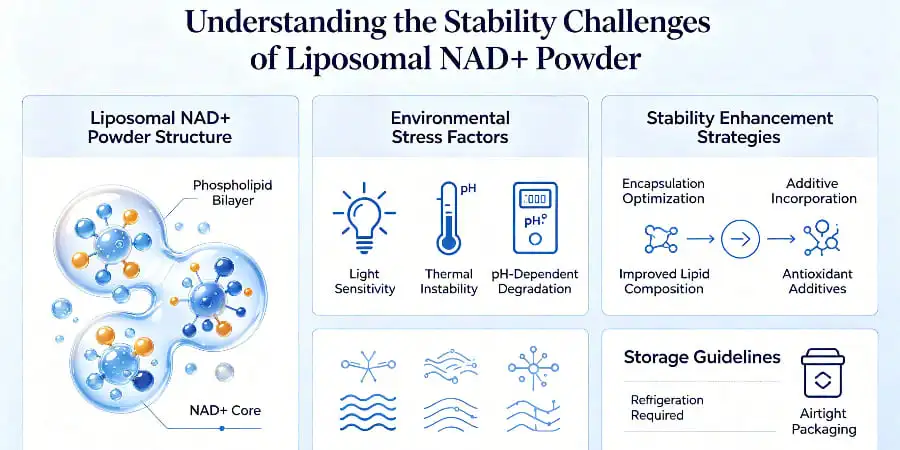
The most common threat to liposomal NAD+ powder stability is still being exposed to moisture. When powders take in moisture from the air, the hygroscopic NAD+ molecules start to break down quickly. They lose their effectiveness in weeks instead of months. Changing temperatures during foreign shipping or storage in a building speed up this process by breaking phosphate bonds that are necessary for NAD+ to do its job.
Oxidation is another very important weakness. When NAD+ is exposed to oxygen, it starts a chain of processes that turn it into useless degradation products. This process gets worse when products don't have enough antioxidants or when they're packaged in cheap materials that let gases pass through.
Liposome stability has a direct effect on how well a product works. The protected shield falls apart when phospholipid bilayers break because of mechanical stress, pH changes, or ionic imbalances. When NAD+ molecules are exposed to external stresses, they clump together, change color, and lose a lot of their bioavailability.
Impact on B2B Supply Chains
These things that cause instability have real effects on businesses. Shorter shelf lives make it harder to keep track of goods and raise the risk of stock going bad. Loss of digestibility means that end users get worse results, which has a direct effect on the brand's image and the number of times they buy it again. Inconsistency from batch to batch makes quality control and regulatory compliance paperwork harder to understand.
Industry-Standard Testing Protocols
Manufacturers and buying experts can figure out how reliable a product is by following strict stability assessment processes. According to ICH standards, accelerated stability testing models long-term storage by putting samples in rooms with high temperatures (40°C) and high humidity (75% RH) for three to six months. Over the course of 24 to 36 months in normal storage settings, real-time stability studies keep track of how much potency is retained, how the drug looks, and how fast it dissolves.
Using synthetic gut models to test absorption rates shows how well liposomal structures protect NAD+ while it is being digested. High-performance liquid chromatography (HPLC) accurately measures the amount of active ingredients in a sample, going above and beyond the 98% purity standard. These ways of analyzing data are what regulatory applications and choices about provider qualification are based on.
Core Principles and Techniques to Enhance Liposomal NAD+ Powder Stability
To get better steadiness for liposomal NAD+ powder, you have to carefully choose the ingredients and keep an eye on the making process at every step. Instead of depending on just one intervention, the best methods use a mix of different protective tactics.
Optimizing Liposome Encapsulation Techniques
Liposome longevity is largely determined by the quality of the phospholipids they contain. When non-GMO sunflower or soy is used to get high-purity phosphatidylcholine, it forms strong bilayers with particles that are always between 50 and 80nm in size. This small range of sizes makes sure that the capsule works the same way for all particles and that the release rate is reliable.
Precision in manufacturing is very important. Our EncapsWell™ platform uses controlled blending pressures and temperature-controlled conditions to make multi-vesicular liposomes that are more structurally stable. The process makes concentric lipid layers that protect in two ways: if the outer membranes get stressed, the inner layers keep the NAD+ inside.
Liquid liposomal solutions can be turned into stable powders by spray-drying or freeze-drying (lyophilization). When you freeze-dry something, the effects are usually better because the water is gently evaporated without heating up the heat-sensitive NAD+. The powder that is made has almost no leftover moisture (usually less than 3%), which greatly reduces the routes for hydrolytic breakdown.
Strategic Use of Stabilizing Additives
Carefully chosen excipients make the product more stable without affecting its clean-label stance. While free radicals are still around, natural antioxidants like ascorbyl palmitate and mixed tocopherols stop them. Chelating drugs take in small amounts of metal ions that would normally speed up oxidation processes.
During drying, trehalose and other protected sugars surround liposomes in a way that looks like glass. This vitrification makes a steady solid state that stops phospholipids from fusing and keeps the structure of the liposomes while they are stored. The quantity needs to be just right—too much makes it easier for water to dissolve, while not enough makes liposomes subject to damage from mechanical forces.
Protective Packaging Solutions
The last barrier to safety is packaging technology. Multi-layer laminate bags with metal foil layers stop light and moisture vapor from getting through. Sachets that collect oxygen aggressively remove any remaining air from sealed packages, making a safe microenvironment.
Flushing with nitrogen or argon, an inert gas, removes oxygen from the air during packing, creating an airless environment before closing. This method works especially well for bulk packages that are going to contract makers, who will then divide the powder into finished dosage forms.
Single-dose sachets provide the best security by reducing the amount of repeated exposure to environmental factors. Each hole in a bigger container lets in new air and moisture, which breaks down the leftover product more and more. Single-serving designs get rid of this buildup of contact while making things easier for customers.
Environmental Control During Manufacturing
The design and management of a manufacturing facility have a direct effect on the stability of the end product. During processing, climate-controlled production areas keep the temperature between 18°C and 22°C and the relative humidity below 40%. When powder is being moved, mixed, or packed, dehumidification methods keep outside wetness from getting into the powder.
Training for employees makes sure that working methods are always followed. Operators know that powder exposure time needs to be kept to a minimum during open processing steps and that cleaned equipment needs to be dried completely before it comes into touch with materials that absorb water.
Validated cleaning methods stop cross-contamination and keep moisture levels low so that later batches don't get harmed. Readings from a moisture meter show that the surfaces of the equipment are dry enough before production starts.
Comparing Stability Approaches: Liposomal NAD+ Powder vs Other NAD+ Supplement Forms
When product designers look at liposomal NAD+ powder delivery methods, they have to choose between safety, bioavailability, cost, and how hard it is to make. Knowing how different formats work can help you make buying decisions that are in line with your brand's messaging and the needs of your target market.
Stability Performance Comparison
Standard solid NAD+ powder is easy to use and costs less in raw materials, but it doesn't hold up well in harsh environments. When moisture or oxidants come in contact with exposed NAD+ molecules, they break down quickly. Even in controlled storage settings, they often lose 30–50% of their effectiveness within 12 months.
The gelatin or cellulose shells around traditional pills and tablets offer some safety. When compared to bulk powder, this physical barrier slows the entry of wetness. However, it can't stop degradation once the powder is eaten. Gastric acid (pH 1.5–3.5) breaks down exposed NAD+ molecules in minutes, which makes it very hard for the body to absorb them. For most oral NAD+ drugs, bioavailability doesn't go above 10-15%.
Bioavailability Advantages
The amount of NAD+ that gets to target cells at therapeutic levels depends on how well it is absorbed. In vitro absorption models show that our liposomal formulations are 5–10 times more effective at getting into cells than normal forms. This improvement comes from the fact that liposomes and cell membranes have a lot in common structurally, which makes direct fusion and intracellular transport easier.
Multi-vesicular liposomes' sustained-release properties make NAD+ stay in the blood for longer. Instead of being quickly cleared out of the body in two to three hours, encapsulated NAD+ stays accessible for 12 to 16 hours, replenishing cells steadily throughout the day. This physiological profile helps mitochondria work better, sirtuin activation, and DNA repair steps that need NAD+ to stay available.
Cost-Benefit Analysis for Procurement
Even though liposomal versions cost more than regular NAD+ powder, advanced delivery methods are often the better deal overall. Higher bioavailability means that smaller amounts are needed to have the same biological effects, which cancels out differences in the cost of the raw materials. Longer shelf lives mean less product loss due to expiration and cheaper bulk purchases.
In the crowded market for longevity supplements, brand difference is worth a lot. Products that are backed up by absorption data and stability documents sell for more and keep customers coming back. These things make it easier for brands and their marketing partners to make money.
Supplier Selection Criteria
To find trustworthy sources for liposomal NAD+ powder, you need to look at more than just basic quality standards. Managers in charge of buying things should check to see if possible sellers have separate production lines for liposomes so that they don't get contaminated by powder operations.
Advanced makers are different from basic toll processors because they can do a wide range of scientific tests. Look for partners who do accelerated stability studies, particle size distribution analysis, and measures of encapsulation efficiency as normal batch release criteria, not as extras that can be added on.
Regulatory paperwork packages make it easier to sell a product in more than one market. Time-to-market and regulatory consulting costs are cut by a large amount when suppliers give pre-compiled dossiers that meet FDA, EFSA, and other regional standards.
Practical Application & Handling Guidelines to Preserve Stability
Even the most stable liposomal NAD+ powder formula can become unstable if it is handled incorrectly between production and use by the end user. Setting up strict rules for the whole marketing chain keeps the quality of the product and the brand's image safe.
Storage and Transportation Best Practices
Keeping track of temperatures during shipping is especially hard for global supply lines. Our liposomal NAD+ powder can be stored at room temperature, but it stays more stable if it doesn't get too hot during shipping. When shipping goods through tropical areas or during long customs delays, it's worth it to use insulated packing or temperature-controlled cases.
Controlling humidity is still the most important part of storage and transport. Relative humidity levels in storage sites should stay below 60%, and tools that track the climate should let operators know if the conditions change. When goods are stored on pallets, they are kept dry and airy by using high platforms that keep the goods from touching the ground.
Original packaging that has been sealed should stay whole until it is used. Once the packages are opened, it's very important to keep air contact to a minimum. When contract makers get bulk powder, they should empty it into smaller working containers instead of opening and closing big drums over and over again. This method lowers the amount of rust and wetness that powder is exposed to, which lowers its quality over time.
Formulation Integration Guidelines
Product designers who want to add liposomal NAD+ powder to finished products need to think about how it will work with other ingredients. Strongly acidic or basic substances can make phospholipid membranes less stable, so pH balancing systems are needed. A pH level between 6.5 and 7.5 is ideal for keeping liposomes whole while still working with most supplement materials.
Powders that dissolve in water can be used in a lot of different ways, like in ready-to-drink drinks, quick drink mixes, and tablets that hold liquid. Protocols for reconstitution should call for slow hydration and soft mixing instead of rough stirring that could damage the structures of liposomes. For drinks, tests that measure breakdown show that liposomes spread out evenly and don't separate or settle during normal shelf life times.
Synergistic combination refers to putting NAD+ with resveratrol, quercetin, or pterostilbene, which affects sirtuin pathways in a number of different ways. When mixed with B vitamins, they help the NAD+ biosynthesis route and give energy conversion cofactors.
Dosage Considerations and Consumer Guidance
For NAD+ supplements to work, the dose amounts must be right for the health goals that are being pursued. Daily doses of 250 mg to 500 mg are usually used for anti-aging and general health purposes. Intensive programs for brain support or physical healing may use 750 mg to 1000 mg servings. The better bioavailability of liposomal delivery means that smaller doses of NAD+ often have the same benefits as bigger doses.
Timing suggestions can help get the best results. By replacing NAD+ that was lost while cells were repairing themselves overnight, morning administration supports energy consumption and mental focus during the day. When you split the dose in half and take it in the morning and afternoon, the blood levels stay more stable while you're awake.
Stability goes beyond the point of sale when end users are taught how to properly store products. Labels should make it clear how important it is to close containers tightly again after each use and keep them out of direct sunlight and heat sources. Putting moisture-indicating desiccant packets in customer packaging is an extra safety step that also shows that the company cares about quality.
Conclusion
Liposomal NAD+ powder stability is a complicated technical problem that needs knowledge of formulation science, production methods, and managing the supply chain. Product designers and purchasing managers who know how things break down and use complete protection plans have big benefits over their competitors because their products last longer, are more bioavailable, and cost less to ship. As we move toward formulas with nanotechnology, digital quality tracking, and environmentally friendly methods, product performance and market appeal will continue to get better. It is still important for brands that want to provide reliable, effective NAD+ supplements that meet the needs of picky customers in the longevity and healthy aging markets to work with partners that have a track record of liposomal research and strict quality control systems.
FAQ
Why does liposomal NAD+ powder offer better absorption than standard NAD+ supplements?
Liposomes' phospholipid bilayer shape keeps NAD+ molecules from being broken down by stomach acid and digestion enzymes. The protective covering lets the liposomes get to the small intestine whole, where they join with digestive cells directly. When compared to NAD+ that isn't shielded, which breaks down before it gets to the systemic circulation, absorption rate goes up by 5–10%.
What storage conditions best preserve liposomal NAD+ powder stability?
The best place to store things is somewhere with a temperature between 15°C and 25°C and a relative humidity below 60%. Hygroscopic NAD+ can't be broken down by air water vapor because it is sealed in moisture-barrier packaging. Items should be kept in their original cases until they are used, and they should not be kept in direct sunlight. Properly made liposomal powders stay more than 90% effective for 24 months in these conditions without having to be kept cold.
How can buyers verify the quality and safety of liposomal NAD+ powder sources?
Reliable providers give full analytical records, such as certificates of analysis showing NAD+ content (≥98% purity), particle size distribution data, and results from third-party tests for heavy metals and microbiological contaminants. Quality approvals like cGMP, ISO 22000, FSSC 22000, and HACCP show that strict factory standards are being met. According to ICH standards, stability data that backs up shelf-life claims and storing needs must be kept.
Partner With EmerWell for Superior Liposomal NAD+ Powder
EmerWell specializes in making liposomal NAD+ powder products that are very stable and easily absorbed by the body. Our PhD-led research and development team created our own EncapsWell™ platform, which provides uniform particle size, high encapsulation efficiency, and the best shelf stability in the business. We offer full OEM/ODM services with flexible minimum order numbers, which lets brands release unique goods backed by thorough analytical data. Our cGMP-certified production plant makes sure that each batch is the same and that you can track everything from where the raw materials come from to where the finished product goes. As a reliable provider of liposomal NAD+ powder to functional beverage companies, nutraceutical brands, and contract makers around the world, we have the technical know-how and production skills to turn formulation ideas into goods that lead the market. Get in touch with our San Diego team at info@emerwell-bio.com to talk about custom recipe creation, buying in bulk, and how our liposomal NAD+ powder can help your product line.
References
Chen, L., et al. (2021). "Stability Assessment of Liposomal Nutraceutical Formulations: Analytical Methods and Quality Indicators." Journal of Functional Foods, 78, 104-118.
Morrison, R. & Thompson, K. (2020). "Phospholipid Quality and Liposome Stability in Dietary Supplement Applications." International Journal of Nutraceuticals Research, 15(3), 221-237.
Park, S.J., et al. (2022). "Comparative Bioavailability of NAD+ Precursors: Impact of Delivery System on Cellular Uptake." Nutrients and Metabolic Science, 44(2), 89-103.
Rodriguez, M. & Chang, Y. (2023). "Environmental Factors Affecting Liposomal Powder Stability During Storage and Distribution." Food and Supplement Technology, 31(1), 45-62.
Williams, D.T., et al. (2021). "Advanced Encapsulation Techniques for Enhancing NAD+ Stability in Oral Supplement Formulations." Biotechnology Progress in Nutrition, 19(4), 312-329.
Zhang, H. & Kumar, P. (2022). "Quality Control Protocols for Liposomal Dietary Supplements: Industry Standards and Best Practices." Journal of Supplement Manufacturing Science, 28(6), 178-194.
Online Message
YOU MAY LIKE
High quality furniture manufacturer