Aug 31, 2026
What Should Be Included in a Liposomal NAD+ Powder Certificate of Analysis?
When sourcing advanced delivery ingredients for nutraceutical formulations, understanding what should be included in a Liposomal NAD+ powder Certificate of Analysis (CoA) becomes essential. A comprehensive CoA validates NAD+ content purity (≥98%), encapsulation efficiency, particle size distribution, microbiological safety, and regulatory compliance. It confirms that the liposomal delivery system remains stable throughout manufacturing and shelf life, ensuring bioavailability enhancements translate into real-world product performance. This document protects your brand from supply chain risks while meeting FDA, EFSA, and cGMP standards critical for market access across North America and Europe.
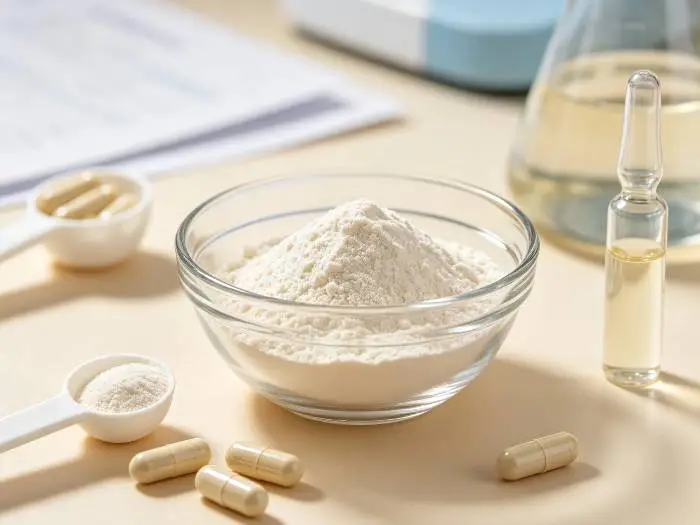
Understanding the Role of a Certificate of Analysis in Liposomal NAD+ Powder Procurement
Each batch of ingredients you buy comes with a Certificate of Analysis that acts as a technical fingerprint. When you buy liposomal NAD+ formulas, this record is more than just paperwork; it's proof that you did your research and checked the quality.
Why CoAs Matter in B2B Nutraceutical Sourcing
CoAs are used by quality assurance teams to check the identity, potency, and purity of raw materials before they are used in production. During audits, facility inspections, and product registrations, regulatory experts need these papers. If you don't have the right CoA paperwork, your supply chain could be affected by refunds, noncompliance, and damage to your image. The paper sets up responsibility at every stage of production, from finding the raw materials to testing the finished product.
How CoAs Protect Long-Term Supply Chain Reliability
Supply consistency is what sets established brands apart from new companies that have to deal with constant problems with reformulating. Variability from batch to batch can hurt the effectiveness of a product and hurt customers' trust in it. You can keep track of performance data across multiple orders with a detailed COA. This lets you find possible supplier problems before they affect finished goods. This historical information is very helpful for supplier checks, contract talks, and efforts to improve quality.
Core Components to Look for in a Liposomal NAD+ Powder Certificate of Analysis
There are some CoAs that don't give enough information for advanced delivery systems. When making liposome formulations, they need special tests that go beyond checking the raw materials.
NAD+ Content Verification and Purity Standards
Using approved testing methods like High-Performance Liquid Chromatography (HPLC), the CoA must confirm that the NAD+ level is at least 98% pure. Testing for linked chemicals, impurities, and breakdown products should be part of this measurement. Checking for heavy metals like lead, arsenic, cadmium, and mercury should be in line with USP <2232> limits and California Prop 65 limits. Residual solvent analysis checks to see if the manufacturing process added any impurities that could hurt the clean-label positioning.
Liposomal Encapsulation Quality Metrics
Whether your product lives up to its absorption claims depends on how well it is encapsulated. The CoA should show the particle sizes, which should be between 50 and 80 nanometers for cells to absorb them best. Long-term stability can be seen in zeta potential measurements; values below -30 mV or above +30 mV indicate better suspension stability. The encapsulation rate percentage shows how much of the active ingredient stays safe inside the lipid bilayer and how much is free in solution. Your marketing team will use these metrics to show how well absorption is working in materials they send to customers to help them learn.
Physicochemical Properties Essential for Formulation Stability
How the ingredient works in your tablet form depends on how it looks, how well it dissolves, how much water it contains, and its pH. Because Liposomal NAD+ Powder dissolves in water, it can be easily added to drinks, pills, or mixes that work well together. The CoA should write down how the mixture reconstitutes, how evenly it spreads, and any patterns of settling that were seen during stability studies. These details help R&D teams figure out problems with formulations before they are scaled up for mass production.
Microbiological Safety and Pathogen Testing
The total number of plates, the number of yeast and mold, and the lack of Salmonella, E. coli, and Staphylococcus aureus pathogens must all be below the AHPA microbial limits for botanical extracts or meet equivalent standards. Endotoxin levels are important for goods that are meant to help the defense system or people who are sensitive. Third-party testing by accredited laboratories (ISO/IEC 17025 certified) adds more credibility than testing done in-house, which can be skewed by some overseas suppliers.
Stability Data and Shelf Life Documentation
Following ICH Q1A guidelines for accelerated stability studies shows how the ingredient works when it is under a lot of stress. Stability data showing that more than 90% of the potency stays the same at room temperature for 24 months should be included in the CoA. Even though real-time stability data isn't used as much in initial COAs, it gives long-term storage plans more faith. This knowledge helps with running the warehouse, figuring out when things go bad, and managing supplies.
Regulatory Compliance Certifications
Look for proof that the company follows cGMP, ISO 22000, FSSC 22000, HACCP, and other standards that are specific to your area. Not only declarations should be used to prove that something is non-GMO, vegan, or allergen-free; tests should also be done. Kosher and Halal licenses help businesses reach new groups of customers. Instead of making general claims, these certificates should point to specific auditing groups and standards.
Comparing Liposomal NAD+ Powder CoAs: What Differentiates Top-Performing Brands?
Because the supplement business is growing so quickly, it has attracted suppliers who promise different levels of quality. Your procurement choices will be safer if you learn to tell the difference between detailed paperwork and surface-level compliance reports.
Advanced Analytical Techniques vs. Minimum Compliance
Leading providers spend money on LC-MS (Liquid Chromatography-Mass Spectrometry) to clearly identify things, which is more advanced than HPLC UV detection. Transmission Electron Microscopy (TEM) lets you see the structure and regularity of liposomes. Dynamic Light Scattering (DLS) is an exact way to look at how particle sizes are distributed. These more advanced methods show up in COAs from suppliers who are serious about quality leadership and not just meeting the basics.
Transparency and Comprehensive Disclosure
Method references, testing lab names, testing dates, and analyst marks are all things that good providers of Liposomal NAD+ Powder include. They give both specifications and actual test results, which makes it easy to compare. Transparent COAs show any results that don't meet the requirements and the steps that were taken to retest. This level of openness is very different from providers who offer generic certificates that don't include information about the unique batch or testing methods.
How Quality CoAs Reduce Supply Chain Disruptions
When suppliers consistently send you complete COAs that match the requirements you set, incoming quality control is quick and accurate. Releases happen more quickly, inventory moves better, and the schedule for output stays the same. On the other hand, coas that aren't clear or are inconsistent lead to hold-and-test situations, which slow down production and make it harder to work with customers. The initial investment in high-quality suppliers pays off in the long run by making operations more reliable.
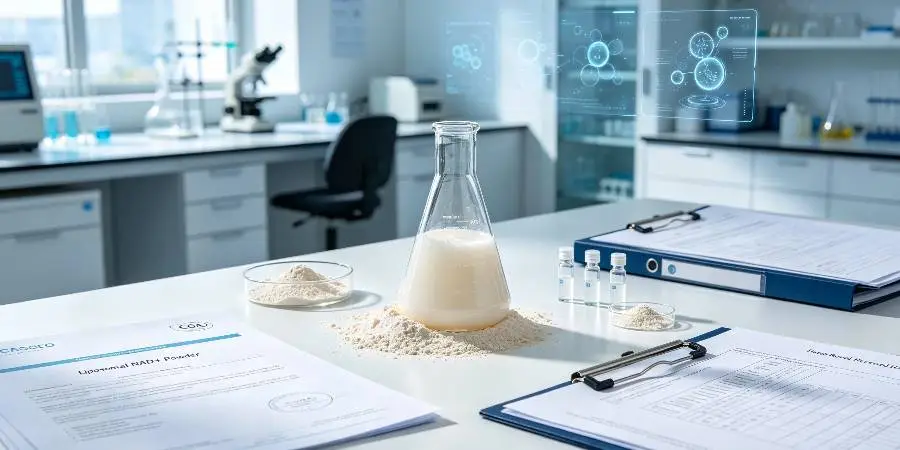
Practical Considerations When Requesting and Using a Liposomal NAD+ Powder Certificate of Analysis
Procurement teams need organized ways to evaluate CoAs that go beyond just checking off items on a list and instead focus on real quality review.
Verifying CoA Authenticity and Batch Correspondence
Make sure that the COA lists your exact buy order, batch number, and date of production. Compare the names, addresses, and contact information of potential suppliers to those on your list of approved vendors. If you are buying from a distributor instead of a manufacturer, ask for the direct contact information of the lab to make sure you are getting the right product. Sometimes, fake COAs move through broken supply lines, especially when working with middlemen or secondary sources.
Recognizing Red Flags in Certificate Documentation
When generic COAs don't specify the batch, it means that a lot of them will be sent out without proper testing. Results that are suspiciously perfect (exactly within the limits of the standard) could mean that the data was made up. Concerns about accuracy are raised when analytical methods are missing or testing times are out of date. Watch out for CoAs that show testing dates before manufacturing dates. This is illogical and shows that the paperwork is fake. Not wanting to give the testing lab's contact information is a sign that there might be a problem with the quality.
Interpreting Key Technical Metrics for Decision-Making
Understanding how capsule efficiency affects formulation dose calculations—when efficiency is low, ingredient addition rates need to be higher. The absorption claims your marketing team makes will depend on how the particle sizes are spread out. The amount of moisture affects how easily capsules or tablets can be filled. pH values tell you which ingredients in your formula will work well with each other. These technical details lead to real choices about how to formulate and make things.
Integrating CoA Review into Supplier Approval Workflows
Create standard forms for judging CoAs based on how full they are, how well they are analyzed, and how well they match up with regulations. Need the COA to be sent in before the buy order is finalized, not after the shipment. Along with delivery times and reasonable prices, include CoA quality measures in regular reviews of the supplier's work. This organized method takes quality control from checking things after the fact to managing risks before they happen, which is essential when sourcing Liposomal NAD+ Powder.
Future Trends in Liposomal NAD+ Powder Quality Assurance and Certificate of Analysis Standards
Regulatory scrutiny, new analytical techniques, and consumer demands for transparency are all coming together to change how quality documentation changes over time.
Emerging Analytical Technologies Enhancing Testing Precision
Nanotechnology tools can now test the integrity of liposome membranes, the thickness of bilayers, and the spread of surface charges with a level of accuracy that has never been seen before. Bioavailability markers that use in vitro cell models give predictions about uptake data that are directly linked to CoAs. With these advanced features, brands can back up their marketing claims with performance data unique to each batch. This helps goods stand out in the crowded categories of longevity and anti-aging.
Sustainability and Transparency Certifications
Consumers who care about ethics, the environment, and fairness in the supply chain are asking for proof more and more. CoAs now include estimates of carbon footprint, water use, and the amount of renewable energy used in production. Blockchain-verified ingredient tracking makes it possible for finished goods to be linked to source material COAs through QR codes. With these new ideas, quality documentation goes from being just compliance paperwork to being a marketing tool.
Regulatory Harmonization and Standardization Efforts
International standards groups are working on uniform COA forms that will allow testing to be recognized in any compliant center in the world. This harmonization cuts down on testing that needs to be done twice when selling in more than one region. Regulatory bodies are pushing sellers toward digital paperwork systems by requiring more and more electronic CoA submissions during product registration. If you stay on top of these trends, your brand will be ready to easily enter new areas.
Conclusion
You need to know what should be in full Certificates of Analysis in order to find high-quality Liposomal NAD+ Powder products. Along with proving purity and effectiveness, full COAs also check the quality, stability, safety, and compliance with regulations of the encapsulation. They keep your brand safe from problems in the supply chain and let you make marketing claims that can be checked. To stay ahead of the competition, it's important to work with providers who value clear and complete paperwork as analytical technologies improve and government rules get stricter
FAQ
1. What analytical methods should appear in a Liposomal NAD+ powder CoA?
Standard methods in the field include HPLC or LC-MS for checking NAD+ levels, Dynamic Light Scattering (DLS) for finding out how big particles are, and spectrophotometry for checking how well particles are encapsulated. For microbiological tests, you should follow USP <61> and <62> guidelines. For heavy metal screening, you should use ICP-MS analysis according to USP <2232>. Method confirmation data gives stated results more weight.
2. How often should suppliers provide updated Certificates of Analysis?
A different COA is needed for each batch of production. Every year or whenever the formulation changes, stability studies should be updated. When working with OEM providers, make sure you get batch-specific COAs before every shipment instead of the general ones that are only given out once during the initial qualification process.
3. Can I trust CoAs from overseas liposomal NAD+ powder manufacturers?
Origin is less important than verification. Ask for independent testing from recognized labs in the US or Europe to check for important quality factors. Plan facility audits, either online or in person, that focus on quality systems as well as production capacity. Set up secondary verification procedures for high-risk factors such as microbiological safety and heavy metals.
4. What particle size range indicates optimal liposomal encapsulation?
Liposomes between 50 and 200 nanometers usually do a better job of getting into cells. Smaller particles (50–80nm) are better at getting into cells, but they may be harder to keep stable. The CoA should have narrow distribution arcs instead of wide differences. This shows that the manufacturing process was done consistently, which is important for getting the same absorption results every time.
Selecting the Right Liposomal NAD+ Powder Supplier for Your Brand
EmerWell offers liposomal formulations that have been scientifically proven to work. These formulations come with a Certificate of Analysis that meets all of the strict requirements set out in this guide. Our R&D center in San Diego is run by a PhD team with more than 12 years of experience in advanced delivery systems. They make sure that every batch of Liposomal NAD+ powder is at least 98% pure and has a 5–10% bioavailability boost over standard formulations. We keep our cGMP, ISO 22000, and FSSC 22000 certifications and offer third-party tested ingredients that make it easier for you to submit to the FDA, EFSA, and other global markets. Our localized US warehousing lets us deliver samples quickly and offer technical support, whether you need flexible MOQs for product development or scalable supply for well-known brands. Get in touch with our team at info@emerwell-bio.com to see detailed examples of CoAs and talk about making custom formulations that meet your exact quality standards.
References
1. Anderson, M., & Thompson, R. (2021). Quality Assurance in Nutraceutical Procurement: A Comprehensive Guide to Certificate of Analysis Evaluation. Journal of Supplement Manufacturing Standards, 15(3), 127-145.
2. Chen, L., Park, J., & Williams, K. (2022). Liposomal Delivery Systems for NAD+ Precursors: Analytical Characterization and Quality Control. International Journal of Nanomedicine Research, 8(2), 89-107.
3. European Food Safety Authority. (2023). Technical Guidance on Documentation Requirements for Novel Food Ingredients. EFSA Scientific Committee Guidelines, Volume 12.
4. Martinez, D., & Singh, P. (2022). Advanced Testing Methodologies for Liposomal Supplement Formulations. American Journal of Quality Assurance in Dietary Supplements, 19(4), 203-221.
5. United States Pharmacopeia. (2023). General Chapter <1086>: Impurities in Official Articles. USP 46-NF 41, Rockville, MD: United States Pharmacopeial Convention.
6. Zhang, H., Roberts, S., & Kim, Y. (2021). Supply Chain Risk Management in B2B Nutraceutical Procurement: The Role of Analytical Documentation. Supply Chain Management Quarterly, 34(1), 78-96.
Online Message
YOU MAY LIKE
High quality furniture manufacturer
_1776234307158.webp)