

Oct 16, 2026
What Factors Influence the Dispersibility of Liposomal NAD+ Powder in Water?
Dispersibility is one of the few quality attributes of liposomal NAD+ powder that a formulator can judge with their own eyes — and one of the easiest to misread. Throughout this article, dispersibility means process and system behaviour: how evenly the powder wets out, how quickly it hydrates, whether it stays suspended, and how consistently it moves through pumps, filters and filling lines. It is a manufacturing and handling property. It is not a statement about absorption or efficacy, and nothing that follows should be read that way.
A second point of terminology matters just as much. When liposomal NAD+ powder is added to water, the result is not a true solution. It is a colloidal dispersion: phospholipid vesicles distributed through a continuous aqueous phase, usually alongside a carrier or bulking agent. There is no dissolved-molecule event to measure, so "how soluble is this powder" is the wrong question. The useful questions are how fast it hydrates, how uniform the resulting dispersion is, and how long it stays that way under your process conditions.
A Colloidal Dispersion, Not a True Solution
The distinction is practical rather than academic. A true solution clears completely and stays clear; a colloidal dispersion scatters light and therefore looks hazy at any realistic solids level. A formulator who expects a sparkling clear liquid from a liposomal ingredient is aiming at the wrong target, and may over-shear the batch trying to reach it. The same logic applies when liposomal NAD+ is compared with plain, unencapsulated NAD+: the two do not behave alike in water, which is why the difference between ordinary NAD+ powder and the liposomal form is worth understanding before any bench work starts.
Why NAD+ Is Different: A Load Range of 10% to 70%
Most liposomal raw materials are supplied in a narrow load window. Liposomal NAD+ powder is offered across a much wider one: nominal NAD+ content runs from 10% to 70%, with the 50% grade the usual starting point for developers. That number is not simply "more active". It fixes the ratio of phospholipid carrier to active material, and that ratio decides which dispersion problem you will actually face. It is also where the manufacturing route behind a given grade becomes visible, because hydration, homogenisation and drying are all tuned to the target load.
| Nominal NAD+ content | Dominant dispersion issue | Practical response at the plant |
|---|---|---|
| 10%–30% (high carrier share) | Large powder mass per unit of active; flow problems, caking, segregation and bridging in feeders dominate, so blend uniformity is the real risk | Keep water activity low and containers sealed between additions, use gentle dry blending, sample the blend at several points to confirm uniformity, and check bulk density and flow before fixing filler settings |
| 40%–55% (common commercial band) | Behaviour is broadly balanced; sensitivity appears as soon as water temperature, addition order or mixing time drifts between operators | Lock a written hydration procedure, pre-disperse before the main vessel, and run turbidity and visual checks on every batch instead of relying on operator judgement |
| 60%–70% (carrier-limited) | Relatively little carrier per unit of active; hydration and shear sensitivity rise sharply, and aggregation followed by sedimentation is the main failure mode | Pre-disperse into a small volume of warm water, keep shear moderate and time-limited, avoid mineral-rich process water, verify Z-average and PDI, and set short hold-time limits before filling |
Read that table as a caution about taking grades as equivalents. A developer who validates a dispersion procedure on a 30% grade and then switches to 65% without re-validating will usually meet aggregation and sedimentation for the first time on the filling line rather than in the lab.
Six Factors That Move Dispersibility — and How to Control Them
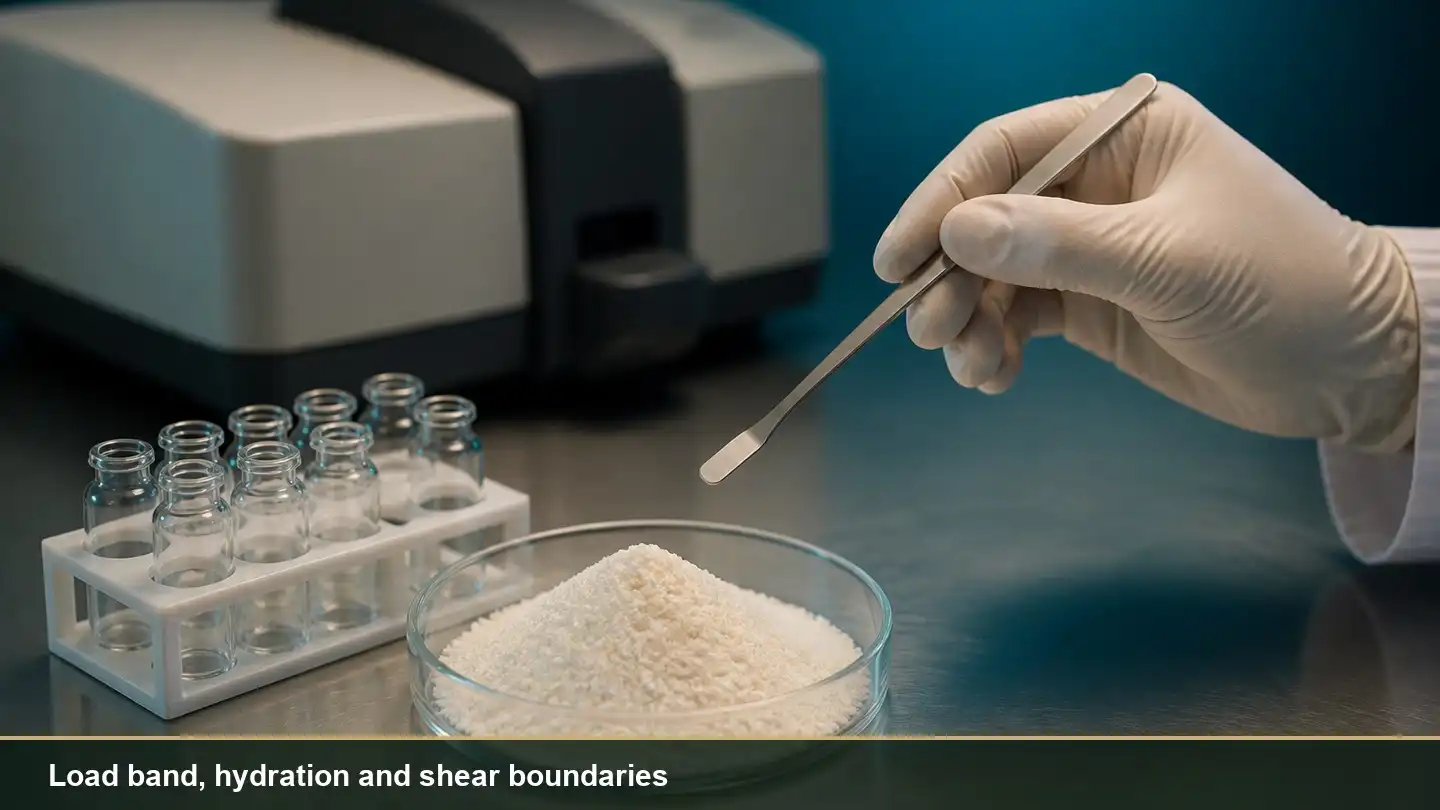
Once the load band is fixed, dispersibility is governed by six practical variables. Each has a failure signature, each can be controlled without exotic equipment, and each behaves differently depending on the particle population in the powder — a point covered from a different angle in the analysis of what influences the solubility of liposomal vitamin C powder.
1. Powder addition and pre-dispersion
Sprinkling powder into a moving vortex, rather than dumping it onto a still surface, keeps particles separated as they meet water. For carrier-limited grades, a 5%–10% pre-dispersion allowed to hydrate fully before it joins the main batch removes most lump formation at source.
2. Hydration time and water temperature
Hydration is a time-and-temperature process, not an instant. Cold water slows it and increases the chance of persistent lumps; a moderate warm band, roughly 20–40 °C, gives faster and more even wetting. The benefit flattens above that, and sustained heat near 60 °C or more puts membrane integrity at risk.
3. Shear intensity and the over-shear boundary
Moderate high shear breaks up agglomerates and speeds hydration. Past a point, energy input stops helping: vesicles can be distorted or ruptured, and the resulting fragments tend to re-aggregate. The practical rule is to use the lowest shear rate that clears visible lumps, and to re-check size after any change of impeller, vessel or batch weight.
4. Ionic strength and pH
Divalent ions, particularly calcium and magnesium, interact with the phospholipid interface, and pH extremes push the same interface toward aggregation. That is why qualification should be run in your actual process water rather than purified laboratory water, and why an acidic or strongly buffered base deserves a compatibility trial before scale-up.
5. Moisture uptake and caking
Liposomal powders are hygroscopic. Moisture taken up when a container is opened, or during a long open-bag addition, plasticises particle surfaces and promotes caking; caked powder then hydrates slowly and unevenly. Sealed containers, controlled room humidity, logged open-bag time and single-use portions for small additions all reduce the effect.
6. Particle size distribution and aggregation tendency
A single average hides the tail of the distribution. Coarse material settles faster while very fine material aggregates, and both show up as uneven dispersion. The size report should therefore be read as Z-average, PDI and distribution span from DLS rather than as one figure, and PDI drift between batches is an early warning worth acting on.
| Factor | Mechanism | Actionable control |
|---|---|---|
| Powder addition method | Powder dropped onto a still surface traps air and forms lumps that hydrate slowly from the outside in | Add into a vortex, or build a hydrated pre-dispersion first |
| Hydration time and temperature | Warm water lowers viscosity and speeds wetting of the bilayer; cold water leaves dry cores | Hold a defined warm band and a minimum hydration time, and record both |
| Shear intensity | Moderate shear de-agglomerates; excessive energy distorts vesicles and creates fines that re-aggregate | Use the lowest effective rate, cap mixing time, re-check size after equipment changes |
| Ionic strength and pH | Calcium and magnesium and pH extremes destabilise the particle interface and promote aggregation | Test in production water, buffer the premix, run compatibility trials for acidic bases |
| Moisture uptake | Hygroscopic surfaces take up water during opening and partial-bag use, leading to caking and slow hydration | Sealed handling, humidity control, logged open-bag time, single-use portions |
| Particle size distribution | A broad or skewed distribution produces fast-settling coarse material plus aggregating fines | Specify Z-average, PDI and span; read PDI drift as an early warning |
How to Tell Whether a Batch Disperses Well
None of this requires a laboratory to screen. A short bench sequence, run identically every time, separates a good batch from a marginal one before it reaches the line.
| Check | How to run it | What it tells you |
|---|---|---|
| Appearance and turbidity | Reconstitute at a fixed solids level and view against a light box with a fixed path length | A uniform, evenly hazy liquid with no streaks or specks; comparable batch to batch |
| Standing sedimentation | Leave the dispersion undisturbed in a graduated cylinder for a set period and note sediment volume | Early sediment indicates an aggregation risk, especially on carrier-limited grades |
| Filter residue | Pass a known volume through a mesh and inspect what is retained | Lumps or gels that do not re-disperse on rinsing point to incomplete hydration |
| DLS confirmation | Measure Z-average, PDI and span on the freshly reconstituted dispersion | Confirms whether the visible behaviour reflects a shifted size population |
Escalate to laboratory confirmation when the visual checks disagree with the certificate of analysis, when a batch behaves differently from the previous one under identical conditions, or when a downstream customer reports sediment. Testing methods used to verify liposomal NAD+ powder quality cover the instrumental side of that question.
Common Misdiagnoses on the Plant Floor
Three misreadings account for most false alarms. The first is reading haze as a defect: a colloidal dispersion is meant to scatter light, and a fully clear liquid usually means too little solids or an over-worked batch. The second is blaming the powder for what is really a water problem, whether mineral content or an unbuffered base. The third is measuring too late, after a hold period during which aggregation had time to develop.
Matching Dispersion Behaviour to the Finished Format
Reconstitution behaviour only has meaning inside a format. The same grade can look excellent in one application and marginal in another, which is why the target should be written down before the batch is made, and why technical work on liposomal NAD+ powder stability and the factors that shape shelf life belong in the same conversation as dispersion trials.
- Ready-to-drink beverages and shots. The acceptance target is a uniform, evenly hazy liquid with no separation, no sediment and no ring at the liquid surface after a defined hold.
- Stick packs and sachets. The target is rapid reconstitution with no lumps; lower-load grades help here because the larger powder mass wets out more readily in a small volume.
- Gummies, bars and dry blends. The question is dry-blend uniformity rather than hydration, so particle size and bulk density should be matched to the other ingredients to limit segregation. A useful cross-reference on the beverage side is incorporating a liposomal powder into functional beverage formulations.
Specifications and Acceptance Criteria
Dispersion should be a documented attribute rather than a matter of opinion. The parameters below are the ones to write into a purchase specification and confirm on receipt, alongside the general checks described in evaluating the purity and quality of liposomal NAD+ powder before buying.
| Parameter | Typical specification |
|---|---|
| NAD+ content | 10%–70% nominal, with the 50% grade the most common commercial band |
| Encapsulation efficiency | 85%–95% |
| Appearance | Pale yellow to white free-flowing powder |
| Heavy metals (Pb) | Less than 0.1 ppm |
| Microbiology (TPC) | Less than 1,000 cfu/g |
| Shelf life | Up to 24 months in sealed, cool, dry storage |
| Analytical methods | HPLC for content, DLS for particle size, TEM for morphology |
| Certifications | cGMP, ISO 9001, ISO 22000, HALAL, KOSHER, Non-GMO, Vegan, Gluten-Free |
Request Specifications, a COA and a Sample
If dispersion behaviour has to be defined before you commit a line, start from the liposomal NAD+ powder product page and send your format, target load band and process water profile to info@emerwell-bio.com. EmerWell can provide the specification sheet, batch COA, size data and a sample so that dispersion can be trialled in your own water and equipment. These discussions stay at the ingredient and process level; end-product claims remain the responsibility of the brand that markets them.
References
- U.S. Food and Drug Administration. Liposome Drug Products: Chemistry, Manufacturing, and Controls; Human Pharmacokinetics and Bioavailability; and Labeling Documentation — Guidance for Industry, April 2018. https://www.fda.gov/media/70837/download
- International Council for Harmonisation. Q1A(R2) Stability Testing of New Drug Substances and Products, 2003. https://database.ich.org/sites/default/files/Q1A(R2) Guideline.pdf
- International Organization for Standardization. ISO 22412:2025 — Particle size analysis: Dynamic light scattering (DLS). https://www.iso.org/standard/85505.html
- Akbarzadeh, A., Rezaei-Sadabady, R., Davaran, S., et al. Liposome: classification, preparation, and applications. Nanoscale Research Letters, 2013;8:102. https://pmc.ncbi.nlm.nih.gov/articles/PMC3599573/
This article is published by EmerWell, a supplier of liposomal raw materials, for manufacturing and formulation teams. It describes ingredient and processing characteristics only. It is not medical, nutritional or regulatory advice and does not address the use, safety or claims of any finished product. Requirements differ between jurisdictions; buyers should confirm the rules that apply to them with their own regulatory specialists.
Online Message