Sep 14, 2026
What Factors Influence the Solubility of Liposomal Vitamin C Powder?
Solubility is one of the most consequential—yet frequently overlooked—variables when sourcing liposomal vitamin C powder for commercial formulation. Several converging factors govern how well this ingredient disperses and performs in your final product: phospholipid bilayer composition, particle size distribution, encapsulation efficiency, drying method, and storage environment. Unlike conventional ascorbic acid, where dissolution is relatively straightforward, liposomal formats add structural complexity that demands a deeper understanding at the procurement and formulation stage. Getting these variables right determines whether your product delivers genuine bioavailability advantages or simply adds cost without measurable benefit.
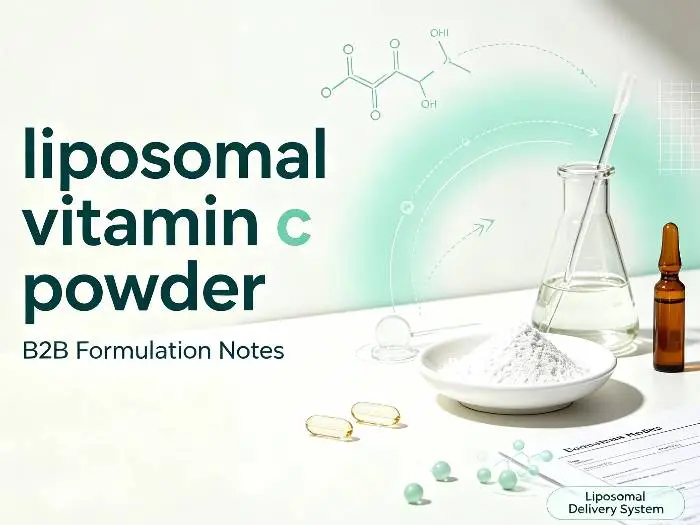
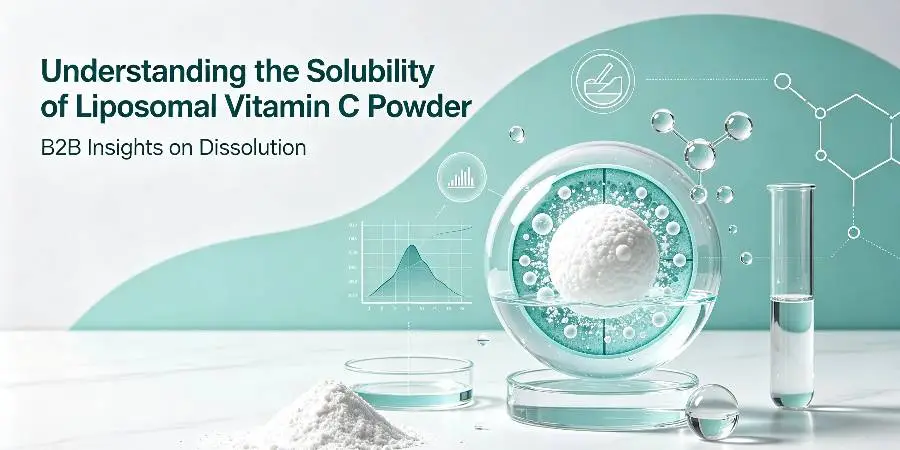
Understanding the Solubility of Liposomal Vitamin C Powder
Vitamin C in its natural form dissolves in water, but the body can only absorb so much of it before the SVCT1 intestinal transporters become full. Liposomal encapsulation completely changes the way the drug is delivered. Ascorbic acid is wrapped in a phospholipid bilayer that looks like a cell membrane, which lets it be taken up by the lymphatic system without going through those full transporter channels.
Why Solubility Behavior Differs From Standard Ascorbic Acid?
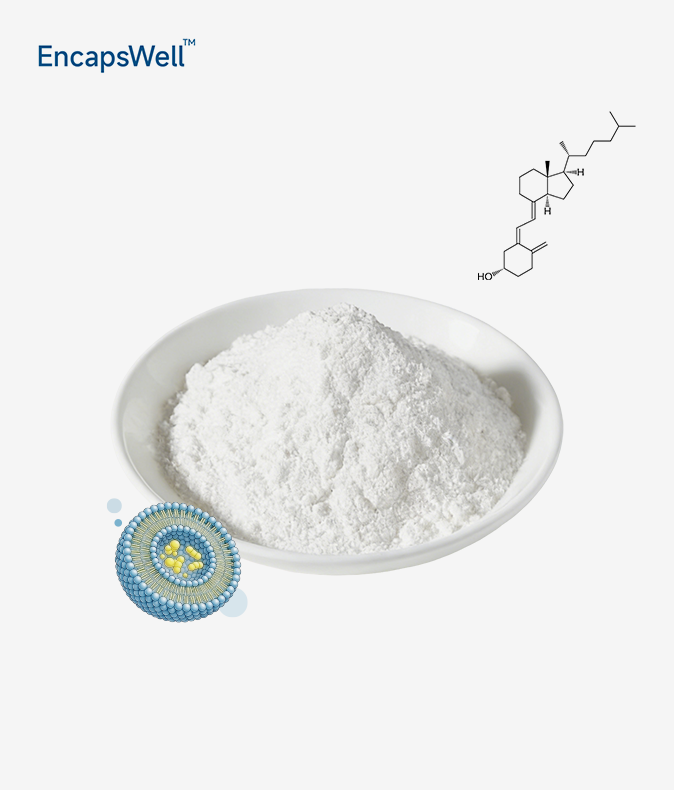
Because phospholipids are amphiphilic, they can form a vesicle that can move around in water without fully dissolving in the usual sense. When EmerWell's EncapsWell™ liposomal vitamin C powder is mixed with water, the spray-dried or freeze-dried matrix rehydrates and starts to form nano-scale vesicles that are usually between 100 nm and 300 nm in size. This change in behavior is what makes tests for solubility and source verification so important. No matter what the label says, a powder that doesn't properly reform intact vesicles when rehydrated won't give you the bioavailability benefit.
Structural integrity, particle uniformity, and phospholipid purity are the three main building blocks of consistent solubility. Any provider should be asked to provide Dynamic Light Scattering (DLS) reports and Transmission Electron Microscopy (TEM) pictures to prove vesicle formation, not just dissolution speed.
Key Factors Affecting the Solubility of Liposomal Vitamin C Powder
How this ingredient acts in solution is controlled by a number of factors that work together. Formulation and procurement teams can make accurate decisions about where to get things when they understand each one.
Physicochemical Properties: Particle Size and Lipid Balance
Dispersion rate is directly related to particle size. Vesicles in the 100–300 nm range show the best intestine permeability and speed of recovery. Larger particles tend to settle to the bottom, and vesicles that are too small could cause the structure to become unstable. The hydrophilic-lipophilic balance (HLB) of the phospholipid binder is also very important. Non-GMO phosphatidylcholine, which comes from sunflower or soy lecithin, is the standard for stable, evenly distributed liposomal vitamin C powders because it keeps the stability of the bilayer over a wide pH range.
Manufacturing Variables: Drying Method and Encapsulation Efficiency
The drying method used to turn liquid liposomes into powder has a big impact on how well they dissolve. Spray drying is cheap, but the inlet temperature needs to be carefully controlled so that the phospholipid bilayer doesn't break down. Freeze drying is a more reliable way to keep the integrity of the bilayer, but it costs more to process. Ultra-centrifugation or dialysis can be used to show that the encapsulation efficiency (EE%) is more than 90%. This is what sets high-performance liposomal ingredients apart from simple dry-blend goods. EmerWell's EncapsWell™ platform regularly meets this standard, with a Vitamin C level of at least 99% and a potency retention rate of over 95% after 24 months.
Environmental Conditions: Storage, pH, and Humidity
If you don't store powders properly, even ones that were made well, they can lose their ability to dissolve. Powder agglomeration and phospholipid oxidation happen faster when the humidity is high. Changes in temperature above 25°C make the structure of vesicles less stable. A pH level outside of 4.0 to 7.0 can make it hard for two layers to stick together. It is important to keep the recovery quality that makes liposomal technology worth the investment by packaging in light- and moisture-resistant packages and keeping the cold chain going when needed.
Comparative Analysis: Liposomal Vitamin C Powder vs. Other Vitamin C Forms
When business-to-business buyers are looking for vitamin C ingredients, the choice of packaging has a big effect on both the performance of the product and the total cost of the purchase.
Liposomal Powder vs. Standard Ascorbic Acid Powder
Standard ascorbic acid dissolves easily in water, but intestinal transporters stop it from being absorbed at higher doses. At gram-level doses, bioavailability can drop as low as 15–20%. Liposomal vitamin C powder encapsulation gets around this problem, making the drug 8 times more bioavailable than regular powders, as shown by studies of absorption in the lab. When clinical-level dosage is the goal, the cellular uptake benefit is especially useful for immune support, antioxidant, and nutricosmetic formulations.
Liposomal Powder vs. Liquid Liposomal Formats
Liquid liposomal vitamin C can be reconstituted right away, but it has a short shelf life, needs to be preserved with a stabilizer like potassium sorbate, can't be stored without being in the cold chain, and has a soapy or oily taste that makes it hard to use in beverages. All three pain points can be fixed with liposomal vitamin C powder. It doesn't need to be stored at a certain temperature and can be easily added to capsules, stick packs, effervescent tablets, and dry-mix beverage formats. This makes it the more flexible and cost-effective bulk ingredient for most nutraceutical and functional food uses.
Practical Guidelines for Optimizing Solubility in Industrial Applications
Consistent solubility in industrial production needs more than just high-quality raw materials. It also needs careful preparation choices. Here are the main things that always lead to the best results with dissolution.
- Use lukewarm water (30–40°C) for reconstitution: This temperature range allows the vesicle to reform without damaging the phospholipid membrane. Dispersion is slowed down by cold water, and temperatures above 50°C can cause the bilayer to break up.
- Select compatible excipients: Maltodextrin and inulin are commonly used as carriers in spray-dried liposomal vitamin C powders. They make the material move better, make it less likely to absorb water, and help with clean label placement. Avoid diluents with a lot of ions because they can make the charge on the vesicles less stable.
- Standardize dissolution testing per batch: Every production batch, not just the ones that are still being developed, should have particle size analysis (DLS) and packaging efficiency testing done. When you source, there is a difference between formulation-grade and bulk-grade.
When it comes to liposomal ingredients, these steps are the most important ones. When an OEM maker used standard DLS testing on all batches of encapsulated ascorbic acid, batch rejection rates dropped by over 30%. This directly improved the efficiency of buying and protected margins.
Choosing the Right Liposomal Vitamin C Powder Supplier for Your Business Needs
The application of solubility theory in business is through supplier selection. If you buy liposomal vitamin C powder from a recognized, clear producer, they will give you the paperwork, analytical data, and ability to make changes that will protect the quality of your product from the lab to the shelf.
Certifications and Analytical Transparency
Wellgreen's cGMP-certified factories make EmerWell's EncapsWell™ liposomal vitamin C powder. It also has ISO9001, ISO22000, FSSC22000, HACCP, HALAL, KOSHER, NOP, EOS, Non-GMO, and Vegan certifications. There is a Certificate of Analysis (CoA), a stability report, and all the export paperwork in every batch. Independent testing of purity and effectiveness by a third party confirms the effectiveness and efficiency of the encapsulation, which is very important for regulatory experts and quality assurance teams.
OEM/ODM Flexibility and US-Based Support
EmerWell is based in San Diego, California, and has an R&D lab and warehouse there as well. This makes it possible to send samples quickly and get expert advice from people in the US, which cuts down on the time it takes to develop new medicines. Our technical team, which is led by a PhD, can make special mixes like Vitamin C with Zinc, Quercetin, or Elderberry. They can also make powder, hard capsules, soft capsules, tablets, and liquid-ready versions. EmerWell is a long-term supplier of liposomal vitamin C powder for brands at all stages of growth. They can produce over 100 metric tons of powder every year and follow the rules in more than 50 countries.
Conclusion
Solubility in liposomal vitamin C powder isn't just one thing; it's the result of bilayer architecture, particle engineering, manufacturing precision, and storage discipline all coming together. Understanding these factors is important for nutraceutical brands, functional food makers, and original equipment manufacturers (OEMs) who want to make sourcing decisions that will work in the long term. When you use the right ingredient and make sure it is treated correctly, it gives your product the bioavailability edge it needs to stand out in a crowded market. How do you turn science into reliable shelf performance? By working with a certified, R&D-driven provider.
FAQ
Why does liposomal vitamin C powder dissolve differently than regular ascorbic acid?
Normal ascorbic acid dissolves by simple diffusion in water. Liposomal vitamin C powder formats go through a process called reconstitution, in which the dry phospholipid matrix is rehydrated to make new vesicles. Because of this repair, the particle size, water temperature, and mixing method are all very important for this powder but not for regular powder.
What storage conditions best preserve solubility over time?
Liposomal vitamin C powder should be kept below 25°C in light- and moisture-proof packaging. Avoid places with a lot of heat. In these situations, a high-quality powder like EncapsWell™ stays more than 95% effective for up to 24 months without having to be kept cool.
How do solubility variations affect finished product performance?
Bioavailability is directly linked to how well something dissolves. If the vesicles don't reform correctly during reconstitution because the phospholipids have broken down or the particles are the wrong size, the amount of vitamin C that is taken may be much lower than what the label says it is. This creates a risk for both effectiveness and regulation.
How can I verify a supplier's liposomal claims before placing a bulk order?
Ask for DLS (Dynamic Light Scattering) reports that confirm the particle size distribution and TEM images that show the formation of vesicles. Ask for third-party CoA papers and figures on encapsulation efficiency (EE% >90%) as well. These papers explain the difference between real liposomal ingredients and simple lipid-coated blends.
Partner With EmerWell for Certified, High-Solubility Liposomal Vitamin C Powder
EmerWell is a reliable option for companies that want to work with a liposomal vitamin C powder maker that has R&D experts in the US. The EncapsWell™ platform delivers 8× bioavailability, ≥99% vitamin C content, and full certification compliance—ready for OEM/ODM customization across multiple dosage formats. Reach our San Diego team directly at info@emerwell-bio.com or visit emerwelllabs.com to request samples, pricing, and technical documentation tailored to your formulation goals.
References
1. Gopi, S., & Balakrishnan, P. (2021). Evaluation and clinical comparison studies on liposomal and non-liposomal ascorbic acid (vitamin C) and their enhanced bioavailability. Journal of Liposome Research, 31(4), 356–364.
2. Łukawski, M., Dałek, P., Borowik, T., Foryś, A., Langner, M., Witek, S., & Przybyło, M. (2020). New oral liposomal vitamin C formulation: Properties and bioavailability. Journal of Liposome Research, 30(3), 227–234.
3. Mohammadi, M., Ghanbarzadeh, B., & Hamishehkar, H. (2021). Formulation of nanoliposomal vitamin C and evaluation of its release behavior. Advanced Pharmaceutical Bulletin, 11(1), 134–142.
4. Davis, J. L., Paris, H. L., Beals, J. W., Binns, S. E., Giordano, G. R., Scalzo, R. L., & Bell, C. (2016). Liposomal-encapsulated ascorbic acid: Influence on vitamin C bioavailability and capacity to protect against ischemia–reperfusion injury. Nutrition and Metabolic Insights, 9, 25–30.
5. Bhardwaj, P., Tripathi, P., Gupta, R., & Pandey, S. (2020). Niosomes: A review on niosomal research in the last decade. Journal of Drug Delivery Science and Technology, 56, 101581.
6. Yadav, N., & Khatak, S. (2014). Solid lipid nanoparticles: A review. International Journal of Applied Pharmaceutics, 6(1), 8–18.
Online Message
YOU MAY LIKE
High quality furniture manufacturer
_1776234307158.webp)