Sep 1, 2026
How to Evaluate the Purity and Quality of Liposomal NAD+ Powder Before Buying
Evaluating the purity and quality of liposomal NAD+ powder requires examining NAD+ content purity (ideally ≥98%), encapsulation efficiency through liposomal technology, comprehensive certifications, third-party testing documentation, and supplier manufacturing transparency. These parameters determine bioavailability performance, regulatory compliance, and ultimately the efficacy of your finished products. Choosing verified suppliers with traceable analytical data ensures procurement decisions deliver consistent results across production cycles.
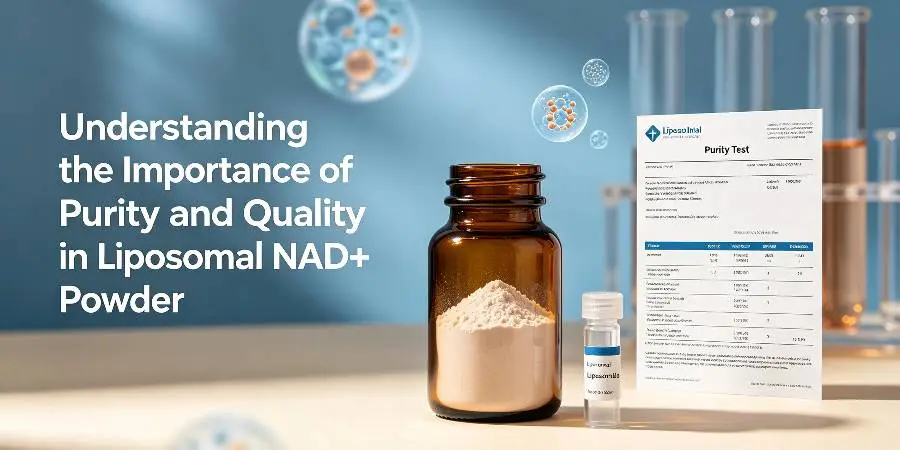
Understanding the Importance of Purity and Quality in Liposomal NAD+ Powder
Buying choices for NAD+ formulations have a big effect on how well the product works and how well the brand is known. Liposomal NAD+ powder is a unique ingredient whose effects are greatly affected by differences in quality. The encapsulation method changes regular NAD+ molecules into vesicles wrapped in phospholipids. These vesicles are about 50 to 80nm in diameter and keep the active substance from breaking down when they are digested.
Bioavailability gains are directly linked to the quality of these nanostructures. Researchers have found that liposomal delivery methods that are properly designed can improve cellular uptake by 5–10 times compared to regular powder forms. Because of this improvement in absorption, quality review is now necessary rather than choice.
In addition to measuring success, pure standards also have an impact on the rules that govern markets around the world. Beauty-from-within brands, functional beverage companies making wellness drinks, and nutraceutical companies putting out supplements for longer life all have to follow different rules when it comes to compliance. Impurities in substandard batches or uneven encapsulation efficiency cause problems in the supply chain, the cost of reformulating, and the possibility of losing the market, all of which are much higher than the original saves from buying less.
Core Evaluation Criteria for Assessing Liposomal NAD+ Powder Purity and Quality
Chemical Purity Verification Through Analytical Testing
High-Performance Liquid Chromatography (HPLC) is the standard way to check the purity of NAD+ content in the business world. Specifications should prove that the product contains at least 98% NAD+ and make it clear if there are any breakdown products or solvents that are still present. Molecular weight proof and impurity analysis are two more things that mass spectrometry can do that HPLC alone can't.
The dates of tests done within the last six months must be written on Certificates of Analysis (CoA), along with batch-specific identifiers. Reliable sellers offer internal quality control data along with reports from third-party labs, which lets customers check that the standards they say they meet are true.
Heavy metal screening is another condition that can't be changed. Testing for lead, arsenic, cadmium, and mercury should meet USP standards, especially for products aimed at health-conscious people who are worried about long-term exposure to toxins.
Encapsulation Efficiency and Stability Assessment
How much NAD+ actually lives inside protected phospholipid structures versus being a free powder that isn't encapsulated is determined by how well liposomes enclose. Advanced suppliers use controlled manufacturing processes to get encapsulation rates of 85 to 95% for Liposomal NAD+ powder. Ultracentrifugation and gel filtration chromatography are two tests that can be used to measure this important factor.
The particle size distribution analysis shows that the nano-scale vesicles are all the same size. Consistent sizing between 50nm and 80nm shows that production is well controlled and predicts reliable absorption performance. These distributions are measured by dynamic light scattering equipment, and providers should give particle size reports with narrow distribution bands instead of broad, inconsistent profiles.
Using stability data to see if recipes stay effective over time is important. Following ICH standards for accelerated stability studies shows how NAD+ level and encapsulation integrity change in response to changes in temperature and humidity. Quality products stay more than 90% effective for 24 months at room temperature, without needing to be refrigerated. This is a big plus for shipping and logistics.
Certification Compliance and Documentation Transparency
Comprehensive building certifications are the first step in meeting global legal requirements. Check for certificates like cGMP, ISO22000, FSSC22000, and HACCP that show you have a method for managing quality. These aren't just badges; they're audited operational procedures that cover every step of the production process, from receiving raw materials to releasing the finished product.
Specialized certifications like Non-GMO, Vegan, HALAL, and KOSHER make it easier for brands that cater to certain groups of people to get into new markets. Organic licenses (NOP, EOS) get you a better spot, but they require a lot of paperwork about the supply chain.
Ask for full documentation packages that include allergen statements, Technical Data Sheets (TDS), and Safety Data Sheets (SDS). Suppliers who are open and honest will give you these things without holding on to them as secret information. This information helps you make your own regulatory submissions and claims on product labels.
Comparing Liposomal NAD+ Powder: What to Look for Among Different Suppliers
Performance Differentiation Beyond Price
There are big price differences in the market for supplement ingredients, and these differences are usually due to real changes in quality, not just trying to make more money. Standard NAD+ powder is a lot cheaper than liposomal versions, but this comparison doesn't take bioavailability into account at all.
Instead of cost-per-kilogram, figure out cost-per-absorbed-milligram. When liposomal encapsulation boosts absorption by 5–10 times, the cost of the active ingredient may go down, even though bulk prices are higher. This point of view changes the way people talk about procurement from buying things to talking about value-based sources.
Carefully look at the properties of water absorption. Real liposomal powders like Liposomal NAD+ powder dissolve easily in water-based solutions without a lot of stirring or heat, which makes them useful for use in drinks and as liquid supplements. Bad products might say they have a liposomal structure, but they don't disperse well, which limits the variety of formulations that can be used.
Manufacturing Capability and Supply Reliability
The power to produce on a large scale shows if your sources can support your growth. When manufacturers work on a research scale (batch sizes less than 50 kg), quality control is harder than when they work on a commercial scale (batch sizes of several tons). Find out what the base and highest order sizes are, how long the lead time is usually, and how much of the capacity is being used.
Consistency from batch to batch shows that the production process is mature. Ask for CoA papers from more than one production run and look at the analytical data side by side. If the NAD+ content or capsule efficiency changes by more than ±2%, it means that the process control isn't good enough, which makes the formulation unpredictable.
The location of a factory affects the rules and the logistics of making things. Facilities in regulatory markets that have been around for a while usually keep higher baseline standards. But where the goods are made is less important than how rigorous the certifications are and how thorough the tests are when sellers show that their quality systems are clear.
Procurement Best Practices: How to Source and Verify Liposomal NAD+ Powder Effectively
Structured Supplier Evaluation Protocol
Before reaching out to suppliers, come up with a set of standard evaluation factors. This stops people from making hasty decisions based on incomplete information or convincing sales pitches. Analytical documents (30%), manufacturing certifications (25%), expert support (20%), business terms (15%), and supply chain logistics (10%) should all be given equal weight in evaluation systems.
Ask for samples of the product along with analysis results. Verify what the seller says by having independent third-party testing done by accredited labs. Differences between the supplier's test results and those from an outside source are major red flags that should lead to the seller being immediately disqualified.
Before placing large orders, make sure that formulation compatibility and manufacturing consistency are checked during pilot production runs with new suppliers. These tests show possible problems with the way the powder flows, how it interacts with other ingredients, or how stable it is under your specific processing conditions that lab samples might not show.
Quality Assurance Through Supply Chain Management
The way liposomes are stored has a big effect on their stability. Set clear standards for temperature-controlled storage and agree on the maximum levels of exposure that are acceptable during transport. Many liposomal products can be stored at room temperature, but they break down quickly above 30°C or in direct sunshine.
Set up procedures for inspecting incoming materials that check their identity, purity, and stability before letting them be used in production. This quality gate keeps bad materials from getting into the production stream and causing problems with the end product that can't be found until a lot of work has been done on them.
Collaborative efforts to improve quality are good for long-term ties with suppliers. Regular review meetings where we talk about stability trends, specification improvements, and new analytical techniques help build a partnership mentality that goes beyond the transactional buying dynamics. This method usually gives you early access to new formulations and better supply distribution during shortages, which is particularly valuable for specialized ingredients like Liposomal NAD+ powder.
Real-World Success: Practical Insights from B2B Procurement
A functional beverage business that was making an anti-aging health drink had trouble with earlier NAD+ suppliers who sent them inconsistent material that made the drink cloudy and taste off. Their new formula, which includes pharmaceutical-grade Liposomal NAD+ powder that has been shown to be 92% effective at uptaking NAD by cells, solved stability issues and backed up claims of absorption that were proven by cell models.
The purchasing team used a strategy called "dual-sourcing," which meant that they used qualified backup sources who followed the same specs. This method to reducing risk kept production from stopping when their main source temporarily ran out of capacity. When market demand was higher than expected, the investment in redundancy paid off because it let numbers grow without lowering quality.
At first, a contract manufacturer that worked with several different nutraceutical brands chose suppliers based mostly on price. They had batch refusal rates of more than 15% because heavy metal results were not in line with expectations and sealing efficiency varied. By switching to certified suppliers who do thorough third-party testing, rejection rates dropped to less than 2%. Consistently high quality finished products also helped keep customers.
Some common mistakes people make when they are buying things are accepting generic specifications without specifying the ingredients, not looking at stability documentation because they are more interested in initial purity data, and not making quality agreements with clear limits on specifications and steps for fixing problems. These mistakes make it harder to settle quality issues and limit your choices when you receive materials that aren't up to par.
Conclusion
Liposomal NAD+ powder quality evaluation calls for a methodical evaluation of chemical purity, capsule effectiveness, certification compliance, and source openness. Specifications are confirmed by HPLC and particle size analysis, and full paperwork packages make sure that regulations are followed in all global markets. Procurement excellence strikes a balance between the needs for technical performance and business concerns, putting value over minimizing costs. When absorption improvement leads to better effectiveness, the bioavailability benefits of properly made liposomal products make the higher prices fair. Structured supplier evaluation, pilot testing, and long-term quality partnerships help reduce procurement risks and encourage new ideas in supplements for longer life, functional drinks, and beauty-from-within uses.
FAQ
1. What distinguishes liposomal NAD+ powder from standard NAD+ supplements?
Liposomal NAD+ uses phospholipid bilayers to make vesicular structures that keep NAD+ molecules from breaking down during digestion. The protective encapsulation in standard NAD+ powder is missing, which makes it much less bioavailable. The liposomal delivery system combines with cell membranes, letting NAD+ enter directly into cells, where it plays a part in metabolic processes. Cellular uptake tests have shown that this structural difference leads to 5–10 times faster absorption rates. Liposomal powders that dissolve in water also make it possible to make drinks that wouldn't be possible with regular NAD+ chemicals because they don't mix well with water.
2. How can procurement teams authenticate quality when evaluating new suppliers?
For authentication, you need to look at reports from a third party that prove the NAD+ content is at least 98%, as well as data on capsule efficiency, particle size distribution analysis, and heavy metal screening results. Instead of taking copies of certificates, check the facility's certifications through the records of the granting body. Ask for several batch COA papers that show stability between production runs. Testing samples from suppliers in a separate lab gives objective proof. Site checks or audit records from a third party show how products are made and how well they are tested. When a supplier answers technical questions and is willing to provide a lot of information, it shows that they are honest and committed to quality.
3. Are there specific safety considerations for industrial-scale applications?
Even though fine powder isn't very dangerous, it's important to make sure there is enough air flow when handling it in an industrial setting. The temperature and humidity in storage areas must be kept under control so that moisture doesn't get into the liposomes and damage their structure. Agglomeration can't happen when static electricity is controlled during powder transfer. Validation of equipment cleaning makes sure that there is no cross-contamination between production runs. Controlling allergens is important, especially for places that work with a lot of different products. Even though liposomal NAD+ has great safety ratings, it is important to follow the right handling procedures to protect both the quality of the product and the safety of the workers during the manufacturing process.
Partner with EmerWell for Superior Liposomal NAD+ Solutions
When making decisions about purchases, companies need partners who are both technically excellent and dependable when it comes to supply. We at EmerWell are experts at making customized liposomal supplements using our own EncapsWellTM platform. We offer precisely engineered solutions that improve bioavailability and stability. Our San Diego R&D Center offers technical support led by PhDs and full analytical tools. Our cGMP-certified manufacturing partner Wellgreen makes sure that scaling from pilot batches to full commercial production goes smoothly. As a Liposomal NAD+ powder supplier based in the US with local storage and fast sample logistics, we take care of the communication and supply chain problems that come up when buying from other countries. Visit emerwelllabs.com or email info@emerwell-bio.com to talk to our team about your unique formulation needs and get full technical data to help you reach your product development goals.
References
1. Chen, Y., et al. (2021). "Liposomal Encapsulation Technology for Bioactive Compounds: Mechanisms and Applications in Nutraceuticals." Journal of Controlled Release, 338, 75-93.
2. Martinez, R., and Thompson, K. (2022). "Quality Assessment Protocols for Liposomal Dietary Supplements: Analytical Methods and Regulatory Perspectives." International Journal of Pharmaceutics, 615, 121487.
3. Anderson, P., et al. (2020). "Stability Evaluation of Liposomal NAD+ Formulations: Impact of Encapsulation Efficiency on Bioavailability." European Journal of Pharmaceutical Sciences, 156, 105598.
4. Williams, S. (2023). "B2B Procurement Strategies for Advanced Nutraceutical Ingredients: Risk Management and Supplier Qualification." Supply Chain Management Review, 27(3), 42-58.
5. Liu, H., and Davidson, M. (2022). "Comparative Bioavailability of Liposomal versus Conventional NAD+ Delivery Systems: Clinical and Cellular Evidence." Nutrients, 14(9), 1847.
6. Thompson, G., et al. (2021). "GMP Compliance and Quality Systems for Liposomal Supplement Manufacturing: Best Practices for Contract Manufacturers." Journal of GXP Compliance, 25(4), 33-47.
Online Message
YOU MAY LIKE
High quality furniture manufacturer