

Oct 8, 2026
What Certifications Matter When Buying Liposomal NAD+ Powder in Bulk?
When procurement teams compare liposomal NAD+ powder suppliers, the certificate pack often arrives before the sample, and it is tempting to read that pack as a single verdict. It is not one. Credentials qualify different things: some describe a facility, some a management system, some a product line, and none describe the specific drum being quoted. This guide sets out a verification method for bulk buyers, using the reference figures published for our liposomal NAD+ powder, to separate risk-reducing documents from reassuring ones.
Four Layers Hiding Behind the Word “Certification”
Buyers who regard every certificate as equivalent end up comparing logo counts, not coverage. Sort each credential into one of four layers, then ask a different question at every layer.
Facility-level credentials
These apply to a manufacturing site and the conditions under which it operates: building, equipment, personnel and record-keeping assessed against a defined standard. They do not travel with a shipment.
System-level credentials
These certify a management system rather than a product: how a company plans, controls, monitors and improves its processes. ISO 9001 and ISO 22000 sit here, checked at the level of the organisation.
Product-level compliance marks
These attach to a material or product line and speak to composition, sourcing or market suitability: Kosher, Halal, Non-GMO, Vegan and Gluten-Free. They are granted for a defined scope at a defined site, so the scope statement matters as much as the mark.
Batch-level records
These follow one production run: the Certificate of Analysis, the batch production record, the reserve sample, the deviation log. This is the only layer that speaks directly to the material in front of you, and the one buyers most often under-weight.
| Layer | Typical credential | Assessed against | Scope it covers | What it does not cover |
|---|---|---|---|---|
| Facility | cGMP | Good manufacturing practice for the site’s operations | The site and its processes | A named lot or a customer specification |
| System | ISO 9001:2015 | Quality management system requirements | The organisation’s processes | Product performance or composition |
| System | ISO 22000:2018 | Food-safety management system requirements | The organisation’s food-safety processes | Individual lot results |
| Product or market | Kosher, Halal, Non-GMO, Vegan, Gluten-Free | Composition, sourcing or processing rules for a scope | A defined product or line at a named site | Potency, purity or lot-specific conformity |
| Batch | Certificate of Analysis, batch record | The specification and test methods for that run | One production lot | Future lots, or attributes not tested |
What cGMP, ISO 9001 and ISO 22000 Actually Tell You
cGMP is the manufacturing-practice framework that dietary-supplement operations in the United States are expected to follow under 21 CFR Part 111: written procedures, qualified personnel, controlled components, laboratory methods, batch records and complaint handling. A site operating under cGMP is organised to produce repeatably, but that says nothing about the potency of any particular ingredient. ISO 9001:2015 certifies a documented quality management system, while ISO 22000:2018 adds food-safety management. Both are voluntary standards, audited periodically, and both are certificates about process discipline — neither samples your drum.
For a material like liposomal NAD+ powder, the systems layer matters most at the extremes of the specification. When content can be set from 10% to 70% and encapsulation runs from 85% to 95%, what protects your formulation is the supplier’s ability to reproduce the same result across orders. Ask for the last three batch values for the exact grade you intend to buy, and read a certificate as the reason to ask, not the answer. Buyers who want a structured way to weigh these signals can compare the criteria for choosing a reliable liposomal NAD+ powder supplier.
Product-Level Compliance: Kosher, Halal, Non-GMO, Vegan and Gluten-Free
These five marks are often presented as technical credentials, which misleads in both directions. They say nothing about potency, particle size or encapsulation. What they confirm is that a scope of production meets a stated rule: Kosher and Halal address permitted ingredients and process handling, Non-GMO addresses the genetic status of the phospholipid carrier and other inputs, Vegan addresses animal-derived content, and Gluten-Free addresses the absence of gluten sources above a defined threshold. Two details decide whether a mark is useful: the scope, meaning whether it names the exact product and site rather than only a parent company, and the source, since a soy- or sunflower-derived carrier is where much of the Non-GMO value originates. A companion note on safety and certification questions for liposomal NAD+ powder covers how to request the scope statement rather than a logo.
Why a Certificate Is Not Evidence That a Batch Conforms
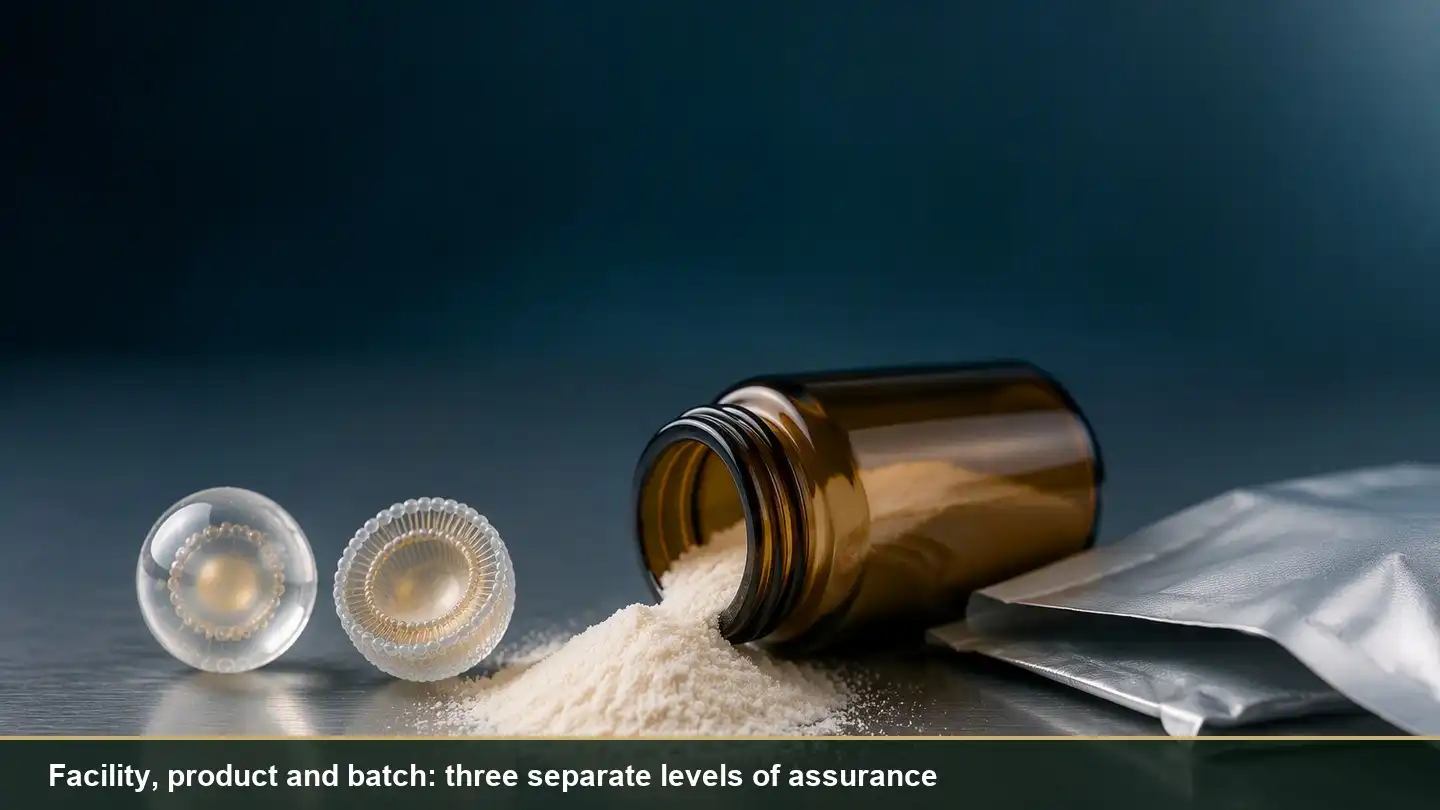
The central confusion in bulk certification is a category error. A certificate is issued at a scope and a point in time; a shipment is a physical quantity produced on a specific date, from specific lots of carrier and active. The two are linked only by the batch record, and the batch record is not the certificate.
A facility certificate can tell you the site was audited. It cannot tell you that the carrier received last month met its incoming specification, that the homogenisation step ran within its validated parameters, or that the fill weight on your drum was verified. Each of those facts lives in the batch-level layer, and each can fail while every certificate stays valid, which is why a traceable record beats an audit badge. A subtler error is reading a compliance mark as a quality indicator: the five product marks are market-access and composition statements, and a supplier can hold all five while the encapsulation on a given lot drifts. Match the marks to the markets you sell into, and use the analytical layer to judge quality, as described in this note on evaluating the purity and quality of liposomal NAD+ powder.
What a Certificate of Analysis Should Contain
A Certificate of Analysis is only as strong as the specificity behind each line. The item name, specification limit, method and result should appear together; a value without a method is a claim, not a result. Insist that the certificate names the lot number, the date of manufacture, the specification version it was tested against, and the testing laboratory, stating whether that laboratory is in-house or independent. For a liposomal material, a useful certificate separates the active-content line from the physical-characterisation lines, because potency alone says nothing about whether the material is genuinely vesicular; sizing and morphology do that work, and both should be reported as a distribution rather than a single average.
| COA field | Typical method | What to check in the document | Layer |
|---|---|---|---|
| Active content | HPLC | Result against the grade’s declared range, not only a pass | Batch |
| Encapsulation efficiency | Method stated by the supplier | Whether the definition and method are given, not only a percentage | Batch |
| Particle size distribution | DLS | Distribution and dispersion protocol, not a lone mean | Batch |
| Morphology | TEM | Whether intact structures are shown for the named lot | Batch |
| Elemental impurities (for example Pb) | Elemental analysis | Limit, method and result reported together | Batch |
| Microbial load | Total plate count | Result against the declared cfu/g limit | Batch |
The reference values for our own material — content from 10% to 70%, encapsulation 85% to 95%, Pb below 0.1 ppm, total plate count below 1,000 cfu/g and a shelf life of up to 24 months — are published so a buyer can compare a COA against a stated specification rather than against trust. Our note on what a liposomal NAD+ powder Certificate of Analysis should include walks through each field, our guide to how liposomal NAD+ powder is manufactured shows how the profile is produced, and the storage factors behind that shelf life are in this note on improving liposomal NAD+ powder stability.
How to Verify Third-Party Testing Claims
“Third-party tested” is one of the most repeated and least specified phrases in ingredient sourcing. It can mean a sample was sent to an accredited laboratory for a full panel, or that a single parameter was checked once as a favour; the difference sits entirely in the paperwork. Start with the laboratory, not the result: it should be identifiable by name, and for regulated scopes its accreditation should be verifiable through the accrediting body’s own records. Then check the chain of custody — which sample was drawn, when, by whom and how it was sealed — and the method alignment, because if the in-house and independent methods differ, the two results are not directly comparable. Third-party work is strongest as a check on the batch you receive, sampled with an agreed method; a report on an earlier lot signals a supplier’s habits but is not evidence about your shipment. For the practical test menu used on NAD+ material, see our note on testing methods for verifying liposomal NAD+ powder quality.
A Due-Diligence Question Checklist
The fastest way to tell a documented supplier from a rehearsed one is to ask questions whose answers must be fetched rather than recited. Use the table below as a script for the first technical call, and note which answers arrive as documents and which as assurances.
| Area | Question to ask | Document to request | Warning sign |
|---|---|---|---|
| Scope | Which legal entity and which site hold each certificate? | Certificate scope statement | A parent-company certificate offered for a different site |
| Validity | What are the issue and expiry dates, and who issued them? | Current certificate and issuing-body reference | Expired dates, or no verifiable issuer |
| Grade | Which grade and content are we quoting and sampling? | Specification sheet with the tested ranges | A generic spec with no grade named |
| Lot | Which lot will ship, and does its COA match this spec version? | Lot-specific COA | A COA that predates the order or names no lot |
| Analytics | Who ran each test, and with which method? | Method list and laboratory identity | Results offered without methods |
| Traceability | Can the carrier lot be linked to the finished batch? | Batch record or traceability summary | No link between inputs and output |
A supplier that keeps these documents current will answer most of this from a folder. To turn these criteria into a shortlist decision, see our guidance on key factors when choosing NAD powder manufacturers and on what to look for in a reputable liposomal NAD+ powder supplier.
Regulatory and Market-Access Considerations
Documentation requirements differ by destination market. Import expectations, permitted ingredient status, labelling rules and registration duties vary between jurisdictions and change over time. Read any supplier summary as a starting point rather than an authority, and confirm current requirements for your product and market with the competent local authority or a qualified regulatory specialist before you commit to a purchase.
Requesting Documentation and Samples from EmerWell
EmerWell supplies liposomal NAD+ powder produced under cGMP with ISO 9001 and ISO 22000 systems, and carrying Kosher, Halal, Non-GMO, Vegan and Gluten-Free compliance. For a supplier file we will send the current specification sheet, the lot-specific Certificate of Analysis for your grade, the certificate scope statements, and a sample for your own laboratory. Our certificates describe documented credentials and testing; they are not a claim about any finished product’s performance. Request the pack or a sample through the liposomal NAD+ powder product page or by email at info@emerwell-bio.com.
References
1. U.S. Food and Drug Administration. Dietary Supplements. https://www.fda.gov/food/dietary-supplements
2. Electronic Code of Federal Regulations. 21 CFR Part 111 — Current Good Manufacturing Practice in Manufacturing, Packaging, Labeling, or Holding Operations for Dietary Supplements. https://www.ecfr.gov/current/title-21/chapter-I/subchapter-B/part-111
3. International Organization for Standardization. ISO 9001:2015 — Quality management systems. https://www.iso.org/standard/62085.html
4. International Organization for Standardization. ISO 22000:2018 — Food safety management systems. https://www.iso.org/standard/65464.html
Disclaimer: This article is written for B2B ingredient-sourcing and product-development teams. It describes documentation and certification practice for a supplement ingredient and is not medical or regulatory advice. Statements about finished products, claims or market suitability must be assessed by the buyer against the requirements of its own markets and confirmed with the competent authorities.
Online Message
YOU MAY LIKE
High quality furniture manufacturer
_1776234307158.webp)