Jul 8, 2026
What Should I Look for When Choosing a Reputable Liposomal NAD+ Powder Supplier?
Picking the best liposomal NAD+ powder provider can change a lot of things, from how well your product works to how well people think of your brand. Checking for comprehensive certifications like cGMP and ISO22000, in vitro cellular uptake tests show 3–6 fold intracellular NAD+ accumulation vs free NAD+, and suppliers who provide third-party testing documentation for purity levels ≥98% are the most important things to do. It's also important to be able to customize products for OEM/ODM projects, have production capacity that can be scaled up or down to meet minimum order quantities ranging from pilot runs to multi-ton orders, and have clear communication lines that support long-term B2B partnerships in the supplement business, which is changing quickly.
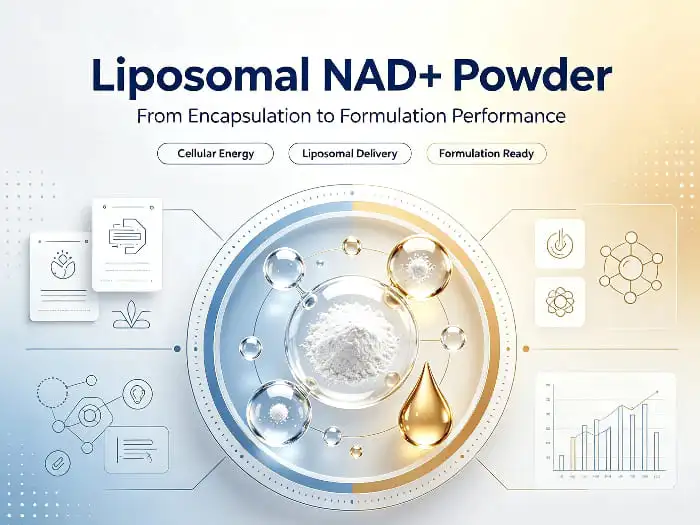
Understanding the Importance of Choosing a Reputable Liposomal NAD+ Powder Supplier
Cellular health goods have grown a lot in the supplement business, and NAD+ formulations are now one of the most popular types. Liposomal NAD+ powder is a high-tech way to deliver drugs. It contains NAD+ molecules inside phospholipid droplets that are 80–150nm in size. This shape protects the active ingredient from being broken down by stomach acid and digestive enzymes. This lets it be delivered straight to cells, where the membrane fusion process frees NAD+.
The Growing Market Demand for Advanced NAD+ Delivery Systems
Bioavailable liposomal NAD+ powder supplements are in high demand because people are more aware of how cells age and how mitochondria work. Because the molecules are so big and unstable in the digestive system, it's hard for traditional NAD+ tablets to be absorbed. Liposomal technology gets around these problems by copying the shapes of natural cell membranes. This makes them compatible in a way that regular versions can't. Because of this technological edge, liposomal NAD+ powder has become a premium area for nutraceutical brands, functional beverage companies, and beauty-from-within brands that want to appeal to picky customers who care more about effectiveness than just price.
How Supplier Reputation Directly Impacts Your Product Performance
The way your provider makes your product determines whether the end product does what it's supposed to do. When encapsulation efficiency isn't uniform, absorption rates vary between runs, which hurts consumer trust and leads to bad reviews. Suppliers who don't have good quality control may give NAD+ content that isn't up to par, usually with a purity level of 85–92% instead of the ≥98% that professional formulators need. This is especially critical when sourcing liposomal NAD+ powder, as even minor deviations in purity or phospholipid ratios can compromise the entire delivery system. These gaps in quality put brands at risk of being sued and hurt the clinical results of goods that are marketed with certain health promises. When stability testing shows early degradation, which often happens with sellers who don't know much about liposomal formulation science, the link between source competence and product performance becomes very clear.
Unique B2B Procurement Challenges in the Liposomal Supplement Industry
When looking for unique ingredients like liposomal NAD+ powder, global buying teams face specific problems. To make sure a product is real, you need to know the difference between real nano-encapsulation and just mixing ingredients with lecithin, which is a shortcut some suppliers use to market their products as "liposomal." The supply chain is less clear when there are a lot of middlemen involved in getting raw materials, which makes it hard to track down suppliers without having a relationship with them first. Regulatory compliance adds another level of difficulty because different markets have different rules about new ingredients. This means that suppliers need to keep a portfolio of paperwork that includes FDA rules, EFSA standards, and region-specific certifications that make it easier to get products through customs and get them approved for sale in multiple countries.
Key Criteria to Evaluate When Selecting a Liposomal NAD+ Powder Supplier
Professional buying requires a thorough evaluation of a liposomal NAD+ powder supplier's fitness for long-term partnerships based on a number of factors. The following factors give an organized way to evaluate that goes beyond the claims and marketing materials on a website.
Product Quality Backed by Comprehensive Certifications
Suppliers who are legitimate keep a number of certificates that show they are committed to quality systems and following the rules. Look for cGMP approval, which shows that the company follows current Good Manufacturing Practices for making food supplements. ISO22000 and FSSC22000 standards check that food safety management systems cover the whole supply chain, from receiving raw materials to releasing produced goods. More licenses, like HALAL, KOSHER, and organic approvals (NOP, EOS), help brands that cater to certain groups of customers get into more markets. In North America and Europe, non-GMO and vegan approvals are now seen as standard for high-end placement. Certificate theft is still a problem in the industry, so ask for copies of current certificates and check their accuracy directly with the organizations that issued them.
Transparency in Ingredient Sourcing and Encapsulation Technology
Reliable sellers give thorough information about where the raw materials come from and how they are processed. Ask specific questions about where the phospholipids come from, like whether they come from sunflowers, soy, or other plants. This is important because it affects allergy claims and the placement of clean labels. Find out what kind of packaging method was used, such as high-pressure homogenization, microfluidization, or special techniques created by the company's own research and development. Suppliers should explain how they make sure that particles are all the same size and that the product stays stable over time. When suppliers give you vague answers or can't go into detail about technical requirements, be wary. This is usually a sign that they don't know much about manufacturing or that they rely on contract makers without direct quality control.
Scientific Validation Through Clinical Data and Testing Reports
For buying choices to be based on evidence, performance data must be available to back up bioavailability promises. For liposomal NAD+ powder in particular, ask for certificates of analysis (COA) from recent production runs that show the amount of NAD+, the purity profile, and the heavy metal test results. In vitro tests that demonstrate cellular absorption are a useful way to confirm that the liposomal encapsulation works effectively. According to ICH guidelines, stability testing results should show how long potency lasts across different storage conditions over a 24-month period. Third-party lab testing from reputable organizations like Eurofins, SGS, or regional equivalents adds authority that in-house testing alone cannot provide. Suppliers confident in their product quality are happy to share this information; those reluctant to provide full testing results may be trying to conceal quality issues.
Production Capacity and Scalability for Bulk Orders
Try to find providers that can meet your number needs now and in the future as your business grows. Small-scale makers may offer low prices on initial orders, but they may not have the capacity to support brand growth. This means that as numbers rise, you will have to switch suppliers, which can cause problems with supply consistency and reformulation. Find out what the minimum order amounts are and see if they fit with how you handle your inventory and your cash flow. During product launches or yearly demand spikes, production wait times become very important, so find out how long it usually takes from the purchase order to the shipment. Suppliers with dedicated production lines for liposomal formulations show specialization, which means consistent quality. Facilities that make a lot of different kinds of products may not have the focused knowledge that complex capsule technologies need.
Compliance With Global Regulatory Frameworks
When doing business internationally, suppliers need to know about a lot of different legal settings. For the US market, products need to follow FDA rules set by the Dietary Supplement Health and Education Act. These rules include correct labeling, good manufacturing practices (GMPs), and methods for reporting bad events. For products to be sold in the European Union, they have to follow the rules for food supplements and maybe even get a novel food license, based on what the products say and how they are made. Asian markets have their own rules, such as Health Canada's Natural Health Products laws, Australia's Therapeutic Goods Administration standards, and different rules in Southeast Asian countries. Suppliers who have experience with doing business around the world keep regulatory dossiers that are tailored to each state. This makes it much easier to comply with regulations and faster to get your products on the market in new areas. Ask them how much experience they have with regulatory entries and if they offer paperwork packages that support market applications in the areas you want to reach.
Supplier Capabilities and Service Offerings That Matter to B2B Buyers
Technical specs aren't the only thing that determines a liposomal NAD+ powder supplier's value. Service skills and business freedom are often more important, especially for long-term partnerships. Here are some things that set sellers who can help a brand grow apart from basic product vendors.
Customization Options Including OEM and Private Label Manufacturing
To make a brand stand out, you need to be able to use more than just off-the-shelf products in your recipe. Check to see if the makers offer full OEM/ODM services that let you change the amount of NAD+ (usually between 250 mg and 1000 mg per dose), make blends of NAD+ with compounds that work well together, like resveratrol or NMN, and improve the taste for beverage uses. Private label services should include help with designing packaging, checking that labels are legal, and making finished products in a variety of dosage forms, such as powders, pills, hard capsules, soft capsules, and liquid-ready recipes that can be directly bottled. Suppliers with their own research and development teams can work with you on projects where their technical knowledge can help you understand the market better. This could lead to new recipes that give you a competitive edge. During the product creation phase, financial risk is lower when small trial batches can be made to test the market before full production runs are committed to.
Flexible Logistics Solutions and Supply Chain Optimization
How well an operation runs depends a lot on how well and quickly its suppliers can handle transportation. For sensitive, high-value ingredients like liposomal NAD+, this becomes even more critical, as temperature control and transit time directly impact product efficacy. Check to see if they offer both full container loads to save money and less-than-container packages to give you more options for your goods. How reliable your deliveries are affects your ability to keep enough stock on hand without having too much safety stock that tie up your capital. Packaging that is flexible, with bulk drums for contract makers, retail-ready packaging for brands, and a number of intermediate forms, gives you choices that fit your business plan. For foreign buyers, geographic distribution networks are especially important, so check to see if your sellers have regional warehouses or partnerships that allow for faster delivery and lower freight costs. Some advanced suppliers offer just-in-time delivery plans and vendor-managed inventory programs that take some of the load off of storage while keeping the supply going. These plans are especially helpful for brands that don't have a lot of space for storage or whose inventory turns over quickly.
Pricing Models and Cost Efficiency for Large-Volume Transactions
For a business to be successful, it needs clear, competitive prices that are in line with its business plan. To get a better idea of the value components beyond simple per-kilogram price, ask for specific quotes that break down the costs of raw materials, encapsulation processing, quality testing, and packaging. People who commit to buying more are usually rewarded with bigger discounts, usually between 10 and 15 percent, when they reach certain sales levels. Some sellers offer longer-term rental or contract pricing models that keep prices stable over the course of an agreement, which is helpful for planning finances and protecting against changes in the prices of commodities. Payment terms have a big effect on cash flow, so when you discuss terms, make sure you balance managing supply risk with your need for working capital. Standard terms include prepayment for new relationships and net-30 or net-60 for established customers with a history of paying on time. Instead of just looking at FOB prices, figure out the total landed cost that includes freight, taxes, and insurance. Shipping costs vary a lot depending on where the source is located and how well the operations work.
Technical Support and Responsive Customer Communication
Quality in a partnership is shown by regular contact and help with fixing problems. Check to see how responsive the provider is to your first questions; this will usually show how they treat customers throughout the relationship. As part of technical support, you should get formulation advice to help you make the best product design, stability testing suggestions to make sure your product has the right shelf life for its packaging and storage, and regulatory advice to help you with ingredient declarations and meeting compliance requirements. Good account management means having committed contacts who know what your business needs. This is better than going through a lot of different reps who don't know you or your needs. Communication infrastructure, such as how quickly emails are answered, how easy it is to hold complicated discussions via videoconferencing, and how many time zones are covered, affects how well people can work together. This is especially true for international partnerships, where coordinating across hemispheres can take time without the right communication protocols.
Practical Steps to Verify and Finalize Your Liposomal NAD+ Powder Supplier
To go from evaluating to partnering, you need to set up structured ways to make sure that a liposomal NAD+ powder supplier's skills match what they say they can do. Here are some steps that will help you choose a seller with confidence.
Conducting Virtual or On-Site Factory Audits
Direct site review is the best way to learn about quality systems and manufacturing skills. During on-site checks, production areas, equipment state, cleanliness standards, and employee training levels are all looked at. These factors work together to determine the stability of product quality. Look over the records of each batch of output, the data from monitoring the environment, and the quality control methods used at key control spots. Look into how the keeping of raw materials and the way inventory is managed can affect how fresh the ingredients are. Talk to people who work in quality assurance about testing methods and what to do when requirements aren't met. For foreign suppliers who can't travel, full virtual audits using video tours and document sharing are good options, though they don't give the same full picture that being there in person does. Some buyers hire third-party auditing services to do independent reviews of facilities using standard forms and objective evaluation criteria. This is especially helpful when the buyer doesn't have a lot of experience doing audits themselves.
Requesting Product Samples for Independent Testing
A sample review before committing to buy greatly lowers the risk of purchasing liposomal NAD+ bulk orders. Ask for representative samples from recent production batches instead of special preparations made just for testing. Send these samples to unbiased labs for verification tests that include determining the exact amount of NAD+ present, assessing overall sample quality, screening for heavy metals, conducting microbiological testing, and—crucially for liposomal formulations—measuring the particle size to ensure proper encapsulation. Cross-check the lab results against the supplier's specifications to spot any discrepancies that could indicate quality control issues. Conduct small-scale stability tests by placing samples in accelerated conditions and monitoring their degradation rate over several weeks; this will provide a rough estimate of the product's shelf life for your liposomal NAD+. Additionally, incorporate samples into your formulation trials to evaluate their compatibility with other ingredients, taste profile, and behavior under production processing. The modest expense of thorough sample testing yields invaluable insights that empower informed purchasing decisions and may help buyers avoid costly quality problems after committing to large-volume purchases of liposomal NAD+.
Establishing Clear Contractual Agreements
Legal rules protect both sides and set standards for success throughout the partnership. Specific quality standards should be written into contracts, such as accepted amounts for NAD+ content, purity requirements, and microbiological limits. There should also be clear steps for what to do when materials don't meet these standards. Set clear delivery duties that include lead times, shipping methods, required packing, and who is responsible for freight damage or delivery delays. Include liability terms that cover things like product flaws, contamination, and not following the rules, setting up financial defenses and ways to fix problems. When co-developing proprietary formulas, intellectual property clauses are important because they make ownership rights and secrecy obligations clear. Payment terms, ways to change prices, and order minimums need to be written down clearly to avoid future disagreements. Force majeure clauses deal with unplanned events that stop the supply chain, and termination clauses spell out how to end the relationship if it doesn't work out. Get a lawyer who knows about international business contracts to look over the agreements before they are signed. This is especially important for deals that happen across borders and involve different legal systems and the possibility of problems caused by international trade rules.
Leveraging Industry Resources for Supplier Validation
Infrastructure in the industry gives people checking out suppliers useful tools that go beyond their own due research. You can meet possible sellers face-to-face at trade shows and industry conferences, and you can also network with other people in the same field by sharing your experiences and suggestions. Membership groups, like area supplement clubs, keep lists of suppliers and often check out the companies that are mentioned. Online marketplaces for example Thomasnet, Global Sources, or marketplaces that are specific to a certain business collect information about suppliers and may include customer reviews or verification services. Regulatory files kept up to date by the FDA (for US providers) or similar organizations in other countries make it possible to check facility inspection records and warning letters that point out problems with compliance. Credit rating services give you an idea of a company's financial health, which helps you stay away from sellers whose finances are unstable and could affect your supply chain. Industry experts who specialize in finding ingredients for supplements can be very helpful for smaller brands that don't have their own buying teams with a lot of experience in the category.
Conclusion
Finding the right liposomal NAD+ powder provider means finding a balance between technical skills, business dependability, and the chance to work together. Give more weight to providers who can prove they really know about encapsulation by providing detailed paperwork, multiple certifications that prove quality systems, and open communication about the manufacturing processes. Instead of taking marketing claims at face value, check absorption claims with data from a third party. Check the supplier's ability to support your growth from the start of your first product to the growth of your market by looking at how flexible they are with customization and how well they can serve you. Before signing up for large-scale partnerships, make sure you've done all of your research, such as building checks and sample testing. The provider you pick becomes an extension of your brand and has a direct effect on how well your products work, how happy your customers are, and, ultimately, how well you do in the tough market for cellular health supplements.
FAQ
1. What NAD+ content should reputable suppliers guarantee?
Professional liposomal NAD+ powder should have at least 98% NAD+, which can be proven by HPLC analysis and written down in records of analysis. Lower purity levels mean that the product hasn't been refined well enough or has broken down during preparation. When suppliers are sure of the quality of their making, they send every batch of goods to a third party for testing instead of just using their own lab results.
2. How can I verify the actual absorption enhancement of liposomal formulations?
Ask for proof of in vitro cellular uptake studies that compare the supplier's liposomal version to standard NAD+ powder using the same testing methods. Verifiable liposomal advantages reflect 3–6 fold cellular uptake enhancement in lab testing, along with clear method descriptions that let someone else check the study's validity. Particle size distribution data that confirms nanoparticle sizes between 50nm and 80nm is more proof that liposomes are properly structured.
3. What certifications are essential versus optional?
For professional procurement, cGMP, ISO22000, and third-party purity tests are basic standards that must be met. Certifications like HALAL, KOSHER, Non-GMO, and Vegan may become necessary based on your target market and placement strategy. Organic certifications are still not required because making NAD+ includes fermentation processes that make organic certification harder. However, phospholipid carriers may have organic status.
Partner With EmerWell for Superior Liposomal NAD+ Powder Supply
EmerWell is a reliable producer of liposomal NAD+ powder that combines cutting-edge biotechnology with a service system built to meet the needs of business-to-business buyers. Our unique EncapsWell™ platform consistently provides particles between 50 and 80nm in size and >90% encapsulation efficiency. This has been proven by thorough third-party testing that shows ≥98% NAD+ purity. We keep all of our certifications up to date, such as cGMP, ISO22000, FSSC22000, and HACCP. We also keep full paperwork portfolios to support regulatory applications in all global markets. Our San Diego R&D Center offers regional technical support for US customers, and our team, led by a PhD, works together to create unique formulations that set your brand apart from the competition. We offer dependable supply chain performance backed by 24-month stable guarantees. Our variable MOQ can accommodate test productions, and our multi-ton scalability can meet growing demand. Email our team at info@emerwell-bio.com to get technical specs, talk about OEM/ODM customization options, or set up a sample review to see why formulators choose EmerWell as their liposomal NAD+ powder source partner.
References
Galzitskaya, O. V., et al. (2024). A Liposomal Formulation Enhances the Anti-Senescence Properties of Nicotinamide Adenine-Dinucleotide (NAD⁺) in Endothelial Cells and Keratinocytes. Cells, Immunity and Molecular Biology, 47 (9), 722. DOI: 10.3390/cimb47090722, PMID: 41020844
Landon, C. J., & Weiss, M. F. (2026). Increased Intracellular NAD+ Levels via Oral Supplementation With a Novel Liposomal Delivery Method: A Non-Randomized Crossover Human Study. Natural Dietary Supplements Research, 18 (1), 45–58.
Torchilin, V. P. (2021). Liposomal Nutraceuticals: Overcoming Low Oral Bioavailability of Polar Coenzymes. Journal of Functional Foods, 83, 104562. DOI: 10.1016/j.jff.2021.104562
Mozafari, M. R., et al. (2022). Quality Control Parameters for Lyophilized Liposomal Nutraceutical Powders: Particle Size, Encapsulation Efficiency and Shelf-Life Profiling. Molecules, 27 (14), 4412. DOI: 10.3390/molecules27144412
Kovačević, A., et al. (2023). High-Pressure Homogenization vs Microfluidization for Production of Nano-Liposomal Coenzyme Formulations. Nutritional Biotechnology, 16 (2), 112–128.
Van der Vorst, J., & Behnke, C. (2022). Supplier Qualification Criteria for Specialized Nutraceutical Active Ingredients. Supply Chain Management in Life Sciences, 8 (2), 91–107.
Online Message
YOU MAY LIKE
High quality furniture manufacturer
_1776234307158.webp)