

Nov 4, 2026
What Makes Liposomal Vitamin C Powder Suitable for Private Label Supplement Development?
Private label development rarely fails because an ingredient is out of specification. It fails earlier, when a concentration tier is fixed before the target load is, or later, when two companies each believe the other holds a document. EmerWell’s liposomal vitamin C powder is a useful case for both failure modes: it is offered at 10%, 20%, 25% and 50%, and the tier chosen reshapes fill weight, pack format, process window and paperwork. This article covers development fit, and the boundary between what an ingredient supplier owes a private label brand and what the brand owes its market.
Development Fit Is a Different Question From Ingredient Quality
The limits themselves are not the subject here. The methods behind them — HPLC for assay, DLS for particle size, TEM for morphology, iodometry for oxidative state — are set out in the vitamin C testing breakdown. What follows assumes those criteria are met and asks what else has to be true before the project ships.
Working Backward From the Target Load to a Concentration Tier
The tier decision is arithmetic, not preference. Start with the mass of ascorbic acid one serving should carry, divide by the concentration, then compare the result with what the format can hold and what the filling equipment can dose repeatably. Only then consider commercial structure.
A 10% powder needs ten grams of powder per gram of ascorbic acid; a 20% needs five; a 25% needs four; a 50% needs two. What changes downstream is not chemistry but the engineering envelope: fill weight, bulk volume, capsule count, stick length, and how much room remains for everything else in the formula.
| Tier | Powder per 1 g ascorbic acid | Capsules and tablets | Stick pack | Ready-to-mix | Gummy |
|---|---|---|---|---|---|
| 10% | 10 g | Not workable in a single unit | Bulky, only at low loads | Easiest dispersion, largest scoop | Workable, but adds bulk to the batch |
| 20% | 5 g | Multi-unit only | Comfortable | Good, moderate scoop | Workable, bulk still dominates |
| 25% | 4 g | Borderline, often two units | Comfortable, shorter pack | Good if wetting is verified | Usual compromise |
| 50% | 2 g | Single unit feasible | Small pack, acidity concentrated | Re-test dispersion at load | Low inclusion protects texture |
Format Fit: Where Each Format Breaks First
Every format stresses a powder differently. The useful question is which failure appears first, because that is what consumes the trial batch. The notes below are process reasoning, not promises about a lot; they are the parameters to verify with your manufacturer before the first run.
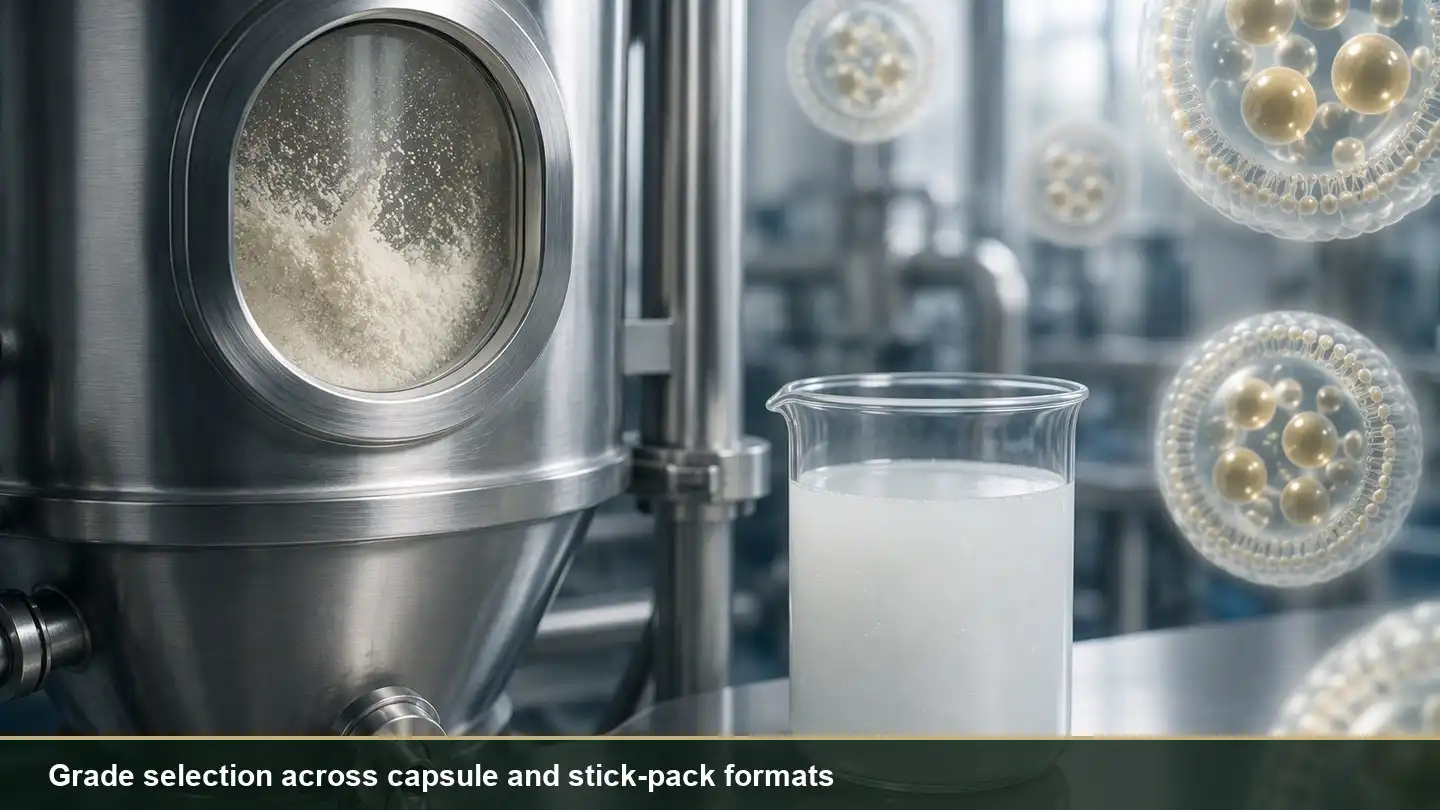
Capsules and tablets
Capsule filling rewards narrow particle size distribution and consistent bulk density, because the dosator doses by volume. A powder that fluidises or cakes produces fill weight drift long before a visible defect. Tableting adds compression: the press generates local heat and pressure at the die, and both act on the vesicle structure and on moisture. Direct compression with a suitable diluent, at the lowest force that still produces a compliant tablet, is the usual starting point. Where a target load cannot be met in one unit, the honest options are two units or a different format.
Stick packs
A stick pack is a fill weight problem wrapped in a moisture problem. The powder is dosed by auger into a narrow tube, so flow has to be steady and static charge controlled; a pale yellow to off-white free-flowing powder doses more reliably than one that has taken up humidity in the hopper. With a single serving and little headspace, moisture ingress shows up as caking rather than as assay loss, and caking is what consumers notice. Cold-water dispersibility belongs in your own trial, at your own load.
Ready-to-mix powders
A ready-to-mix product is a beverage in waiting, so behaviour after dispersion matters more than behaviour as a powder. Check three things at bench scale: whether the dispersion stays homogeneous long enough to drink, whether the ingredient’s natural colour is acceptable in a clear liquid, and how the acidity interacts with the rest of the blend. Metal ions in the water or in co-ingredients accelerate ascorbate oxidation, and the resulting colour drift is visible in a transparent drink. The solubility factors for this powder are the starting point.
Gummies
Gummies are the least forgiving format and the one where fit is most often assumed. The mass spends time at elevated temperature during cooking, the gel system is pH-sensitive, and water activity in the finished piece drives both texture and degradation. A high tier helps because it lowers the inclusion rate and leaves the matrix intact, but it concentrates the taste, so masking becomes limiting. Begin with a thermal exposure budget in time and temperature agreed with the manufacturer, plus a bench trial at the intended inclusion rate.
The Document Pack a Private Label Brand Actually Needs
Documentation requests fail when they arrive as a wish list rather than a statement of purpose. Split the pack into three groups and the supplier can answer in one pass.
With every batch
- Certificate of analysis covering assay by HPLC, encapsulation efficiency, particle size by DLS, and microbiological and heavy metal results against the agreed limits.
- Lot number, manufacture date and the specification version the lot was released against.
- Any deviation note for that lot, even where the lot was released.
This material is specified at 85% to 95% encapsulation efficiency, lead below 0.5 ppm and total plate count below 1,000 cfu/g, with morphology confirmed by TEM and oxidative state by iodometry. Those are the figures a buyer can hold a supplier to, and they should appear on the certificate in the same units and against the same methods as the specification sheet.
Once, at qualification
- Technical specification sheet with test methods named, not only limits.
- Safety data sheet in the format your site requires.
- Stability summary with conditions, timepoints, parameters and trend rather than a single pass or fail.
- Third-party heavy metal and microbiological reports, with the laboratory identified.
- Certificates for cGMP, ISO 9001:2015, ISO 22000, Kosher and Halal, read for scope rather than for logos.
- Written change notification terms, including what counts as a change.
Clean label status is a separate conversation from certification. Gluten-free, non-GMO, vegan-friendly and soy-free positions are available as options, which means the brand must confirm which option was applied to the lot it bought and keep the supporting declaration. An option is not a default.
What the supplier cannot issue
Three documents always belong to the brand: the finished-product label, the claim substantiation file, and the market authorisation or notification for each country of sale. A supplier can provide the specification and the test data underneath them; it cannot sign them, because it does not know your serving, your format, your other ingredients or your market. A supplier evaluation framework is useful because it tests whether a supplier understands that line.
Who Owns What: The Responsibility Boundary
Most disputes in private label projects are not technical. They are disagreements about ownership that surface after a problem. This is the version worth putting in front of both parties before the trial batch.
| Project item | Ingredient supplier owns | Brand or contract manufacturer owns | Evidence |
|---|---|---|---|
| Identity, assay, encapsulation efficiency | Testing and release to the agreed specification | Incoming verification, or documented reliance on the certificate | Batch COA and incoming release record |
| Heavy metals and microbiological limits | Testing to stated limits by named methods | Setting limits in the purchase specification; periodic verification | COA and third-party laboratory report |
| Raw material stability as supplied | Stability summary, storage conditions, retest basis | Retest dates in your inventory; storage compliance | Stability protocol and summary |
| Finished-product stability | Technical input only | Accelerated and long-term study on the packed SKU | Finished-product report |
| Format and process validation | Bench-scale dispersion and compatibility data | Line trial, fill weight capability, scale-up records | Trial batch report and retained samples |
| Label and artwork | Nothing | Full ownership, including ingredient declaration | Approved artwork and review record |
| Efficacy and health claims | Nothing beyond specification and test data | Full ownership under each market’s rules, including substantiation | Claim file held by the brand |
| Market entry notifications | Export and origin documents | Any notification or authorisation required at destination | Submission receipt |
| Change notification | Written notice of specification or process change | Impact assessment and re-qualification | Signed change notice |
The Six Gates Before Launch
Six decisions, in order, catch most of what goes wrong. Each has an owner and an output, and each should be closed in writing before the next opens.
- Target load confirmed. Mass per serving fixed for each format before a tier is quoted; output is a one-page load definition signed by brand and manufacturer.
- Format and process matched. The tier is tested against the actual route, including thermal exposure, water activity and dosing method; output is a trial plan naming the parameters.
- Stability on the finished unit. Accelerated and long-term work on the packed product, not the raw powder; output is a report supporting the shelf life you print.
- Label and claims reviewed. Artwork and each claim checked against the target market before printing; output is approved artwork and a claim file.
- First production scale-up. The line run confirms fill weight capability, homogeneity and pack integrity at commercial speed; output is a signed batch record.
- Change control live. The notification clause is signed, triggers are listed, a person is named on each side; output is an executed quality agreement.
Gate three is where schedules slip, and the gate most often substituted with raw material data. Powder stability describes the ingredient in its own pack, not inside a gummy at a given water activity or in a stick that has picked up moisture in a humid warehouse. The shelf life factors for liposomal vitamin C powder are the input to that study, not a replacement for it.
Change Control Deserves Its Own Clause
A workable clause names four things: what counts as a change, how notice is given and how far ahead, who assesses the impact on the finished product, and which changes trigger re-qualification. Changes to identity, assay method, encapsulation efficiency outside the agreed band or lipid origin should trigger re-qualification; packaging and labelling changes should at least trigger document review. The clause is cheap at the start and expensive after the first recall discussion. Ask the supplier to describe its last change and how customers were told; a working system answers in specifics. The wholesale buying guide covers the same ground from the purchasing side.
Building the Specification Your Manufacturer Works From
Brands comparing formats at this stage often find the ingredient choice and the format choice are one decision seen twice. A capsule and a stick pack made from the same powder need different tiers, different taste strategies and different stability work. The powder versus capsule comparison and the powder versus tablet comparison set out those trade-offs in terms a development team can use, the powder and liquid formats compared covers the process route, and the bulk purchasing options overview shows where tier and pack choices meet purchasing.
Request the Technical Pack for Your Format
The specification and current certificate are available through the liposomal vitamin C powder product page, and the technical team can be reached at info@emerwell-bio.com to discuss tier selection, dispersibility at your load and the documentation your qualification process requires. No commercial terms, volumes or schedules are stated here; those follow the specification you agree.
References
- U.S. Electronic Code of Federal Regulations. 21 CFR Part 111 — Current Good Manufacturing Practice in Manufacturing, Packaging, Labeling, or Holding Operations for Dietary Supplements. https://www.ecfr.gov/current/title-21/chapter-I/subchapter-B/part-111
- U.S. Food and Drug Administration. Structure/Function Claims. https://www.fda.gov/food/nutrition-food-labeling-and-critical-foods/structurefunction-claims
- Rahim MA, Zahran HA, et al. Liposomal encapsulation in food systems: a review of formulation, processing, and applications. Food Science & Nutrition, 2025. https://pmc.ncbi.nlm.nih.gov/articles/PMC12321603/
This article is written for supplement ingredient buyers, brand owners and contract manufacturers, and discusses development planning, processing and documentation only. It is not medical or nutritional advice, and nothing in it should be read as a statement about the effects of any ingredient or finished product on human physiology.
Online Message