Aug 20, 2026
How to Choose a Reliable Liposomal Vitamin C powder Supplier?
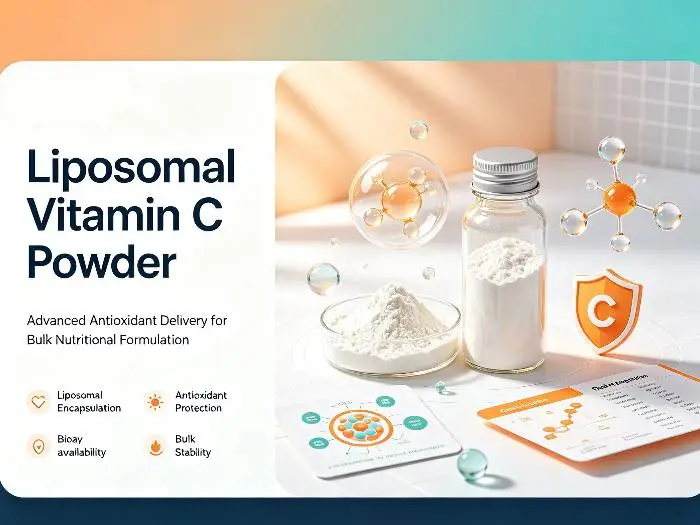
Selecting a dependable supplier for Liposomal Vitamin C powder requires balancing innovation, compliance, and operational reliability. This ingredient—featuring L-ascorbic acid wrapped in phospholipid layers—delivers up to 8x higher bioavailability compared to standard ascorbic acid. Your choice impacts product efficacy, regulatory approval timelines, and brand reputation. Prioritize suppliers offering third-party testing, cGMP certification, and flexible formulation support to align with your nutraceutical, functional beverage, or cosmetic supplement goals. The right partnership transforms technical specifications into market-ready solutions that meet consumer expectations for absorption and purity.
Understanding the Liposomal Vitamin C Powder Market and Product Fundamentals
What Makes Liposomal Encapsulation Different?
Traditional vitamin C supplements have problems with being absorbed. Uptake is limited by SVCT1 transporters in the small intestine, which means that higher amounts are only 20–30% bioavailable. This is fixed by liposome technology, which wraps ascorbic acid in very small lipid bilayers made of non-GMO phosphatidylcholine. These very small bubble-like structures, which are usually 100 to 400 nanometers across, look like cell membranes. This lets them directly fuse with intestine cells and move through the lymphatic system. This skips the breakdown process in the gut system and improves transport to cells. For B2B buyers making immune support capsules, collagen-boosting drinks, or antioxidant mixtures, this means that powerful products need lower doses to work just as well. Encapsulation efficiency, or the amount of active ingredient that is successfully trapped within liposomes, is a key quality measure that has a direct effect on cost-per-dose estimates and label claims.
Applications Across Industry Segments
Nutraceutical companies use this ingredient in immune-boosting pills and powders that are aimed at seasonal health. Functional beverage makers like that it doesn't dissolve easily in water, so they can use it to make ready-to-drink shots and fizzy sachets without changing the taste. Companies that make beauty-from-within use it to help make anti-aging drinks and softgels by mixing it with hyaluronic acid or ceramides. Contract manufacturers are looking for suppliers who can provide a range of services, such as bulk powders for private-label capsules or custom blends of vitamin C with zinc, quercetin, or elderberry. Whether you're using it for clinical nutrition, cosmetics, or wellness retail, knowing your end use will help you choose a supplier that meets your needs for taste masking, dosage flexibility, and certifications like Halal, Kosher, or organic credentials.
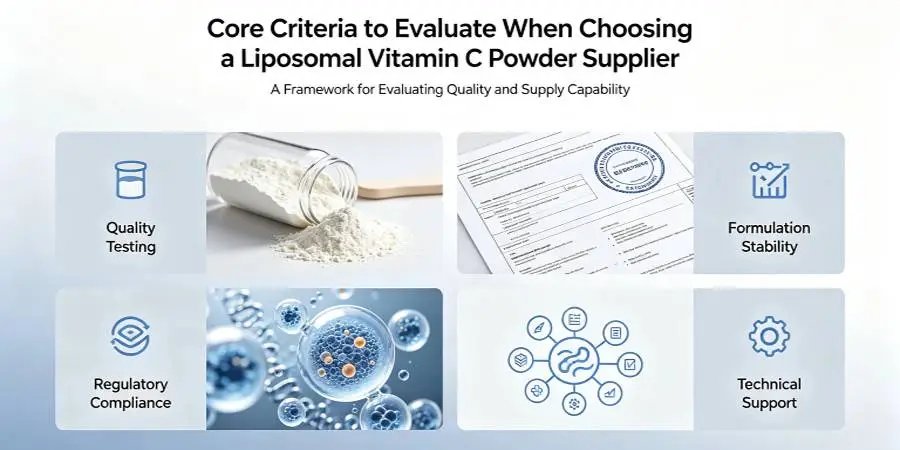
Core Criteria to Evaluate When Choosing a Liposomal Vitamin C Powder Supplier
Verifying Supplier Credentials and Quality Systems
Certifications show how committed a seller is to safety and regularity. Check for cGMP compliance, which requires written factory processes, training guidelines for staff, and controls for contamination. The ISO 22000 and HACCP standards show that food safety is managed in a planned way, which is important for beverage uses. Brands that use clean labels like organic certificates (NOP, EOS) and Non-GMO Project Verification. Check these claims by asking for copies of up-to-date certificates and doing audits of the suppliers. Reliable partners provide third-party lab reports that prove the vitamin C content is more than 99% pure, along with microbe testing results that show the product meets USP standards. Transparency in this area builds trust and protects against problems in the supply chain caused by people not following the rules.
Assessing Product Quality Through Key Metrics
How much of the active ingredient makes it through processing and keeping depends on how well the capsule is sealed. Top providers use microfluidics or high-pressure homogenization to get 90–95% efficiency, which makes sure that each run is the same. Ask for Certificates of Analysis (CoA) that show the particle size distribution, zeta potential (which shows how stable the liposomes are), and peroxide values (which show how quickly they break down). Stability statistics should show that more than 95% of the potency is still present after 24 months of fast circumstances. For use in drinks, stability tests show that the Liposomal Vitamin C powder doesn't clump and spreads out evenly. Samples help your R&D team make sure that the sensory profiles and compatibility with existing formulations are correct. This way, you can avoid costly delays in reformulating after the contract is signed.
Evaluating Supply Chain Reliability
Lead times affect when products come out. Make it clear if the seller keeps raw materials in stock or only orders what they need when they need it, which increases the risk during phospholipid shortages. Minimum order numbers (MOQs) should match your production cycles. Suppliers who are open can do trial runs starting at 25–50 kg and then move up to metric tons. Logistics skills are important for international buyers. Does the supplier take care of export paperwork, cold chain shipping for batches that need to be kept at a certain temperature, or regional storage? EmerWell's center in San Diego has U.S.-based inventory and fast sample delivery, which cuts down on shipping times for North American names and offers localized technical support through our in-house lab.
Understanding Pricing Structures and Contract Terms
Transparent pricing models separate the costs of the ingredients, the fees for encapsulation, and the costs of packaging. As the order size goes up, so should the volume price. For example, when you go from 500 kg to 2 tons, you can expect a 10-15% drop. There are different ways to pay. Suppliers that have been around for a while may offer net-30 or net-60 terms after credit approval, while new partnerships need fees. Contracts must include quality promises (for example, CoA match rates), delivery plans with penalties for being late, and agreements to keep unique blends secret. Talk about being flexible with changes to the formula during the pilot phase, but make sure that small changes don't lead to full reordering cycles.
Comparison of Top Liposomal Vitamin C Powder Supplier Types and Solutions
Specialized Liposomal Manufacturers vs. Multi-Product Distributors
Companies that make liposomal technology put a lot of money into their own encapsulation platforms. This is shown by EmerWell's EncapsWellTM system, which uses a multi-vesicular approach that makes things more stable and helps cells take them in. These sources have a lot of technical know-how. Our team, which is led by a PhD, works together on bioavailability optimization and custom testing methods. Multi-product distributors, on the other hand, carry a wide range of ingredients but may not have the expertise to make their own products, so they depend on third-party makers. Their larger catalogs are good for buyers who need to find a lot of different raw materials, but they don't offer much in the way of formulation support or advanced analytics. Specialized partners speed up innovation, especially for brands that say they have better absorption claims that are backed up by clinical evidence.
Organic Certified vs. Conventional Suppliers
Organic Liposomal Vitamin C powders cost 20–30% more than regular ones, but they are better positioned to meet sustainability trends and are seen as high-end. Certifications like USDA Organic or EU EOS need non-GMO lecithin sources that can be tracked and don't allow manufactured fluids to be used during processing. This trustworthiness helps brands that want to sell at Whole Foods or European health stores. When price is more important than approval, conventional providers are a better choice for mass-market goods. Think about the people you want to sell to. Millennials and Gen Z customers are growing interested in clean labels, while value-focused segments are happy with traditional choices. Cost structures and brand positioning should be balanced to get the highest margins and market share.
Established Global Brands vs. Emerging Innovators
Legacy suppliers have long-term track records, lots of compliance paperwork, and production networks that span multiple continents to ensure a steady supply. Large contract makers that handle private-label business for Fortune 500 companies like how stable they are. New developers add flexibility by using cutting-edge technologies such as microfluidic mixing to better control particle size. Smaller MOQs and faster sample turnarounds make them perfect for startups that want to see if their product fits the market. EmerWell connects these worlds. Our R&D center in San Diego speeds up innovation, and Wellgreen's well-established infrastructure (100+ metric ton annual capacity, 50+ country compliance) gives us confidence in our ability to scale. This dual ability helps brands from the idea stage of a product all the way through to foreign growth.
How to Conduct Due Diligence and Supplier Assessment Effectively?
Requesting and Testing Product Samples
A sample review shows what the requirements are missing. Ask for 100–200 gram Liposomal Vitamin C powder samples along with COAs, and then test them internally or with a third party to find out how much vitamin C they contain using HPLC, how well they are encapsulated using ultracentrifugation, and how big the particles are using dynamic light scattering. Sensory screens measure taste and mouthfeel, which is important for beverage uses where sharpness can make people not want to drink it. Stability testing at the settings you want to store it in (for warm markets, 40°C/75% RH) tells you how long it will last. Score each supplier on quality, solubility, and the completeness of their technical data while comparing three at the same time. This parallel evaluation speeds up the decision-making process and gives you more power in negotiations.
Investigating Supplier Reputation and Client Feedback
B2B sites like Alibaba, ThomasNet, or nutraceutical-specific websites collect reviews of suppliers, but you should look deeper. Ask for case studies that show how their ingredients have been used to successfully launch products, making sure to include details about the size, timeline, and problems that were solved. If you do a search on LinkedIn for "team credentials," you can find people like food scientists, regulatory affairs experts, and quality assurance managers. Going to a trade show like SupplySide West or Vitafoods Europe shows that you are interested in the industry and can make investments. Contact the references directly and ask how quick they were to quality problems, how flexible they were with renegotiations, and how accurate their lead time promises were. EmerWell's clear communication model includes specialized account managers and real-time order tracking, which fixes common problems like taking too long to respond or not being clear about when things will be made.
Reviewing Legal Protections and Compliance Documentation
Contracts should have quality guarantee terms that say CoA specifications must match shipped batches and that nonconforming material can be fixed by getting a discount or being replaced. Delivery terms (Incoterms like FOB or CIF) make it clear who is responsible for damage that happens in transit. Exclusive formulas need to be kept safe, which is why confidentiality agreements are so important when sharing target dosages or companion ingredients. Check to see if the seller has product liability protection and will pay for claims of contamination. International buyers need export licenses, phytosanitary certificates, and customs reports. Suppliers with a lot of knowledge take care of these things for you. To avoid delays at the border, make sure that you are following the rules for FDA GRAS status, EU Novel Food laws, or your target market. Legal due diligence keeps arguments from getting expensive and makes sure that customs clearance goes smoothly.
Maximizing Procurement Success: Best Practices for Bulk Purchasing and Long-Term Partnerships
Negotiating Volume Commitments and Flexible MOQs
To get a good price, you have to balance your commitments to volume with the risk of having too much inventory. Offer tier-based agreements: start with 250 kg trial shipments at standard prices, then move up to 1-ton orders with 12% discounts once the product has been proven to work. Set up multi-year contracts with yearly volume promises. This will protect prices against rising costs of raw materials and give you a way out in case of "force majeure" events. Seasonal changes in demand can be accommodated by flexible MOQs. Instead of expecting lump orders, talk about splitting packages every three months. Suppliers who are sure of their quality, like EmerWell, will often work with these terms because they know that happy trial customers will become regular customers. Everything should be written down in addendums instead of verbal agreements that make disputes harder to settle.
Establishing Performance Metrics and Communication Protocols
Key performance indicators (KPIs) measure how reliable a company is. Track the number of on-time deliveries (goal: >95%), the quality of the COA (100% batch match), and the time it takes to answer a question (<24 hours). Formalizing feedback loops, quarterly business reviews talk about quality trends, future regulation changes, or chances to make new products. Use shared digital platforms, like ERP integrations or supplier portals, to see your inventory in real time and set automated reminders to reorder. EmerWell's localized U.S. presence lets people meet in person at our San Diego center, which builds connections beyond business transactions. Technical questions should be sent to the R&D team, and logistics problems should be sent to the operations manager. This keeps things from getting stuck. Collaborative partnerships plan ahead for what people will need, like storing materials before your busiest production times.
Technology tools make Liposomal Vitamin C powder partnerships work better. Purchase orders, invoices, and compliance papers are all kept in one place by cloud-based procurement tools, which makes audits easier. CRM systems keep records of all interactions, so when an account changes hands, institutional information is not lost. Tracking software keeps track of groups of ingredients from where the raw phospholipids come from to how they are packaged at the end, which is very important for managing recalls. EmerWell gives you batch traceability reports that connect the lot numbers of your finished products to our own production records. These reports meet FDA 21 CFR Part 117 standards. These systems cut down on administrative work while improving quality control. This means that your team can focus on making new products instead of looking for paperwork.
Conclusion
When picking a liposomal vitamin C provider, you need to look closely at their quality systems, technical skills, and ability to be flexible with their operations. Give priority to partners whose encapsulation efficiency has been tested, who have full certifications, and who communicate clearly. Sample testing, checking a company's reputation, and contract protections all lower the risks that come with getting ingredients. When you negotiate strategically about volume commitments and performance metrics, you can build partnerships that grow with your brand. Aligning supplier strengths with your product roadmap speeds up market success, whether you're making immune-boosting capsules, antioxidant drinks, or collagen-boosting cosmetics. With the right partnership, raw materials can be turned into unique products that are backed by solid science and dependable supply lines.
FAQ
What bioavailability advantages does liposomal encapsulation provide over standard vitamin C?
Liposomal versions are 8 times more effective at absorption than regular ascorbic acid powders. Standard supplements have intestinal transporters that get full, which stops the body from taking in more than 200 mg at a time. The nutrient is protected by liposomes as it travels through the digestive tract, and lymphatic absorption makes it easier for the nutrient to get to the bloodstream and tissues at higher concentrations. Studies in humans have shown that plasma levels stay high for longer, which improves the immune system and collagen production.
How can buyers verify a supplier's manufacturing quality standards?
Ask for up-to-date cGMP, ISO 22000, and HACCP certificates and check the granting bodies and expiry dates. Get audit reports on your building from clients or outside inspectors. Check that the vitamin C level (>99%) and microbial counts are consistent across various batch COAs. Direct observation of the quality system can be done by visiting manufacturing sites or working with U.S.-based suppliers like EmerWell that offer access to local facilities.
What encapsulation efficiency percentage should buyers expect?
Premium providers get 90–95% encapsulation efficiency, which can be proven by ultracentrifugation or dialysis tests. Less than 80% efficiency means there are problems with the process control, which leads to lost active ingredients and uneven doses. To make sure you're paying for protected liposomes and not free ascorbic acid mixed with phospholipids, you should always ask for efficiency numbers in CoAs instead of just total vitamin C content.
Partner with EmerWell: Your Trusted Liposomal Vitamin C Powder Manufacturer
Through our own EncapsWellTM platform, EmerWell turns difficult bioavailability problems into solutions that are ready for the market. Wellgreen's cGMP-certified manufacturing makes over 100 metric tons of products every year. Our San Diego R&D center and nearby U.S. warehouses make it easy to get samples and get technical advice quickly. Our PhD-led team can help you with formulation optimization and stability validation whether you need clean-label vegan formulations, custom blends with complementary antioxidants, or flexible OEM/ODM partnerships. Email us at info@emerwell-bio.com to talk about the details of your project, ask for CoAs, or set up a tour of our building. Experience the difference of working with a Liposomal Vitamin C powder supplier that combines American innovation with production excellence from around the world.
References
1. Davis, J.L., Paris, H.L., Beals, J.W., Binns, S.E., Giordano, G.R., Scalzo, R.L., Schweder, M.M., Blair, E., & Bell, C. (2016). Liposomal-encapsulated Ascorbic Acid: Influence on Vitamin C Bioavailability and Capacity to Protect Against Ischemia-Reperfusion Injury. Nutrition and Metabolic Insights, 9, 25-30.
2. Hickey, S., Roberts, H.J., & Miller, N.J. (2008). Pharmacokinetics of oral vitamin C. Journal of Nutritional & Environmental Medicine, 17(3), 169-177.
3. Gopi, S., & Balakrishnan, P. (2021). Evaluation and clinical comparison studies on liposomal and non-liposomal ascorbic acid (vitamin C) and their enhanced bioavailability. Journal of Liposome Research, 31(4), 356-364.
4. Prantl, L., Eigenberger, A., Gehmert, S., Haerteis, S., Aung, T., Rachel, R., Baringer, M., & Jung, E.M. (2020). Enhanced Resorption of Liposomal Packed Vitamin C Monitored by Ultrasound. Journal of Clinical Medicine, 9(6), 1616.
5. Lykkesfeldt, J., & Tveden-Nyborg, P. (2019). The Pharmacokinetics of Vitamin C. Nutrients, 11(10), 2412.
6. Zhao, Y., Hou, X., Wang, X., & Yan, Y. (2022). Advances in liposomal drug delivery systems for nutraceuticals: Preparation, characterization, and applications. Food & Function, 13(5), 2598-2615.
Online Message
YOU MAY LIKE
High quality furniture manufacturer
_1776234307158.webp)
_1776234266736.webp)