Oct 10, 2026
What Formulation Challenges Should Developers Consider When Using Liposomal NAD+ Powder?
Formulating with liposomal NAD+ powder rarely fails for want of a good concept; it fails at the bench, where a clean specification meets the realities of powder flow, moisture, blend compatibility and fill weight. This guide works through the problems that surface between sample request and first stability pull, pairing each with a mitigation and the data a supplier should provide.
Start With the Loading-versus-Active-Content Trade-off
NAD+ content is a formulation variable, not a fixed number. The material is offered across 10%–70% NAD+, with 50% positioned as the recommended grade for premium formulas. The active is only part of the powder; the phospholipid carrier accounts for the rest of the mass. The lower the active content, the more powder a unit must carry to reach the same active target, and that arithmetic travels into capsule size, tablet weight, stick-pack net weight and the volume needed for one reconstitution.
Settling the grade early, and re-checking it against the intended fill weight, is cheaper than redesigning a capsule or sachet later. It also decides how much of the manufacturing process for liposomal NAD+ powder has to be re-validated, because a change in loading is a change in the blend, not merely in label text.
A worked mass-balance illustration
Assume a brief fixes 0.25 g of active NAD+ per finished unit. The ingredient mass required is the active target divided by the grade’s potency. The table is an arithmetic demonstration of that relationship and of the formats each result can fit; it is not a serving recommendation, and the target is chosen only to make the division visible.
| Active target per unit | Grade | Powder mass required | Format feasibility |
|---|---|---|---|
| 0.25 g | 10% NAD+ | 2.50 g | Exceeds a single capsule; suits a stick pack or sachet |
| 0.25 g | 30% NAD+ | 0.83 g | Two capsules, or one sachet |
| 0.25 g | 50% NAD+ | 0.50 g | Single larger capsule or a slim stick pack |
| 0.25 g | 70% NAD+ | 0.36 g | Small capsule; the most compact option |
Read across the rows and the pattern is simple: potency and powder mass move in opposite directions, and the format follows. The same logic runs in reverse when a capsule shell sets the powder-mass ceiling and the team must work out which active target the chosen grade can deliver; for broader orientation, see everything you need to know about liposomal NAD+ powder.
Why a higher grade is not automatically the right grade
Moving up the range reduces the carrier burden and eases capsule and sachet design. The trade-off is that the carrier-to-active ratio falls with it, so blend behaviour, colour contribution and compatibility work have to be repeated at the grade actually chosen. A grade chosen for a tablet and one chosen for a clear drink are not interchangeable.
Dispersion and Clumping in Dry and Wet Processing
Conventional NAD+ has a reputation for clumping when it meets water. A liposomal grade is built to behave differently: it is engineered for high water dispersibility and forms a stable colloidal suspension rather than a stubborn lump. That behaviour makes stick packs and instant powders workable, but it survives only if the process respects it. The distinction between the two materials is set out in this comparison of plain NAD+ powder and liposomal NAD+ powder.
Dry blending
In a dry blend the constraints are localised shear and trapped moisture. Add the liposomal powder late, keep the blend short, and avoid aggressive high-shear mixing that could disturb the bilayer. A diluent can separate particles that would otherwise press together, and blend uniformity should be verified, because a poorly blended lot yields units that differ.
Wet processing and rehydration
When the powder is hydrated, order of addition and shear matter. Dispersing under mild agitation, and avoiding prolonged high temperature, keeps the suspension uniform. High-shear equipment licensed for a plain powder may be harsher than the bilayer tolerates, so set the process window with the actual grade rather than inherit it from another project.
Stick-pack filling
A free-flowing powder is a filling requirement as much as a quality one: consistent flow keeps net weight inside tolerance, cuts dust at the sealing station and limits the moisture a shallow sachet picks up before it is closed. In a drink, suspension behaviour also shapes how the product looks in the glass, a point covered in this overview of applications of liposomal NAD+ powder in wellness products.
Hygroscopicity and Water Activity on the Factory Floor
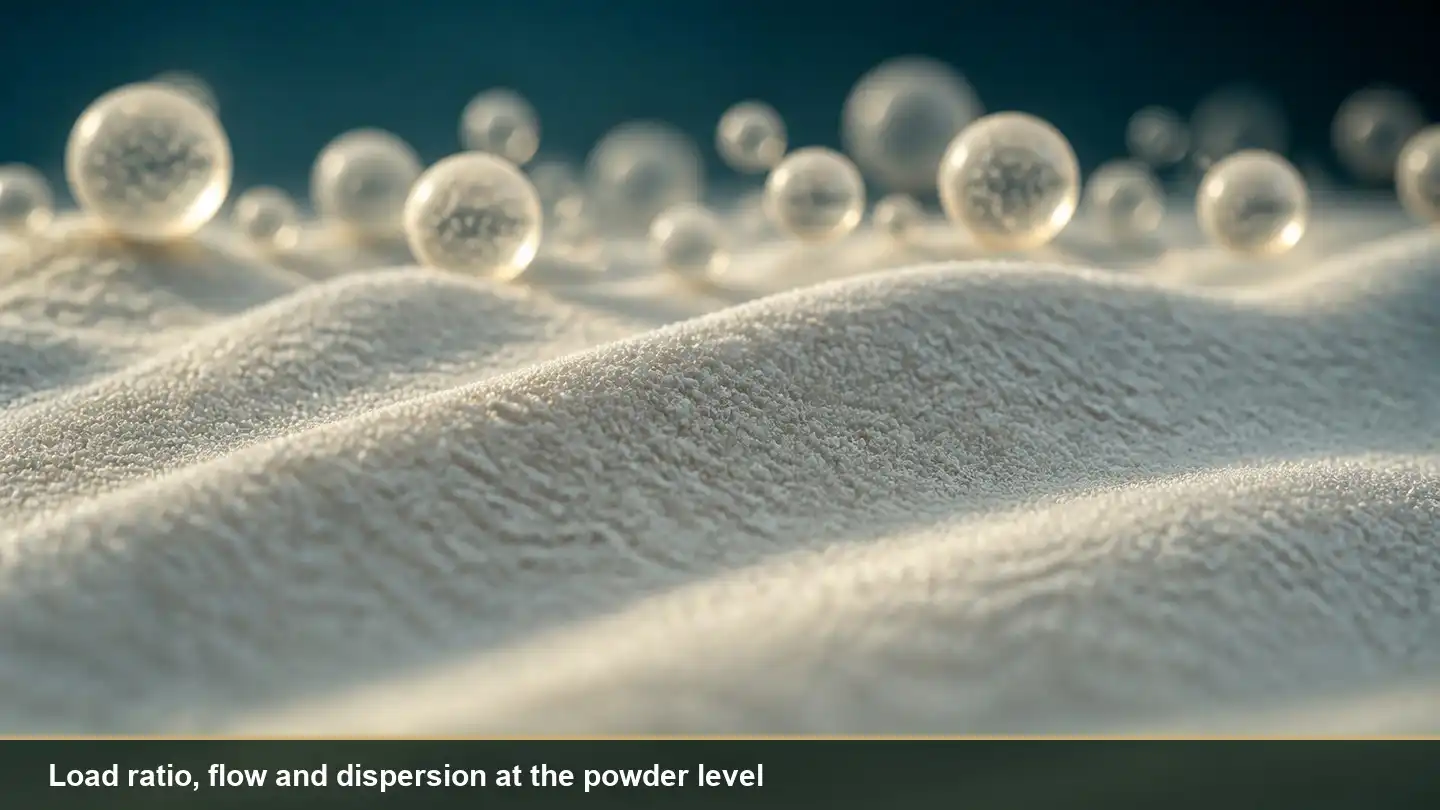
Powders take up moisture from the air, and the rate is governed less by the headline moisture figure than by water activity. As water activity rises, particles stick, flowability falls and caking begins; the same moisture accelerates chemical change, so an ingredient well inside specification on arrival can drift during a slow blend. Moisture, temperature and time interact in ways examined in this guide to improving liposomal NAD+ powder stability.
Plant humidity and open time
Dispensing and blending areas are best held at a controlled relative humidity, and the time a container stays open should be a written limit rather than a habit. Balance enclosures, sealed transfer and short open times protect both flow and potency.
After the pouch is opened
Once a multilayer foil pouch is open, its barrier is gone. Re-close promptly, exclude headspace where the equipment allows, and keep the remainder cool and dry. A desiccant in the secondary container and a stated open-material use window help the floor handle an opened pouch as a limited-life material.
Compatibility When NAD+ Is Blended With Other Actives
Multi-active formulas are where compatibility problems surface first, because co-ingredients and processing aids interact with the bilayer as well as with one another. Concentrated salts, surfactants and emulsifiers are the usual suspects, but the effect can also come from an apparently benign excipient that shifts the water activity of the blend. Compatibility cannot be reasoned from first principles; it has to be tested.
Designing the compatibility study
Start from binary blends of the liposomal powder with each candidate, then move to the full premix. Hold the test articles at accelerated conditions alongside a control of the powder alone, and include the intended primary package, because a pouch adequate for one blend may not suit another. The control is the only way to separate an incompatibility from ordinary change over time.
What to observe
Track appearance over time, then assay, particle-size distribution and dispersion behaviour at each pull point. A fall in assay beside a steady control points to an interaction; a shift in particle size, or a change in how the powder wets, points to a disturbed bilayer.
Shelf Life, Packaging and the Transit Window
The published shelf life is up to 24 months under correct storage, and that qualifier does real work. The variables that shorten it are heat, moisture, oxygen and light, and the primary package is the first line of control: a nitrogen-flushed, multilayer foil pouch limits headspace oxygen and blocks the moisture and light a single-layer film would pass. Development should confirm that the package and storage statement still hold after blending, not only for the neat powder; these factors are explored in this article on what affects the shelf life of liposomal NAD+ powder.
Colour and Appearance in Light-Coloured Systems
The material is specified as a pale yellow to white free-flowing powder. In an opaque capsule or a coloured drink that range is invisible; in a transparent capsule, a clear sachet or a pale beverage it is not, and a batch at the yellow end can read as a defect to a consumer. Teams should decide early whether the target system can absorb that range and, if not, address it through opaque packaging, an opacifier or a darker flavour base rather than tightening the specification beyond what the material supports. Checking appearance per lot at release, and again on the aged sample, turns a subjective worry into a tracked parameter.
Documentation and Release: What to Ask For at Development Stage
The paperwork that matters at development differs from the paperwork that matters at purchase. Ask early for the technical specification, so the chosen grade, appearance range and testing methods are fixed in writing; for a representative Certificate of Analysis, to see the release limits in the format you will receive; and for whatever compatibility and stability support data the supplier can share, since those results shorten your own study. Checking that a lot conforms, rather than trusting a certificate, is covered in this guide to evaluating the purity and quality of liposomal NAD+ powder before buying, and the release parameters are described in this note on what a liposomal NAD+ powder Certificate of Analysis should include. Where an independent method check is needed, this explainer on testing methods used to verify liposomal NAD+ powder quality sets out what each technique measures.
Challenge-to-Control Summary
The table below collects the recurring development problems, with their likely impact, a practical mitigation and the supporting data worth requesting before the first blend.
| Challenge | Impact | Mitigation | Data to request from the supplier |
|---|---|---|---|
| Low active loading | Large powder mass per unit; capsule or sachet constraints | Select a higher grade or change format; re-check fill weight | Potency range, particle-size distribution, bulk and tapped density, flow data |
| Clumping or poor dispersion | Uneven units, visible sediment, rejected batches | Use the dispersible grade; control shear, order of addition and hydration | Dispersibility report, DLS particle size, TEM morphology images |
| Moisture pickup and rising water activity | Caking, loss of flow, faster change in storage | Control room humidity, limit open time, add desiccant | Moisture and water-activity data, moisture-uptake support data |
| Blend incompatibility | Disturbed bilayer, assay loss, colour shift | Run binary and premix compatibility studies with a control | Compatibility and stability support data; excipient guidance |
| Packaging and storage | Potency loss during storage or transit | Nitrogen-flushed multilayer foil pouch; temperature and humidity control | Shelf-life statement, packaging specification, stability data |
| Colour variance | Visible tint in clear or pale systems | Mask with opaque packaging or a colour base; verify per lot | Appearance specification with colour range; batch appearance records |
| Release documentation gaps | Cannot verify a lot; downstream rework | Agree specification and Certificate of Analysis acceptance before ordering | Specification sheet, Certificate of Analysis, test methods |
Reference Specifications for Development Planning
The figures below are the published reference points for the material; the Certificate of Analysis for a specific lot remains the binding record.
| Parameter | Reference value |
|---|---|
| NAD+ content | 10%–70% (customizable); 50% recommended for premium formulas |
| Encapsulation efficiency | 85%–95% |
| Appearance | Pale yellow to white, free-flowing powder |
| Dispersion | High water dispersibility; forms a stable colloidal suspension (avoids the clumping typical of conventional NAD+) |
| Particle-size distribution | Uniform |
| Heavy metals (Pb) | <0.1 ppm |
| Total plate count | <1,000 cfu/g |
| Shelf life | Up to 24 months under correct storage |
| Testing methods | HPLC (content), DLS (particle size), TEM (morphology) |
| Certifications | cGMP, ISO 22000, ISO 9001, HALAL, KOSHER, Non-GMO, Vegan, Gluten-Free |
Requesting Samples and Documentation from EmerWell
EmerWell supplies liposomal NAD+ powder with the technical package development teams need to scale up: a written specification, lot-level Certificates of Analysis and the compatibility and stability support data behind them. To discuss a grade or request a sample, visit the liposomal NAD+ powder product page or write to info@emerwell-bio.com.
References
1. Akbarzadeh, A., Rezaei-Sadabady, R., Davaran, S., et al. (2013). Liposome: classification, preparation, and applications. Nanoscale Research Letters, 8, 102. https://pmc.ncbi.nlm.nih.gov/articles/PMC3599573/
2. Allen, T. M., & Cullis, P. R. (2013). Liposomal drug delivery systems: from concept to clinical applications. Advanced Drug Delivery Reviews, 65(1), 36–48. https://pubmed.ncbi.nlm.nih.gov/23036225/
3. U.S. Food and Drug Administration. Dietary Supplements. https://www.fda.gov/food/dietary-supplements
4. U.S. Food and Drug Administration. Q1A(R2) Stability Testing of New Drug Substances and Products. https://www.fda.gov/regulatory-information/search-fda-guidance-documents/q1ar2-stability-testing-new-drug-substances-and-products
This article is written for formulators and ingredient buyers. It describes the physical and processing behaviour of a raw material and does not provide medical advice or a recommendation for any finished product. EmerWell supplies ingredients to manufacturers, and claims made about finished products remain the responsibility of the brand that markets them.
Online Message
YOU MAY LIKE
High quality furniture manufacturer
_1776234307158.webp)
_1776234266736.webp)