

Nov 5, 2026
Liposomal Vitamin C Powder for Functional Beverages: Key Formulation Considerations
A functional beverage does not care how elegant a powder looks on a specification sheet. It cares whether the powder disperses in cold water without leaving a ring of sediment, whether the vesicles survive the fill line, and whether the ascorbic acid is still there after twelve months in a bottle. Formulating with liposomal vitamin C powder is therefore a problem of matching one aqueous colloidal system to another, and the constraints that decide the outcome are pH, heat, trace metals, sensory load and package atmosphere.
What a Beverage Demands from a Liposomal Powder
Four requirements dominate every brief. The powder must wet out and disperse in cold water without lumps, fish eyes or a separate phase. The dispersion must stay homogeneous for the shelf life of the pack, with no sediment, creaming or floc. The vesicles must survive whatever thermal process the format requires. And the ingredient must contribute neither a sharp acid note nor an off-colour at the intended load.
The dry state is forgiving and the wet state is not. Water activity in a sealed sachet is low enough that hydrolysis and oxidation run slowly, which is how a 24-month dry shelf life is reached. Drop the same powder into a beverage and both reactions are switched on at once, with oxygen, light and metal ions now able to reach the payload continuously. The stability question that matters is therefore the finished product's, not the ingredient's, which is also why powder and liquid liposomal formats behave so differently once water is present.
The pH Trade-Off: Acid Protects the Ascorbate, Not the Bilayer
Ascorbic acid has two relevant ionisation constants, near pH 4.2 and pH 11.6. Across the range a beverage actually occupies, the molecule shifts from the undissociated acid to the monoanion, and the monoanion is the species that reacts most readily with oxygen. Lowering pH therefore slows the chemistry of the payload. This is the reason acidic fruit bases have historically been kind to vitamin C and the reason a formulator's instinct is to push pH down.
The carrier does not share that preference. Below roughly pH 4, acid-catalysed hydrolysis of the phospholipid ester bonds accelerates, the phosphate group becomes protonated, surface charge is neutralised and van der Waals attraction starts to win. Vesicles fuse, and fusion means contents are no longer separated from the continuous phase. There is a second, less obvious leak: at low pH a larger fraction of the ascorbate inside the vesicle is undissociated, and undissociated acid crosses a bilayer far more readily than an anion does.
Move towards neutrality and the picture inverts. Hydrolysis pressure falls and the bilayer sits in its most comfortable band, but ascorbate oxidation accelerates sharply as the dianion fraction rises, and the degradation sequence that follows ends in yellow-brown pigments rather than a clean loss of assay. There is no pH that is simultaneously ideal for the payload and for the membrane. There is only a band where both penalties are tolerable, and the choice has to be made deliberately rather than inherited from the flavour system.
| Working pH | Ascorbate chemistry | Bilayer condition | Formulation consequence |
|---|---|---|---|
| 2.8–3.5 | Undissociated acid dominates; oxidative loss slow | Ester hydrolysis, charge neutralisation, fusion | Short hold times, cold chain, EE verified at release and at three months |
| 3.5–4.5 | Mixed speciation; moderate stability | Hydrolysis rising but manageable | Workable for citrus profiles if the thermal budget is tight |
| 4.5–6.0 | Oxidation accelerating with pH | Lowest hydrolysis and curvature stress | Preferred band, provided oxygen and metals are controlled |
| 6.0–7.5 | Rapid oxidation and non-enzymatic browning | Stable membrane, ionic and osmotic stress | Only with strict deoxygenation and short dating |
The practical resolution is to pick the band the product genuinely needs and buy the remaining margin elsewhere. For most drinks, pH 4.0 to 5.5 is the least-bad compromise, and the stability and permeability behaviour of liposomal vitamin C in that window is predictable enough to design around. A pH 3.2 citrus base is not forbidden, but it should come with shorter dating, a cold chain and a higher encapsulation efficiency at release, because the membrane is being spent from day one.
Heat: The Encapsulation Window Is a Time Budget
At process temperature the bilayer is fluid. Above its phase transition, curvature fluctuates, vesicles collide and fuse, and encapsulated material exchanges with the surrounding phase. Encapsulation efficiency therefore falls as a function of time at temperature, not simply as a function of the peak number on the chart. Two processes reaching the same peak for different hold times will not leave the same residue of intact vesicles. This is why the same powder can look robust in one filler and fragile in another.
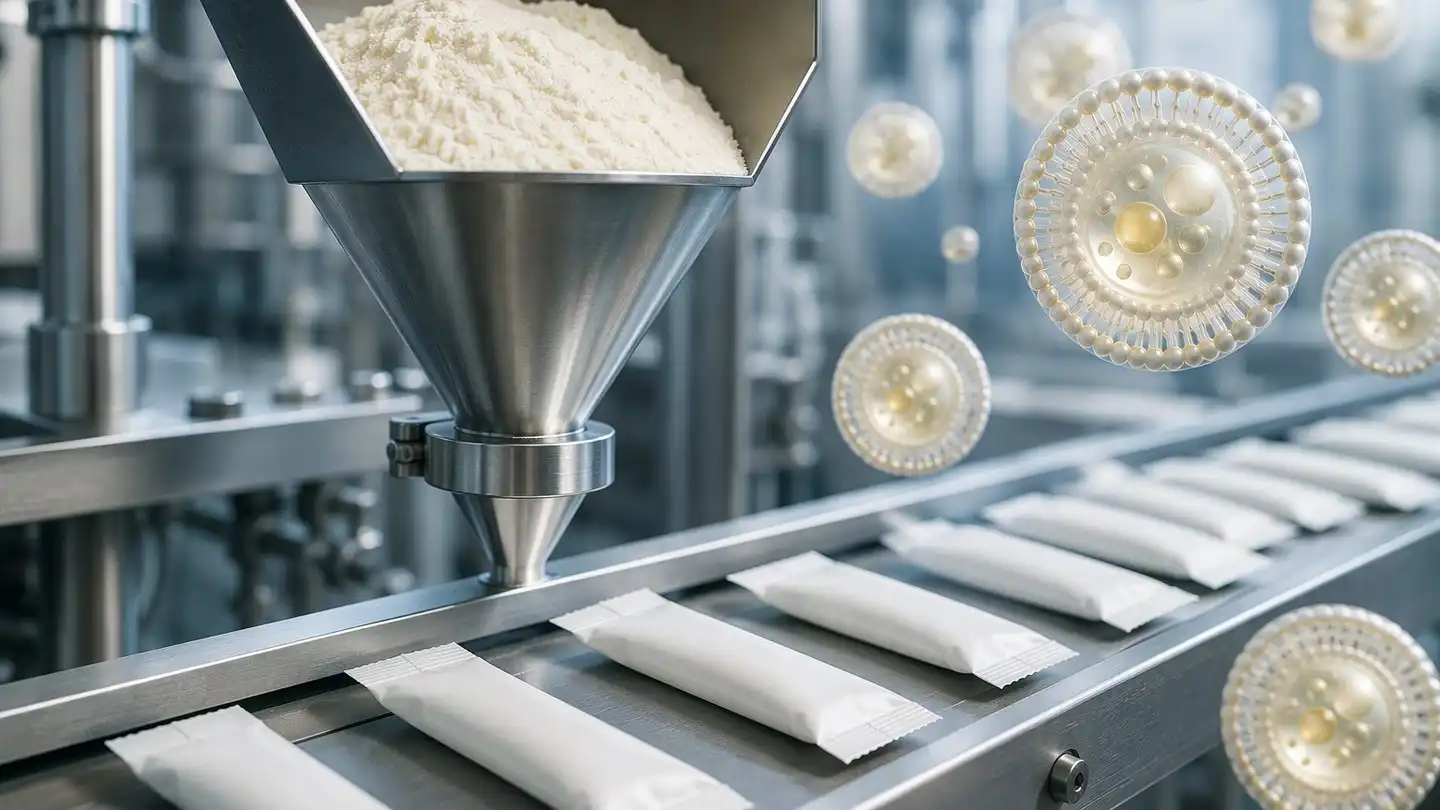
Batch pasteurisation at 63 °C for thirty minutes and HTST at 72 °C for fifteen seconds both cost efficiency, one through dwell time and the other through temperature; UHT at 135 to 150 °C is a far harder test, and direct steam infusion adds condensate that dilutes the base. Where the format allows it, pasteurise the base first, cool, then dose the liposomal dispersion aseptically downstream. That change moves the heat constraint onto the base, where it belongs.
When hot filling is unavoidable, spend the budget deliberately: pre-chill the feed, shorten the hold tube, and set the release limit for encapsulation efficiency to reflect what the process actually leaves behind. Verify before and after on the same lot. A certificate from the supplier describes powder that has never seen your filler, and the difference between dry and liquid processing routes is exactly the difference between a stable starting material and a stressed one.
Divalent Metals: ppm-Level Catalysts
Iron and copper cycle between oxidation states and catalyse ascorbate consumption, generating hydrogen peroxide and hydroxyl radicals as they go. The metal is not consumed, so a few hundred parts per billion can set the degradation rate for an entire batch. Sources are mundane: process water, juice concentrate, iron-oxide colourants, salt impurities, corroded fittings, wear from pumps and valves, and the lecithin itself.
The control strategy is a specification, not a sentence in a manual. Put iron and copper on the incoming water and concentrate testing plan. The specification discussed here sets lead below 0.5 ppm and total plate count below 1,000 cfu/g, but iron and copper are not always on a standard certificate of analysis, so ask, or test. Choose a permitted chelator where the label allows it, and avoid iron-based colours.
Metal-catalysed oxidation produces dehydroascorbic acid, which hydrolyses further to 2,3-diketogulonic acid, and that is the compound behind the yellow-brown drift formulators notice before any assay result arrives.
Sensory: Metallic Notes, Colour Drift and Sediment
Encapsulation changes the taste of the load. At an equal ascorbic acid content, a liposomal powder presents less of the sharp, clean sourness that free acid delivers, because the acid is inside the vesicle rather than in the saliva. What replaces it is the carrier: the powder is light yellow to off-white, and lecithin brings a fatty note that some palates read as beany. Oxidised ascorbate reads metallic, which is a warning rather than a flavour.
Sediment and floc are the failures that reach the consumer. Vesicles aggregate near the isoelectric point of a whey protein, in the presence of polyvalent cations, or against certain hydrocolloids at the wrong dose. Track turbidity, a centrifuge sediment volume and a CIELAB colour reading with a defined delta-E limit against a retained reference. The approach used to solve taste and stability issues in liposomal omega-3 powders transfers well, because the underlying problem is the same one: a phospholipid shell in an aqueous food.
Package Atmosphere Decides the Shelf Life
For a dry mix, moisture is the controlling variable. A foil laminate with a low water-vapour transmission rate, a desiccant where the format allows one, and a fill room held below its dew point will do more for the ingredient than any formulation trick. Once water activity climbs, hydrolysis restarts and caking follows. The storage conditions that preserve liposomal vitamin C powder are narrow, and they are worth writing into the purchase agreement rather than the warehouse notice.
For a ready-to-drink product, oxygen is the controlling variable. Measure dissolved oxygen at the filler and headspace oxygen after closure. Nitrogen sparging, deaeration and an oxygen scavenger all help, and a pack with a low oxygen transmission rate keeps the gain. Light drives a separate, photosensitised oxidation pathway, so amber or opaque packaging is functional, not decorative. The dry ingredient may carry a 24-month shelf life; the beverage inherits a shorter one, set from the factors that govern shelf life in the finished application.
Match the Format Before the Specification
Most formulation failures are format failures. A sachet, a pasteurised ready-to-drink bottle and a concentrated shot present three different sets of stresses, and a specification optimised for one looks mediocre in another. Format is the first decision, taken before load or particle size; the load itself, from 10% to 50%, sets how much powder sits in a serving and therefore the mouthfeel, buffering and sediment risk.
| Format | Continuous phase and water activity | Dominant risk | Design response |
|---|---|---|---|
| Ready-to-mix sachet or stick | Dry, low water activity | Segregation, caking, moisture pick-up after opening | Dry blend with free-flowing excipients, foil laminate, dose uniformity testing |
| Ready-to-drink, thermally processed | Aqueous, heat load at fill | Efficiency loss in process, oxidation over shelf life | Post-heat aseptic dosing, nitrogen, shorter dating supported by data |
| Concentrate or shot | Aqueous, low pH, high solids | Hydrolysis, preservative interaction, sediment | Cold chain or reformulation to a dry format, preservative challenge testing |
The same sequence governs how liposomal omega-3 powder is used in beverage formulation: fix the format, then the process, then the ingredient attributes. Working in the other order produces a technically impressive powder that cannot be filled.
Verify in the Matrix, Not in Water
Supplier data is the starting point, not the answer. An encapsulation efficiency of 85% to 95%, a particle size distribution by dynamic light scattering and a TEM image confirm that vesicles exist and that the process is controlled. None of them predicts what happens in a pH 3.8 base held at 72 °C for fifteen seconds with 40 ppm of dissolved oxygen. That has to be measured in your own matrix.
The verification set is short and repeatable: encapsulation efficiency and polydispersity after 24 hours in the finished base, then at each stability pull point; ascorbic acid by HPLC with an iodometric check on total reducing content; colour against a retained reference; turbidity and sediment; dissolved oxygen at the filler; and a trained sensory panel at the intended load. Run the same set on the particle size distribution the application actually produces, because a powder that disperses to 300 nm in water can arrive at 900 nm in a beverage. The quality tests used for liposomal vitamin C powder supply the vocabulary for that conversation.
Build the Brief Around the Constraints
EmerWell supplies liposomal vitamin C powder manufactured under cGMP, ISO 9001:2015 and ISO 22000, with Kosher and Halal certification and gluten-free, non-GMO, vegan-friendly and soy-free options. Typical loads are 10%, 20%, 25% and 50%, with encapsulation efficiency of 85% to 95%, lead below 0.5 ppm, total plate count below 1,000 cfu/g, and a light yellow to off-white appearance that disperses in cold water without separation.
For a beverage project, the useful first conversation is about your pH, your thermal process and your package, not about a catalogue number. Share those three inputs and we will return a specification, a certificate of analysis and a sample that matches the matrix you intend to fill. Write to info@emerwell-bio.com, or review the full liposomal vitamin C powder specification before the call.
References
- U.S. Food and Drug Administration. Current Good Manufacturing Practice in Manufacturing, Packaging, Labeling, or Holding Operations for Dietary Supplements, 21 CFR Part 111. ecfr.gov
- U.S. Food and Drug Administration. Dietary Supplements. fda.gov
- European Food Safety Authority. Nutrition and Health Claims. efsa.europa.eu
- U.S. Pharmacopeia. General Chapter <711> Dissolution. usp.org
This article is written for formulators, quality teams and ingredient buyers. It describes ingredient and process characteristics only and is not medical or nutritional advice, nor a recommendation for any finished product claim.
Online Message