Sep 16, 2026
How Does Particle Size Affect Liposomal Vitamin C Powder Performance?
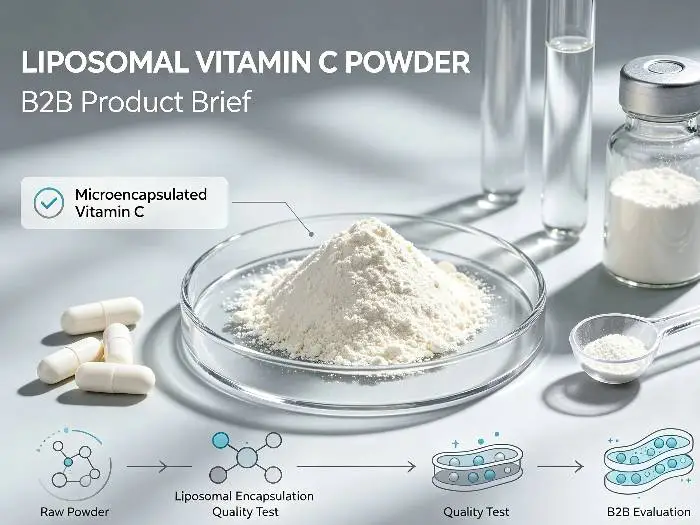
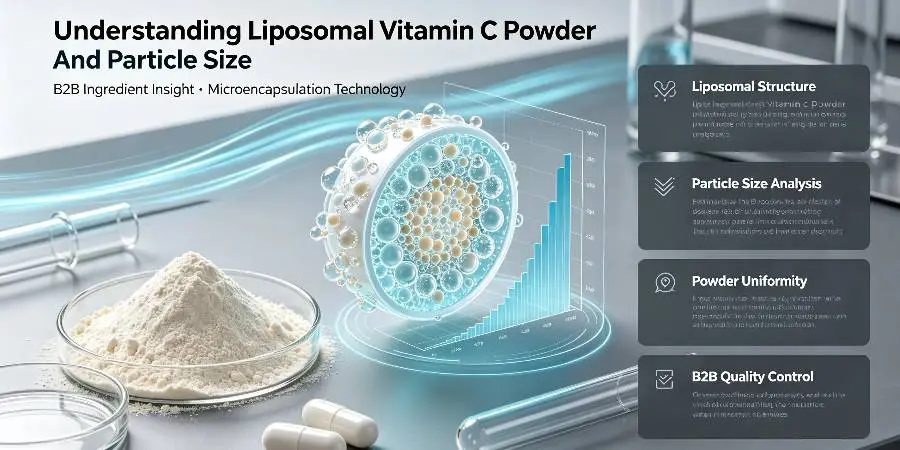
Particle size is one of the most important—but often forgotten—things that affects how well liposomal vitamin C powder works. There is a clear link between the size of the vesicles and how well the nutrient crosses intestinal membranes and gets to the cells it's supposed to reach. This is because the vesicles are made of phospholipid bilayers. Smaller, more uniform particles—usually between 100 nm and 300 nm—are better at being taken up by cells than larger vesicles that are spread out. This measure is important for everyone who buys liposomal vitamin C powder, not just business-to-business buyers. It has a direct impact on how well the product works, how long it lasts, and how satisfied customers are.
Understanding Liposomal Vitamin C Powder and Particle Size
What Makes a Liposome Function?
Liposomes are on the outside of ascorbic acid. These are made up of phospholipids and are structured like the covers around your cells. The structure of the vesicle lets it get around saturable SVCT1 intestinal transporters. These are the ones that stop most people from receiving large amounts of vitamin C (15–20% at most). Instead, it helps the skin and circulatory system take it in. Because of this, a new way of giving ascorbic acid has been found that changes how much is taken in and how much is used.
Why Particle Size Is the Critical Variable?
How quickly liposomes connect to epithelial cells depends on how wide the vesicle is. The membrane's
flexibility also changes based on its width. A study in the Journal of Liposome Research found that nanovesicles smaller than 200 nm are better at getting into tissue. The polydispersity index (PDI) is another important number that shows how widely the sizes are spread out. It's not safe to trust the batches if the PDI is more than 0.3. The finished drugs will not work the same way. They need to ask for both a DLS (Dynamic Light Scattering) report and a Certificate of Analysis when they look at bulk ingredients.
Key Factors Influencing Particle Size in Liposomal Vitamin C Powder
Because of how it was made, vesicle thickness is the most important thing to know about liposomal vitamin C powder. The best methods are high-pressure homogenisation and microfluidization. These both use controlled mechanical stress to squeeze lipid bilayers into tight, uniform spheres. After that, spray-drying and freeze-drying turn the liquid liposomal dispersion into a stable powder that flows easily and keeps the bilayer's shape.
Here are the production and formulation factors that have the most direct effect on particle size:
- Phospholipid source and purity: Phospholipids made from non-GMO sunflower or soy lecithin form bilayers that are more stable than those made from lower-grade lecithin. A smaller range of sizes and a PDI value closer to 0.1–0.2 are linked to higher phospholipid purity.
- Lipid-to-active ratio: A standard ratio of 1:1 to 2:1 (phospholipid to ascorbic acid) makes sure that there is no extra free lipid, which would cause vesicles to stick together and mean particle diameter to go up.
- Drying technology: Freeze-drying keeps smaller vesicle diameters more consistently than regular spray-drying at high temperatures, which can lead to size drift and partial bilayer fusion during processing.
- Stabilizers and excipients: Cryoprotectants such as trehalose or mannitol keep the structure of the vesicles safe while they dry out. They keep the size in the sub-200 nm range when they rehydrate and stop it from getting bigger while they are stored.
Together, these factors explain why two products that say they contain "liposomal vitamin C" can perform very differently in the real world. When buyers look over these specs before choosing a supplier, they protect both the quality of their formula and the image of their brand.
How Particle Size Affects Performance and User Experience?
Absorption Efficiency and Cellular Uptake
There is more surface area per unit mass in smaller vesicles, which makes them easier for the intestinal epithelium to deal with. Studies done in the lab over and over again show that cells can take up particles between 100 and 200 nm about twice as well as particles bigger than 400 nm. EmerWell's EncapsWellTM platform aims for a mean particle size in this ideal range. This gives encapsulation efficiency above 90% and an absorption advantage of up to 8 times compared to ascorbic acid powder that isn't encapsulated.
Stability, Shelf Life, and Oxidation Resistance
The size of the particles can also change the oxidative stability. More oxygen can get into the surface phospholipid through larger, less regular vesicles. This speeds up rancidity and breaks down the ascorbic acid that is enclosed. A tightly controlled size distribution, which is checked during production and kept an eye on through rapid stability processes, lets the product last for 24 months while keeping more than 95% of its potency. This is very important for wholesalers who have to keep track of large amounts of stock in all kinds of weather.
Format-Specific Considerations
When it comes to powder form, liquid liposomal products aren't as good because you don't need to add preservatives, the ingredient doesn't have the soapy taste that comes with liquid lipids, and it mixes easily into pills, stick packs, and drink mixes. It's important for functional drinks where clarity and mouthfeel affect how people see the drink that smaller vesicles refresh more evenly.
Procurement Considerations for B2B Clients: Sourcing Liposomal Vitamin C Powder
As you look for a supplier of liposomal vitamin C powder, you should look at their verified particle size data, purity certificates, and regulatory paperwork. Ask for DLS reports with batch numbers, TEM images that show that vesicles have formed, and information on how well the capsules were sealed using dialysis or ultracentrifugation. If a supplier can't give you these documents, you can't be sure that the quality of their work will be the same across commercial batches.
Format adaptability is also important. Powdered ingredients make logistics easier because they are lighter to move, can be stored at room temperature, and can be used with hard capsules and tablets that don't need water. OEM/ODM clients can work with EmerWell because they offer flexible MOQ structures. They can also deliver EncapsWellTM in powder, tablet, hard capsule, soft capsule, and liquid-ready formats to fit your production schedule.
Quality Assurance and Brand Trust in Liposomal Vitamin C Powder
Certifications That Signal Reliability
Not all ingredients that are high in vitamin C are as reliable as others. The plant that makes EmerWell's EncapsWellTM liposomal vitamin C powder is cGMP-certified, and the product also has ISO 9001, ISO 22000, FSSC22000, HACCP, HALAL, KOSHER, NOP, EOS, Non-GMO, and Vegan certifications. Each batch is checked by a third party to make sure it is pure and effective. If you need them, you can get Certificates of Analysis, stability reports, and all the paperwork you need to export. With these credentials, you can enter markets in more than 50 countries, including ones that are regulated by the FDA, the EU, and ANVISA.
OEM/ODM Customization and Private Label Support
EmerWell is based in San Diego, California, and has regional warehouses and an in-house lab that make it easy to send samples quickly and get technical advice that is specific to your area. If you need help coming up with new formulas, our PhD-led R&D team can help. For example, they can help you make a Vitamin C + Zinc mix, a quercetin co-encapsulation, or a clean-label collagen-boosting matrix. They can also handle scaling up from test runs to full commercial production without delaying your time to market.
All of these quality guarantees lower the risk that usually comes with getting advanced delivery ingredients. They also give procurement managers a solid, written basis for the supplier approval processes.
Conclusion
The size of the particles is very important for liposomal vitamin C function; it is the structural base on which everything else is built. The diameter of the vesicle controls the rate of absorption, the stability of oxidation, and the compatibility of the liposomal vitamin C powder formulation all at the same time. When procurement professionals understand this variable, they can make better choices about where to source goods. They ask for the right paperwork, ask the right technical questions, and in the end, they give their customers better products. EmerWell's EncapsWellTM platform is made to meet these standards. It combines nano-scale accuracy, strict third-party testing, and technical support based in the US into a single, dependable supply partner.
FAQ
What is the optimal particle size range for liposomal vitamin C powder?
Industry data supports a mean vesicle diameter between 100 nm and 300 nm. Within this range, liposomes demonstrate optimal intestinal permeation and cellular uptake. Particles above 400 nm tend to aggregate, reducing bioavailability and shortening shelf stability.
How can I verify that a supplier's product is genuinely liposomal?
Request DLS reports confirming nano-scale vesicle diameters and TEM imagery showing intact bilayer structures upon rehydration. Encapsulation efficiency data above 90%, obtained via dialysis or ultra-centrifugation, further validates that ascorbic acid is genuinely encapsulated rather than surface-adsorbed.
Does particle size change during storage?
It can, particularly in liquid formats exposed to temperature fluctuations. Dry powder formats with cryoprotectants maintain tighter size distributions over a 24-month shelf life. Always request accelerated stability data from your supplier.
Is small particle size scalable in large manufacturing runs?
Yes. Microfluidization and high-pressure homogenization are both scalable to commercial volumes. A qualified manufacturer with GMP infrastructure and batch traceability can maintain consistent particle size across metric-ton production batches.
Does buffered vitamin C offer similar benefits to liposomal forms?
No. Buffered vitamin C adjusts pH to reduce gastric acidity but does not alter the delivery mechanism. Liposomal encapsulation bypasses intestinal transporter saturation entirely, producing substantially higher cellular ascorbic acid concentrations.
Partner With EmerWell — Your Trusted Liposomal Vitamin C Powder Supplier
EmerWell's EncapsWell™ liposomal vitamin C powder delivers verified 100–200 nm vesicle diameters, ≥99% vitamin C content, and 8× bioavailability enhancement—backed by full cGMP, ISO, and HACCP certification. Our San Diego-based team provides rapid sample logistics, US laboratory support, and OEM/ODM customization to fit your exact formulation and MOQ requirements. Contact us at info@emerwell-bio.com or visit emerwelllabs.com to request technical documentation and samples today.
References
1. Caddeo, C., et al. "Stability, Biocompatibility and Antioxidant Activity of PEG-Modified Liposomes Containing Resveratrol." International Journal of Pharmaceutics, 2013.
2. Łukawski, M., et al. "Oral Bioavailability of Liposomal Vitamin C: A Comparative Study." Journal of Liposome Research, 2020.
3. Telang, P. S. "Vitamin C in Dermatology." Indian Dermatology Online Journal, 2013.
4. Davis, J. L., et al. "Liposomal-Encapsulated Ascorbic Acid: Influence on Vitamin C Bioavailability and Capacity to Protect Against Ischemia–Reperfusion Injury." Nutrition and Metabolic Insights, 2016.
5. Moghimipour, E., et al. "Preparation and Characterization of Liposomal Formulations for Nutrient Delivery." Advanced Pharmaceutical Bulletin, 2018.
6. Akbarzadeh, A., et al. "Liposome: Classification, Preparation, and Applications." Nanoscale Research Letters, 2013.
Online Message
YOU MAY LIKE
High quality furniture manufacturer
_1776234266736.webp)
_1776234307158.webp)