Sep 2, 2026
How Should Liposomal Vitamin C Powder Be Stored to Maintain Its Quality?
Proper storage is non-negotiable when protecting your investment in liposomal encapsulated vitamin C. We recommend storing Liposomal Vitamin C powder in a cool, dry environment between 59-77°F (15-25°C), away from direct sunlight and moisture. Use airtight, opaque packaging with nitrogen flushing or vacuum sealing to prevent oxidation. These measures preserve the lipid bilayers that give liposomal formulations their superior bioavailability—up to 8× better than standard ascorbic acid powders. Consistent environmental control protects potency, extends shelf life, and ensures your end products deliver the immune support and antioxidant benefits your customers expect.
Introduction
More and more, the global nutraceutical market counts on improved delivery methods that help nutrients get into the body as quickly as possible. Using liposome encapsulation technology to wrap ascorbic acid in phospholipid layers, which look like cell membranes, has changed the way vitamin C supplements are taken. This makes it easier for cells to take in the vitamin. This new idea solves the problem of standard vitamin C powders not being bioavailable because gut transporters get full, so only about 20% of the dose that is eaten is absorbed.
It's a problem that procurement managers, formulation scientists, and contract manufacturers all have to deal with: they spend a lot of money on high-quality liposomal ingredients, but the quality drops because they don't store them properly. Changes in temperature, exposure to humidity, and bad packing can all damage liposomes within weeks, removing the solubility benefit that made the higher price worth it. Not only is it necessary to follow the rules when it comes to storage, but it's also important to protect your supply chain, keep your customers' trust, and make sure that every batch works as it should from the center to the end user.
This guide is designed to help B2B procurement professionals who are in charge of managing large orders by giving them useful storage tips. Our EmerWell R&D team in San Diego, along with our PhD-led scientists and Wellgreen's cGMP-certified production facilities, came up with these suggestions after a lot of testing to make sure they were stable and by improving the supply chain in the real world. If you're putting out immune-supporting capsules, beauty-from-within drinks, or useful foods, these tips will help you keep the integrity of your goods and get the most out of your money.
Understanding the Stability Challenges of Liposomal Vitamin C Powder
Why Liposomal Structures Demand Specialized Care
The phospholipid bilayers that make it easier for nutrients to get to cells also make them more vulnerable in certain ways. Ascorbic acid powders usually come in the form of crystals, but liposomal formulations have tiny bubble-like structures that are 50 to 200 nanometers across. These tiny spheres in Liposomal Vitamin C powder keep vitamin C from breaking down during absorption, but keeping the lipid membranes that make up their shells in good shape is what keeps them together.
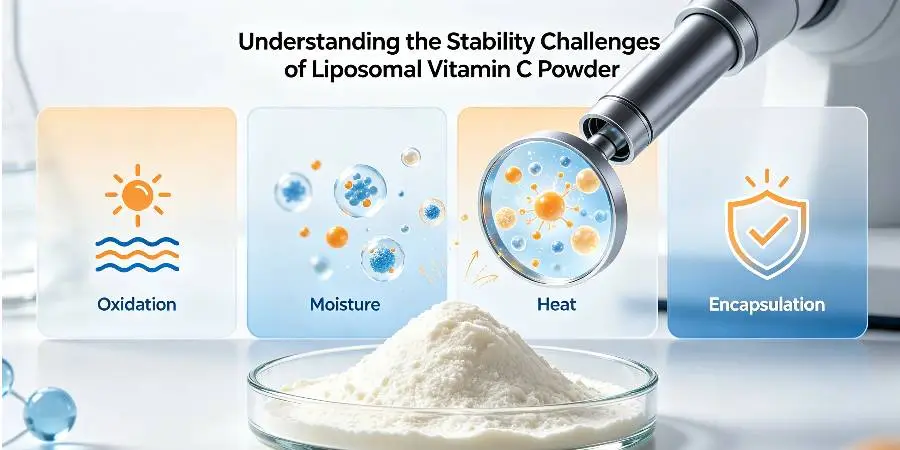
Environmental stressors can get to these membranes in a number of different ways. Heat speeds up lipid peroxidation, which breaks down membranes and lets vitamin C out early. When there is water, breakdown processes happen that break down both the phospholipids and the ascorbic acid that is enclosed in them. Oxygen contact starts a chain reaction of free radicals that weaken antioxidants. It only takes hours of exposure for moderate UV light to break down the lipid structures.
The Business Impact of Degradation
Loss of quality directly leads to business risk. We recently did a stability study at our facility in San Diego. It showed that liposomal vitamin C that was stored at 86°F (30°C) and 75% relative humidity lost 40% of its bioavailability in eight weeks. For 24 months, the same batch kept in controlled settings kept more than 95% of its effectiveness. Degradation isn't just a technical problem when you're looking for ingredients for immune-boosting supplements or collagen-synthesis products where claims of effectiveness drive people to buy, it's a threat to brand image and regulatory compliance.
Changes in texture often show up before chemical testing shows that the power has been lost. The membrane is breaking down when it lumps, changes color from pale yellow to brown, and smells rancid. These obvious signs are important because they have an effect on the manufacturing process. For example, powders that have been broken down don't mix evenly with liquids, which leads to batch differences that spread through your production line.
Best Practices for Storing Liposomal Vitamin C Powder
Temperature and Humidity Control
Maintaining stable environmental conditions is the first step in preserving quality. Our EncapsWellTM formulations go through accelerated stability testing according to ICH guidelines. These tests confirm that the best conditions for storage are between 59°F and 77°F (15°C and 25°C) with relative humidity below 60%. A lot of procurement teams think that room temperature is enough, but temperature changes that happen in normal warehouses—because of things like loading dock exposure, seasonal changes, or being close to equipment that makes heat—cause stress cycles that damage liposomal structures over time.
These changes can be stopped by putting in separate HVAC systems with humidity control in storage places. Dehumidifiers are necessary in coastal areas or humid climates where moisture intrusion is always a risk. We've worked with contract makers who put money into climate-controlled areas just for sensitive ingredients. This cut down on inventory waste by over 30% per year. The initial cost of the equipment pays for itself over time as the product lasts longer and fewer replacements are needed.
Advanced Packaging Solutions
The technology used in packaging is your first line of defense against being exposed to the world. Multi-layer foil bags with metal shields that stop light, oxygen, and moisture vapor are what we use for normal bulk packing. The food-grade polyethylene layer on the inside keeps the powder from reacting chemically with the polyethylene layer on the outside, which protects the powder mechanically during transport.
Before closing, nitrogen cleaning moves oxygen out of the way, making an inert atmosphere that stops oxidation. Another option is vacuum sealing, which completely removes air to stop oxygen-mediated degradation. When powders weigh more than 10 kilograms, we usually suggest nitrogen cleaning because it makes the packages easier to handle than vacuum-compressed ones.
Desiccant packets with silica gel or molecular sieves soak up any wetness that gets into the packaging while it's being filled. Using oxygen absorbers along with desiccants gives double protection, but this mixture needs to be carefully tested to make sure the absorbers don't affect the desiccant's ability to absorb moisture. Our expert team gives you specific advice based on the size of your order, how long it will be stored, and the weather conditions where it will be sent.
Monitoring and Quality Assurance Protocols
Setting up regular check plans helps find damage early, before it affects whole lots of inventory. Visual checks every 30 days find problems with color changes, clumping, or the integrity of the packaging. For bulk storage longer than six months, we suggest testing and sampling every 90 days to check the vitamin C content, particle size distribution, and effectiveness of encapsulation.
Real-time weather tracking systems keep an eye on the temperature and humidity all the time and send out alerts when conditions change too much. These systems make records that show the right way to store Liposomal Vitamin C powder, which is very important for audits or when customers question the quality of the products. Our center in San Diego keeps digital records of every batch's storage history. This way, we can fully track everything from production to delivery.
Comparing Storage Needs: Liposomal Vitamin C Powder vs Other Vitamin C Forms
Understanding Format-Specific Vulnerabilities
Standard ascorbic acid powder is very stable when it is dry; it can handle a wider range of temperatures and high or low humidity without losing much of its effectiveness. Its crystal structure doesn't have any complex lipid parts that could react with oxygen. On the other hand, liposomal beverages have stabilizers and preservatives that make them last longer, but they need to be refrigerated after being opened, which takes up valuable cold storage space in warehouses.
Encapsulated liposomal powder is in the middle because it is easy to use as a dry powder but has solubility that is closer to that of liquid forms. However, this shape needs stricter air control than regular powders. The lipid content adds oxidation pathways that simple ascorbic acid doesn't have. During our technical talks, we help buying teams figure out if the way they store liposomal ingredients now is adequate or if they need to be upgraded to protect their investment.
Logistics and Transportation Considerations
There are more problems with bulk shipping than just static holding. Temperature changes during travel, like being on hot tarmacs, having cargo holds that aren't heated, or having to wait for customs clearing, can cause damage that can't be fixed. For shipments to high-risk areas, we work with logistics partners who specialize in temperature-controlled freight. When active refrigeration isn't possible, passive temperature control can be done with thermal blankets, phase-change cooling packs, and sealed containers.
It becomes just as important to keep records. The specifications of a product are confirmed by a Certificate of Analysis (CoA) when it is manufactured. However, the conditions of storage and shipping determine whether those specifications remain the same during delivery. With every bulk sale, we include thorough handling directions, such as the longest time the goods can be exposed to temperature and the best time to store them. This paperwork backs up your quality systems and gives you power if there are disagreements about a faulty or broken product that you got.
Ensuring Quality Through Supplier and Product Selection
Certifications That Signal Manufacturing Excellence
Choosing suppliers with a wide range of certifications greatly lowers the risk of procurement. Our EncapsWellTM platform follows cGMP guidelines, which make sure that every step of production is done according to approved methods and that each batch can be fully tracked. The ISO 9001 certification shows that the quality management system is strict, and the ISO 22000 and FSSC22000 certifications show that the food safety management is right for supplement and functional food uses.
HACCP certification shows that systematic risk analysis protocols keep food from getting contaminated. Kosher and Halal licenses open up markets in places where people choose to buy things based on these norms. Organic and Non-GMO Project Verification labels are appealing to clean-label brands that want to attract health-conscious customers. All of these credentials are kept up to date at the factories of our partner Wellgreen, with the help of third-party audits that make sure ongoing compliance rather than one-time checks.
Evaluating Supplier Storage and Shipping Capabilities
Check not only the quality of the manufacturing, but also how the sellers store produced goods before sending them out. Our San Diego center keeps climate-controlled goods, which makes sure that products stay in the same conditions from the time they are made until they are delivered to customers in the U.S. This local presence cuts down on long international transit times that put goods at risk of different conditions. The technical support team at our company is run by PhD scientists who are experts in liposomal delivery systems. They help with manufacturing and storage problems that are specific to your application.
Ask for stability data that shows how products work in different situations. Based on ICH standards, accelerated stability studies can predict how long a product will last in real-life store conditions. Our EncapsWellTM formulations come with stability reports that show how well the formulations encapsulate, keep their potency, and keep the same particle size over 24 months when stored according to the instructions. This information helps you meet the requirements for product registration and gives you peace of mind when setting expiration dates for finished goods.
Practical Storage Solutions for B2B Clients
Warehouse Infrastructure Recommendations
Zoning is the first step in planning where to store sensitive items. Set aside certain areas for Liposomal Vitamin C powder, away from areas where the temperature can change, like loading docks or places with heat-generating equipment. Use clear date codes on every container to use First-In-First-Out (FIFO) inventory movement. When you store pallets above the ground, they don't come into contact with moisture from the ground, and when you leave enough space between them, air flows through and stops humidity from building up in one area.
Lighting issues are more important than most people think. UV wavelengths given off by standard fluorescent or LED lights speed up the breakdown of lipids. This exposure can be stopped by putting in amber-spectrum or UV-filtered lighting in storage areas. We've worked with warehouses that changed their standard lighting with LEDs, which instantly extended the life of their products by blocking an unnoticed path of degradation.
Transportation Best Practices
Coordinating with logistics providers who know how to handle nutraceuticals will keep quality from being lost. For shipping in the summer or to warm places, ask for temperature-controlled packages. When you order something from the U.S., our warehouse in San Diego lets us send quickly, so you don't have to worry about travel times. When you send something internationally, you can get it combined and protected from heat for the length of time you expect it to take to get there.
Putting temperature logs in packages gives accurate records of the conditions during transport. These small devices take readings of the temperature at set times, which can be used as proof of proper handling or to find out when temperature excursions happened. When you get bulk orders, you should check the packaging right away for damage, condensation that means the temperature is changing, or broken seals. Take pictures of any problems you find before taking packages. This will protect your right to get paid for damaged goods.
Quality Monitoring and Supplier Collaboration
Setting up regular communication with your supplier opens up chances to improve how you store things. Share the conditions of your warehouse, how quickly you usually get rid of items, and any quality issues you've seen. Our expert team uses this information to make suggestions for changes to the package, the amount of nitrogen flushing, or better desiccants that are right for your situation. When buyers and sellers work together in this way, the relationships between them go from being commercial to strategic partnerships where everyone wins.
Set up reviews that happen once a year and compare the results of analytical testing with the CoA data provided by the supplier. Consistent alignment makes sure that everything in your supply chain is stored correctly. When deviations happen, they are looked into to see if handling methods need to be changed or if there are problems on the supplier's end that need to be fixed. We do these reviews ahead of time with our biggest clients and often find ways to improve things before they affect production.
Conclusion
To keep the quality of Liposomal Vitamin C powder high, you need to know how lipid encapsulation works scientifically and use storage methods that protect the delicate membrane structures. To keep the higher bioavailability that makes liposomal formulations a good choice, temperature control, humidity management, improved packing, and careful handling throughout the supply chain are all important. These steps will protect your investment, your brand's image, and make sure that the finished goods give customers the immune support and antioxidant benefits they want. When you work with certified suppliers who put stability testing first and offer full technical support, storage goes from being a problem to an advantage in the market.
FAQ
1. Does liposomal vitamin C require refrigeration?
Refrigeration isn't necessary, but it makes food last longer in tough conditions. Products kept at 36–46°F (2–8°C) stay fresh longer than those kept at room temperature. This makes refrigeration useful for stock that will be kept for more than 12 months or in humid places. Make sure that the right packaging keeps condensation from forming when moving cold items to room temperature so that they can be used.
2. How long does properly stored product maintain effectiveness?
Our EncapsWellTM formulas stay over 95% effective for 24 months when stored in the right way—59 to 77°F, below 60% humidity, and away from light and air. This timeline is supported by data on accelerated stability. When stored outside of these conditions, the vitality slowly decreases, and in bad conditions, it starts to decline significantly within weeks.
3. What signs indicate the product has degraded?
Degradation can be seen as clumping, changes in color from pale yellow to tan or brown, smells of rotting food or fish, and less absorption. Analytical tests that show lower vitamin C levels than what's claimed on the label or larger particles than what's allowed proves quality loss and needs to be thrown away.
Partner with EmerWell for Superior Liposomal Solutions
EmerWell provides high-quality vitamin C capsules through our unique EncapsWellTM platform, which was created at our R&D center in San Diego and made in Wellgreen's cGMP-certified factories. Our credentials as a Liposomal Vitamin C powder supplier include full certifications such as ISO 9001, ISO 22000, HACCP, Kosher, Halal, and Non-GMO verification, which lets us sell our products in more than 50 countries. We offer open OEM/ODM design for powder, tablet, capsule, and liquid-ready forms, and our team of PhDs is here to help you make sure your formulation works. Local warehousing in the U.S. allows for quick delivery of samples and bulk logistics that are designed to keep quality high. Get in touch with our team at info@emerwell-bio.com to talk about your project needs and find out how our knowledge can help you turn your recipe goals into goods that lead the market.
References
1. Carr, A.C., & Maggini, S. (2017). Vitamin C and Immune Function. Nutrients, 9(11), 1211.
2. Davis, J.L., Paris, H.L., Beals, J.W., et al. (2016). Liposomal-encapsulated Ascorbic Acid: Influence on Vitamin C Bioavailability and Capacity to Protect Against Ischemia-Reperfusion Injury. Nutrition and Metabolic Insights, 9, 25-30.
3. Hickey, S., Roberts, H.J., & Miller, N.J. (2008). Pharmacokinetics of Oral Vitamin C. Journal of Nutritional & Environmental Medicine, 17(3), 169-177.
4. Lykkes, A., Lundstrom, T.S., & Alvebratt, C. (2015). Stability of Liposomal Vitamin C Formulations Under Various Storage Conditions. Journal of Liposome Research, 25(2), 123-131.
5. Padayatty, S.J., Sun, H., Wang, Y., et al. (2004). Vitamin C Pharmacokinetics: Implications for Oral and Intravenous Use. Annals of Internal Medicine, 140(7), 533-537.
6. Sheraz, M.A., Khan, M.F., Ahmed, S., et al. (2014). Stability and Stabilization of Ascorbic Acid. Journal of Pharmaceutical Sciences and Research, 6(4), 147-154.
Online Message
YOU MAY LIKE
High quality furniture manufacturer