Oct 8, 2026
Liposomal Vitamin C Powder for Beauty Supplements: Product Development Considerations
Ingestible beauty is one of the fastest-moving segments in the supplement aisle, and formulation teams evaluating liposomal vitamin C powder for it usually work through the same shortlist of questions: which format will carry the ingredient, how the powder behaves in cold water, whether the finished mix stays uniform through the fill, and what documentation a buyer can place in a supplier-qualification file. This article stays on the development side of that work — how a formulator assesses a liposomal raw material, not what a finished product does. The base specifications for the ingredient discussed here are on the liposomal vitamin C powder product page.
Why Formulators Revisit Vitamin C for Ingestible Beauty Products
Ascorbic acid is one of the best-characterised water-soluble vitamins, which makes it a familiar starting point for a dry blend. The practical appeal of a liposomal vitamin C powder is that it arrives as a free-flowing dry input rather than a liquid, so moisture control in capsules, gummies, tablets and stick packs stays simpler and there is no water activity to manage inside the base powder itself. A liposomal format also gives the formulator a defined physical structure to work with: the active is carried inside a phospholipid bilayer rather than simply blended with a carrier. That distinction matters when a brand wants to describe an ingredient in technical terms on a specification sheet. For a broad orientation on how the ingredient is positioned as a raw material, see this overview of liposomal vitamin C powder.
Format Selection: Capsules, Gummies, Stick Packs, and Ready-to-Mix
Matching the format to the powder
The chosen format usually decides which physical properties of the powder become critical. A dry-filled capsule cares about bulk density and flow; a gummy cares about how the powder disperses into a warm, high-water-activity base; a stick pack cares about instant rehydration in a small volume of cold water. The table below summarises the usual pressure points and the evidence worth requesting from a supplier.
| Format | Typical pressure point | What to request from the supplier |
|---|---|---|
| Hard-shell capsule | Dry fill, so bulk density and flow affect fill-weight consistency | Particle size distribution and flow behaviour of the lot |
| Gummy | Warm, high-water-activity base can stress the bilayer; the powder must disperse cleanly | Dispersibility data and a suggested processing window |
| Stick pack / sachet | Rehydration in a small volume of cold water in a single serving | Cold-water dispersion and no-separation evidence |
| Ready-to-mix drink | Must stay suspended after reconstitution and not layer or settle out | Suspension behaviour and lot-to-lot colour consistency data |
| Tablet / effervescent | Compression and acid-base chemistry interact with the powder matrix | Compatibility notes for the intended excipient system |
It is worth comparing a powder route with a liquid liposomal input before a format is locked; the trade-offs between the two are covered in this note on liposomal vitamin C powder versus liquid.
Colour and Appearance Consistency in Transparent and Light Systems
Batch-to-batch colour control
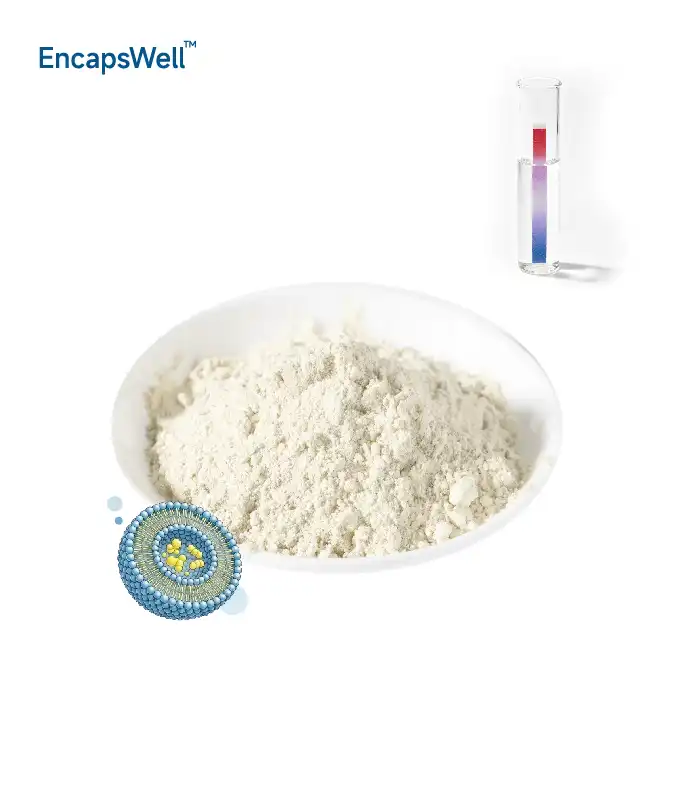
Colour is where a liposomal powder can surprise a clear or light-coloured system. The material is supplied as a light yellow to off-white free-flowing fine powder, and in an opaque capsule or a dark drink that range is invisible. In a clear stick pack, a lightly tinted jelly, or a pale ready-to-mix base, however, a yellow cast or a hint of speckling is on display. The formulator's job is to fix a colour expectation for the base and confirm that the lots received sit inside it, ideally against a documented reference sample. Consistency across lots matters more than the exact shade, because a shifting base colour forces rework in the flavour and appearance system downstream. Practical background on how liposomal ingredients actually look in finished formats is in this note on the appearance of liposomal products.
Cold-Water Dispersion and the No-Separation Requirement
Rehydration in a small volume
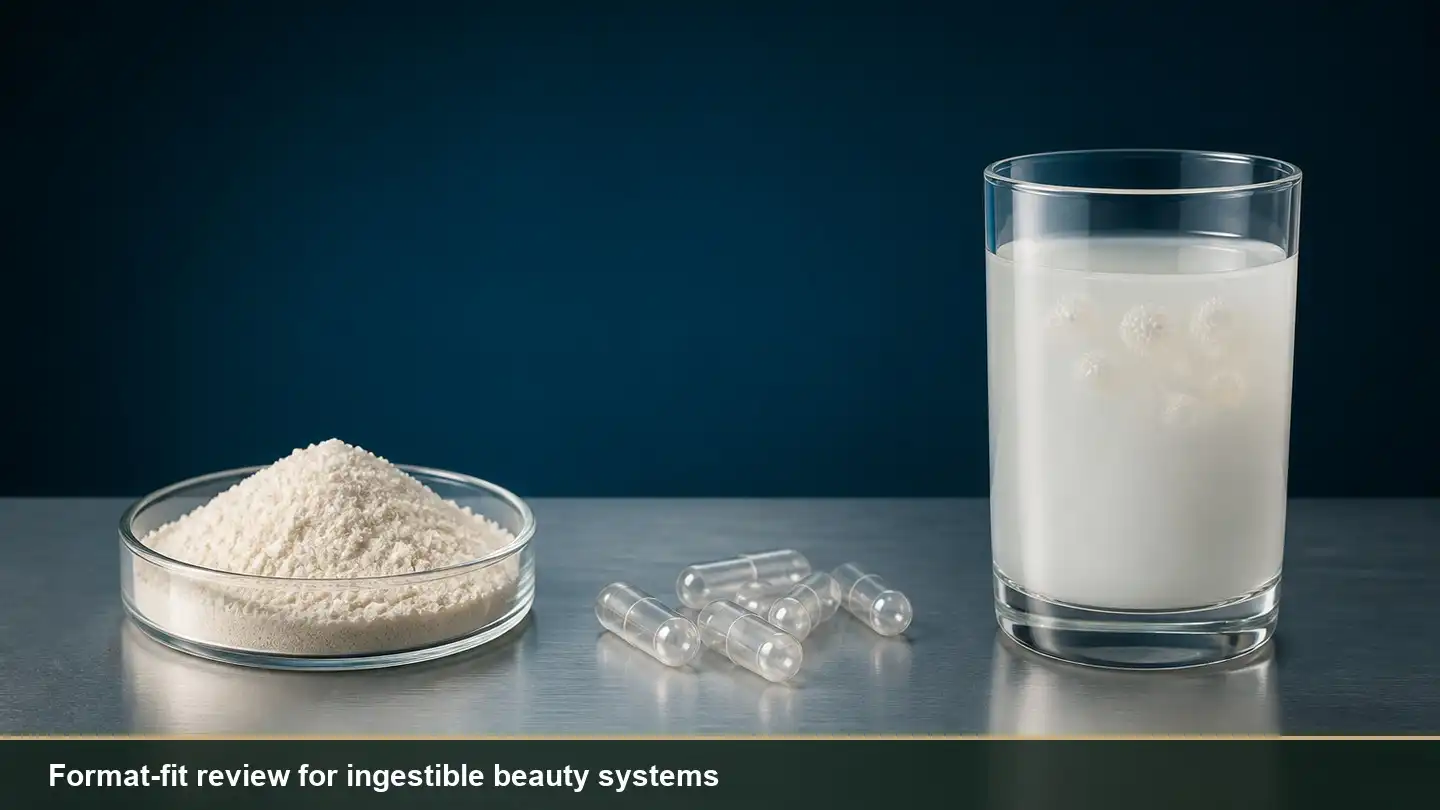
Ready-to-mix and stick-pack products are unforgiving about dispersion. The consumer adds the sachet to a small volume of cold water and expects a uniform drink, so the powder has to wet out quickly and stay suspended rather than settle into a ring at the bottom of the glass. A liposomal vitamin C powder intended for this use disperses instantly in cold water with no separation, which is the behaviour to specify and to test in the intended base rather than in water alone. Particle size, surface properties and the surrounding excipient matrix all influence how cleanly the powder rehydrates. The variables that drive this behaviour are discussed in this guide to the solubility of liposomal vitamin C powder.
Encapsulation Efficiency and Particle Size as Design Inputs
Why encapsulation efficiency changes the use level
Encapsulation efficiency describes how much of the vitamin C present sits inside the vesicles rather than outside them, and for a formulator it is a design number rather than a slogan. A higher efficiency means a greater share of the material is in the form the recipe was built around, which in turn affects how much powder is weighed into a batch to reach the intended label amount. Particle size distribution matters for the same reason: a tight, uniform distribution supports repeatable mixing and predictable dispersion, while a broad one invites segregation in a dry blend. Both are measurable properties that can be written into a specification. Particle size is covered in more detail in this article on how particle size affects liposomal vitamin C powder performance.
| Parameter | Typical value for this ingredient |
|---|---|
| Appearance | Light yellow to off-white, free-flowing fine powder |
| Available concentrations | 10% / 20% / 25% / 50% |
| Encapsulation efficiency | 85–95% |
| Dispersibility | Cold-water instant dispersion, no separation, suited to ready-to-mix |
| Particle size | Uniform distribution |
| Heavy metals (lead) | Below 0.5 ppm |
| Total plate count | Below 1,000 cfu/g |
| Analytical methods | HPLC, DLS, TEM, iodometric titration |
| Stability | Improved versus non-encapsulated vitamin C; resists light and heat with a lower degradation rate over shelf life |
| Clean-label options | Gluten-free, non-GMO, vegan-friendly, soy-free |
| Certifications | cGMP, ISO 9001:2015, ISO 22000, Kosher, Halal |
Acidity, Flavour Systems, and Sensory Compatibility
Ascorbic acid brings an inherent tart, acidic note, and in an ingestible beauty product that note is either harnessed or masked depending on the format. In a capsule or tablet the taste question is largely moot; in a gummy, stick pack or ready-to-mix drink it sits at the front of the experience, so the flavour system has to be chosen with the acidity in mind rather than added afterwards. Sweetener and acidulant levels, the choice of fruit or botanical notes, and the buffering capacity of the rest of the blend all interact with the vitamin C load. The sensible sequence is to fix the flavour architecture alongside the use level, then run a sensory check on the finished base, because a system that tastes balanced at a low inclusion can turn sharp once the amount is raised.
Light and Heat Stability: Degradation Rate as a Formulation Variable
Storage and packaging inputs
Vitamin C is sensitive to light, heat and oxygen, and part of the reason to choose a liposomal powder is that the bilayer shields the active from those stresses far more effectively than an unprotected powder. Compared with non-encapsulated vitamin C, the encapsulated material resists light and heat better and shows a lower degradation rate across the shelf life. That advantage is a property of the ingredient as supplied, but it still depends on how the finished product is handled: an opaque primary pack, a moisture barrier, and sensible storage conditions protect the work the encapsulation did. Shelf-life planning should therefore build the primary pack in as a formulation decision made early rather than a detail settled at the end of development. Two useful references are this piece on the shelf life of liposomal vitamin C powder and this comparison of dry and liquid manufacturing routes.
Clean-Label Labelling and Allergen Source Decisions
Clean-label positioning is often the deciding factor at the premium end of the ingestible beauty shelf, and it is easier to protect when it is designed in from the start. The ingredient can be offered with gluten-free, non-GMO, vegan-friendly and soy-free options, so a brand can align the declaration with its own label standard rather than reformulating around a mismatch. The allergen question deserves early attention: where a phospholipid source is soy-derived, the finished product may carry a soy declaration, while a sunflower-derived source avoids it. Asking about the phospholipid source and the corresponding labelling consequence at the specification stage is far simpler than changing a claim after artwork is signed off. The wider picture is set out in this guide to the certifications to look for when buying liposomal vitamin C powder.
Stability Data and Technical Files for Supplier Qualification
Most of the questions above are answered with documents rather than adjectives. A practical qualification pack for a liposomal vitamin C powder pairs a specification sheet and a batch certificate of analysis with the analytical results behind the key numbers, so that the buyer can see how content, particle size, morphology and oxidative status were established. The table below maps the common methods to what they show.
| Method | What it characterises | Why a formulator asks for it |
|---|---|---|
| HPLC | Vitamin C content and assay | Confirms the active load used to set the label and the use level |
| DLS | Particle size distribution | Indicates vesicle homogeneity and batch-to-batch consistency |
| TEM | Vesicle morphology | Confirms intact spherical structures rather than a simple blend |
| Iodometric titration | Oxidative status / peroxide value | Tracks oxidative degradation relevant to shelf life |
Beyond the certificate, the supplier's manufacturing context is part of the assessment. EmerWell holds cGMP, ISO 9001:2015, ISO 22000, Kosher and Halal listings for this ingredient and can support a qualification file with the stability and test documentation a brand needs. The tests themselves are described in this article on quality testing for liposomal vitamin C powder, and the production side is covered in this overview of manufacturing standards for quality liposomal vitamin C powder.
A Buyer's Checklist for Liposomal Vitamin C Powder
- Confirm the format the powder must serve and the physical properties that format stresses.
- Fix an appearance range and a reference sample for the lots you will receive.
- Test dispersion in the intended finished base, not only in water.
- Ask for encapsulation efficiency and particle size distribution on the specification sheet.
- Build the flavour system around the acidity of the use level.
- Plan the primary pack as a stability input, not a packaging afterthought.
- Resolve the phospholipid source and its allergen labelling consequence early.
- Collect the specification, certificate of analysis, analytical results and stability data for the qualification file.
Working With EmerWell on Liposomal Vitamin C Powder
If you are scoping an ingestible beauty product and want to work through the points above against a real specification, EmerWell can help. Request the specification sheet, a batch certificate of analysis and a sample from the liposomal vitamin C powder product page, and the technical team can discuss dispersion, format compatibility and documentation for your qualification file. Tell us the format and the base you have in mind, and we will respond with the material information that fits it. Email info@emerwell-bio.com to start the conversation.
References
1. U.S. Electronic Code of Federal Regulations, Title 21, Part 111 — Current Good Manufacturing Practice in Manufacturing, Packaging, Labeling, or Holding Operations for Dietary Supplements. https://www.ecfr.gov/current/title-21/chapter-I/subchapter-B/part-111
2. International Council for Harmonisation (ICH), Quality Guidelines, including Q1A(R2) Stability Testing. https://www.ich.org/page/quality-guidelines
3. Study on the decomposition kinetics of vitamin C powder (PubMed record). https://pubmed.ncbi.nlm.nih.gov/2085134/
Disclaimer: EmerWell supplies liposomal ingredients as raw materials for supplement and food manufacturers. This article is a business-to-business formulation discussion and is not medical, nutritional or label advice, nor does it describe the effects of any finished product. Claims, labelling and regulatory compliance for a finished product are the responsibility of the brand and must be confirmed against the requirements of each destination market.
Online Message
YOU MAY LIKE
High quality furniture manufacturer