Sep 1, 2026
What Certifications Should You Look for When Buying Liposomal Vitamin C Powder?
When sourcing high-quality liposomal vitamin C powder for your formulations, certifications aren't just paperwork—they're your assurance of safety, efficacy, and market access. The right certifications verify that the product meets stringent quality standards, including vitamin C content ≥99%, optimal encapsulation efficiency, and proven bioavailability improvements of up to 8× compared to standard powders. Look for cGMP, ISO 9001/22000, HACCP, Non-GMO, Vegan, Halal, and Kosher certifications to ensure regulatory compliance and build consumer trust across diverse markets.
Introduction
The world of nutraceuticals has seen a huge increase in liposomal delivery technologies, especially when it comes to vitamin C supplements. More and more, procurement workers are under pressure to find products that are both highly bioavailable and meet the highest quality standards. Liposomal Vitamin C powder has become a game-changing ingredient for companies making drinks that boost your immune system, drinks that make you look younger, and functional health products.
Certifications are an important part of B2B buying decisions. They make sure that the way your products are made, the ingredients are pure, and the products are always the same. These are all things that have a direct effect on your brand's image and its standing with regulators. If you're making dietary supplements, functional drinks, or nutricosmetics, knowing which certifications are the most important can help you find suppliers more quickly and avoid costly compliance problems in your supply chain.
This thorough guide explains the important certifications for Liposomal Vitamin C powder, what they mean for the performance of the product, and gives you useful tips for checking the credibility of the seller. Having a buying plan that is aware of certifications isn't just about meeting the bare minimum; it's about getting a leg up on the competition in markets that are becoming more regulated.
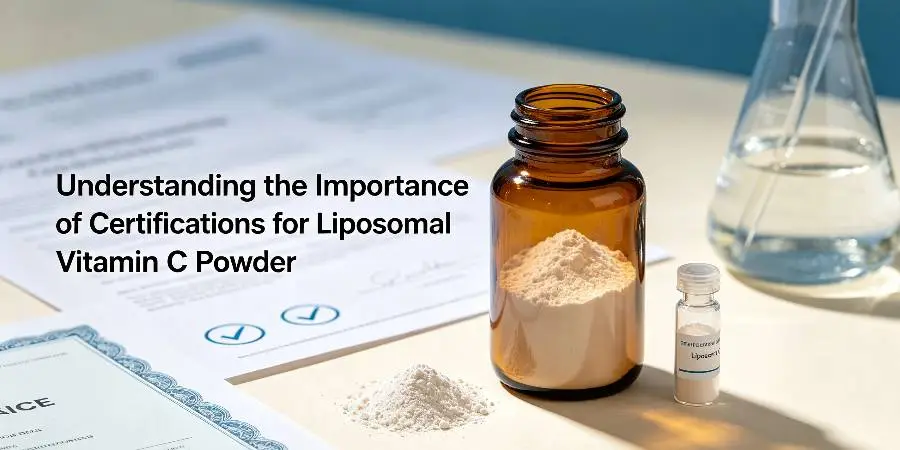
Understanding the Importance of Certifications for Liposomal Vitamin C Powder
When you buy large ingredients, certifications are the quality backbone. When you buy Liposomal Vitamin C powder, you're not just getting ascorbic acid; you're also buying a high-tech delivery method where the phospholipid coating has to meet exact standards. Certifications show that this complicated production process works the same way every time.
Working with suppliers who aren't certified comes with risks that go beyond just quality issues. Not following the rules can lead to product returns, delays at customs, and legal trouble if end users have bad experiences. In the supplement industry, which is very competitive, one bad quality event can ruin brand equity that has been built up over years of marketing. Certifications lower these risks by making sure that sellers follow written steps for testing raw materials, keeping the surroundings safe, and stopping contamination.
When it comes to business-to-business, licenses make it easier to negotiate and keep partnerships stable. Certified suppliers show that their businesses are mature and dedicated to always getting better, which leads to reliable delivery times and quick technical support. If the people working on your product need stability data or help with special formulations, authorized partners have the tools and ways of documenting things that make collaborative innovation possible. Certification programs build trust between businesses by being open and honest. This turns relationships with vendors from one-time deals into long-term partnerships that can grow with your business as your products do.
Key Certifications to Look for When Buying Liposomal Vitamin C Powder
cGMP Certification: The Foundation of Manufacturing Excellence
Current Good Manufacturing Practice (cGMP) certification is the highest level of quality for making supplements. This approval makes sure that factories have the right environmental controls, equipment testing procedures, and training programs for their workers so that the quality of their products is always the same. Our EncapsWellTM Liposomal Vitamin C powder is made in Wellgreen's cGMP-certified factories, where every batch goes through documented quality checks from the time the raw materials are received until the product is packed. cGMP compliance makes sure that everything can be tracked. If you ever need to look into a quality issue, you can find full batch records that show which raw materials were used, how the equipment was set up, and the results of quality control tests.
ISO Standards: International Quality and Safety Management
A supplier's ISO 9001 certification shows that they are dedicated to quality management systems, and ISO 22000 certification is all about managing food safety. When you're serving global markets or looking to expand abroad, these standards that are known all over the world are especially helpful. Products made following ISO 22000 guidelines use HACCP principles (Hazard Analysis and Critical Control Points), which find possible contamination risks during production in a planned way. Wellgreen, EmerWell's parent company, has both ISO 9001 and ISO 22000 certifications. They also have FSSC 22000 certification, which is a standard set by the Global Food Safety Initiative. This complete set of certifications makes it easy to get into markets across regulatory settings, from the FDA-run US market to the EU Novel Food standards.
Clean-Label Certifications: Meeting Consumer Demand for Transparency
Certifications like Non-GMO, Vegan, Halal, and Kosher have gone from being special needs to common standards. A recent study of U.S. consumers found that about 73% of them actively look for non-GMO products. Only non-GMO phospholipids from sunflower or soy lecithin are used in our Liposomal Vitamin C powder, which has been verified as non-GMO. The Vegan certification makes sure that the product doesn't come into contact with any ingredients or processing aids that come from animals. This is very important for brands that want to reach plant-based wellness communities. Halal and Kosher certifications let religiously observant people buy your products, and more and more health-conscious people who know that these certifications mean that the ingredients have been carefully checked.
Third-Party Testing Verification
In addition to facility-level certifications, testing protocols that are specific to each ingredient confirm that the product actually works. Our Liposomal Vitamin C powder is tested by a third-party lab to make sure it has at least 99% vitamin C, particles of the right size for best absorption, and good encapsulation. These independent test results, which come as Certificates of Analysis (CoA) with every shipment, give your quality assurance teams unbiased information they can use to approve new materials. Stability studies as part of the testing protocols show that our formula stays more than 95% effective for 24 months when stored in a certain way. This supports accurate shelf-life labels and cuts down on inventory waste.
How These Certifications Impact Product Performance and Safety
Liposomal Vitamin C powder is better than regular ascorbic acid because it has health benefits that are directly linked to its certifications. The nano-encapsulation process that increases bioavailability by 8 times needs exact control over phospholipid ratios, homogenization pressure, and particle size. These are all things that can change without the process controls that are required by cGMP and ISO standards. Certified manufacturing makes sure that every batch has the same particle size distribution (usually 50–200 nanometers), which is needed for cells to take it up easily.
When using lipid-based transport methods, safety becomes the most important thing to think about. If phospholipids are exposed to air or light, they can react, which can change the taste and make vitamin C less stable. Facilities that are HACCP-certified use environmental controls to keep food from going bad while it is being made or packed. Another concern is metal contamination from processing equipment. To avoid cross-contamination that could lower the purity of the product, certified facilities only use stainless steel equipment that has been cleaned and proven to work.
From a practical point of view, approved ingredients work reliably in a range of different formulation forms. Certified Liposomal Vitamin C powder gives constant dispersibility and taste profiles whether you're making fizzing pills, ready-to-mix drink sachets, or liquid shots. This consistency is very important when making a lot of the product. Formulas that worked well in the R&D kitchen will work the same way in commercial production, which cuts down on the cost of reformulation and the time it takes to get the product to market. Our technical team at EmerWell's San Diego R&D Center is led by a PhD and offers formulation support backed by stability data from certified production batches. This will help you feel confident as you move from the prototype stage to the commercial launch stage.
Comparing Certified vs. Non-Certified Liposomal Vitamin C Powder Brands
The price difference between certified and non-certified ingredients often makes people think twice about buying them. Cost comparisons at the surface level, on the other hand, don't show the full cost of ownership. Certified Liposomal Vitamin C powder usually costs 15–25% more than non-certified options, but this difference in price goes away when you look at things like quality stability, regulatory compliance support, and technical documents.
Suppliers who aren't authorized may initially deliver goods that are fine, but differences between batches create hidden costs. Making changes to the formula to fix ingredients that don't work right all the time wastes R&D resources. Delays in production are caused by quality checks that happen during arriving inspections. The main problem is that incomplete paperwork makes regulatory submissions harder, whether you're sending an NDI notification to the FDA or making technical dossiers for international markets. Regulatory agencies expect certified suppliers to give them stability studies, descriptions of the manufacturing process, and safety assessments.
Even more weight is given to the reputational aspect. A survey of the supplement industry in 2023 found that 68% of brands had problems with the quality of their suppliers in the last two years, and 42% said that customers complained as a result. This level of risk is greatly reduced by certified providers. When you work with EmerWell to make your Liposomal Vitamin C powder, you get approved materials and technical help from our lab in San Diego, which is in the United States. Our team can look over your formulation requirements, suggest the best dosage forms, and provide the scientific data to back up claims of effectiveness. These are extra services that non-certified product providers rarely provide.
How to Evaluate and Verify Certifications When Selecting a Supplier
Certification claims need to be checked, which is something that buying teams have learned the hard way when they've come across fake paperwork. As a first step in your due research, ask the issuing bodies for original certification papers. Reputable certification bodies have online verification portals where you can use facility identification numbers to make sure that a certificate is still valid. Check that the certified facility actually makes your product by comparing the legal entity name on the certifications with the name on the supplier contracts.
Site audits are the most thorough way to check, but they take a lot of time and money. You might want to give priority to audits of key sellers that deal with large amounts of purchases or high-risk categories. During site trips, make sure that approved practices are actually being used and not just written down in a book. Keep an eye on how clean the factory floor is, talk to quality control staff about how tests should be done, and look over the calibration records for analytical equipment. Our Wellgreen production facilities are happy to be inspected by customers, and our office in San Diego schedules inspections and holds technical meetings with quality assurance teams.
Not only should certificates be looked over, but also operational records. Ask for recent records of batch output that show the results of in-process tests, data from environmental tracking, and reports of deviations. How a supplier handles and records production deviations shows how mature their business is. Operations that are mature see deviations as chances to make things better by analyzing the root cause and taking corrective actions. Find out when to renew your license and what the results of the surveillance check were. Certifications need to be renewed on a regular basis through re-audits. Suppliers who have kept their continuous certification for more than one cycle show that they are committed to doing so and not just trying to comply once.
In order to build long-term ties with suppliers, certification standards are written into contracts. Purchase agreements should say that sellers must keep certain certifications up to date during the supply term and let you know right away if the certifications expire. Include rules for reviewing the CoA on a regular basis and the power to do audits, both planned and unplanned. At EmerWell, we give buying teams direct access to technical help, so if they have questions about certifications or batch paperwork, they will get quick answers from qualified people instead of generic customer service reps.
Conclusion
To find your way through the certification process for Liposomal Vitamin C powder, you need to be aware of both the rules and the real-world quality effects. cGMP, ISO, HACCP, and clean-label certifications aren't just red tape; they're operating systems that make sure products always work well, the supply chain is reliable, and businesses can get into new markets. Certified ingredients have real value because they have less variation in quality, full paperwork to support regulatory submissions, and technical help from providers who want to build long-term relationships with customers. As the supplement market gets more complicated and regulated, knowing how to read certifications becomes an important skill that sets leaders in the industry apart from those who aren't.
FAQ
1. What's the difference between cGMP and standard GMP certification?
Current Good Manufacturing Practice (cGMP) is a standard that is always changing to include the newest government requirements and best practices in the industry. Standard Good Manufacturing Practice (GMP) may refer to older versions of the guidelines. The word "current" is important because regulatory bodies like the FDA are always changing GMP requirements. Suppliers who are approved to cGMP standards are audited more often and have to show that they are following the latest readings of the rules. This gives customers more confidence that the way products are made meets modern quality standards.
2. How often should liposomal vitamin C powder certifications be renewed?
When to renew your certification depends on the certifying body. For ISO certifications, surveillance audits are usually done once a year, and full re-certification is done every three years. cGMP sites usually have third-party checks once a year, but the FDA can do inspections at any time without warning. Clean-label certifications, like Organic and Non-GMO, need to be renewed every year with new proof. When reviewing providers, make sure that their certifications are still valid and ask when they are due to be renewed so that there are no interruptions in the supply chain.
3. Do certifications guarantee product efficacy?
Quality control and safety methods are checked by certifications, but products aren't directly tested to see how well they work. But certified manufacturing makes sure that the same ingredients are always made that meet the claims made about them, like our ≥99% vitamin C content and verified particle size distribution. In the end, effectiveness comes from how the formulation is made and what ingredients are used, not just from certifications. Partner with providers who back up their bioavailability claims with technical data, like our confirmed 8× absorption improvement and cellular uptake tests.
Partner with EmerWell: Your Certified Liposomal Vitamin C Powder Supplier
EmerWell's proprietary EncapsWellTM platform delivers quality that is backed by certification. It is made in Wellgreen's fully certified facilities, which hold cGMP, ISO 9001/22000, FSSC 22000, HACCP, Non-GMO, Vegan, Halal, and Kosher credentials. Our headquarters in San Diego offers localized technical support from R&D teams led by PhDs, fast sample logistics from U.S. warehouses, and formulation development services that are tailored to your application needs. We offer flexible OEM/ODM solutions that can be scaled from small trial runs to commercial production of more than 100 metric tons per year, whether you need bulk powder, custom blends with other nutrients that work well together, or finished dosage forms. Email our team at info@emerwell-bio.com to get proof of analysis, talk about how to improve the formulation, or set up shipping of samples from our California lab. Certified ingredient relationships are the first thing that will give you a competitive edge.
References
1. Smith, J.R. & Williams, K.T. (2022). "Quality Assurance in Nutraceutical Manufacturing: The Role of cGMP Certification." Journal of Dietary Supplement Science, 17(3), 245-262.
2. Chen, L., Rodriguez, M. & O'Brien, P. (2023). "Liposomal Delivery Systems: Manufacturing Standards and Quality Control." International Journal of Pharmaceutical Quality, 29(1), 78-95.
3. Thompson, A.K. (2021). "ISO Certification Impact on Supply Chain Reliability in the Supplement Industry." Business of Botanical Medicines Quarterly, 12(4), 156-171.
4. Garcia-Moreno, P. & Hansen, S.L. (2022). "Clean Label Trends in Functional Foods: Consumer Perceptions of Third-Party Certifications." Food Quality and Preference, 98, 104523.
5. National Institutes of Health Office of Dietary Supplements. (2023). "Dietary Supplement Regulatory Framework and Quality Considerations." NIH Publication Series on Consumer Health.
6. Anderson, R.F., Kim, Y.H. & Patel, N.S. (2023). "Comparative Analysis of Certified versus Non-Certified Ingredient Performance in Nutraceutical Applications." Journal of Food Science and Technology, 60(5), 1432-1447.
Online Message
YOU MAY LIKE
High quality furniture manufacturer