Aug 4, 2026
What are the Manufacturing Standards for Quality Liposomal Vitamin C Powder?
Quality liposomal vitamin C powder manufacturing demands strict adherence to internationally recognized standards, including cGMP compliance, ISO certifications (9001, 22000, FSSC22000), HACCP protocols, and comprehensive third-party testing. These standards ensure encapsulation efficiency exceeding 90%, vitamin C purity ≥99%, particle size consistency below 200 nm, and sustained stability throughout shelf life. Manufacturing protocols must validate lipid bilayer integrity, bioavailability enhancement, and contamination prevention across the entire production cycle—from raw material sourcing through final packaging—to meet the stringent requirements of B2B nutraceutical brands, functional beverage companies, and OEM partners in global markets.
Introduction
If you go into a health store today, you'll see products with ascorbic acid all over. But not many do what they say they will do. Most traditional vitamin C supplements don't work at the cellular level because they break down in the digestive tract before they reach the tissues they're supposed to. This problem with bioavailability has led to new lipid-based encapsulation technologies.
Liposomal delivery methods have grown a lot in the nutrition industry, especially for water-soluble vitamins that are easily broken down in the gut. Understanding production standards is very important for buying managers at companies that make dietary supplements, functional drinks, and contract goods. Not only does poor production put the product at risk of failing, it also puts the brand's image, compliance with regulations, and customer safety at risk.
This guide answers the main question that B2B decision-makers have: what makes great liposomal vitamin C powder different from average ones? We'll talk about the standards for manufacturing, certification requirements, and evaluation criteria that will help you make sure that the suppliers you choose meet quality standards and market needs.
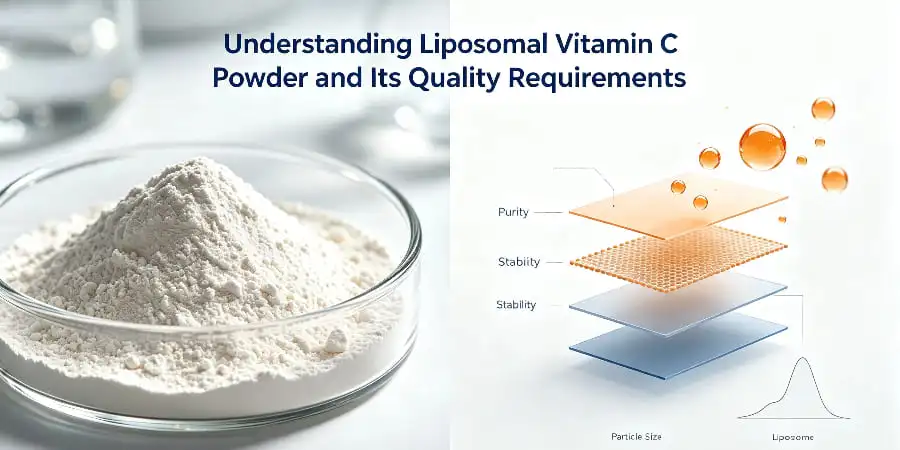
Understanding Liposomal Vitamin C Powder and Its Quality Requirements
The Science Behind Lipid Encapsulation
When compared to traditional ascorbic acid forms, liposomal vitamin C powder is a big step forward. Vitamin C molecules are wrapped up in phospholipid bilayers, which are tiny bubble-like structures that look like the membranes of human cells. This structural similarity lets cells directly fuse, which gets around the problems that normally come up with digestion and absorption.
When you eat a regular powder, only 15 to 20% of the vitamin C you take in gets into your bloodstream. But when liposomal versions are made correctly, they are up to 8 times more bioavailable. The phospholipid shell keeps the active ingredient safe from stomach acids and enzymes that break it down. This way, the ascorbic acid molecules stay whole and go straight into the bloodstream and tissues.
Critical Quality Attributes
Quality in manufacturing depends on a number of factors that can be measured. To be therapeutically effective, vitamin C level purity must hit or go beyond 99%. Particle size distribution needs to be tightly controlled. For maximum cellular uptake, liposomes should be between 100 and 200 nanometers in size. Larger particles make absorption less effective, and droplets that are too small can't keep their shape.
Another important metric is encapsulation efficiency. Good makers get encapsulation rates of 85 to 95%, which means that almost all vitamin C molecules are inside protective lipid layers instead of being free and fragile ascorbic acid. This measure has a direct relationship with how well the product works and how stable it is on the shelf.
For beverage applications, water dispersibility is very important. Premium formulations keep the suspension homogeneous so that it doesn't settle or clump, which lets you make clear liquid products that people like. It doesn't matter if the lipid comes from sunflower lecithin, soy lecithin, or specialized phospholipid mixes; the source affects taste, safety concerns, and clean-label positioning.
Application-Driven Quality Standards
Manufacturers of nutritional capsules put a lot of emphasis on flow and compression qualities. For automatic encapsulation tools to work, the powder must have a uniform mass density and particle cohesion. Functional beverage formulators need flavors that don't go off, a pH range that is stable from acidic to neutral, and the ability to handle heat during pasteurization.
Beauty-from-within brands need more proof, and they often need clinical data that shows they help skin cells make collagen or are antioxidants. For these uses, quality standards go beyond simple compositional analysis and include checking how well the functions work.
Core Manufacturing Standards and Certifications for Quality Assurance
Good Manufacturing Practices as Foundation
Current Good Manufacturing Practices (cGMP) approval is the standard for companies you can trust. These FDA-approved guidelines control how facilities are set up, how equipment is calibrated, how employees are trained, and how records are kept. Standardized operating procedures, validated cleaning protocols, and environmental monitoring are some of the ways that cGMP compliance makes sure that each batch is the same.
To keep things from getting contaminated, factories must keep storage areas for raw materials, work areas, and packing areas separate. In important parts of air control systems, HEPA filtering with positive pressure is needed. Regular checks of the equipment's calibration are done, and any deviations from standard procedures lead to official reviews with written records of what was done to fix the problem.
ISO Certifications for Global Market Access
Getting ISO 9001 certification shows that you are dedicated to quality management systems, which include frameworks for continuous growth, leadership responsibility, and risk-based thought. This standard is the same in all industrial sectors, which gives procurement teams trust in the organizational ability of their suppliers.
The ISO 22000 and FSSC22000 standards are all about managing food safety. These certifications prove that the necessary risk assessment protocols, prerequisite programs, and traceability systems are in place for supplement ingredients. Certified facilities do full tests for allergen control, heavy metals, microbes that are harmful, and pesticide residues.
HACCP (Hazard Analysis and Critical Control Points) integration finds specific stages of production where quality risks appear. Lipid heating temperatures, homogenization pressures, or the amount of moisture in the mixture during spray drying could all be important control points. At these points, quality problems can be stopped before they happen by continuous tracking.
Regional Regulatory Compliance
To get into the US market, you have to follow the FDA's rules on food supplements, which are found in 21 CFR Part 111. Suppliers must give Certificates of Analysis (CoA) for each batch that show its identity, purity, strength, and make-up. Label claims need to be backed up by stability studies and, if necessary, clinical research.
Some liposomal vitamin C powder formulations need Novel Foods' approval to be sold in European markets. This depends on how they are made and what kinds of fats they contain. Before putting a product on the market, the European Food Safety Authority (EFSA) looks at safety dossiers. To be compliant, you need to provide thorough toxicological data and details of the production process.
Getting more certifications opens up more business possibilities. Halal and Kosher certifications take into account the dietary needs of religious groups. Brands that care about clean labels, like the Non-GMO Project Verification. For organic approvals like USDA NOP and EU EOS, you need to use approved organic phospholipid sources and processing aids.
Advanced Production Techniques Ensuring Product Quality
Encapsulation Technology Methods
One of the best approaches to manufacture uniform-sized liposomes is microfluidization. Using 30,000 psi, this method forces lipid and vitamin C solutions down microscopic tubes. This causes shear forces to automatically form phospholipid vesicles. Narrow particle sizes were excellent for encasing objects.
While high-pressure homogenization has some of the same benefits, it works differently. Complex fatty clumps are broken up and vitamin C mixed in by many homogenization valve passes. Processing temperature must be controlled. Too much heat degrades ascorbic acid, whereas too little prevents lipid hydration and vesicle formation.
Ultrasonication alters lipid layers using high-frequency sound vibrations. Ultrasound is good for lab production, but it's hard to ensure batch consistency in commercial quantities. The final product depends on probe position, power density, and processing time.
Process Monitoring and In-Line Quality Control
Strong production uses real-time process analysis. Particle-size analyzers measure liposome sizes in real time using dynamic light scattering. Adjusting pressure, temperature, or processing time can fix deviations before complete runs.
Maintaining pH levels stabilizes ascorbic acid during processes. Vitamin C degrades quickly in alkaline environments, so pH must be monitored. Nitrogen is removed by dissolved oxygen monitors that detect oxidation.
Heating and cooling are kept within acceptable limits by temperature mapping. Thermal sensors in various vessels confirm temperature uniformity. Hot spots that break down active ingredients or melt lipids are prevented.
Post-Production Verification Testing
Products undergo extensive scientific testing before sale. HPLC measures vitamin C accurately. By separating ascorbic acid from its breakdown products, you can accurately measure its potency.
TEM shows nanoscale liposome structure. Products with whole circular vesicles and visible bilayer walls are good. Broken or mismatched structures indicate processing or stability issues.
The temperature and humidity are raised during accelerated stability testing to age samples as quickly as months on the shelf. For a 24-month shelf life at room temperature, products must maintain over 95% effectiveness and structural stability under stress.
Microbiological tests found no pathogenic bacteria, yeast, or mold. Powder plate counts must be below 1,000 CFU/g. Salmonella, E. coli, and Staphylococcus aureus tests are more numerous. High-quality liposomal vitamin C powder must meet these standards.
Supplier Evaluation Criteria for Bulk and OEM Procurement
Certification Verification and Audit History
The first step in qualifying a provider is to ask for current certification papers. cGMP, ISO, and HACCP certificates that are still valid should have clear scope statements that cover the production of liposomal vitamin C powder and recent audit dates. Certifications that are out of date or only cover certain types of products are a sign that compliance isn't being met.
Third-party audit reports give more information than certifications that are self-reported. Suppliers with a good reputation share audit results with redactions, which shows that they are open about their quality management systems. Pay attention to nonconformances that happen more than once during different audits. Patterns of the same violations can point to problems with the quality culture as a whole.
References from well-known brands' customers show that the product works in the real world. Talking to present clients gives you information about how consistent orders are, how quickly technical support responds, and how well you can solve problems that aren't in the marketing materials.
Production Capacity and Technical Capabilities
The size of a factory has a direct effect on prices and the reliability of supplies. Suppliers with yearly capacity of several tonnes can offer better prices for big orders and keep extra stock on hand in case demand goes up without warning. Smaller businesses might have more flexible minimum order quantities, but there is a chance that supplies will be cut off during times of high demand.
In-house research and development (R&D) is what sets partnership-oriented providers apart from commodity traders. Companies with their own labs and PhD-level experts can make products work better for certain uses by changing lipid ratios to make them stable in hot climates, changing particle sizes to deliver vitamins more effectively, or creating custom mixes of vitamin C and other nutrients that work well together.
Customization options give products a chance to stand out. In addition to normal powder forms, check to see if the providers offer direct compression tablets, encapsulation-ready granules, liquid concentrate bases, or spray-dried mixes for quick drinks. Time-to-market is sped up by private labeling services, custom package forms, and help with co-branding.
Documentation and Traceability Systems
Each batch should come with a full Certificate of Analysis that lists the test results for identification, strength, microbiology, heavy metals, and particle size. CoAs that show actual test results instead of vague "complies" statements show that the analysis is thorough. Standards set by the USP, the EP, or the maker should be used as a guide.
Systems that keep track of batches can follow raw materials from their original suppliers all the way through production and final packaging. Good suppliers give full proof of the chain of custody, which connects the lot numbers of finished goods to the batches of raw materials that they came from. This skill comes in very handy during quality reviews or governmental inquiries.
Shelf life claims are backed up by facts on stability. Suppliers should give real-time, stable studies that include the conditions and length of time that the goods will be stored. Initial shelf life estimates can be based on accelerated stability data, but ongoing real-time validation confirms long-term performance.
Regulatory support paperwork makes it easier to register a market in a target country. This includes details about the production process, where ingredients come from, allergen statements, reports of GMO status, and safety assessment notes made in a way that meets the requirements of each area.
Case Studies: Exemplary Standards in Commercial Production
EncapsWell™ Platform: Precision-Engineered Delivery Systems
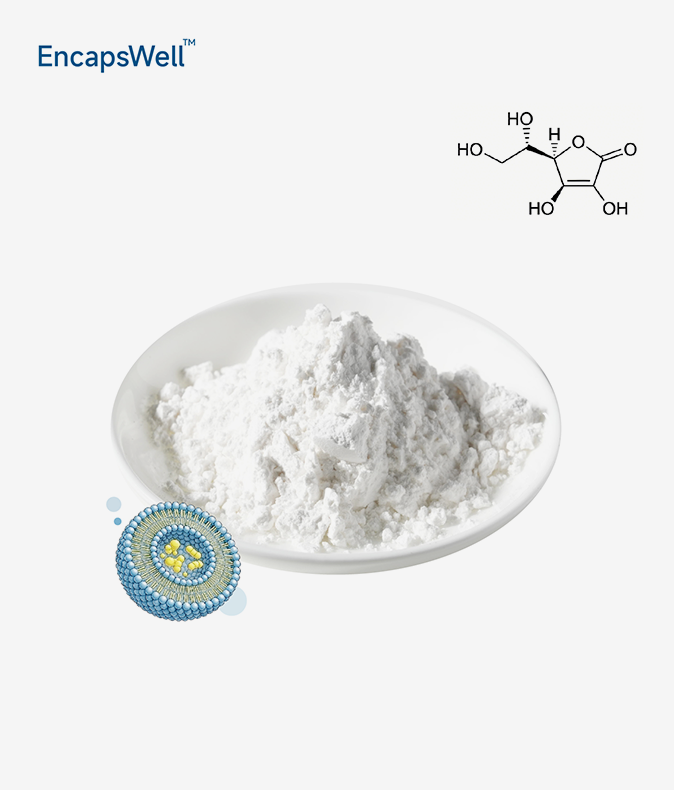
Our R&D team at EmerWell in San Diego created the EncapsWell™ liposomal platform to solve the absorption problems that come with regular vitamin pills. We improved the bioavailability of phospholipids, processing parameters, and stabilization strategies in a planned way, which made the powders 8 times more bioavailable than regular ascorbic acid powders.
Our method is different from what most contract producers do. Instead of using the same liposomal methods for all of the ingredients, our PhD-led scientists design delivery systems that are specific to the physical and chemical qualities of each active ingredient. Because vitamin C is water-soluble and easily oxidized, it needed specific lipid ratios and antioxidant protection methods that were improved through repeated tests.
The EncapsWell™ vitamin C formula stays more than 95% effective for 24 months at room temperature. This has been proven by both accelerated and real-time stability protocols. The particle size range stays the same from batch to batch, staying between 120 and 180 nanometers. This makes sure that cells can easily take them up. Third-party absorption studies show that plasma vitamin C levels peak earlier and are higher than with standard supplements of the same dose.
Manufacturing Excellence Through Strategic Partnership
Wellgreen, which is EmerWell's main business, runs cGMP-certified factories that can make more than 100 metric tons of products every year. This size lets us offer low prices for large orders while still being able to handle smaller test runs for product development.
Standard approvals aren't the only way we make sure of our quality. Every batch of liposomal vitamin C powder that is made goes through a lot of tests, such as HPLC potency analysis, particle size verification, microbiological screening, and heavy metal testing. We keep full records of each batch and can track down the raw materials used in them. This gives procurement teams the information they need to make regulatory submissions.
Our U.S. offices are in San Diego, California, which is a great place for domestic names. Local storage makes it possible to deliver samples quickly and manage inventory just-in-time. Our technical support team is based in the United States and can help with formulation questions, regulatory issues, and application problems without having to deal with language barriers or time zone issues. This localized presence works well with Wellgreen's large-scale manufacturing, blending quick customer service with efficient production.
Addressing Real-World Application Challenges
Liposomal ingredients that make drinks look cloudy or settle during storage are a common problem for people who make drinks. EncapsWell™ solves this problem by improving the particle size and surface charge. The mixture stays evenly spread out in both acidic sports drinks and neutral-pH functional waters, so it stays clear without needing to be stirred all the time.
Manufacturers of capsules like our powder because it flows easily and has very little moisture (<5%). These features keep tools from sticking together and make sure that automatic dosing systems work correctly. The powder compresses cleanly and doesn't need a lot of binders, which helps clean-label formulations.
Beauty supplement companies respect that we are ready to back up their marketing promises with scientific evidence. In addition to normal CoAs, we can compare absorption, test stability under different pH levels, and check compatibility with ingredients that work well together, such as collagen fibers or hyaluronic acid.
Conclusion
There are a lot more standards that go into making quality liposomal vitamin C powder than just basic purity measures. To make a good purchase, you need to look at how well the particles are encapsulated, how stable they are, and the company's full certification portfolio. This should include cGMP, ISO 22000, HACCP, and application-specific credentials like Halal or Kosher verification.
When compared to older ultrasonication methods, newer production methods, like microfluidization and confirmed high-pressure homogenization, produce more bioavailable and consistent batches. These manufacturing claims are backed up by thorough testing after production, including TEM structural verification, HPLC potency analysis, and accelerated stability protocols.
Certifications aren't the only thing that matters when choosing a supplier. Technical skills, the ability to customize, the completeness of the documentation, and a responsive support infrastructure are also important. The best agreements combine large-scale production with scientific knowledge, which lets formulations be optimized for specific uses while keeping prices low and supplies steady.
Knowing these production standards helps you make smart sourcing choices that protect your brand's image, make sure you're following the rules, and give real therapeutic benefits to end users.
FAQ
1. What distinguishes liposomal vitamin C manufacturing from standard ascorbic acid production?
To make liposomes, you need special tools and knowledge that go beyond making vitamins. For the process to work, the conditions for forming vesicles, homogenization, and lipid hydration must be carefully controlled. Quality manufacturers test the effectiveness of encapsulation, the distribution of particle sizes, and the structural integrity of their products. These tests are not done in regular vitamin C production. Different supply chain needs also come up because liposomal formulas need pharmaceutical-grade phospholipids and specific storage conditions to keep the safety of the vesicles.
2. Which certifications matter most when sourcing bulk liposomal vitamin C powder?
cGMP approval is essential for making sure that production practices are uniform and that contamination doesn't happen. Food safety management systems that are important for supplement uses must be approved by ISO 22000 or FSSC22000. HACCP certification shows that risks are controlled at key points in the production process. Market-specific certifications, such as Organic, Non-GMO, Halal, Kosher, or Halal, help you reach more of your target audience. Make sure that the certifications are still valid and only cover liposomal vitamin C powder and not other products that aren't connected.
3. How can procurement teams verify actual bioavailability claims?
Ask for pharmacokinetic study data that compares the amount of vitamin C in the blood after liposomal supplementation versus regular supplementation. Reliable suppliers use approved analytical methods to do third-party clinical research or absorption studies. The Certificate of Analysis should have measures of particle size and encapsulation efficiency, which are related to absorption. If a seller says something about absorption without any data to back it up, be wary because it's probably just marketing speak and not real performance.
Partner with EmerWell: Your Trusted Liposomal Vitamin C Powder Supplier
EmerWell specializes in high-performance liposomal formulas that are designed to be more bioavailable and successful in the market. Our EncapsWell™ vitamin C powder improves uptake eight times and is ≥99% pure, as proven by thorough testing by a third party. We offer quick service by combining Wellgreen's cGMP-certified manufacturing scale with technical support based in San Diego and local storage.
Whether you're developing immune-supporting capsules, functional drinks, or beauty-from-within formulas, our PhD-led research and development team can help you with any project, whether it's making immune-supporting capsules, functional drinks, or beauty-from-within formulas. We offer a variety of dosage forms, vegan formulations with clean labels, and a lot of regulatory paperwork to help you get into the global market.
Email our team at info@emerwell-bio.com to talk about the needs of your project. We'll give you clear prices for both trial runs and large-scale orders, as well as full technical specs and sample amounts for you to try. Add liposomal vitamin C powder to your product line from a provider that is dedicated to manufacturing excellence and relationship success.
References
1. Gopi, S., & Balakrishnan, P. (2021). Evaluation and clinical comparison studies on liposomal and non-liposomal ascorbic acid in human volunteers. Journal of Liposome Research, 31(4), 356-364.
2. Davis, J.L., Paris, H.L., Beals, J.W., et al. (2016). Liposomal-encapsulated ascorbic acid: Influence on vitamin C bioavailability and capacity to protect against ischemia-reperfusion injury. Nutrition and Metabolic Insights, 9, 25-30.
3. Łukawski, M., Dałek, P., Borowik, T., et al. (2020). New oral liposomal vitamin C formulation: properties and bioavailability. Journal of Liposome Research, 30(3), 227-234.
4. Hickey, S., Roberts, H.J., & Miller, N.J. (2008). Pharmacokinetics of oral vitamin C. Journal of Nutritional & Environmental Medicine, 17(3), 169-177.
5. Pharmaceuticals and Medical Devices Agency. (2019). Quality Standards for Liposomal Drug Products: Manufacturing and Control Guidelines. Tokyo: PMDA Technical Publications.
6. European Food Safety Authority. (2020). Scientific Opinion on the safety of synthetic amorphous silica when used as liposome stabilizer in dietary supplements. EFSA Journal, 18(7), 6213.
Online Message
YOU MAY LIKE
High quality furniture manufacturer
_1776234266736.webp)