

Oct 14, 2026
Liposomal Resveratrol Wholesale: What Buyers Need to Know Before Ordering
Buying liposomal resveratrol powder at wholesale volume is a documentation exercise before it is a commercial one. This article is written for procurement teams, quality reviewers and product developers who have already accepted the format and now need to know what to obtain, and check, before a purchase order is released. It covers four things: the specification items worth locking, the evidence that supports each one, the file package that should accompany a quotation, and the acceptance steps that catch a mismatch before the material reaches production. It does not cover commercial terms or commitments, and it says nothing about what any ingredient does in the human body.
What a Pre-Order Review Should Decide
A pre-order review answers three questions. Can the supplier state every relevant parameter as a value, a range and a test method? Can the supplier show that those figures hold for the lot you will receive, not only for a catalogue example? And does the file set let your quality team release the material without chasing missing pages? Most risk in this category is documented risk: a parameter that was never agreed cannot later be disputed. The same checklist used when vetting a liposomal resveratrol powder supplier applies here, focused on the specification file itself.
Risk One: Isomer Identity and the Isomer Report
For resveratrol, the first risk item is not concentration and it is not appearance. It is isomer identity. Specifications in this category are written around trans-resveratrol, and the shift from trans to cis is the change most likely to move a lot out of specification without altering how the powder looks, flows or disperses. A quotation that offers one resveratrol content figure, with no isomer breakdown, has supplied a number that cannot be acted on.
Why the isomer, not the percentage, is the specification
The published stability work on resveratrol is largely a study of the trans-isomer: its solubility, its sensitivity to pH and temperature, and its behaviour on exposure to light. Zupančič and colleagues reported that pH and temperature strongly influence the stability and solubility of trans-resveratrol, and later work describes the photoisomerisation route that leads away from the trans form. For a buyer, a lot that has partly converted is a different material, even when the headline percentage is unchanged.
What the isomer report has to show
An isomer report should name the isomer being reported, give the measured trans proportion against the 99% target, state whether cis was detected and at what level, name the analytical method, and carry a lot number. Reversed-phase HPLC with isomer separation is the usual approach, and the method reference matters more than the headline value. A percentage with no method, no detection limit and no lot reference is a marketing sheet.
Two gaps remain. The report describes the lot at release, not the powder after a month in a warm warehouse, and it says nothing about light exposure already accumulated.
Risk Two: Photostability Data and the Packaging Envelope
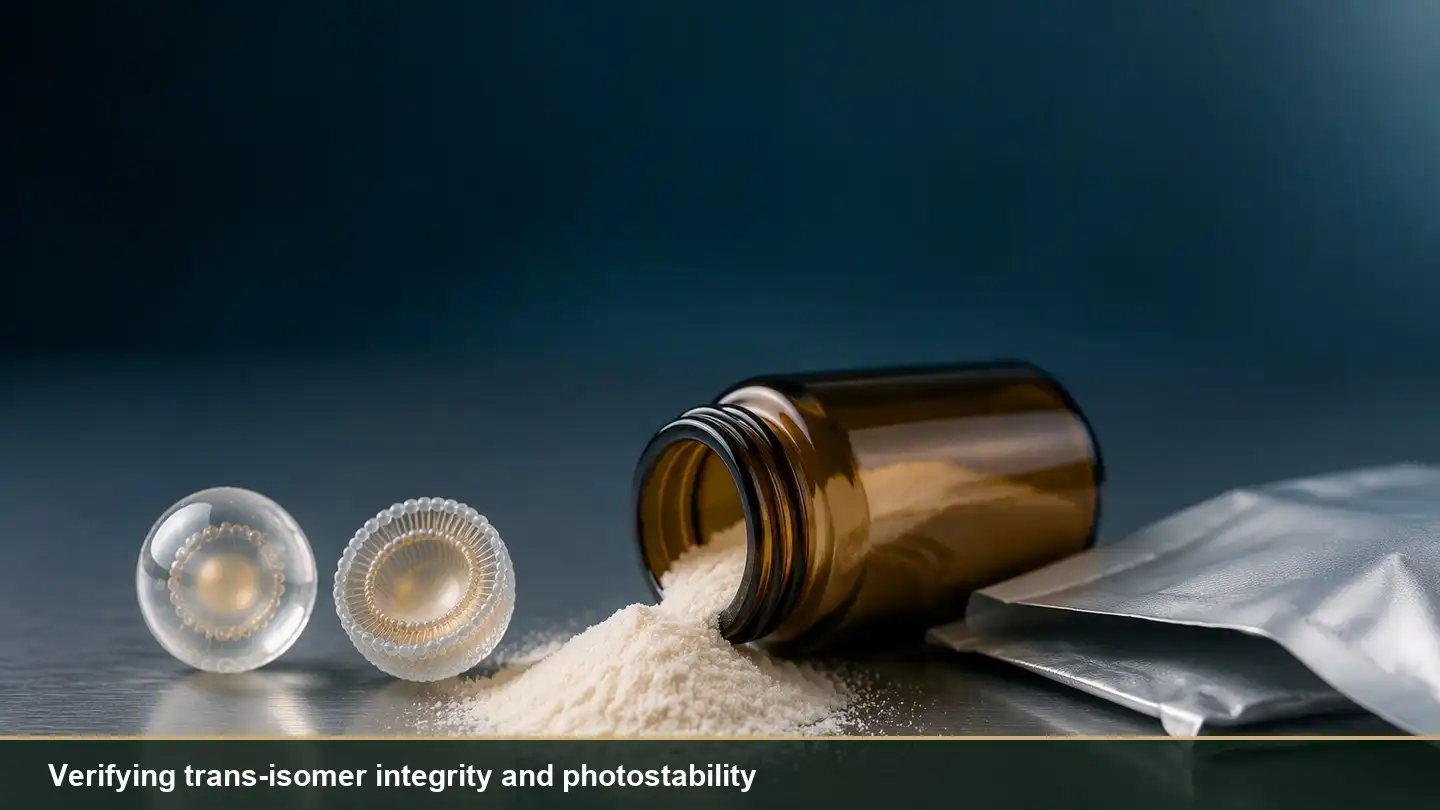
Light acts on the isomer ratio, not only on appearance, so photostability belongs in the same review as isomer data. A supplier should provide photostability and accelerated stability data for the finished powder, and state which packaging those data were generated in.
Packing, transport and storage
Three confirmations are worth putting in writing. The primary pack must be light-shielding, so the inner bag or foil is not a transparent film. The stability data must relate to that same pack rather than to a laboratory jar. Storage and transport conditions must be stated, because a specification that holds only in a climate-controlled store is a different specification. Buyers comparing powder and liquid formats will recognise the pattern: a 24-month shelf life only holds when the packaging and storage condition behind it is named.
The Specification Items to Lock Before You Order
The table below lists the parameters worth locking, why each earns a line, and the evidence that makes it checkable. The right-hand column is the deliverable: a parameter without a stated method and a lot reference is not yet a specification.
| What to check | Why it earns a line | Evidence that makes it checkable |
|---|---|---|
| Isomer identity: trans-resveratrol at 99% or above, cis reported | The specified material is one isomer; a lot shifted toward cis is a different material | Per-lot isomer report: isomer named, trans value, HPLC method, detection limit |
| Encapsulation efficiency: 85% to 92% | Distinguishes an encapsulated powder from a physical blend and drives label accuracy | EE result plus the separation step and assay method |
| Active concentration: 10% to 50% | Sets how much powder carries the active in your formula | Spec sheet or COA stating the figure and its basis |
| Particle size and morphology | Drives flow, filling consistency and dispersion in cold water | DLS reporting Z-average and PDI, with TEM images from the lot |
| Lipid oxidative state | Indicates carrier condition after processing and storage | Peroxide value by iodometric titration on the lot |
| Heavy metals: Pb below 0.5 ppm | Release limit for a food- and supplement-grade powder | Lot COA entry with result, limit and method |
| Microbiology: TPC below 1,000 cfu/g | Release criterion that affects handling in your facility | Lot COA microbiology section |
| Appearance: off-white to pale yellow, free-flowing | Colour and flow consistency for capsules, sachets and suspensions | Specified range plus a retained reference sample |
| Storage, light shielding and shelf life: 24 months | A shelf-life claim is only valid with the packaging and storage condition behind it | Stability protocol summary, photostability and accelerated data, written storage condition |
Two notes on the table. Encapsulation efficiency is what separates an encapsulated powder from a physical blend, and it is the figure most often quoted without a method, so ask how the free fraction was separated before the assay. The concentration range of 10% to 50% is wide by design, and a percentage is only comparable when the basis for the calculation is stated; the ingredient quality markers used in specification review cover the same ground, and a specification guide written for supplement brands sets the parameters out in the same order.
The Document Pack: What Each File Covers
A quotation for a wholesale quantity should arrive with a fixed file set; the liposomal raw materials range is a useful reference for the grade in question. Each document answers one question and leaves others open, so read the table as a map of what your release decision still needs from elsewhere.
| Document | What it covers | What it does not cover |
|---|---|---|
| Specification sheet | Target value and range for every agreed parameter | Anything about the lot you will actually receive |
| Per-lot COA | Measured results for that lot against the specification | Parameters the template omits, including isomer data when no isomer section is present |
| Isomer report | The trans and cis distribution and the method that produced it | Light exposure accumulated after release |
| Photostability and accelerated data | Behaviour of the powder in the tested pack and conditions | Real transport routes and warehouse conditions |
| Method statements for HPLC, DLS, TEM and iodometric peroxide value | How each value was generated, including sample prep and limits | Method transfer and validation in your own laboratory |
| Certification scope: cGMP, ISO 9001, ISO 22000, Kosher, Halal, Non-GMO, Vegan | The site and the system that produced the material | The quality of an individual lot |
| Retention and re-test arrangement | Traceability and evidence if a dispute arises | Lots outside the agreed retention window |
| Change notification commitment | Advance notice of process, carrier or packaging changes | Changes your own formula introduces |
Certification illustrates the point. cGMP, ISO 9001, ISO 22000, Kosher, Halal, Non-GMO and Vegan describe the site and the system that produced the material; they are not a verdict on the drum in front of you. That verdict comes from the lot COA, the isomer report and your own acceptance testing.
Four Buying Mistakes That Survive a Spec Review
- Comparing one content number. A resveratrol percentage with no isomer breakdown, no assay method and no lot reference is not comparable with anything.
- Mistaking one concentration basis for another. A powder may be quoted against total mass or against carrier, and a figure on one basis is not the same figure on another. Ask for the basis in writing.
- Skipping isomer and light data because the COA looks complete. Standard COA templates rarely carry an isomer section or a photostability statement, and the omission is invisible unless it is requested specifically.
- Reading certification as a verdict on the lot. A site certificate confirms that a system is audited, not that this drum meets this specification; lot COAs, isomer reports and goods-in testing do that.
Buyers who want the reasoning behind the format rather than the paperwork can read why formulators choose the liposomal form, but the four mistakes above are decided by what your own specification says.
What to Write Into the Purchase Specification
The purchase specification turns the review into an enforceable document. Write every parameter as a value, a method and a consequence, so acceptance never depends on interpretation.
| Specification line | Value to write | Method to name | Action if it fails |
|---|---|---|---|
| Isomer identity | trans-resveratrol at 99% or above, cis reported | HPLC with isomer separation | Hold the lot and request the report |
| cis content | Reported, with an agreed upper limit | Same HPLC method | Re-test a retained sample, then reject if confirmed |
| Active concentration | One value between 10% and 50%, with the basis stated | HPLC | Query the basis before comparing quotations |
| Encapsulation efficiency | One value between 85% and 92% | Separation step followed by assay | Technical review before release |
| Appearance | Off-white to pale yellow, free-flowing | Visual check against a retained reference | Request a replacement sample |
| Cold-water dispersion | Uniform suspension, no lumps | Timed bench dispersion test | Re-test a second sample, then hold |
| Pb | Below 0.5 ppm | As declared on the lot COA | Reject |
| TPC | Below 1,000 cfu/g | As declared on the lot COA | Reject |
| Packaging and storage | Light-shielding primary pack, written storage condition | Pack specification and stability statement | Query before the order is released |
| Shelf life | 24 months from manufacture, dates recorded | Stability protocol summary | Re-test or short-date the stock |
Where a project involves custom grades or co-development, the same table structure carries into OEM and ODM formulation briefs, which also fix particle size targets, carrier choice and dispersion behaviour in the intended vehicle.
Acceptance on Arrival: Sampling and Re-Test Triggers
Goods-in testing should be small, specific and agreed in advance. Decide which parameters are verified at goods-in and which are accepted on the supplier COA, then state the sampling plan: how many containers are sampled, from which positions, and how the composite is taken. Agree the triggers as well. Appearance outside the off-white to pale yellow range, a cold-water dispersion test that leaves lumps, a trans proportion below 99% on a retained-sample re-test, or a missing isomer report should each map to a defined action: quarantine, request a replacement sample, or reject. For repeat supply, agree the retention and re-test arrangement and the change notification commitment, so a new carrier or packaging supplier is flagged before the material ships. Bulk supply planning follows the same logic once the first lot has been released.
Get the Data Before You Release the Order
If you are building a specification for liposomal resveratrol powder, the team at EmerWell can provide the technical file set for the grade you are considering: specification sheet, per-lot COA, isomer report, photostability and accelerated stability data, method statements for HPLC, DLS, TEM and iodometric peroxide value, the certification scope covering cGMP, ISO 9001, ISO 22000, Kosher, Halal, Non-GMO and Vegan, retention and re-test arrangements, and a change notification commitment. Request samples through the liposomal resveratrol powder product page or by email at info@emerwell-bio.com. Ask for method statements alongside the numbers; that is where a technical conversation starts.
References
1. Zupančič, Š., Lavrič, Z., and Kristl, J. (2015). Stability and solubility of trans-resveratrol are strongly influenced by pH and temperature. European Journal of Pharmaceutics and Biopharmaceutics, 93, 196-204. https://pubmed.ncbi.nlm.nih.gov/25864442/
2. Robinson, K., Mock, C., and Liang, D. (2015). Pre-formulation studies of resveratrol. Drug Development and Industrial Pharmacy, 41(9), 1464-1469. https://pmc.ncbi.nlm.nih.gov/articles/PMC4427559/
3. Yoshinaga, M., Toldo, J. M., Rocha, W. R., and Barbatti, M. (2024). Photoisomerization pathways of trans-resveratrol. Physical Chemistry Chemical Physics, 26, 24179-24188. https://pubmed.ncbi.nlm.nih.gov/39254634/
4. Mattioli, R., Di Risola, D., Federico, R., Ciogli, A., Gasparrini, F., and Villani, C. (2022). Effect of natural deep eutectic solvents on trans-resveratrol photo-chemical induced isomerization and 2,4,6-trihydroxyphenanthrene electro-cyclic formation. Molecules, 27, 2348. https://pmc.ncbi.nlm.nih.gov/articles/PMC9000676/
Disclaimer: This article is written for ingredient and product-development professionals and describes raw material specifications, documentation and acceptance practice only. It is not medical advice and it does not describe or imply any effect of a finished product on human health. Buyers and formulators remain responsible for confirming that their own products and any statements made about them comply with the regulations of each market where they are sold.
Online Message