Jun 23, 2026
How to Choose a Trustworthy Supplier of Liposomal Resveratrol Powder
To find a trustworthy liposomal resveratrol powder supplier, you need to look at a number of factors that have an immediate effect on the product's success and the image of the brand. The right partner offers constant quality through tested encapsulation technology, keeps up-to-date certifications like cGMP and ISO standards, and gives clear paperwork that includes data on batch tracking and stability. In addition to technical specs, you should also look at how much they can produce, how well they understand regulations in your target markets, and how ready they are to make changes to formulas. A reliable seller combines scientific seriousness with operating dependability to make sure that your final goods meet both customer standards and legal requirements.
Understanding the Decision Scenario: Why Choosing the Right Supplier Matters
When you're building a nutraceutical brand or adding functional drinks or beauty-from-within vitamins to your product line, the seller you work with becomes an extension of your quality promise. Liposomal resveratrol powder has become a popular ingredient because it solves the main problem with regular resveratrol, which is that it is not bioavailable well. Regular resveratrol is broken down quickly and not absorbed well by the body, so it's usually not more than 1% available. Liposomal encapsulation changes that equation by keeping the active ingredient safe through digestion and improving uptake by cells, but only if the preparation is done right.
Whether you're a dietary supplement company releasing life capsules, a beverage company making antioxidant drinks, a nutricosmetics company making skin health shots, or a contract maker working with many private-label clients, the things you need to buy will be different—but liposomal resveratrol powder has emerged as the versatile raw material that can satisfy all four paths. For supplements, the most important things are clean label ingredients and efficient capsule formation, and liposomal resveratrol powder delivers both with its phospholipid coating that requires fewer excipients; for drinks, it's water dispersibility and hiding of taste, where the liposomal encapsulation ensures a neutral flavor profile and clear dissolution without sediment; for beauty products, it's proven absorption claims and scalable supply with flexible MOQs for OEM partners, and the clinically-backed bioavailability of this liposomal form gives you the marketing edge while maintaining production agility.
There are more risks than just lost money when you choose a seller you haven't checked out. When product quality is compromised, it doesn't always work as well as it should, which hurts customer trust and leads to bad reviews. Problems in the supply chain throw off production plans, which delays product launches and makes it harder for retailers to work together. If you don't follow the rules, your company could be recalled, sued, or have its image hurt. Evaluation criteria like GMP certification, production capacity, reliable wait times, and clear pricing systems make it possible to choose a provider with confidence. If your business wants to start in the US market, meet EU Novel Food standards, or grow quickly with a growing customer base, these benchmarks can help you find a supplier whose skills match your needs.
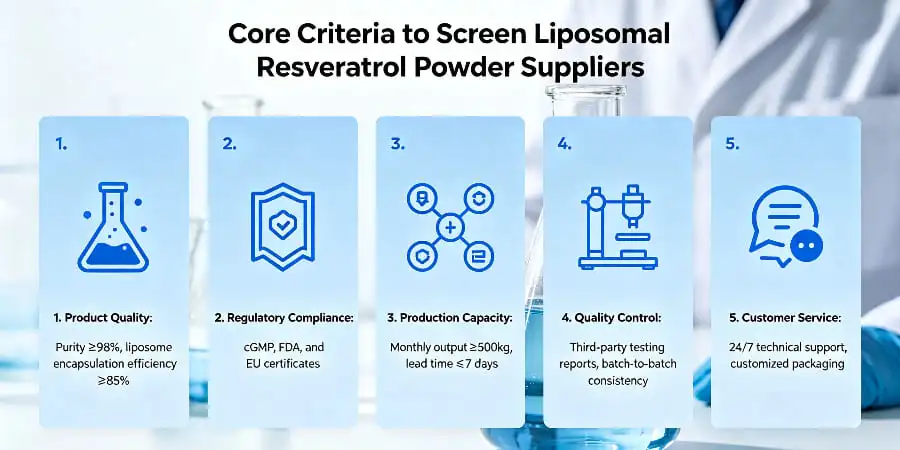
Core Criteria to Screen Liposomal Resveratrol Powder Suppliers
Quality Assurance and Certification Standards
Manufacturing guidelines that ensure safety, purity, and stability are the first step in making sure a product is honest. Look for providers who are currently certified in good manufacturing practice (cGMP). This makes sure that strict process controls are used throughout production. The ISO 22000 and FSSC22000 certifications show that the food safety management is thorough, and the HACCP certification shows that the risks are systematically identified and stopped. For example, if you want to meet the needs of your target market, you might need extra certificates like HALAL, KOSHER, Non-GMO Project verification, and vegan certification.
Ask for third-party laboratory validation of key factors in addition to certificates. The amount of resveratrol should be at least 98% pure, and the trans-resveratrol isomer should be the main type because it has better biological function than the cis-isomer. If the encapsulation rate is between 85 and 90%, it means that most of the active ingredient is inside the protective lipid bilayer and not as a free powder. Dynamic light scattering should show a small range of particle sizes, between 100 and 300 nanometers, with a polydispersity index below 0.3. This will make sure that the absorption properties of the liposomal resveratrol powder are the same across runs.
Transparency and Documentation
Suppliers you can trust give you detailed records for each batch, from where the raw materials come from to when the finished product is released. For a specialized ingredient like liposomal resveratrol powder, this traceability is especially critical, as it ensures the phospholipid encapsulation and active compound remain consistent across production. This includes Certificates of Analysis that list the results of physical, chemical, and microbiological tests, stability studies that follow ICH standards and show how long the product will last, and allergy statements that say typical sensitivities are not present. For markets that are controlled, pre-compiled regulatory dossiers shorten the time it takes to get approval by giving the officials the scientific proof they need—dossiers that, for liposomal resveratrol powder, often feature additional data on encapsulation efficiency and bioavailability to satisfy stringent health authority requirements.
Batch tracking systems, which are being backed more and more by blockchain technology, let you check where the phospholipids used in the liposomal structure come from and make sure that the carrier materials are non-GMO. Suppliers should be happy to share absorption modeling data and in vitro breakdown studies that back up what they say about bioavailability. This makes people more likely to believe that marketing claims about "14x enhanced absorption" are based on facts and not just claims.
Operational Capabilities
Your production ability must match your number needs while still meeting quality standards. Whether you need 50 kilograms for a pilot run or 500 kilograms or more every month for business purposes, the provider should be able to show consistent output without changing the specs. Flexible minimum order amounts let brands at different stages of growth work with each other without having to buy too much inventory.
Product security and shelf life are directly affected by the type of packaging used. Suppliers who offer aluminum foil bags with nitrogen cleaning, desiccant integration, and light-protective materials help keep the resveratrol, which breaks down easily when exposed to oxygen, safe during distribution. Logistics skills help make sure that shipping is kept at the right temperature when it's needed and that arrival times are reliable so that just-in-time manufacturing methods can work. The best partners keep warehouses close to key markets. This cuts wait times by a huge amount and makes customer service faster.
Comparing Suppliers: What Differentiates Top Liposomal Resveratrol Powder Manufacturers
Reputation and Track Record
Established providers of nutritional ingredients have usually been working with well-known names for a number of years, which is a good sign of their dependability and technical skill. Case studies and comments from clients show how providers have solved specific formulation problems, such as getting the best dispersion in acidic beverage systems, keeping the stability during hot-fill processing, or meeting tight launch deadlines. One way to build a reputation is for businesses to work with research institutions and for people to share confirmation studies at scientific conferences.
New providers may offer low prices and new ways of doing things, but they need to be checked out more thoroughly first. Ask present clients for references, and check with certifying groups directly to see if they can back up what they say about their production capacity and certification status. If a supplier is ready to give you a virtual or in-person tour of their building and put you in touch with their technical team, that shows that they are confident in their business and want to work with you.
Customization and OEM/ODM Services
Suppliers who work as real partners are different from those who just sell ingredients because they can offer private label and custom preparation services. Leading companies offer recipe creation services that mix liposomal resveratrol powder with actives that work well together, such as NMN, quercetin, or collagen peptides. This makes synergistic blends that make your product stand out in a busy market. They can change the powder size to fit different delivery methods, the excipients to improve taste profiles, or the branded ingredient forms to make marketing stories stronger.
OEM and ODM help is more than just putting your own name on finished goods. The best partners help choose the right dosage form by comparing how stable and well-liked powders, hard pills, soft gels, and liquid-ready formulas are by customers. They help you with the design of your package, make sure you have the right paperwork for your target markets, and can even put you in touch with outside testing labs to do proof studies. This all-inclusive service model speeds up your time-to-market and makes your internal team's technical work easier.
Pricing Models and Value Assessment
The unit cost is only one part of the total value. When you buy in bulk, you can often get tiered prices, which helps your margins a lot as your brand grows. Look at the payment terms, number agreements, and ways that prices can be changed when the price of raw materials changes. Clear price systems that break down encapsulation processing, testing, documentation, and packing into their individual costs help you know exactly what you're paying for and find ways to save money.
Value is more than just price; it also includes professional support, help with regulations, and a strong supply chain. When suppliers use two different sources to get important raw materials like resveratrol and phospholipids, they protect your business from problems with area supplies. People and businesses that invest in processing technologies that use less energy and produce less waste not only help the environment, but they also often give people cost saves. Cost, quality, and service must all be balanced so that your relationship with your provider supports both short-term profits and long-term brand building.
Practical Steps to Verify and Engage with Your Supplier
Conducting Due Diligence
The first step in verification is authenticating the certificate. Check the truth of license numbers by comparing them to the organizations that issued them and seeing when they expire. Ask for the supplier's most recent inspection reports or audit results that show they are committed to always getting better. Third-party lab reports should only come from approved testing facilities, and you should be able to get in touch with the lab to make sure the report is real.
Before agreeing to large purchases, sample orders are important to make sure the idea works. You can check the consistency of samples by asking for them from different production runs and trying their quality yourself. Check how the powder mixes with the material you want it to work with, whether that's water for a beverage or oil for a soft gel. For supplement uses, you might want to do small-scale absorption studies or work with research groups to make sure that bioavailability claims are true in the settings that are right for your product format.
Contractual Considerations
Your production plans and cash flow should be in line with the minimum order numbers. Talk about MOQs that let you test market liposomal resveratrol without taking on too much inventory risk and that make it clear how you can switch to volume-based pricing as your brand grows—ensuring your initial trial batch of liposomal resveratrol is affordable, while later bulk orders unlock better margins. The rules of the contract should include quality standards, such as accepted ranges for key parameters (specifically, liposome stability and resveratrol concentration), and how to handle batches that don't meet the standards, so you are protected from inconsistent formulations from the start.
Return policies and ways to settle disagreements protect your rights when problems happen. Having clear terms that cover things like product flaws, shipping damage, and not meeting specifications stops arguments that cost a lot of money. Your payment plans should strike a mix between protecting your suppliers and meeting your working capital needs. For big custom formulation projects, you might want to include milestone payments.
Building Long-Term Partnerships
Supplier ties that work well depend on regular contact and investment from both sides. Set up regular quality review meetings to talk about how well each batch did, fix any issues with changing specifications, and share information about market trends that could affect the needs for formulations. Feedback systems should work both ways: suppliers should share new developments in liposomal technology, and you should share success data from real users.
Digital supply chain platforms and blockchain-based traceability systems make the purchasing process easier by showing production plans, inventory levels, and shipping tracking in real time. These tools make things more clear and less work for administrators, so your team can focus on long-term growth instead of putting out routine fires. When suppliers spend money on these features, it shows that they want to work with current, efficient relationship models.
Conclusion
Finding a reliable source for liposomal resveratrol powder requires a careful look at their quality, honesty, and how they run their business. Give more weight to partners who have full certifications like cGMP, ISO 22000, and specialty certifications that are important to your target market. Make sure their scientific claims are true by having a third party test and evaluate samples. This will make sure that the particles are the same size, the packaging works well, and the bioavailability is really improved. Check to see if they can grow with your business, if they are ready to make changes to the formulas, and if they know how to follow the rules in different countries. Strong ties with your suppliers help you get competitive prices, reliable service, technical support, and a supply chain that can handle changes. This protects the image of your brand and allows for long-term growth.
FAQ
1. Why is liposomal resveratrol powder better than regular resveratrol?
Liposomal encapsulation fixes the main problem with regular resveratrol: it's not very bioavailable because it breaks down quickly and doesn't mix well with water. The phospholipid membrane protects resveratrol in the stomach's acidic environment and makes it easier for the body to absorb it directly in the intestines through lymphatic transfer, skipping the liver's first step of metabolism. This makes the drug much more available in the body; quality formulas have been shown to be up to 14 times more effective at absorption. When properly packed, powder liposomal products can last up to 36 months, which is longer than liquid liposomal products.
2. How do I check the absorption claims of a supplier?
Ask for thorough in vitro dissolution studies that show release profiles in artificial stomach and intestinal conditions. Also, ask for particle size analysis to prove that the particles are spread out in the nanometer range. Ask for metabolic data from a third party that shows how blood plasma concentrations change over time compared to regular resveratrol. Suppliers you can trust will give you public research or internal confirmation studies that explain how they did the research. Before placing big orders, you might want to do your own test absorption study with a contract research organization to check the claims on your own.
3. What licenses are most important for getting into the US market?
If a dietary supplement brand wants to sell its products in the US, it should look for sources that have current cGMP certification for dietary supplements and third-party quality certifications like NSF or USP verification. Non-GMO Project verification and organic approvals (when available) are becoming more and more important to consumers when they decide what to buy. For plant-based product lines, vegan approval is important. Kosher and Halal licenses help businesses reach new customers in certain groups. Even though it's not needed, FDA registration of the production site shows that the company knows what US legal standards are.
Ready to Partner with a Liposomal Resveratrol Powder Manufacturer That Delivers Results
Through our strategic relationship with Wellgreen, EmerWell combines cutting-edge research and development in San Diego with large-scale cGMP production. This is how we can bring you the EncapsWell™ liposomal platform, which is designed to be more bioavailable. Our liposomal resveratrol powder has been shown to increase absorption by 14 times and stay stable for 36 months. It comes in a variety of forms, from bulk powder to finished pills. We offer full OEM/ODM services, including formulation help from a PhD, regulatory dossiers already put together for FDA and EU markets, and local US storage for quick sample delivery. Our team helps you from the idea stage all the way through launch, whether you need 50 kg for test production or 500 kg or more per month for business scale. Get in touch with info@emerwell-bio.com right away to ask for technical details, place an order for samples, or talk about special formulations. Let's turn your product idea into vitamins that are the best on the market and that people trust.
References
1. Cottart, C.H., Nivet-Antoine, V., & Beaudeux, J.L. (2014). Review of recent data on the metabolism, biological effects, and toxicity of resveratrol in humans. Molecular Nutrition & Food Research, 58(1), 7-21.
2. Fang, Y., Cao, W., Xia, M., Pan, S., & Xu, X. (2017). Study of chitosan-TPP nanoparticles as a controlled release system for trans-resveratrol. Journal of Food Science, 82(11), 2614-2620.
3. Gökçe, E.H., Korkmaz, E., Dellera, E., Sandri, G., Bonferoni, M.C., & Özer, Ö. (2012). Resveratrol-loaded solid lipid nanoparticles versus nanostructured lipid carriers: evaluation of antioxidant potential for dermal applications. International Journal of Nanomedicine, 7, 1841-1850.
4. Sinha, D., Sarkar, N., Biswas, J., & Bishayee, A. (2016). Resveratrol for breast cancer prevention and therapy: Preclinical evidence and molecular mechanisms. Seminars in Cancer Biology, 40-41, 209-232.
5 .Zu, Y., Overby, H., Ren, G., Fan, Z., Zhao, L., Wang, S., & Liang, H. (2018). Resveratrol liposomes and lipid nanocarriers: comparison of characteristics and inducing browning of white adipocytes. Colloids and Surfaces B: Biointerfaces, 164, 414-423.
6. Amri, A., Chaumeil, J.C., Sfar, S., & Charrueau, C. (2012). Administration of resveratrol: What formulation solutions to bioavailability limitations? Journal of Controlled Release, 158(2), 182-193.
Online Message
YOU MAY LIKE
High quality furniture manufacturer