

Sep 24, 2026
How to Use Liposomal NAD+ Powder for Maximum Absorption?
Compounding teams rarely see how a liposomal NAD+ powder behaves after it leaves the plant, so the practical question is how to use the material in a way that preserves the properties you can measure: how evenly it wets out, what happens to its particle size distribution, and how much of the payload is still encapsulated once the step is finished. This guide covers the handling side: pre-dispersion, shear, water quality, order of addition, and filling. The reference points come from the specification published for EmerWell’s liposomal NAD+ powder: active content of 10% to 70% with 50% as the standard grade, encapsulation efficiency of 85% to 95%, lead below 0.1 ppm, total plate count below 1,000 cfu/g, a pale yellow to white free-flowing powder dispersible in water, and a stated shelf life of up to 24 months under proper storage.
Absorption Is a Laboratory Word, Not a Batch Record Line
No production floor can release a batch against an absorption figure; nobody can measure it in a mixing vessel or sign for it at the end of a run. What can be measured are three properties that change the moment the powder meets water or shear: how completely it disperses, what its size distribution and width look like, and how much of the encapsulated payload is still encapsulated when the operation ends.
Dispersion uniformity
No visible agglomerates, no streaking on the vessel wall, no dry islands that survive a defined agitation window. A dispersion that looks smooth but still carries unhydrated particles will fail particle size analysis later: those particles hydrate slowly and release payload after the process window closes.
Particle size distribution
Dynamic light scattering returns a mean diameter and a width; both are reported, and both are compared with the value measured before the handling step rather than with a figure copied from a brochure. Microscopy confirms morphology, showing vesicles rather than collapsed or fused debris.
Encapsulation efficiency before and after the step
This number tells you whether handling was kind or brutal, and it is measured twice: on the material you received and on the material you produced. In an optimized spray-drying study of a loaded liposomal powder, encapsulation efficiency after drying was reported at 88.24% ± 0.98%, with only marginal movement in particle size and encapsulation efficiency over 90 days of ambient storage [5]. Retention is a testable, reportable number, and the drying step decides much of it.
Pre-Dispersion and Wetting: the Step That Decides Everything Downstream
Drying is where a liposomal payload is most exposed: freezing and dehydration destabilize vesicle organization and drive leakage, which is why protective excipients are selected and drying parameters optimized [4]. By the time a drum reaches your warehouse, your task is to reverse that drying as gently as it was done. See how liposomal NAD+ powder is manufactured for the upstream context.
Dry blending is not wetting out
A ribbon blender can distribute powder evenly through a carrier while leaving a fraction of particles that never hydrate individually. Those particles act as aggregates: they hydrate late and pull the measured distribution upward, showing up as caking in a dry blend or sediment in a liquid premix.
A workable wetting sequence
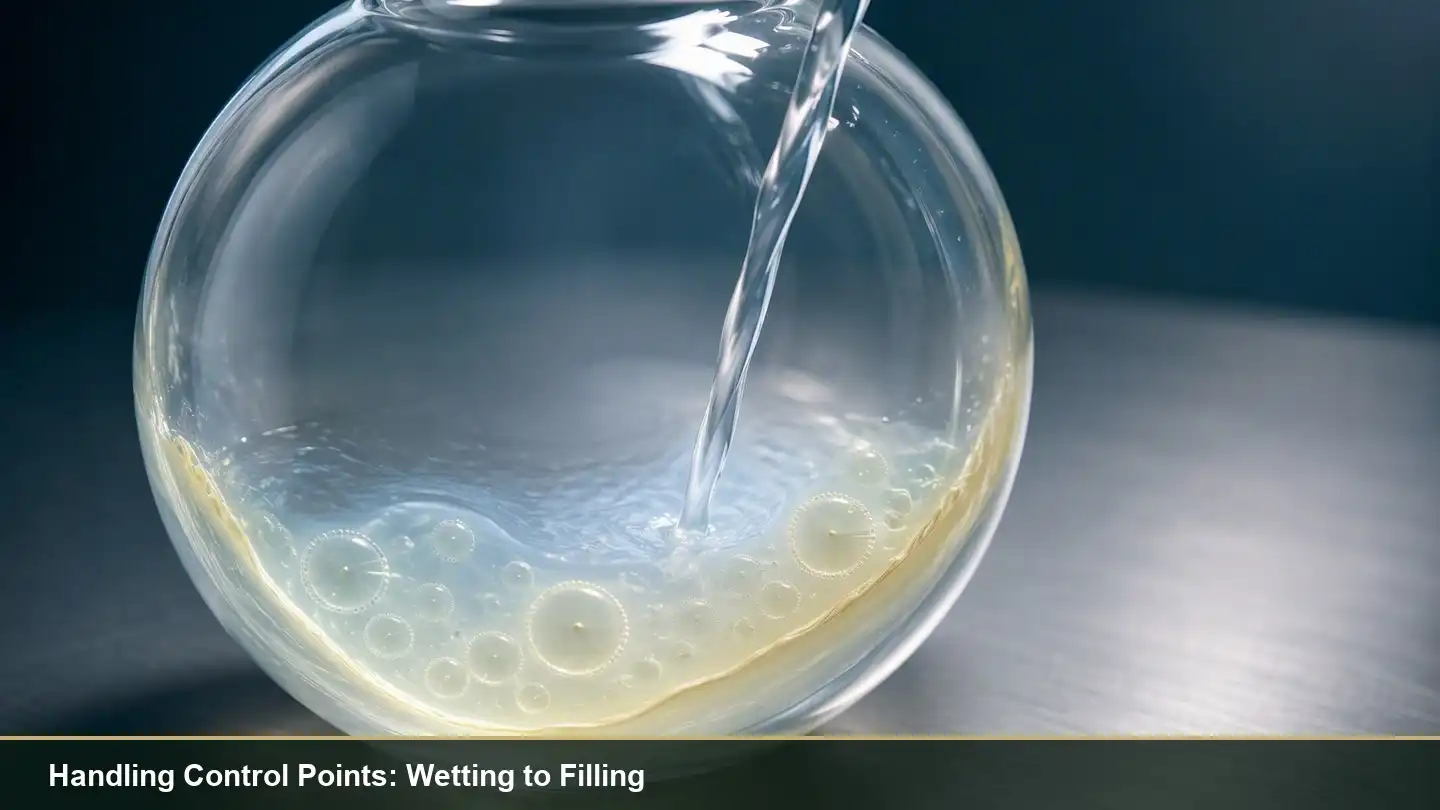
- Keep the aqueous phase in gentle motion, so particles enter water individually rather than buried in a mound.
- Add the powder as a thin stream at the shoulder of the vortex, not as a single charge dropped onto the surface.
- Hold a short low-agitation wetting window before raising mixer speed; full shear applied to dry material abrades it instead of dispersing it.
- Record the water phase temperature before addition and the product temperature afterwards; the two are never the same number.
Shear and Temperature: Where Good Intentions Cause Damage
Shear is a tool with a budget: it breaks agglomerates down to primary particle size and keeps them apart long enough for the rest of the formula to be added, and every extra minute is energy the product has to absorb. A powder arriving with a uniform distribution and an encapsulation efficiency in the 85% to 95% band needs enough agitation to hydrate and distribute, and then it needs to stop. More on that trade-off: improving liposomal NAD+ powder stability.
What shear buys, and what it costs
Agglomerate reduction tightens the measured distribution. Beyond that point the extra energy is dissipated as heat, and the local temperature at the rotor can run well above what the jacket gauge suggests, so sample the product rather than the equipment.
Set the ceiling by chemistry, not by habit
NAD+ is hydrolytically vulnerable in aqueous systems, and the sensitivity is not theoretical. A 43-day study of nicotinamide cofactors in phosphate, HEPES and Tris buffers at 19 °C and 25 °C found buffer-dependent degradation rates, and the authors concluded that even a mild temperature increase matters for long-term stability [1]. Use the coolest water the formulation tolerates, keep dispersion time short, hold pH where the material is stable, and do not let a long mixing time become a warm hold.
| Unit operation | Control variable | Failure mode if pushed | In-process check |
|---|---|---|---|
| Pre-dispersion and wetting | Powder addition rate and agitation level | Unhydrated lumps, uneven hydration, distribution skewed upward | Visual clarity of the dispersion against the qualification batch |
| High-shear mixing | Tip speed and duration | Local heating, size drift, payload released into the aqueous phase | Product temperature; size and encapsulation efficiency before and after |
| Holding the dispersion | Time and temperature between mixing and filling or drying | Progressive hydrolysis of NAD+, drifting assay | Scheduled sampling with assay by HPLC |
| Aqueous phase preparation | Water quality, ionic content, pH | Aggregation and a wider distribution than the qualification batch | pH and conductivity recorded on the batch record |
| Filling and sealing | Moisture ingress control and headspace exposure | Caking, loss of free-flowing behaviour | Seal integrity check; appearance against the release description |
Water Quality and Ionic Strength in the Aqueous Phase
Water is a raw material with a specification, and in a liposomal system it is an active participant rather than a solvent. The behaviour of phospholipid vesicles depends on the charge, composition and size of everything else present, and on the nature of the dispersing medium — pH and ionic strength included [2]. A change in your water system, or one extra salt-bearing active, can therefore move a distribution you validated. Related factors are covered in this note on what influences the solubility of a liposomal powder in water.
- Draw the aqueous phase from a controlled water system with a defined ionic and microbiological specification.
- Keep polyvalent cations out of the dispersion stage; they interact with the phospholipid surface and promote aggregation.
- Do not add buffering salts by habit; NAD+ degrades fastest under alkaline conditions, so an unnecessary buffer is not a neutral choice [1].
Order of Addition and the Mixing Sequence
Sequence carries more weight here than in a conventional dry blend, because the first thing that hydrates sets the environment — pH, ionic strength, viscosity — that every later particle experiences. Comparable factors are discussed for another liposomal material in these notes on key formulation factors for product developers.
- Prepare and equilibrate the aqueous phase first, confirming pH before anything else is added.
- Add wetting aids, soluble carbohydrates or polyols before the liposomal powder, so it enters a liquid that already accepts it.
- Introduce the powder into the moving vortex, then allow full hydration at moderate agitation.
- Add pH-shifting or salt-bearing actives last, pre-dissolved in a separate portion and blended in slowly.
Two habits cause most rework: charging every powdered active at once, and correcting pH after the liposomal powder is dispersed.
Filling, Sealing and Hold Time After Handling
Material begins to change the moment it sits in plant air. Free-flowing behaviour and a pale colour are reported attributes of the supplied powder, and both are sensitive to moisture uptake. Fill promptly, keep headspace exposure short, purge with nitrogen where the format allows, and close the pack with a barrier layer rather than a single bag; the routine used for a comparable liposomal powder is a reasonable template — see storage practice for liposomal glutathione powder.
The shelf-life statement of up to 24 months applies to material in its original, properly stored packaging. A re-handled intermediate or a bulk bag opened and resealed repeatedly is a different subject, and its hold time is a number your own site must generate.
In-Process Verification: What to Measure Before and After Each Step
Two checkpoints per unit operation are usually enough: one on the input, one on the output. The second is informative only if the method, instrument, dilution protocol and temperature match the first; otherwise the change you measure belongs to the method, not the material. The toolkit is described in this outline of the testing methods used to verify liposomal NAD+ powder quality.
| Attribute | Reference value on the supplier specification | Checkpoint | Method basis |
|---|---|---|---|
| Active content | 10% to 70%, with 50% as the standard grade | Incoming; after any step that dilutes or dries the product | Assay by HPLC |
| Encapsulation efficiency | 85% to 95% | Incoming; after shear, drying or prolonged holding | Separation of free from encapsulated fraction, then assay |
| Particle size distribution | Stated as a uniform distribution | After wetting out; after high-shear mixing | Dynamic light scattering, same protocol at both points |
| Morphology | Vesicular structure expected | Qualification batches and process changes | Electron microscopy |
| Heavy metals (lead) | Below 0.1 ppm | Incoming, per lot | Supplier method, reported on the lot COA |
| Microbiological load | Total plate count below 1,000 cfu/g | Incoming, per lot | Standard plate count |
| Appearance and flow | Pale yellow to white, free-flowing powder | Incoming; after any wetting and re-drying | Visual inspection against the release description |
Reading Particle Size Data Without Over-Reaching
A mean diameter without a width is half a result. The literature on lipidic nanocarriers regards mean size and polydispersity index together as quality attributes that determine stability and behaviour, and regards controlling and validating them as the difference between a reproducible formulation and an anecdote [3]. Report the two numbers together and hold the instrument and protocol constant; neither describes what happens after the material is swallowed, and a supplier implying otherwise is asking you to accept a claim you cannot verify. The wider significance of size is discussed in this note on how particle size affects liposomal powder performance.
Documentation, Support and the Questions Worth Asking Before Scale-Up
Ask for the assay grade and its stated standard, the encapsulation efficiency range, the particle size method and instrument, whether morphology was confirmed, the heavy-metal and microbiological results on the specific lot, and the COA that accompanies it; the checks a buyer can complete before ordering are set out in this guide to evaluating the purity and quality of liposomal NAD+ powder before buying.
The Liposomal NAD+ Powder product page sets out the assay range, encapsulation efficiency, appearance and dispersibility statements, and the analytical methods applied. To request a COA, the technical specification sheet or a sample for your own wetting and dispersion trials, write to info@emerwell-bio.com. EmerWell’s technical team can review proposed dispersion and mixing parameters, discuss hold-time and stability study design, and support pilot-scale trials; supply terms are confirmed per project and per destination.
References
- Long-Term Stability of Nicotinamide Cofactors in Common Aqueous Buffers: Implications for Cell-Free Biocatalysis. Molecules, 2024. https://pmc.ncbi.nlm.nih.gov/articles/PMC11597533/
- Experimental aspects of colloidal interactions in mixed systems of liposome and inorganic nanoparticle and their applications. International Journal of Molecular Sciences, 2012. https://pmc.ncbi.nlm.nih.gov/articles/PMC3472766/
- Impact of Particle Size and Polydispersity Index on the Clinical Applications of Lipidic Nanocarrier Systems. Pharmaceutics, 2018. https://pmc.ncbi.nlm.nih.gov/articles/PMC6027495/
- Lyophilization of Liposomal Formulations: Still Necessary, Still Challenging. Pharmaceutics, 2018. https://pmc.ncbi.nlm.nih.gov/articles/PMC6161153/
- Optimized spray-drying of zinc sulfate-loaded liposomes: physicochemical characterization and in vitro release assessment. Scientific Reports, 2025. https://pmc.ncbi.nlm.nih.gov/articles/PMC12216601/
Disclaimer: this article describes raw material handling and processing practice for dietary supplement and food manufacturers; it is not medical advice and makes no claim about the effect of the ingredient in the human body.
Online Message