

Oct 23, 2026
How to Improve the Dispersibility of Liposomal Vitamin C Powder in Beverages
Ask a formulator to rank ingredients by dispersion difficulty and a hydrophobic oil usually comes first: an oil phase has to be forced into water, so the problem announces itself. Liposomal vitamin C powder breaks that intuition. Ascorbic acid is genuinely water-soluble, yet the powder still produces drifting haze, films on the surface or floor of the bottle, and gradual colour change in beverage systems. Solubility removes the wetting problem; it does not remove the dispersion problem. This article explains why, and what production teams can do about it.
Scope: here, dispersibility and performance mean processing and system behaviour — how the powder distributes, suspends, settles and holds its appearance in a liquid matrix. They are not statements about human absorption or any physiological effect, and nothing below is a dosing or health recommendation.
The Composite That Makes a Soluble Vitamin C Awkward
The powder is not one substance. A share of the ascorbic acid sits inside phospholipid vesicles; the remainder stays outside them as free ascorbic acid, alongside the carrier solids left behind by drying. An encapsulation efficiency of 85%–95% is a strong ingredient figure, and it also predicts what a beaker will show: a measurable free-acid fraction from the moment the powder meets water.
That one fact rearranges the whole problem. The free fraction begins dissolving within seconds, while the vesicles do not dissolve at all — they are dispersed colloids. For a short period the tank therefore contains a fast, local, ionic event running inside a slow, particle-scale suspension.
Why the Physics Differs From an Oil-Phase Problem
For a hydrophobic ingredient the controlling physics is interfacial: surface tension, emulsifier choice, droplet break-up energy. For a water-soluble active carried in liposomes, the controlling physics is kinetic and local — how quickly the free fraction dissolves, how concentrated the resulting microenvironment becomes, and whether the bilayer tolerates it. The two problems need different tools, which is why an aggressive high-shear protocol borrowed from oil dispersion can make liposomal vitamin C worse rather than better.
Mechanism One: Local Acidity and Ionic Strength
What Changes at the Particle Surface
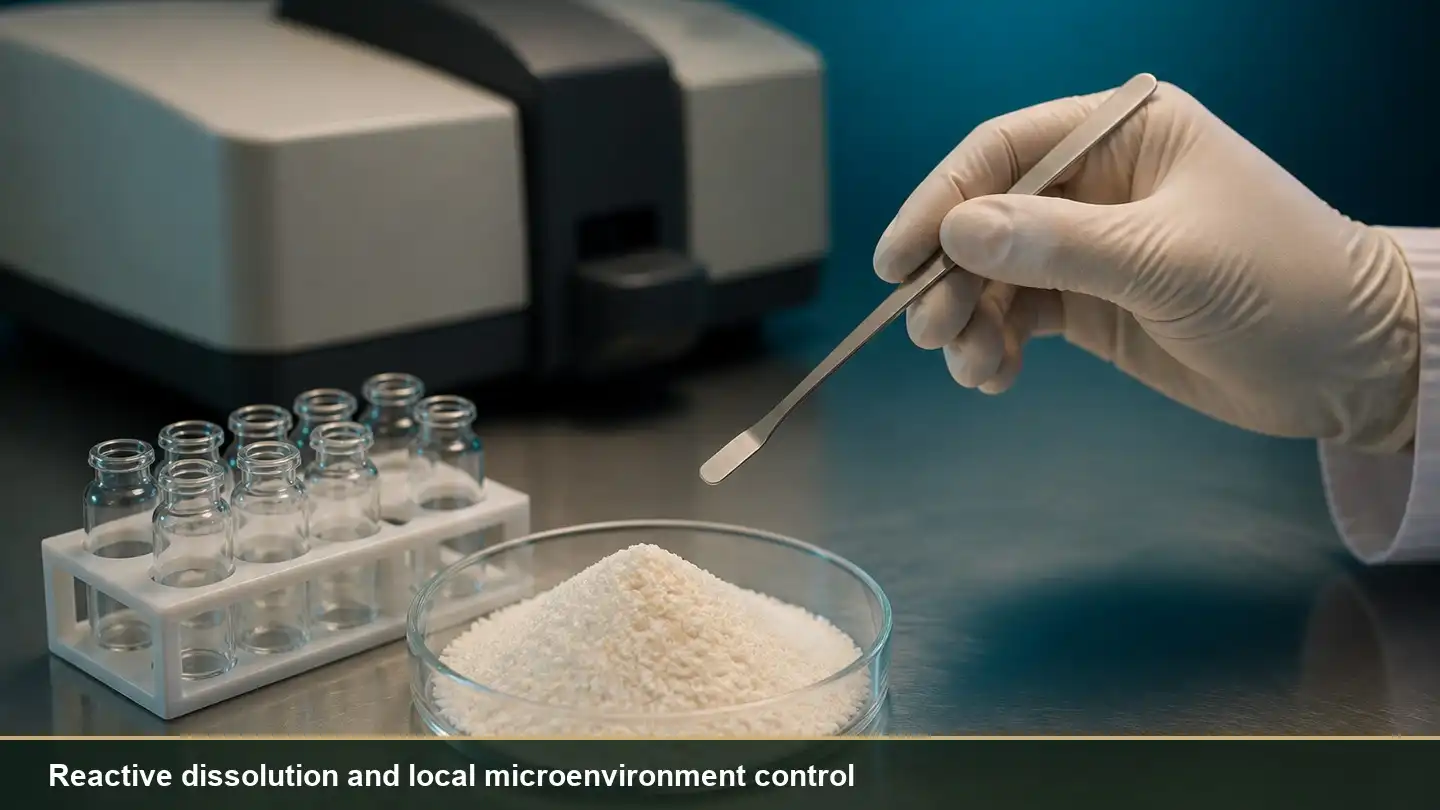
Inside the boundary layer around each dissolving particle, pH can fall below the bulk value and ion concentration can rise above it before bulk mixing restores equilibrium. A phospholipid bilayer is sensitive to exactly those variables. Lower pH alters headgroup ionisation; higher ionic strength screens surface charge and compresses the electrical double layer that keeps vesicles apart. Zeta potential — the practical readout of that electrostatic barrier — is therefore a property of the matrix you pour the powder into, not a fixed number attached to the ingredient. The measurement discipline behind size and distribution is described in our note on particle size and liposomal vitamin C powder performance.
 What the Bilayer Does in Response
With the repulsion barrier lowered, vesicle-to-vesicle contact becomes more likely and the distribution broadens over hours instead of holding steady. Three events are visible on the bench: turbidity that drifts and never settles to a stable reading; a lipid-rich film or ring forming as gravitational separation wins; and a pale deposit on the base of a chilled container. None of these means the active failed to dissolve. The active dissolved. They mean the colloidal carrier was destabilised by the act of dissolution.
Symptom, Mechanism and Control
The table below lists the symptoms specific to a water-soluble, acid-bearing encapsulated powder, the mechanism behind each, and the production control that addresses it.
| Symptom in the beverage | Most likely mechanism | Production-side control |
|---|---|---|
| Haze that drifts and never stabilises | Free acid dissolving in the boundary layer while the vesicle population redistributes | Pre-disperse in a dilute phase; compare turbidity at day 0 and after a defined standing period |
| Off-white film or ring at the surface | Lipid fraction separating upward once charge screening lowered the repulsion barrier | Reduce local ionic shock; increase dilution volume at the addition point |
| Compact deposit on the container base | Vesicle aggregation and settling after compression of the electrical double layer | Stage the addition; keep continuous, moderate mixing through filling |
| Finished pH below the predicted value | More free, unencapsulated acid than the lot specification implied | Check encapsulation efficiency per lot; reconcile the acid term in the pH model |
| Yellow to brown drift over hours or days | Acid-assisted degradation with trace-metal catalysis | Control water quality and contact materials; use a food-grade sequestrant; run an accelerated colour check |
| Lumps or caked bridges in the supplied bag | Hygroscopic fraction taking up moisture above its critical relative humidity | Store sealed and dry; use containers promptly; check moisture at receipt |
Mechanism Two: Moisture Uptake and Caking
Free ascorbic acid is hygroscopic. Above its critical relative humidity the powder takes up moisture, builds liquid bridges between particles, and the bulk shifts from free-flowing to lumpy. Our guide to storing liposomal vitamin C powder covers the storage conditions that keep this in check.
On a line, a partially caked powder changes feeding behaviour before anyone records a specification failure: screw feeders deliver uneven mass, sachet fill weights drift, and acid degradation can begin inside the pack while the powder still looks acceptable. Humidity and packing decisions also shape how long the material holds specification, as discussed in the factors that affect shelf life.
Mechanism Three: Acid, Metal Ions and Colour Drift
Acid and heat accelerate ascorbic acid degradation, and trace transition metals catalyse the oxidative route. Because the material is supplied as a light yellow to off-white fine powder, early change is easy to miss unless a retained reference is kept beside the line. Metal traces reach the blend from process water, from contact materials and from other ingredients such as mineral salts, so the first control is source reduction and the second is a food-grade sequestrant used at a level your sensory panel accepts — a chelator adds ions of its own. Behaviour specific to this grade is reviewed in vitamin C stability in liposomal solutions. Confirm the outcome in your own matrix with an accelerated colour check rather than assuming it.
The Four Concentration Grades Change the Problem Profile
EmerWell supplies 10%, 20%, 25% and 50% grades. Concentration is usually framed as a cost-and-dosing question, but it also decides which failure mode dominates.
| Grade | Acid load per gram | Powder mass to disperse | Dominant dispersion risk |
|---|---|---|---|
| 10% | Lowest | Highest | Carrier solids drive sediment load, mouthfeel and fill-weight accuracy |
| 20% | Moderate | Moderate | Balanced; tune the addition sequence to the target viscosity |
| 25% | Standard | Standard | Common starting point; verify the pH prediction in your own matrix |
| 50% | Highest | Lowest | Sharp local acid and ionic shock at the addition point |
The 50% grade delivers the acid load in the smallest powder mass, which suits compact formats but concentrates the local ionic and acid shock at the addition point. The 10% grade spreads the acid load but asks you to disperse several times the powder mass, so carrier solids begin to influence mouthfeel, fill-weight accuracy and the sediment load in a finished bottle. The 25% grade sits between the two and is the usual starting point.
Controlling the Dissolution Rate, Not the Water
The objective is not to break droplets apart; it is to make a dissolution event gentle and evenly distributed.
Order of Addition and Dilution Sequence
Pre-disperse the powder in a small volume of the beverage or of water, then add that pre-mix to the main batch under continuous motion. Never tip the full charge into a concentrated phase or into a still tank; introduce it into the most dilute, best-agitated region available. Manufacturing route matters here as well, as covered in dry versus liquid manufacturing technology.
Buffering and Ionic Strength Management
If the beverage already carries a buffer system or electrolytes, the local spike is cushioned. Sequence additions so the powder meets a partially buffered phase rather than plain water. Then verify: measure the pH of the finished blend against the value your formula predicts. A lower-than-expected pH indicates more free acid than the model assumed. The variables that govern this grade in solution are set out in the factors influencing solubility.
Shear and Temperature: Keep Both Mild and Defined
High shear is the wrong reflex for this ingredient. Use enough agitation to keep the suspension moving, avoid prolonged intense shear, and accept that warm water wets a lipid-rich powder faster while also accelerating acid degradation. Set a temperature window, hold it, and record it on the batch sheet.
Standing Time and Pre-Fill Inspection
Let the blend stand for a defined period after the last addition, then sample before filling. Compare turbidity and colour against a retained reference and re-measure size distribution on a redispersed sample. The test menu is described in the quality tests used for this powder, and the appearance a well-dispersed system should present is illustrated in our note on what liposomal products actually look like.
Specifications Worth Writing Into Your Agreement
The values below are the specification points for this grade. Keep them as the receiving baseline rather than restating them as marketing copy.
| Parameter | Specification |
|---|---|
| Appearance | Light yellow to off-white, free-flowing fine powder |
| Concentration grades | 10%, 20%, 25%, 50% |
| Encapsulation efficiency | 85%–95% |
| Cold-water behaviour | Disperses readily with no stratification; suited to ready-to-mix formats |
| Lead | <0.5 ppm |
| Total plate count | <1000 cfu/g |
| Test methods | HPLC, DLS, TEM, iodometric titration |
| Light and heat tolerance | Enhanced, with a lower degradation rate than unprotected ascorbic acid |
| Clean label options | Gluten-Free, Non-GMO, Vegan-friendly, Soy-Free |
The material is produced under cGMP, ISO 9001:2015, ISO 22000, Kosher and Halal schemes, in the framework described in our overview of manufacturing standards for quality liposomal vitamin C powder, with clean-label options of Gluten-Free, Non-GMO, Vegan-friendly and Soy-Free. Where your market imposes further requirements, confirm them with the relevant local authority, because rules differ by region.
Partner With EmerWell
If you are specifying a beverage, sachet or ready-to-mix format, EmerWell can supply the technical file you need to qualify the ingredient: specification sheet, certificate of analysis, method summaries for HPLC, DLS, TEM and iodometric titration, and a sample for your own matrix trials. Start from the liposomal vitamin C powder product page or write to info@emerwell-bio.com with your matrix and process conditions.
References
Yin X, Chen K, Cheng H, et al. Chemical Stability of Ascorbic Acid Integrated into Commercial Products: A Review on Bioactivity and Delivery Technology. Antioxidants (Basel), 2022. https://pmc.ncbi.nlm.nih.gov/articles/PMC8773188/
Enhanced Stability of Oral Vitamin C Delivery: A Novel Large-Scale Method for Liposomes Production and Encapsulation through Dynamic High-Pressure Microfluidization. Nanomaterials (Basel), 2024. https://pmc.ncbi.nlm.nih.gov/articles/PMC10975307/
Quality by Design-Driven Zeta Potential Optimisation Study of Liposomes with Charge Imparting Membrane Additives. Pharmaceutics, 2022. https://pmc.ncbi.nlm.nih.gov/articles/PMC9503861/
Vitamin C fortification: need and recent trends in encapsulation technologies. Frontiers in Nutrition, 2023. https://pmc.ncbi.nlm.nih.gov/articles/PMC10517877/
Integrated Analytical Approach to Identify Whey Permeate Powder Caking: Revealing Internal Structure Using X-Ray Micro-Tomography. Molecules, 2026. https://pmc.ncbi.nlm.nih.gov/articles/PMC13209891/
Disclaimer: EmerWell is a supplier of liposomal raw materials. This article covers ingredient processing and system behaviour in beverage manufacture only. It is not medical advice and is not intended for the evaluation of any health condition.
Online Message