

Oct 15, 2026
Can Liposomal NAD+ Powder Be Used in Functional Food and Nutraceutical Products?
Ask whether liposomal NAD+ powder can be used in functional food and nutraceutical products, and the only defensible answer is: it depends. EmerWell supplies liposomal NAD+ powder as a bulk raw material, and its physical profile — a pale yellow to white, free-flowing powder that wets out readily in water to form a stable colloidal suspension — makes it a realistic candidate for many formats. But feasibility is not a property of the powder alone. It is decided by three factors acting together: whether the intended dose form can carry and process the material, whether the target market permits the ingredient, and whether the documentation behind it is strong enough to support what the brand wants to say.
The Short Answer: A Feasibility Question, Not a Yes-or-No
For a formulator, “can it be used?” is three questions rather than one, and a workable yes requires all three to pass. A powder can be technically elegant and unusable in a chosen market, or permitted yet unable to fit a stick pack or a gummy base. Approaching feasibility as a checklist rather than a single verdict keeps development programmes out of late-stage dead ends.
Three Preconditions That Decide Feasibility
Before formula work begins, three preconditions should be settled; if any one fails, the application is not feasible in its current form.
1. Dose-Form Process Feasibility
First, the format must be able to carry the ingredient. A powder sachet, a stick pack, an RTM beverage, a gummy and a compressed tablet each impose different constraints on powder load, dispersion and moisture. The grade selected matters: the material is offered across a 10%–70% NAD+ range, with 50% positioned as the recommended grade for premium formulas, and the grade decides how much powder a unit must hold to reach the intended active content. Because loading sits inside the blend, a change in grade is rarely a label-only change, so a sense of how liposomal NAD+ powder is manufactured helps a team plan the re-validation that follows.
2. Regulatory Permissibility in the Target Market
Second, permissibility is jurisdiction-specific. The same ingredient can be handled one way when positioned as a conventional food and another when sold as a dietary supplement. What is routine in one country may call for a pre-market notification, a novel-food assessment or a different set of labelling conditions in another. Buyers who raise these questions early should also ask a supplier what safety certifications to look for when selecting liposomal NAD+ powder, because certification scope and market permission are two different things.
3. Documentation and Testing Support
Third, the documentation must stand behind the physical material. A specification sheet, a batch certificate of analysis, stability data and ingredient statements are what allow a brand to register a product and repeat a result. Where a claim depends on a test, the method has to be named and traceable. The same discipline applies when evaluating the purity and quality of liposomal NAD+ powder before buying: numbers mean something only when the method and batch reference travel with them.
Matching the Powder to the Dose Form
Even a passing material still has to fit a specific format. The table below shows how the main formats differ in what they ask of the powder.
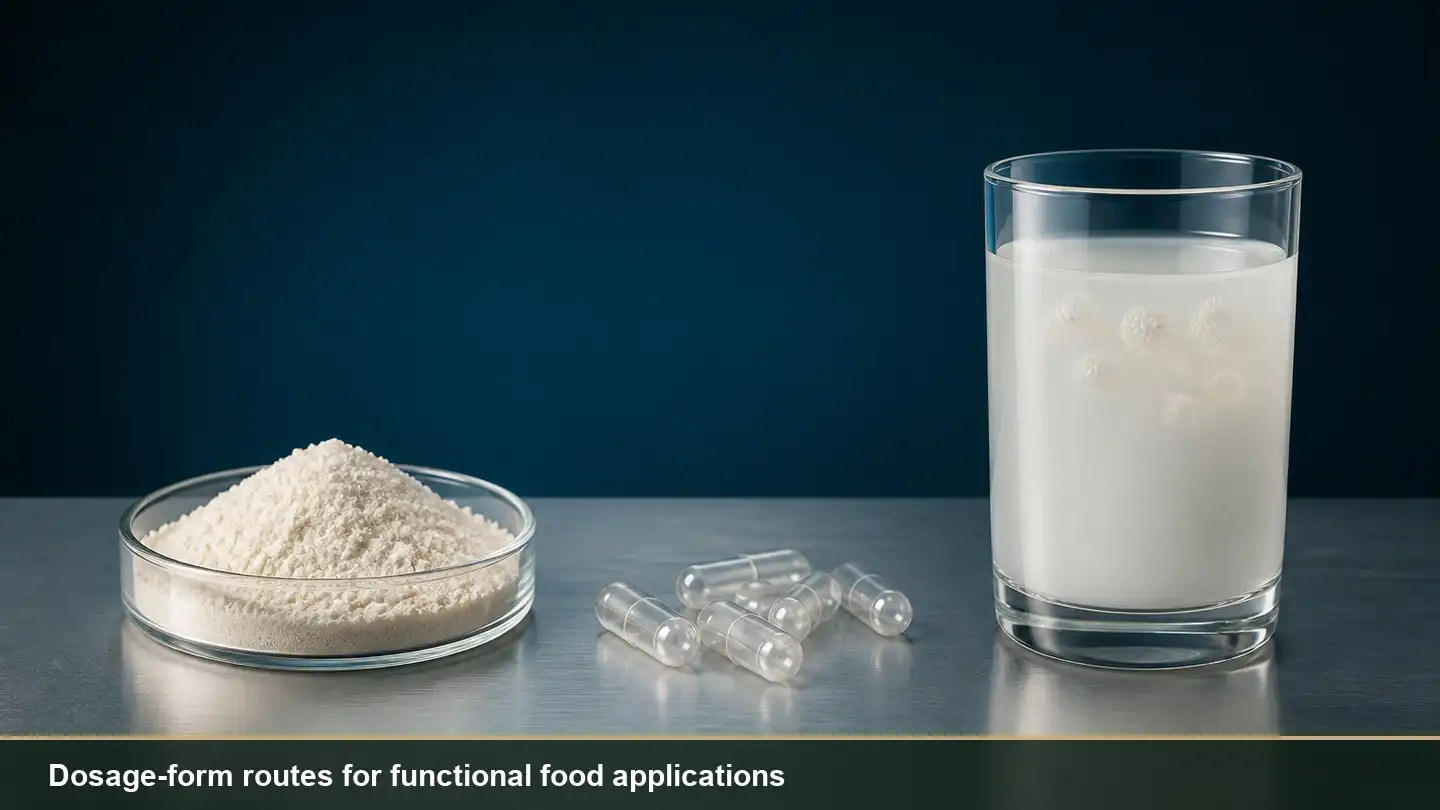
| Dose form | Powder load it can carry | Dispersion and fill uniformity | Caking and moisture risk | Colour behaviour |
|---|---|---|---|---|
| Powder sachet / stick pack | High — suits lower-potency grades | Free flow and lump-free wetting | Moderate; hygroscopic powder needs line humidity control | Minimal effect in pale or clear bases |
| Ready-to-mix (RTM) beverage | Moderate — balanced against taste and body | Must form a stable colloidal suspension and resist settling | Higher; reconstitution and storage expose the powder to moisture | Low across the pale yellow to white range |
| Gummy | Low to moderate — limited by texture and flavour | Must disperse evenly through the base before setting | High; water activity in the base interacts with the powder | Needs review where the base is lightly tinted |
| Tablet or capsule | Variable — set by unit size and fill weight | Blend and content uniformity must be controlled | Moderate; low-moisture matrices suit compression | Minimal in opaquely coated systems |
No route is inherently better; each shifts the engineering effort. Whichever is chosen, packaging and storage should be planned against a shelf-life target from the outset, and it is worth reviewing what factors affect the shelf life of liposomal NAD+ powder first.
Ready-to-Mix Beverages Under the Closest Scrutiny
An RTM or instant-drink application puts dispersion behaviour under the tightest watch. The ingredient is designed for high water dispersibility and forms a stable colloidal suspension rather than settling out, which keeps a reconstituted drink visibly consistent from first sip to last. Formulators exploring this route can review the wider set of applications of liposomal NAD+ powder in wellness products before choosing a base.
Gummies and Tablets as Load-Management Problems
A gummy base carries only so much powder before texture and flavour suffer, and a tablet must hold together under compression while breaking down as intended. In both, the grade interacts with the moisture of the surrounding matrix, so these formats reward early prototyping.
Formulation Essentials: Dispersion, Moisture and Handling
The powder is engineered for high water dispersibility, forming a stable colloidal suspension rather than clumping. That behaviour is the practical opposite of ordinary NAD+ powder, which tends to cake and resist wetting. Maintaining that performance is largely a matter of moisture discipline. Liposomal powders are hygroscopic, so water activity in the surrounding matrix, and humidity on the plant floor, both shape whether a blend stays free-flowing over time.
Good practice starts with controls that are easy to overlook: keeping blending and filling rooms within a defined humidity band, limiting how long an opened pouch stays exposed, and resealing part-used packs. Packaging and storage carry much of the remaining load, and the principles sit behind this guide to improving liposomal NAD+ powder stability. Appearance works the same way: the ingredient runs from pale yellow to white, so in pale, clear or lightly coloured systems its contribution is minimal, while a strongly tinted system may call for a masking strategy. For how transparent formats handle these powders, see what liposomal products actually look like.
Co-Blending and Compatibility Testing
Most commercial formulas are blends, so compatibility is a design input rather than an afterthought. The disciplined approach is a small, structured trial rather than a judgement based on appearance in a single batch. A usable protocol asks three questions: does the blend stay homogeneous, does it stay free-flowing, and does its appearance remain stable under the conditions the finished product will meet?
In practice that means preparing representative binary and multi-component blends, holding them under accelerated conditions alongside an ambient reference, and reading a fixed set of indicators on a schedule — flow and caking, colour drift, odour, moisture uptake and, where relevant, the physical state of the suspension after reconstitution. The goal is to generate data on the specific combination a project intends to use; any blend change later should be re-tested on the same basis.
The Regulatory View: It Depends Where You Sell
Regulatory permissibility is the precondition most often assumed rather than checked. NAD+ as a food or dietary-supplement ingredient is handled differently across jurisdictions, and the same substance often falls under separate frameworks depending on whether it is offered as a conventional food or as a dietary supplement. In the United States, dietary supplements and their ingredients are overseen under a distinct set of rules from conventional foods, administered by the U.S. Food and Drug Administration under the Dietary Supplement Health and Education Act. In the European Union, ingredients without a significant history of consumption before 1997 can fall within the novel food framework, which EFSA assesses and the European Commission and member states authorise.
These examples show how far the frameworks diverge; they say nothing about any single ingredient’s status. EmerWell supplies raw materials and cannot determine whether a given ingredient is permitted in a given market or category. Confirm permissibility with the competent authority for each destination market, or a qualified regulatory consultant, before committing to a formula and a label. This article reaches no compliance conclusion and is no substitute for that confirmation.
The Documentation Package to Request
Documentation turns a promising sample into a repeatable product. A supplier should provide a specification sheet, a batch certificate of analysis, supporting stability data, and the ingredient statements a brand needs for its market — Non-GMO, Vegan and Gluten-Free among them — with the test methods named for every parameter that carries a claim. For the batch paperwork itself, see what a liposomal NAD+ powder certificate of analysis should include.
Methods matter as much as numbers. Here, content is measured by HPLC, particle size by DLS and morphology by TEM; a specification without its methods is only half a specification. The parameter set to request, taken from the material’s own data sheet, is below. Buyers who want to go deeper can review the testing methods used to verify liposomal NAD+ powder quality.
| Parameter | Specification |
|---|---|
| NAD+ content | 10%–70% (customizable); 50% recommended for premium formulas |
| Encapsulation efficiency | 85%–95% |
| Appearance | Pale yellow to white, free-flowing powder |
| Dispersibility | High water dispersibility; forms a stable colloidal suspension |
| Lead (Pb) | <0.1 ppm |
| Total plate count | <1,000 cfu/g |
| Shelf life | Up to 24 months under correct storage |
| Analytical methods | HPLC (content), DLS (particle size), TEM (morphology) |
| Certifications | cGMP, ISO 22000, ISO 9001, HALAL, KOSHER, Non-GMO, Vegan, Gluten-Free |
Decision Table: Matching Scenario to Risk
One view of the three preconditions makes the trade-offs visible. The table below maps common application scenarios to the factor most likely to decide success, the risk that most often derails them, and the information to request from a supplier first.
| Application scenario | Key success factor | Main risk | What to request from the supplier |
|---|---|---|---|
| Powder sachet or stick pack | Free-flowing powder and consistent fill weight | Caking in pack or on the line | Specification sheet, COA and moisture-handling guidance |
| Ready-to-mix beverage | A stable colloidal suspension that does not settle | Poor dispersion or visible separation | Dispersibility data and a reconstitution sample |
| Gummy | Loading that fits texture and flavour limits | Moisture migration and uneven distribution | Recommended grade and compatibility data |
| Tablet or capsule | Content uniformity at the chosen fill weight | Blend segregation or compression problems | Grade guidance and blend-support documents |
| Multi-ingredient blend | Compatibility across all actives and excipients | Instability or interaction among ingredients | Accelerated stability data on representative blends |
Requesting Samples and Documentation from EmerWell
EmerWell supplies liposomal NAD+ powder as a bulk raw material for business-to-business customers and supports brands with the documentation a development programme needs. To discuss a format, or to request a specification sheet, certificate of analysis or a sample, visit the liposomal NAD+ powder product page or email info@emerwell-bio.com. The team can share the current specification, ingredient statements and stability data for the grade under consideration, so feasibility can be assessed against real documents.
References
1. U.S. Food and Drug Administration. Dietary Supplements. https://www.fda.gov/food/dietary-supplements
2. European Food Safety Authority. Novel Food. https://www.efsa.europa.eu/en/topics/topic/novel-food
3. Akbarzadeh, A., Rezaei-Sadabady, R., Davaran, S., et al. (2013). Liposome: classification, preparation, and applications. Nanoscale Research Letters, 8:102. https://pmc.ncbi.nlm.nih.gov/articles/PMC3599573/
4. Allen, T. M., & Cullis, P. R. (2013). Liposomal drug delivery systems: from concept to clinical applications. Advanced Drug Delivery Reviews, 65(1), 36–48. https://pubmed.ncbi.nlm.nih.gov/23036225/
Disclaimer: This article covers a bulk raw material supplied to business-to-business customers and is provided for technical and informational purposes only. EmerWell is a raw-material supplier and does not sell finished consumer products; it makes no representation about how a finished product may be positioned, labelled or described in any market. Consumer-facing wording, serving information and market-specific labelling remain the responsibility of the brand owner and must be assessed against the rules of the destination market. Nothing here is a legal or regulatory determination; confirm permissibility with your local competent authority or a qualified regulatory adviser.
Online Message