

Nov 3, 2026
What Makes a High-Quality Liposomal Vitamin C Powder for Nutraceutical Formulations?
A specification sheet for liposomal vitamin C powder can look complete and still leave a formulation team unable to answer one question: which result would make us reject this batch? In B2B terms, quality is not an adjective on a brochure. It is a short list of measurable properties, each with a defined method, a stated reporting basis and a limit a quality unit can apply on receipt. The six criteria below are written in that form, covering assay against label, encapsulation efficiency, particle size as dynamic light scattering reports it, appearance as an oxidation signal, moisture with lead and microbial load, and dispersion in cold water.
Why an Attribute Only Counts as a Release Criterion
Two habits separate a working specification from a decorative one. Measure the material as it is shipped, not a dispersion prepared differently in every laboratory. And state the basis of every percentage, because a powder holding several percent moisture reads differently as-is than on an anhydrous basis. A wider view of the test menu sits in this review of quality tests for liposomal vitamin C powder.
| Attribute | Why it matters in the formulation | How it is measured | Release criterion |
|---|---|---|---|
| Assay versus label | Carrier dilutes the active, so label maths depends on grade | HPLC on the finished powder, as-is and anhydrous | Within tolerance of declared content, on a named basis |
| Encapsulation efficiency | Separates vesicle-held active from free active | Free fraction removed, vesicles disrupted, then assayed | 85% to 95% by the declared method |
| Particle size and PDI | Governs redispersion, sediment and fill behaviour | DLS after fixed redispersion; TEM for morphology | Named distribution, median band, PDI limit, three replicates |
| Appearance and colour | First visible evidence that oxidation has begun | Comparison with a retained reference under fixed light | Not darker than reference; free-flowing, no caking |
| Moisture | Free water drives hydrolysis, oxidation and caking | Karl Fischer or loss on drying, sample size stated | Limit fixed in the specification, method named |
| Lead | Mineral carry-over and equipment wear | ICP-MS, quantification below the limit | Below 0.5 ppm |
| Total plate count | No sterilising step downstream | Compendial plate count, conditions declared | Below 1,000 cfu/g |
| Dispersion | Decides stick pack and ready-to-mix viability | Timed cold-water dispersion, visual and sieve | No lumps or film; no stratification in the window |
Criterion One: Assay and Label Consistency
Label consistency is arithmetic before it is analytics. A 20 percent grade carries one fifth active and four fifths carrier, so a unit must be filled with five times the label quantity in powder. If the assay sits two points below declaration, the delivered quantity falls by the same proportion unless fill weight is adjusted. That is why assay belongs on every lot certificate, not on one issued at development.
Which Basis the Percentage Is Reported On
Ascorbic acid is hygroscopic, and a dried liposomal matrix can hold several percent water while still flowing freely. One lot reported at 99 percent anhydrous and another at 95 percent as-is may be the same material, or four points apart. Ask for both values and the moisture result that connects them, then write the basis into the specification so a new analyst cannot compare unlike figures a year later. The certificate should also say whether the method reads ascorbic acid alone or total vitamin C after a reduction step.
Choosing Between the 10, 20, 25 and 50 Percent Grades
Grade selection is a mass balance. Divide the target label quantity by the fill weight the format can carry. A label quantity equal to half the fill weight points to the 50 percent grade; the same quantity in a stick pack carrying five times that fill weight points to 20 percent. Higher grades leave less carrier per unit of active, which reduces the phospholipid available to stabilise each particle, while lower grades protect better but consume fill volume. Carrier-system implications are set out in this note on manufacturing standards for liposomal vitamin C powder.
Criterion Two: Encapsulation Efficiency and Its Method
The range is 85 to 95 percent, measured by separating the free fraction and then releasing what sits inside the vesicles. That sequence is where the number is made or lost: damage the bilayer early and the result falls, leave free active in the retained fraction and it rises. The figure is only as good as the procedure behind it.
Sample Preparation Can Break the Vesicle First
High-shear mixing, heavy dilution, a shift in ionic strength, sonication used to speed dispersion, or a warm bath can all rupture vesicles. A preparation that looks tidy on paper may report 78 percent for material that would read 90 percent under gentler handling, and the buyer cannot tell which number describes the powder. Ask for the medium, dilution factor, separation technique and its centrifugation or filtration parameters, plus the temperature at each step.
Can the Number Be Recalculated?
Encapsulation should reconcile with assay. Encapsulated plus free ought to equal the total determined independently on the same lot, within method uncertainty. On a 20 percent grade reporting 92 percent encapsulation and 20.4 percent total ascorbic acid, a reviewer can check the arithmetic in a minute. A percentage with no supporting totals cannot be audited, and un-auditable criteria drift once the analyst who set them moves on.
Criterion Three: Particle Size and Distribution
"Uniform particles" is not a specification. Dynamic light scattering returns a mean, a polydispersity index and a distribution, and the shape of that distribution carries more information than the mean. Two batches with the same median near 200 nm behave differently if one has a long tail toward the micron range: that tail sediments in a stick pack and feels gritty in a dry mix, and the mean hides it.
Intensity or Volume: Which Distribution Is on the Report
DLS weights by scattered intensity, which scales steeply with diameter, so a small population of aggregates can dominate an intensity curve while a volume curve of the same sample looks clean. Neither is wrong, but they are not interchangeable. The report should name the weighting, give the polydispersity index, and show at least three consecutive measurements on one dilution. Transmission electron microscopy then shows whether particles are discrete or fused, a distinction scattering cannot make.
Batch Consistency Over a Single Good Number
One impressive measurement proves one sample was good. Consistency is what a process can be built around, and it is demonstrated with a trend: median size and polydispersity plotted lot by lot with the specification band drawn on the same chart. Ask for the last several lots rather than the best one, and ask whether the band came from capability data or a textbook. Downstream consequences are traced in this analysis of how particle size affects liposomal vitamin C powder.
Criterion Four: Appearance and Colour as an Oxidation Signal
The specification calls for a pale yellow to off-white, free-flowing fine powder. That sentence does more work than it appears to, because colour is the cheapest analytical instrument in the warehouse and it responds to the start of the degradation pathway rather than its endpoint.
Reading the Degradation Chain
Ascorbic acid oxidises to dehydroascorbic acid, which hydrolyses irreversibly to 2,3-diketogulonic acid and then fragments into products that polymerise into brown pigments. A batch that has darkened measurably has already travelled part of that path. The detail that matters is where the colour sits: oxidation begins at particle surfaces and in pockets where moisture and oxygen concentrate, while assay is a bulk average. A lot can pass assay while carrying a discoloured fraction that seeds further change in the pack.
How to Make Colour Judgement Repeatable
Colour assessment fails when done from memory. Retain a reference from a fully released lot, compare the new lot against it on the same day, in the same room, against a white card under fixed lighting, and record "not darker than reference" rather than "off-white". Read the observation alongside assay and, where the specification includes one, peroxide value by iodometric titration, since the three move at different speeds. Storage factors that accelerate the change are covered in this note on factors affecting shelf life of liposomal vitamin C powder.
Criterion Five: Moisture, Lead and Microbial Load
These three form the floor of any release decision and none can be inspected visually. Moisture matters because free water, not total water, drives hydrolysis of the phospholipid and the oxidation chain above; a powder that gains a fraction of a percent in transit can cake in a stick pack and lose flow on a capsule line. Name the method, the sample size and the limit, and report the result against that limit rather than as a bare number.
Criterion Six: Dispersion in Cold Water
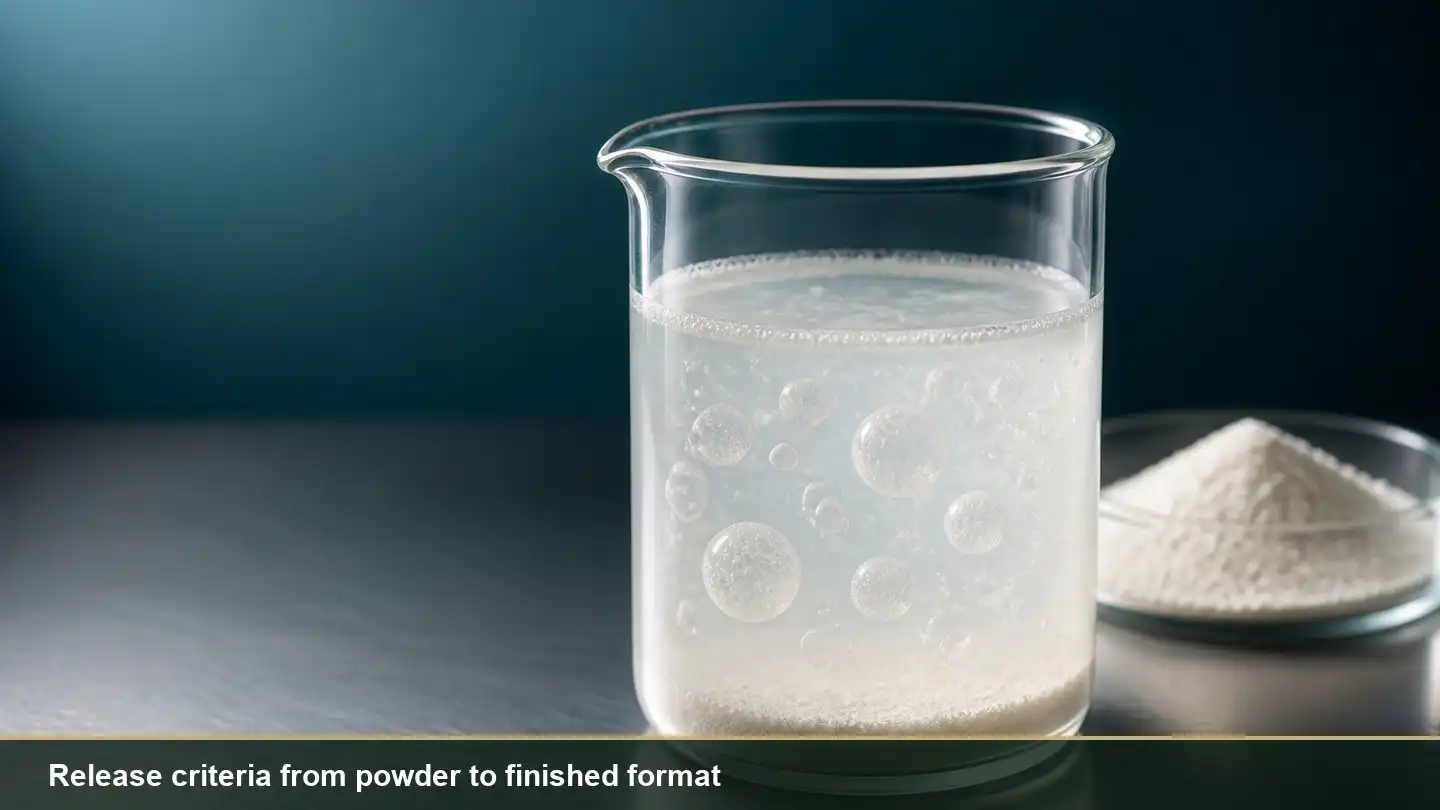
Specify dispersion rather than assume it, because phospholipid matrices wet unevenly. A powder that disperses cleanly in a beaker at 40 degrees may fail on a filling line at 15, and the gap surfaces as complaints instead of a rejected batch. Variables that shift the result are reviewed in this analysis of solubility factors for liposomal vitamin C powder.
Matching Criteria to Capsules, Stick Packs and Ready-to-Mix
One certificate supports three very different processes, and each punishes a different weakness. A criterion that never fails in one format can be the controlling one in another, so the specification should be read against the intended line rather than in the abstract.
| Format | Characteristic failure mode | Criteria that catch it | What to lock in the specification |
|---|---|---|---|
| Hard capsule | Fill weight variation and short fills as density and flow drift; moisture pick-up during encapsulation | Moisture, size distribution, density and flow, appearance | Density and flow ranges, moisture limit, grade matched to capsule volume |
| Stick pack | Segregation and static at low fill weights; hard caking after sealing; poor wetting by the user | Dispersion, moisture, size tail, colour | Cold-water method and observation window, moisture limit, reference colour |
| Ready-to-mix | Sediment and stratification on standing; visible colour change after reconstitution; uneven content across the batch | Dispersion and homogeneity, colour, assay, encapsulation | Homogeneity at the stated ratio, colour reference, assay tolerance on the mix |
Turning Criteria into a Specification That Survives Scale-Up
Release testing says what one lot is; trending says what the process is. Plot assay, encapsulation, median size and moisture lot by lot, and set internal alert limits inside the specification limits so drift is investigated before a lot is rejected. Three changes deserve fresh qualification rather than a paper review: a new phospholipid source, altered homogenisation pressure or passes, and a change of drying route. Each can move encapsulation and the size tail without moving assay, which is the combination that slips through a certificate-only review. Sampling also belongs in the specification: draw from more than one position, because a dried powder can stratify inside its own liner.
Documentation That Carries the Criteria
Every criterion above depends on a document that states it: a specification sheet naming methods, a batch certificate of analysis with results against each limit, a stability summary, and method references a second laboratory could follow. Manufacturing is covered by cGMP, ISO 9001:2015, ISO 22000, Kosher and Halal certification, with clean-label options available. Certification scope is a separate question from the technical criteria here and is covered in this guide to vitamin C powder certifications; the same release logic applied to a neighbouring ingredient appears in the liposomal glutathione powder line, and the stability background behind these figures is summarised in this discussion of vitamin C stability in liposomal systems.
Request a Specification and a Sample
Buyers who want to test these criteria on real material can request the current specification sheet, a batch certificate of analysis and a sample of the grade under consideration from the liposomal vitamin C powder page, or write to info@emerwell-bio.com with the intended format, target grade and the methods your quality team plans to run. Technical support covers method comparison, dispersion trials and the reporting conventions described above, so the specification you issue and the certificate you receive speak the same language.
References
1. U.S. Food and Drug Administration. Current Good Manufacturing Practice in Manufacturing, Packaging, Labeling, or Holding Operations for Dietary Supplements, 21 CFR Part 111. https://www.ecfr.gov/current/title-21/chapter-I/subchapter-B/part-111
2. International Council for Harmonisation. Stability Testing of New Drug Substances and Products, Q1A(R2). https://database.ich.org/sites/default/files/Q1A%28R2%29%20Guideline.pdf
3. Dewhirst, R. A., and Fry, S. C. The oxidation of dehydroascorbic acid and 2,3-diketogulonate by distinct peroxidative activities. Biochemical Journal, 2018. https://pmc.ncbi.nlm.nih.gov/articles/PMC6225978/
4. Giannakourou, M. C., and Taoukis, P. S. Effect of Alternative Preservation Steps and Storage on Vitamin C Stability in Fruit and Vegetable Products: Critical Review and Kinetic Modelling Approaches. Foods, 2021. https://pmc.ncbi.nlm.nih.gov/articles/PMC8619176/
Disclaimer: This article discusses raw material specifications and analytical release criteria for a dietary supplement ingredient. It is written for formulators, quality teams and procurement staff and is not medical or nutritional advice. Finished-product labelling, claims and regulatory compliance remain the responsibility of the brand owner for its target market.
Online Message