

Nov 6, 2026
Liposomal Resveratrol vs Nano Resveratrol: Key Differences Explained
Liposomal resveratrol and "nano resveratrol" are usually presented as two grades of one idea, the second simply smaller than the first. That framing hides the decision that actually matters. A liposomal resveratrol powder is defined by an architecture: a phospholipid bilayer enclosing an aqueous compartment. Most materials sold as nano resveratrol are defined only by a size band, and they may be emulsions, micelles or milled crystals with no aqueous core at all. Structure, not diameter, decides what can be claimed on a label, what can be measured on a certificate of analysis, and what a supplier should be asked to prove.
The Difference Is Structural, Not Dimensional
Both categories are colloidal, both can be dried into powders that redisperse in water, and both can be reported with a mean diameter in the low hundreds of nanometres. That overlap is why comparison tables built on size alone tell a buyer very little. The useful question is what the particle is made of and where the resveratrol sits inside it, because that fixes loading limits, dilution behaviour and the analytical method able to verify the claim.
What a Liposome Actually Is
A liposome forms when phospholipids close into a bilayer, with head groups facing water on both the inner and outer surfaces. The result is a real aqueous core separated from the continuous phase by a membrane. For a hydrophilic payload such as ascorbic acid, that core is the loading space. Resveratrol behaves differently: it is poorly water soluble and partitions readily into the hydrophobic region of the bilayer, so in a resveratrol liposome much of the payload occupies the membrane rather than the core. That distinction matters when a supplier describes core loading without saying which phase carries the molecule.
What a Nano-Emulsion or Micelle Actually Is
A nano-emulsion is an oil-in-water dispersion stabilised by surfactant and made by high-pressure homogenisation or high-shear processing. It has no aqueous interior: the droplet is oil, and the interface is a monolayer rather than a bilayer. A micelle is smaller and simpler, a surfactant aggregate that solubilises lipophilic molecules in its hydrophobic interior. A milled nanocrystal is the opposite extreme, pure crystalline resveratrol reduced in size with no carrier at all. Each of these can be sold under the same three-letter prefix, and none of them is a vesicle.
Comparing the Architectures Side by Side
The table is not a ranking, and the columns are not interchangeable. Read it as a map of what each architecture can support. Where a supplier cannot say which column their material belongs to, the specification is incomplete no matter what diameter is quoted. A complete guide to the ingredient is a reasonable starting point before that conversation begins.
| Aspect | Liposome | Nano-emulsion or micelle |
|---|---|---|
| Internal aqueous compartment | Yes, enclosed by a bilayer | None |
| Payload location | Bilayer membrane; core for hydrophilic actives | Oil droplet or micelle interior |
| Interface | Bilayer, typically phospholipid | Surfactant monolayer |
| Typical processing | Film hydration, then homogenisation and drying | High-shear or high-pressure emulsification |
| Dilution behaviour | Vesicle persists above its critical concentration | Droplet may coalesce; micelle dissociates below its critical concentration |
| Evidence of structure | Electron microscopy plus size distribution | Size distribution and surfactant declaration |
"Nano" on a Label Is a Question, Not a Specification
The word has no single agreed regulatory meaning. Some markets define an engineered nanomaterial by a size threshold and expect a specific safety dossier; others regard the term as a description rather than a category. A specification reading "nano resveratrol, 100 nm" therefore gives a number and says nothing about architecture, carrier composition, or the definition being applied. That gap is where procurement risk accumulates.
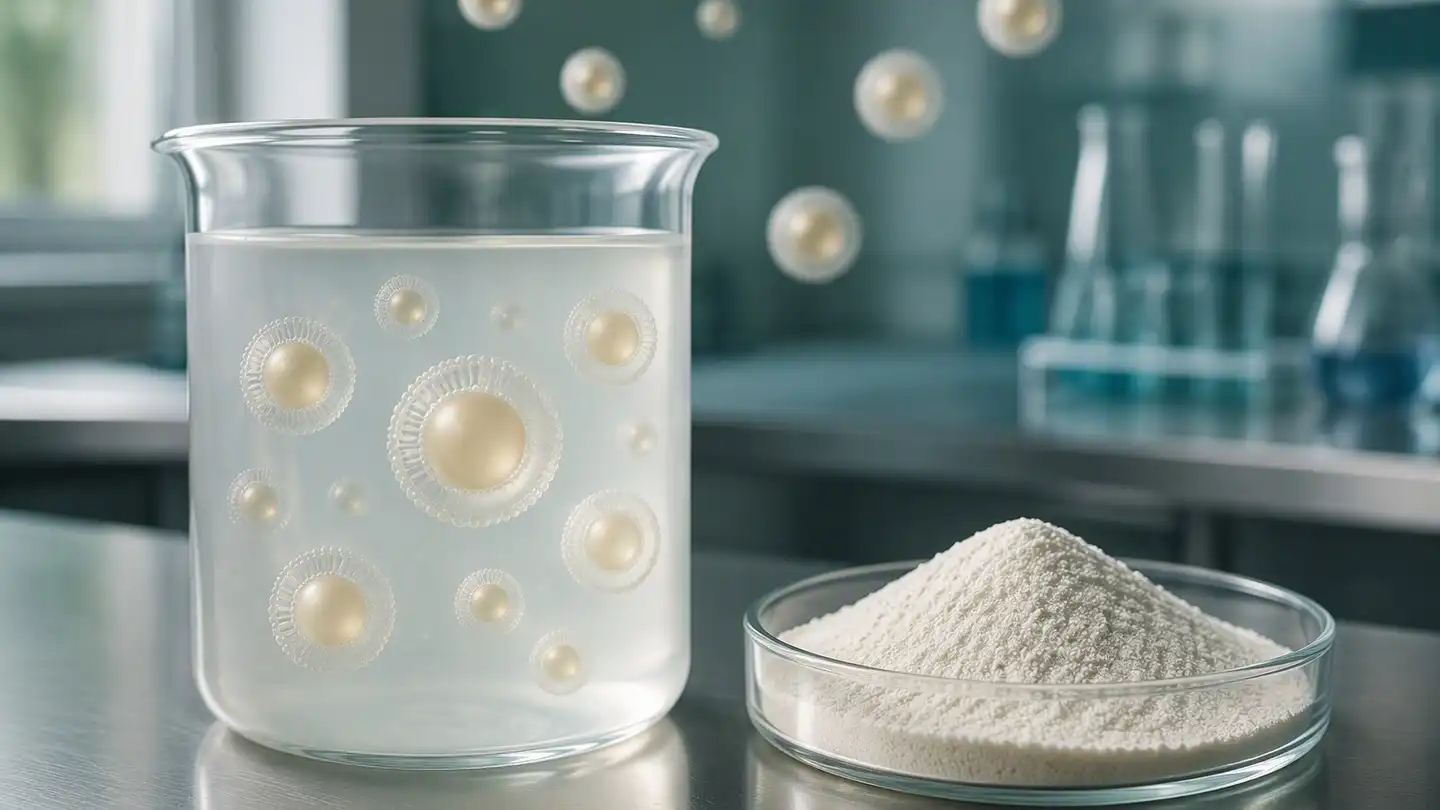
The term should start four questions rather than one. Is the material a vesicle, an emulsion, a micelle or a milled solid? What is the carrier made of, and is it declared on the ingredient statement? Which definition of nanomaterial applies in the target market? And does the technical dossier match the wording on pack? The last question produces most of the discrepancies, because label copy is often drafted long after the specification is fixed. Guidance on screening a liposomal resveratrol ingredient is useful precisely because it forces those questions into the first exchange.
A liposomal ingredient is measured on the same nanometre scale as a nano ingredient, so a brand that markets one as nano and the other as liposomal is drawing a structural line, not a size line. Even where the word is deliberately avoided, particle size still belongs in the specification, because it is a measurable property whether or not it appears on pack.
Particle Size: Intensity Distribution and Number Distribution
Dynamic light scattering does not return one size. It measures fluctuations in scattered light and converts them into a distribution weighted by scattering intensity. Intensity rises steeply with diameter, roughly with the sixth power in the Rayleigh regime and less steeply but still sharply in the Mie regime, so a minor population of large particles or aggregates can dominate the mean. The underlying delivery concept is often explained in structural terms for the same reason.
Instruments also report volume and number distributions, derived by applying Mie theory with an assumed refractive index. Those are calculated quantities, not independent measurements. Intensity, volume and number answers taken from one dataset can differ by a wide margin, and the divergence grows with polydispersity. This is the most common reason two laboratories disagree about a single lot while both are reading their own software correctly.
Reading a Supplier Claim
Supplier statements are usually true and rarely sufficient. The table pairs common wording with the document that would substantiate it, and with the reading rule that keeps a comparison fair. The same discipline applies when vetting a resveratrol powder supplier, where the paperwork trail matters more than the sample.
| Supplier statement | Document to request | How to read it |
|---|---|---|
| "Nano, under 100 nm" | Method statement naming instrument and weighting | A diameter without weighting is not comparable |
| "Liposomal, high grade" | Bilayer composition and carrier ratio | Grade language is not a specification |
| "High encapsulation efficiency" | Assay method and separation procedure | Efficiency depends on how free payload is defined |
| "99% trans-resveratrol" | Chromatogram showing the cis region | A table entry alone does not show a peak |
| "Two-year stability" | Protocol with a light-stressed arm | Ambient-only data do not cover photoisomerisation |
| "Cold-water dispersible" | Test conditions and reference standard | Ask for temperature, shear and time |
Payload, Encapsulation Efficiency and Isomer Purity
Three numbers are routinely conflated. Payload is the mass fraction of resveratrol in the finished powder and sets how much material a capsule or sachet must carry. Encapsulation efficiency is the fraction of that payload associated with the carrier rather than free in the continuous phase. Trans isomer content is a purity measure of the molecule itself, independent of any carrier. Each is measured differently, and none can be inferred from the others. Formulation work for OEM and ODM projects usually begins with exactly this separation.
Encapsulation efficiency is an operational definition before it is a property. Ultrafiltration, dialysis, centrifugal separation and solvent extraction return different absolute values on the same lot, because each defines free payload differently. A range of 85% to 92% is meaningful only when the method is named. Ask for the separation conditions, the assay, and whether the figure came from subtraction against a total assay.
Trans isomer content is where the molecule itself is specified. A claim of not less than 99% trans, with no cis peak on the chromatogram, is a statement about raw material quality and about process history. It should be supported by the chromatogram rather than a table entry, and by forced degradation data showing that purification and drying do not generate the cis form.
| Parameter | Range in our specification | Method |
|---|---|---|
| Resveratrol payload | 10%–50%, customisable | HPLC |
| Encapsulation efficiency | 85%–92% | Separation plus HPLC |
| Trans isomer | ≥99%, no cis peak reported | HPLC |
| Lead | <0.5 ppm | Elemental analysis |
| Total plate count | <1,000 cfu/g | Compendial plate method |
| Appearance | Off-white to pale yellow | Visual |
| Particle size | DLS with weighting stated per lot | DLS and TEM |
| Shelf life | 24 months | Stability protocol |
Light, Heat and the Trans to Cis Shift
Trans-resveratrol absorbs ultraviolet light and isomerises to the cis form in solution. The reaction is photochemical, so exposure drives it more than temperature alone, though warmth and light together accelerate the change. The two isomers differ in solubility and crystal packing, so a shift appears in assay, in colour, and eventually in dispersion behaviour.
Process control is therefore mostly about excluding light and limiting thermal load. Opaque or amber vessels, short residence times during homogenisation, and drying conditions that do not hold the material wet and warm for long periods all reduce the opportunity. Packaging follows the same logic: an opaque pouch with a moisture barrier does more for isomer content across a shelf life than a desiccant alone. Bulk supply arrangements should state those conditions in writing rather than leaving them to assumption.
Verify rather than assume. A release test at time zero will not reveal a slow photochemical drift. Forced degradation under controlled light exposure, plus a stability protocol with an illuminated arm, is the only way to know whether a 99% trans specification survives to the end of the declared shelf life. Ask whether the stability data include light stress and whether the assay reports cis separately, or only as a difference from the main peak.
Dispersibility and What the Powder Looks Like
A liposomal resveratrol powder should disperse in cold water into a translucent colloidal system, with colour between off-white and pale yellow. Visible grit, a film on the vessel wall, or a settle that does not redisperse after gentle agitation all point to aggregation. Aggregation is a structural failure: once vesicles fuse, the bilayer architecture and the encapsulation measured at release no longer describe what is in the sachet. Powder and liquid formats diverge here, and the trade-off is worth settling before the format is fixed.
Test the material the way the finished product will use it. Weigh a fixed quantity into water at the temperature your process runs, apply the shear your equipment provides, and observe at five and at thirty minutes. Compare against a retained reference lot rather than a photograph. Record transmission through a fixed path length if an instrument is available; that reading alone detects batch-to-batch drift.
A Purchase Sequence That Holds Up
Start with the architecture the product needs and the claim intended, then work back to the measurements that support it. A clear beverage puts dispersion and aggregate control ahead of a headline diameter. A two-piece capsule puts payload and flow first. Write the reporting basis into the specification before samples are requested, so every quotation is answered on the same terms. A look at how the encapsulated form compares with unencapsulated resveratrol helps confirm whether the structural premium is being evaluated at all.
EmerWell supplies liposomal resveratrol powder at 10% to 50% payload, with encapsulation efficiency of 85% to 92% and trans isomer content of not less than 99%. Certificates of analysis, method statements and dispersion data are available on request, together with samples for bench work. The liposomal raw material range lists the current portfolio, and enquiries can be sent to info@emerwell-bio.com.
References
- U.S. Food and Drug Administration. 21 CFR Part 111, Current Good Manufacturing Practice in Manufacturing, Packaging, Labeling, or Holding Operations for Dietary Supplements. ecfr.gov
- U.S. Food and Drug Administration. Dietary Supplements Guidance Documents. fda.gov
- European Food Safety Authority. Health Claims. efsa.europa.eu
- United States Pharmacopeia. Standards and General Chapters. usp.org
This article is written for formulators, quality teams and procurement staff evaluating ingredients. It is not medical or nutritional advice, and it makes no claim about any finished product.
Online Message