Oct 9, 2026
Liposomal Omega-3 Powder for Children’s Nutrition Products: Key Formulation Factors
Formulators working on products for the children’s nutrition aisle rarely start from a blank page. The ingredient has to survive a short label, a mild sensory target, and a format that is more often a stick pack, a chewable or a drink mix than a capsule. Liposomal omega-3 powder was built for that brief: EPA and DHA carried inside phospholipid bilayers and spray-dried into a free-flowing powder that disperses in cold water. The published specification for liposomal omega-3 powder tells you what the ingredient is; the harder work begins when that powder meets a flavour system, a filling line and a shelf-life target.
Why the Category Changes the Ingredient Brief
Three constraints separate a children’s nutrition project from general supplement work. Sensory tolerance is narrower, because the finished format is often tasted directly rather than swallowed whole, so any oily or chalky note is far less forgiving. Formats skew toward dry blends, sachets, chewables and drink mixes, which expose the powder to air, moisture and shear differently from a softgel. And the documentation bar is high, because the brand owner has to assemble a labelling and compliance file for every market it sells into.
These are process and sensory constraints rather than health arguments, and they are what this article covers. The underlying technology is described in this overview of the science behind liposomal omega-3 powder formulation, and the shift from liquid fish oil toward a new generation of fish oil ingredients frames the brief.
Reading the Specification in Bench Terms
A specification is a set of numbers; a formulation is a set of interactions. The table below restates the published specification for this ingredient in terms of what each value changes once the powder is in a blend — the same screening logic that applies when buyers compare liposomal omega-3 bulk powder options.
| Parameter | Published specification | What it changes at the bench |
|---|---|---|
| Appearance | Off-white to light yellow, fine free-flowing powder | How easily it blends into a pale mix without an off-colour |
| Concentration | 10%–25%; standard DHA 10%, EPA 5% | The mass needed to hit a label target, and therefore fill weight and sachet size |
| Encapsulation efficiency | Greater than 85% | How much oil is held inside the bilayer versus sitting free on the particle surface |
| Peroxide value (POV) | Below 2 meq/kg (iodometric titration) | The oxidation starting point, and how much headroom remains across the shelf life |
| Particle size (DLS) | Uniform distribution | Smoothness on the tongue versus a gritty, coarse tail |
| Water dispersibility | Water-dispersible; stable suspension in cold water, no oil separation | Whether the powder can be reconstituted cold rather than dispersed with heat |
| Heavy metals (Pb) | Below 0.5 ppm | Contaminant control documented per batch |
| Total plate count | Below 1,000 cfu/g | Microbiological control documented per batch |
Sensory: Masking the Fishy Off-Note and Building the Flavour System
How Encapsulation Keeps the Oil off the Palate
The marine note in a fish-derived powder comes mostly from oxidation products and from oil exposed on the particle surface. Encapsulation efficiency above 85% means the large majority of the EPA and DHA is held inside the phospholipid bilayer, so less free oil is available to volatilise in the mouth. That is a structural property of the powder, not something a flavour house can fix after the fact, which is why sensory problems are best resolved at the ingredient stage rather than by adding more masking agent. The taste and stability issues reported with liposomal omega-3 powders follow this pattern closely.
Designing the Flavour System Around the Powder
Even a well-encapsulated powder carries a faint marine base note, and in a directly tasted format it has to be matched rather than hidden. Masking works best when the flavour system complements the carrier: citrus or vanilla, a mildly acidic fruit system and a cocoa base each interact with the powder differently, and the sweetener level changes how much of the base note is perceived. Taste the powder hydrated at the target use level, inside the finished matrix rather than in water alone, and re-taste after accelerated storage, because the system that works on day one is not always the one that still works at the end of the shelf life.
Oxidative Stability: Managing Peroxide Value
Why POV Is the Number to Watch
Omega-3 oils oxidise, and the first measurable sign is a rising peroxide value. This ingredient is specified at a POV below 2 meq/kg, which sets a low starting point; the formulator’s job is to keep it low through blending, filling and storage. Because POV is measured by iodometric titration on the batch, it is one of the few stability parameters that can be checked on the incoming COA and again on a retained sample, giving a direct read on whether the powder gained oxidation during handling. The stability challenges in liposomal omega-3 powder formulations are largely a study of this single number.
| Stage | Oxidation risk | Control measure | What to check |
|---|---|---|---|
| Raw powder on receipt | Baseline value already elevated | Supplier specification and batch COA | POV on the incoming certificate |
| Dry blending | Air entrainment, heat from shear | Short, low-shear blend; limit open time | POV on a blended retained sample |
| Filling and headspace | Residual oxygen sealed in the pack | Nitrogen flush; minimal headspace | Pack integrity and flush record |
| Storage | Temperature and moisture drive the reaction | Foil laminate; cool, dry storage | POV at accelerated and real-time intervals |
Cold-Water Dispersion and Suspension Stability
Avoiding Oil Separation and Ringing
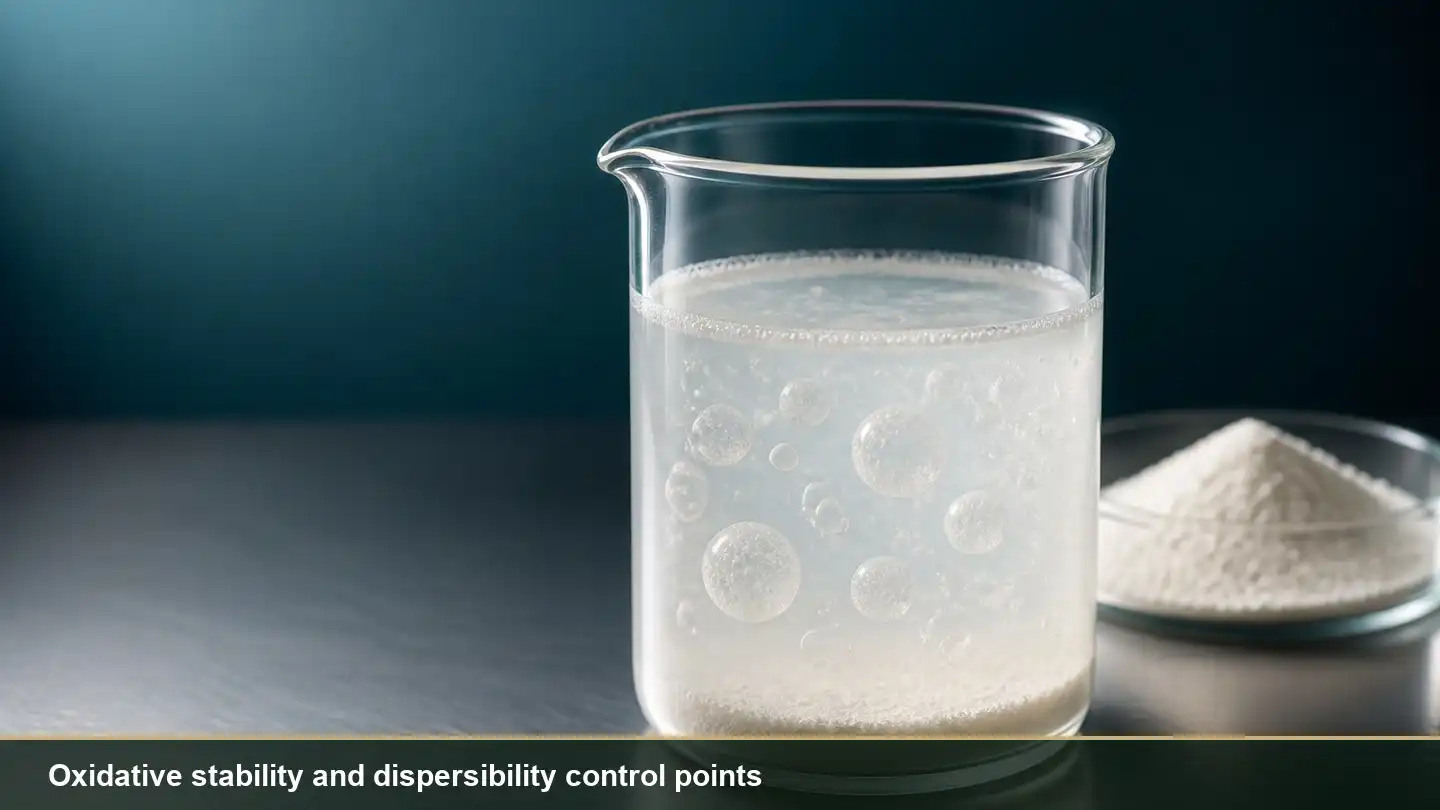
The commercial advantage of a water-dispersible powder is that it can be reconstituted cold, without the heat that would drive off volatiles or stress the matrix. A well-made liposomal omega-3 powder forms a stable, slightly translucent suspension in cold water and holds it without an oily film or a ring at the meniscus. Oil separation is the failure to watch for, and it usually traces back to encapsulation efficiency, to a particle size distribution that is too broad, or to an over-aggressive blend that has sheared the bilayer. Run reconstitution as a routine release test, because a suspension that looks clean in a beaker at the bench can behave differently once a drink mix is stored in a sachet. The beverage case is covered in more depth in this guide to using liposomal omega-3 powder in beverage formulation.
Particle Size, Mouthfeel and Grittiness
In a directly tasted format, particle size is a sensory variable as much as a stability one. A uniform distribution produced by controlled high-pressure homogenisation reads as smooth on the tongue; a broad one, with a coarse tail, reads as gritty even when the average size is acceptable. Dynamic light scattering gives the distribution rather than a single number, so ask for the full curve and not only a mean, and check how that curve moves after blending and storage.
Powder Flowability and Fill Weight in Sachets and Stick Packs
Much of the children’s nutrition category is filled by weight into small sachets and stick packs, and a free-flowing powder is what keeps that fill weight consistent. Flow behaviour depends on particle shape, moisture pickup and the level of anti-caking or flow aid in the blend. A powder that is free-flowing on receipt can begin to bridge in a hopper once it has absorbed moisture during an open blend, and the failure usually shows up as short fills or weight drift rather than as an obvious defect. Keep hygroscopic co-ingredients to a minimum, control the blend-room humidity, and confirm flow after the powder has been held as well as when it is fresh. The format trade-offs are set out in this OEM guide for liposomal omega-3 powder.
Packaging and Shelf Life
Oxidation and moisture pickup are both accelerated by headspace oxygen and water vapour, so the package is part of the formulation. Nitrogen flushing, vacuum and multi-layer foil laminates are the standard tools, and the same powder held in a single-layer bag versus a foil laminate will not age at the same rate. Specify the package alongside the ingredient, establish whether the sachet or stick pack will itself be nitrogen-flushed, and design the shelf-life study around the real package rather than the laboratory jar. This ingredient is produced by high-pressure homogenisation followed by spray drying, a route described in this account of how liposomal omega-3 powder is produced, and the drying route and package together determine how much of the starting quality survives to the end of the shelf life.
Allergen Control and Purity Documentation
Marine-sourced omega-3 brings a fish allergen question that is answered by the source and by the documentation rather than by the label alone. The brand owner needs a clear allergen statement, a source declaration and a batch COA that ties the ingredient to the file. Values such as lead below 0.5 ppm and total plate count below 1,000 cfu/g are only meaningful when they are reported per batch and supported by the test method, so the practical task is to check both the number and the method behind it. This guide to evaluating the purity of liposomal omega-3 powder before buying covers the file in more detail.
| Document | What it should show | Why it matters in this category |
|---|---|---|
| Specification sheet | Assay, encapsulation efficiency, POV, particle size, limits | Read against the values above before screening further |
| Batch certificate of analysis | Results for the actual lot supplied | A specification describes a grade; a COA describes the batch |
| Heavy-metal test | Reported value and the method used | Framed as lead below 0.5 ppm on the product page |
| Allergen statement | Source declaration and any declared allergens | Fish-derived material needs a clear statement for labelling |
| Certification list | cGMP, ISO 9001:2015, ISO 22000, HACCP, Kosher, Halal | Facility-level evidence, separate from batch conformity |
| Stability data | POV and dispersion over time and storage conditions | Supports the shelf-life study the brand must run anyway |
Where Our Responsibility as an Ingredient Supplier Ends
EmerWell supplies a liposomal omega-3 raw material with a defined specification, a batch certificate of analysis and a supporting technical file. This product is a raw material: whether it is suitable for use in an infant or children’s formulation, and whether the finished product and its label comply with the rules of each market, is a determination the finished-product brand must make and confirm against the regulations that apply where it sells. We provide the ingredient data; the brand owner owns the finished product.
Requesting Specifications, COAs and Samples
If you are building a product for this category, the fastest way to move it forward is to test the ingredient in your own matrix. We can share the full specification, a batch certificate of analysis, allergen and purity documentation, and samples for bench work, and our technical team can discuss sensory, dispersion and packaging questions against your specific format. Request the documentation and a sample through the liposomal omega-3 powder product page or write to info@emerwell-bio.com.
References
- Liposomal Encapsulation in Food Systems: A Review of Formulation, Processing, and Applications. Food Science and Nutrition. 2025;13(8):e70587. https://pmc.ncbi.nlm.nih.gov/articles/PMC12321603/
- Effect of packaging and encapsulation on the oxidative and sensory stability of omega-3 supplements. Food Science and Nutrition. 2023;11(3):1426-1440. https://pmc.ncbi.nlm.nih.gov/articles/PMC10003024/
- Comparison of physicochemical properties and oxidative stability of microencapsulated perilla oil powder prepared by freeze-drying and spray-drying. Food Science and Biotechnology. 2023;32(13):1831-1839. https://pmc.ncbi.nlm.nih.gov/articles/PMC10541381/
- ISO 22412:2025, Particle size analysis - Dynamic light scattering (DLS). International Organization for Standardization. https://www.iso.org/standard/85505.html
- U.S. eCFR, 21 CFR Part 111 - Current Good Manufacturing Practice in Manufacturing, Packaging, Labeling, or Holding Operations for Dietary Supplements. https://www.ecfr.gov/current/title-21/chapter-I/subchapter-B/part-111
This article is written for B2B ingredient evaluation and formulation planning. EmerWell is a liposomal ingredient manufacturer; the content is not medical advice and sets out no finished-product instructions or health claims.
Online Message
YOU MAY LIKE
High quality furniture manufacturer