

Nov 2, 2026
Liposomal NMN Powder Stability, Testing, and Storage
Liposomal NMN powder is bought on a specification sheet but judged later on what is left in the bag. The specification for EmerWell’s liposomal NMN powder — NMN 10%–70%, encapsulation efficiency 85%–95%, Pb <0.1 ppm, TPC <1,000 cfu/g, and 24+ months of stability in powder form — holds only if the conditions, test panel, and packaging behind those numbers are documented. That definition is a stability program: a study that produces evidence a buyer can audit and a shelf life that can be defended, rather than a storage instruction that cannot be checked.
Why a Storage Instruction Is Not a Stability Program
Two documents are routinely confused. A storage page — such as our guide on how to store liposomal NMN powder to maintain potency — is an operating instruction: keep it cool, dry, and dark, and reseal after opening. That is advice. A stability program is a study: it fixes sample form, package, conditions, timepoints, methods, and acceptance criteria in advance, then generates data that either substantiate a shelf-life claim or do not. Advice cannot be audited, cannot be extended to a new package, and cannot tell you whether a lot that spent six weeks in a warm warehouse is still releasable. A program can, because it ties a measured attribute to a defined condition and period.
Where Encapsulated NMN Fails: Six Routes of Loss
NMN is a nucleotide intermediate: a nicotinamide ring, a ribose, and a phosphate joined through a phosphoric anhydride bond. That bond, and the phospholipid shell around it, define where loss occurs. Each route below maps to a control in the liposomal NMN manufacturing process or the package.
Hydrolysis and Dephosphorylation
Water attacks the phosphoric anhydride linkage, splitting NMN into nicotinamide and a ribose phosphate fragment; prolonged exposure also favours phosphate loss to nicotinamide riboside. In a dry powder these reactions are slow, not stopped. Read assay loss against the impurity profile: a falling NMN peak with a rising nicotinamide peak is hydrolysis, while a falling peak with an unchanged profile more often points to an extraction or method problem.
Water Activity, Not Only Water Content
Water content says how much water is present; water activity says how available it is. The two diverge in amorphous powders, which can sorb moisture, pass a glass transition, and cake. Once the matrix collapses, the bilayer is no longer a discrete shell and encapsulation efficiency falls with it. A lot can therefore pass a moisture limit at release and fail after two weeks in a humid room, which is why water activity belongs in release testing.
Heat, pH, and Trace Metals
Heat accelerates hydrolysis and lipid oxidation, so accelerated storage is a stress test rather than a prediction. The anhydride cleavage is base-sensitive: an alkaline buffer or excipient drives loss faster than the same material at neutral pH, while mildly acidic conditions push dephosphorylation. Iron and copper catalyse lipid oxidation at levels too low to notice on a certificate, so passivated equipment and controlled water quality matter as much as the raw material specification.
| Degradation route | Mechanism | Where it appears first | Control point |
|---|---|---|---|
| Hydrolysis | Water cleaves the phosphoric anhydride bond | Assay decline with rising nicotinamide | Moisture and water activity limits; dry-room filling |
| Dephosphorylation | Phosphate loss gives nicotinamide riboside | Impurity shift without moisture gain | Buffer pH control; short wet-processing time |
| Moisture sorption | Amorphous matrix plasticises and cakes | Caking, slower dispersion, lower encapsulation | Water activity limit; nitrogen flush; sealed foil |
| Thermal load | Faster hydrolysis and lipid oxidation | Yellowing and off-odour when accelerated | Drying outlet temperature; controlled storage |
| Trace metals | Iron and copper catalyse oxidation | Discolouration and peroxide rise | Metal limits; equipment passivation |
| Light and oxygen | Photodegradation; headspace oxygen drives peroxidation | Surface yellowing; rancid odour on opening | Opaque foil; nitrogen blanket; headspace check |
The Test Panel: What to Measure and With Which Method
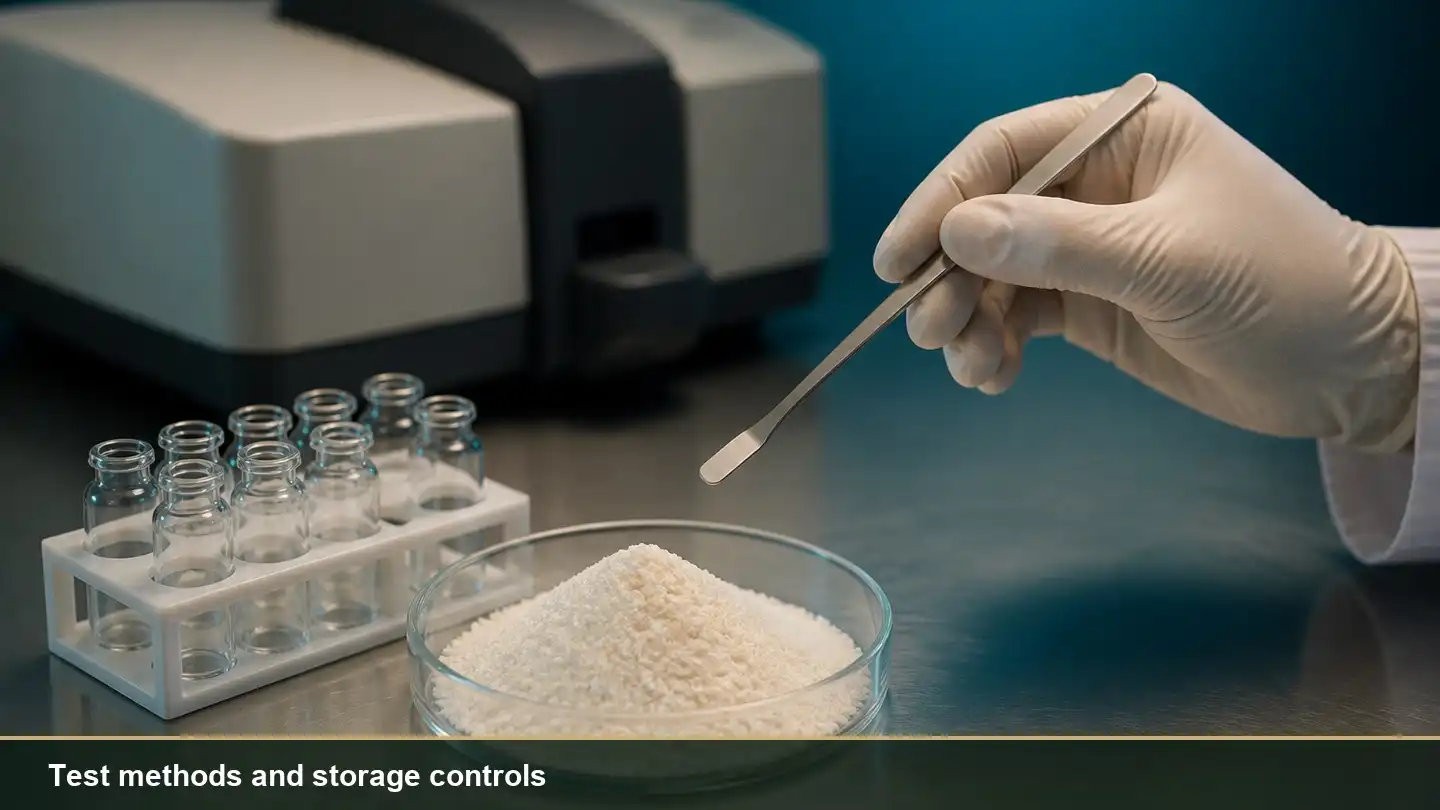
A purity result alone cannot describe a liposomal powder. HPLC shows how much NMN is present; it says nothing about whether that NMN sits inside a vesicle. A blend of NMN and lecithin can pass an assay and fail every structural expectation. The testing methods used for liposomal NAD powder follow the same logic.
Assay and Impurity Profile by HPLC
Reverse-phase HPLC with an external standard gives NMN content; run against a reference mix, it also gives the related-substance profile. Report both. A single assay figure cannot distinguish a three per cent loss from hydrolysis, from moisture dilution, or from analytical variance. For the raw material the baseline is 99% purity; for the encapsulated powder it is the declared load within the 10%–70% range, measured on the same basis and traceable in a COA review.
Encapsulation by NMR, Size by DLS
NMR does two jobs: confirming that the signal set belongs to NMN rather than a structural analogue, and quantifying the encapsulated fraction after free NMN is separated. That second job separates a liposomal material from a blend. DLS then describes the population — median and 90th-percentile diameter plus polydispersity — and a stable product shows neither an upward drift nor a broadening. Karl Fischer and water activity cover moisture, while total plate count and lead are release parameters rather than trends.
| Test item | Method | Acceptance basis | Frequency |
|---|---|---|---|
| Assay | HPLC, external standard | Within 10%–70% load; stability limit ±5% of initial | Every batch and timepoint |
| Related substances | HPLC impurity profile | No new impurity above threshold; trend reviewed | Every batch and timepoint |
| Encapsulation efficiency | NMR after free NMN separation | 85%–95% | Every batch; 0, 6, 12, 24 months |
| Particle size | DLS: D50, D90, polydispersity | Development range; no upward drift | Every batch and timepoint |
| Water content | Karl Fischer titration | In-house limit from development | Every batch and timepoint |
| Water activity | Water activity meter | In-house limit; no upward trend | Every batch; 0, 3, 6, 12 months |
| Total plate count | Plate count method | <1,000 cfu/g | Every batch |
| Lead | ICP-MS | <0.1 ppm | Every batch; annually on stability |
| Appearance | Visual against reference photograph | White to off-white, free-flowing | Every batch and timepoint |
Designing the Study: Conditions, Timepoints, and Batches
Most programs borrow the architecture of ICH Q1A(R2) and apply it by analogy; that should be stated openly, because the conditions have a recognised basis while the criteria come from the specification. A technical guide to liposomal NAD powder stability uses the same framework. Long-term is 25 °C and 60% relative humidity; accelerated is 40 °C and 75% relative humidity for six months; an intermediate condition applies if the accelerated arm shows significant change. The accelerated arm backs short-term excursions and package comparisons. It does not replace real-time data, and extrapolation beyond the covered period follows ICH Q1E only when there is no significant change and no trend.
| Timepoint | Long-term 25 °C / 60% RH | Accelerated 40 °C / 75% RH | Panel | Purpose |
|---|---|---|---|---|
| 0 month | Yes | Yes | Full | Baseline for later comparison |
| 1 month | No | Yes | Assay, impurities, moisture | Early failing signal |
| 3 months | Yes | Yes | Full | First slope estimate |
| 6 months | Yes | Yes (endpoint) | Full | Accelerated conclusion |
| 12 months | Yes | No | Full | First real-time commitment |
| 24 months | Yes | No | Full | Confirms the 24+ month claim |
Three choices decide whether the data mean anything. Sample form: test the powder in the package it ships in, not a laboratory jar, and test the finished blend separately if the customer will dilute it. Batch count: three independent lots, ideally from different raw material lots, give a variance estimate that one lot cannot. Bracketing: across a 10%–70% range, the lowest, middle, and highest strengths can carry the range if the worst case is genuinely worst for the attribute.
Deviations belong in the design. An out-of-specification result should trigger a documented investigation: assignable cause, a retest decision made before the retest runs, corrective action, and an impact assessment covering released lots. A stability budget — allowed retests and the statistical handling of trends — stops a program from resetting its baseline whenever a timepoint disappoints.
Packaging as an Engineering Control
If moisture, oxygen, and light are the routes of loss, the package is the primary control for all three. Nitrogen filling displaces headspace oxygen before sealing, and the check is residual headspace oxygen on sampled units, not a line specification. Multilayer foil provides the moisture barrier; its weak points are folds, seams, and pinholes, so seal integrity belongs in release testing. Light protection needs an opaque construction plus a secondary carton, because amber reduces transmission without eliminating it.
The practical failure mode is not the package but the opening. Every opening exchanges headspace, saturates desiccant, and lets surface powder sorb water. Repack bulk into smaller sealed units, heat-seal rather than clip, replace desiccant at each opening, and log the first-open date; the sourcing guidance for liposomal NMN powder covers the same handover points.
Incoming Inspection, Retention Samples, and Retest Triggers
Incoming inspection is where the claim meets reality. The minimum is document review against the specification, identity by HPLC and NMR, water content, appearance, and a seal check on units as received. Microbiological and heavy-metal results are normally accepted on the certificate with periodic verification. Material stays in quarantine until those checks close.
Retention samples are the buyer’s insurance: same laminate, label conditions, enough material for two full panels, kept through shelf life plus twelve months. Retest is triggered by evidence — an out-of-specification or out-of-trend result, breached packaging, a logged excursion, dwell beyond the validated period, a supplier change, or a complaint about caking or discolouration.
What a Buyer Should Ask For
Ask for a stability summary report, not a folder of chromatograms: the design in one table, conditions and timepoints, batch numbers and raw material lots, results against criteria, the shelf-life conclusion for a named pack, and any deviation. The certificate should carry assay, impurities, encapsulation efficiency, particle size, moisture, total plate count, and lead. Ask for the change notification mechanism — written notice before a change in process, source, specification, or packaging, with a defined requalification trigger. Certifications for this material are cGMP, ISO 9001, ISO 22000, FSSC 22000, HACCP, HALAL, KOSHER, Non-GMO, and Vegan. They confirm an audited management system, not stability data, and a certification checklist should sit alongside the questions worth putting to a manufacturer and the seven supplier checks used to compare quotes.
Request the Stability Summary and a Sample
EmerWell supplies liposomal NMN powder at 10%–70% NMN with 85%–95% encapsulation efficiency, backed by a panel built on HPLC, NMR, and DLS and by a stability program covering the 24+ month claim. Buyers can request the stability summary, a batch certificate, the specification, and a sample for method verification through the liposomal NMN powder product page or by writing to info@emerwell-bio.com. Review of a customer’s proposed storage and repacking conditions belongs in the same conversation, because a shelf life is only valid for the package and handling it was tested against.
References
1. International Council for Harmonisation. Q1A(R2): Stability Testing of New Drug Substances and Products. ICH Harmonised Tripartite Guideline, 2003. https://database.ich.org/sites/default/files/Q1A(R2)%20Guideline.pdf
2. International Council for Harmonisation. Q1E: Evaluation of Stability Data. ICH Harmonised Tripartite Guideline, 2003. https://database.ich.org/sites/default/files/Q1E%20Guideline.pdf
3. Wang JP, Huang ZR, Zhang C, et al. Methodological advances in liposomal encapsulation efficiency determination: systematic review and analysis. Journal of Drug Targeting, 2025. https://pubmed.ncbi.nlm.nih.gov/40126566/
4. International Council for Harmonisation. Q2(R1): Validation of Analytical Procedures: Text and Methodology. ICH Harmonised Tripartite Guideline, 2005. https://database.ich.org/sites/default/files/Q2(R1)%20Guideline.pdf
Disclaimer: This article is written for ingredient buyers and formulators and describes raw material specifications, analytical methods, and stability program design. It is not medical or nutritional advice and makes no claim about any finished product or its use. Shelf-life and specification values refer to the raw material under the stated storage conditions; finished-product claims are the responsibility of the brand owner.
Online Message