Sep 14, 2026
What to Ask a Liposomal NMN Powder Manufacturer
When sourcing liposomal NMN powder for your supplement line, asking the right questions upfront separates a reliable long-term partner from a costly mistake. This guide walks procurement professionals, product developers, and OEM clients through the essential technical, regulatory, and commercial questions to raise before signing any supply agreement. Whether you are launching a new anti-aging capsule or scaling a functional beverage line, understanding what separates true liposomal NMN powder from a simple lecithin blend will protect your brand and your customers.
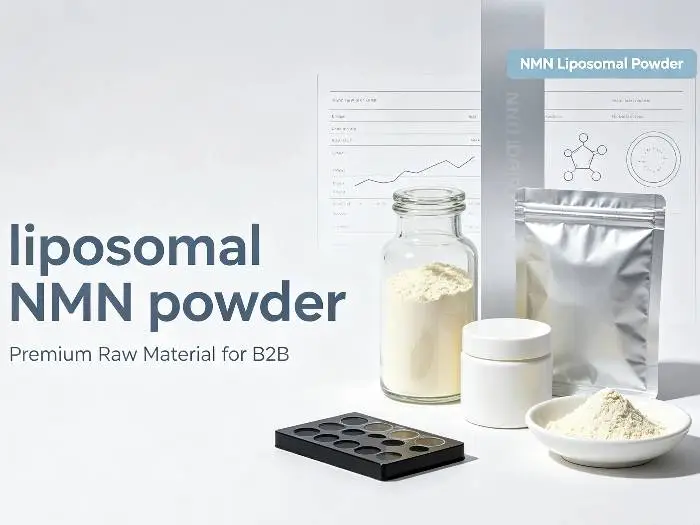
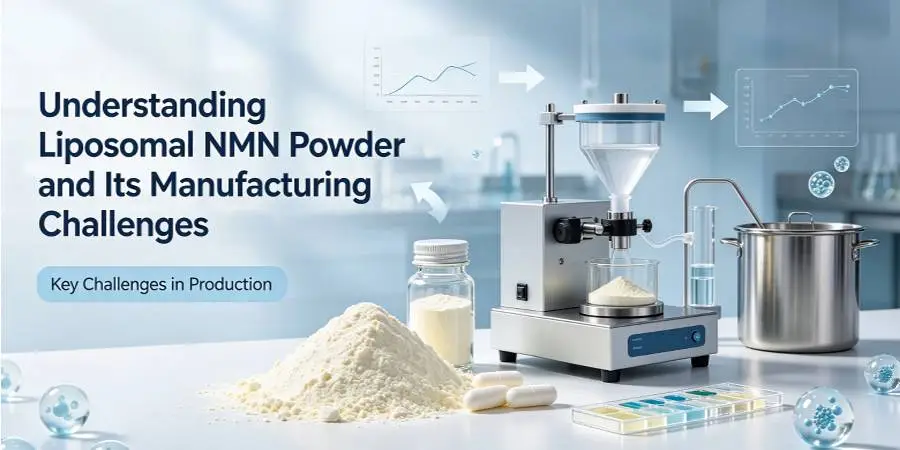
Understanding Liposomal NMN Powder and Its Manufacturing Challenges
Some NMN ingredients are better than others, and this difference is very important during the preparation stage.
What Makes Liposomal Delivery Different?
Standard NMN can be broken down by stomach acid, turning into nicotinamide before it can be absorbed in the intestines. Liposomal NMN wraps the active ingredient in a phospholipid coating that looks a lot like the membranes of human cells. This structure protects the molecule as it moves through the GI tract and makes it easier for the cell to take it in through membrane fusion and endocytosis, which get around the problem that unprotected NMN has with transport. Based on pharmacokinetic studies, high-quality liposomal NMN powder absorbs 4–8 times better than powder that isn't enclosed.
Manufacturing Complexity You Should Understand
It takes controlled high-pressure blending or thin-film hydration followed by freeze-drying to make a real liposomal ingredient, not just a physical mix. Manufacturers must keep the particle size distribution steady between 100 and 300 nm (D90) and get encapsulation efficiency above 85%. Changes from batch to batch in these factors have a direct effect on the bioavailability your customers feel. Buyers who understand how complicated this is are much better able to think critically about what suppliers say.
Essential Technical Questions to Ask Your Liposomal NMN Powder Manufacturer
The ingredient's quality starts a long time before it gets to your recipe team. It is necessary to check basic details early on.
These are the most important technical questions that everyone who works in procurement should ask:
- What is the NMN purity, and can you provide HPLC verification? Suppliers you can trust will confirm that the NMN content is at least 99% with batch-specific analytical data, not just a general standard sheet.
- What encapsulation technology do you use, and what is your verified encapsulation efficiency? Ask for TEM or Cryo-SEM pictures to show the spherical bilayer layers. A physical mix of NMN and sunflower lecithin does not protect the stomach at all.
- What is the reconstituted particle size range, and how is it measured? Dynamic Light Scattering (DLS) testing should show that D90 numbers are in the nanoscale range. Instead of formal promises, ask for updates.
- What is the phospholipid source — soy, sunflower, or synthetic? It is best to use non-GMO sunflower phosphatidylcholine for products that are clean-label and allergen-free.
- What stability data do you hold, and under what storage conditions? ICH-aligned stability tests should confirm the shelf life for your product across a range of temperature and humidity conditions that are important to your distribution area.
When put together, these questions show if a supplier follows scientific principles or just sells the liposomal NMN powder label without the technology to back it up.
Compliance, Certifications, and Quality Control Requirements
Being regulated isn't just a procedure; it's a business necessity to protect your company and your customers.
Certifications That Signal Manufacturing Integrity
A reliable NMN packaging provider should have a stack of quality certifications that can be checked. Check for cGMP, ISO 9001, ISO 22000, FSSC 22000, and HACCP at the very least. Certifications like HALAL, KOSHER, NOP, EOS, Non-GMO, and Vegan make it easier for brands that sell to niche markets to reach more customers. It is necessary to have Certificates of Analysis (CoA) that have been checked by a third party and cover things like purity, heavy metals, residual solvents (GC-MS confirmed below 5,000 ppm), and microbial safety.
Regulatory Readiness Across Markets
For brands that sell in the US, following FDA rules about food supplements and 21 CFR Part 111 cGMPs is very important. Your time to market is cut down by a lot if you work with suppliers who have already put together dossiers for EU Novel Food, ANVISA, or other regional bodies. Always check allergen cross-contamination controls and traceability protocols from the time raw materials are received until finished goods are released.
Pricing, MOQ, and Supply Chain Considerations
If your supply chain can't support your business, even the best feature in terms of technology won't help.
Questions That Protect Your Budget and Timeline
Directly ask potential suppliers how flexible they are with their minimum order quantity. Rigid MOQ designs hurt new brands that are trying test runs before going full-scale. Find out if the different price levels are based on real volume economics or just random thresholds. Make sure you know the standard lead times and what happens when demand goes up without warning. American buyers can save a lot of time and hassle with customs when they buy from a seller with warehouses in the US. EmerWell Bio is based in San Diego, California, and has local infrastructure for warehousing and sample handling that is meant to speed up shipping for US clients with liposomal NMN powder.
In addition to unit prices, you should ask about any other costs that can quietly cut into margins, such as stability testing fees, paperwork surcharges, or reformulation charges. Reliable transportation with help with foreign customs is an important factor that is often overlooked, but it becomes clear when time is of the essence.
OEM & Private Label Services and After-Sales Support
Finding an active ingredient isn't usually the only thing that goes on in a relationship. How smoothly your product gets to market depends on how much OEM and technical support the manufacturer offers.
What Full-Service OEM Support Actually Looks Like
A strong OEM partner can do more than just give powder. They help with formulating, hiding flavors, offering enteric coatings, and producing a variety of dosing forms, such as powders, pills, hard capsules, soft capsules, and liquid-ready formats. With white-label package help and a turnaround time of 8–12 weeks for custom projects, you can speed up your start date without having to build your own research and development department. EmerWell Bio's technical team, which is led by a PhD and works out of the San Diego R&D Center, helps with preparation and has more than 12 years of experience encapsulating nutraceuticals.
Post-sale support should also include access to Safety Data Sheets, regulatory documentation packages, and a person who can help you with technical issues. Manufacturers who don't show up after the order is placed are a liability, not a partner.
Conclusion
Choosing a producer for your liposomal NMN powder is a smart move that will affect how well your product works, how it is regulated, and how competitive it is in the market. The right seller can answer technical questions with data, has valid certifications, supports your business's ability to be flexible, and stands behind their product after the sale. Before committing to any supply relationship, the best way to get a recipe that works and a partnership that grows with your brand is to ask these questions over and over again.
FAQ
How do I verify that a supplier's NMN powder is truly liposomal and not just a blend?
Ask for TEM or Cryo-SEM pictures of spherical bilayer structures, along with data on how well the structures are encapsulated that has been proven by ultrafiltration and HPLC analysis. EE will be above 85% for a real liposomal ingredient. A mix of NMN and lecithin doesn't have any of these structural benefits and doesn't really protect the stomach.
What dosage forms can liposomal NMN powder be used in?
Good liposomal NMN powder can be used in many ways. It can be put into pills, soft capsules, hard capsules, powdered drink mixes, and oral strips. Making sure that your supplier is willing to be flexible in this way will give your formulation team real creative freedom.
Is liposomal NMN powder stable at room temperature?
Liposomes in liquid form usually need to be kept cold, but liposomes in powder form are much more stable. When stored properly in a cool, dry, sealed area, the phospholipid shell stays intact and works as long as the label says it will.
What tests should I request before finalizing a supply agreement?
Ask for a batch-specific COA that includes NMN purity (≥99%), heavy metals, microbial limits, residual solvents, particle size distribution (DLS), and how well the particles are enclosed. Once the powder is mixed again, zeta potential data shows that the solution will stay stable for a long time.
Partner With EmerWell Bio for a Trusted Liposomal NMN Powder Supplier
EmerWell Bio is a US-based company based in San Diego, California, that supplies liposomal NMN powder. They have their own research and development lab, local storage, and a professional team led by a PhD that is ready to help you with your project from the test stage to the commercial stage. It has NMN content of at least 99%, absorbs 4–8 times better than unencapsulated powder, and is fully certified for cGMP, ISO 22000, HALAL, KOSHER, Non-GMO, and Vegan. Reach our team directly at info@emerwell-bio.com or visit emerwelllabs.com to request your sample or custom formulation quote today.
References
1. Yoshino, J., Baur, J.A., & Imai, S. (2018). NAD+ Intermediates: The Biology and Therapeutic Potential of NMN and NR. Cell Metabolism.
2. Allen, T.M., & Cullis, P.R. (2013). Liposomal Drug Delivery Systems: From Concept to Clinical Applications. Advanced Drug Delivery Reviews.
3. Mills, K.F., et al. (2016). Long-Term Administration of Nicotinamide Mononucleotide Mitigates Age-Associated Physiological Decline in Mice. Cell Metabolism.
4. Immordino, M.L., Dosio, F., & Cattel, L. (2006). Stealth Liposomes: Review of the Basic Science, Rationale, and Clinical Applications. International Journal of Nanomedicine.
5. Bhatt, D.K., & Bhattacharya, S. (2018). Nanoencapsulation Technologies for the Food and Nutraceutical Industries. Journal of Food Engineering.
6. United States Pharmacopeia (USP). (2023). Dietary Supplement Quality Standards: Monographs and Testing Methods. USP-NF.
Online Message
YOU MAY LIKE
High quality furniture manufacturer
_1776234307158.webp)