

Oct 19, 2026
How to Use Liposomal Glutathione Powder in Functional Beverage Formulations
Formulating with liposomal glutathione powder in functional beverage formulations is a different discipline from using the same ingredient in a dry format. A stick pack is a low-water, oxygen-limited environment; a ready-to-drink bottle is a wet, acidic, thermally processed, oxygen-exposed system that must also look and taste right on a shelf. This guide stays inside the beverage and ready-to-mix (RTM) context: pH, thermal load, the sulfur note, turbidity, sedimentation, packaging oxygen and line control. Developers working on dry formats should start from these supplement formulation notes instead.
The Beverage-Specific Stressors That Decide Success
Four stressors define beverage work, and they act together. Acidity: most bases sit between pH 2.8 and 4.2, and the buffer system, not the label, governs local chemistry. Heat: pasteurisation, hot fill and sterilisation apply a cumulative load a dry powder never sees. Oxygen: dissolved oxygen from mixing and headspace oxygen from filling stay in contact all through shelf life. Time: the vesicle sits in water, ions and flavour compounds for months.
A liposomal active is a phospholipid vesicle with an aqueous core: that is why it protects its payload when dry, and why a warm, acidic, oxygenated drink is a demanding home for it. The real question is which combination of pH, thermal load, packaging and grade your base tolerates.
Acidity, pH, and the Reduced-Form Stability Window
Reduced-form retention is the line that matters most in a beverage brief: the powder is specified to hold 98% or more of the active in the reduced (GSH) form, measured by HPLC of the GSH/GSSG ratio. In a liquid that ratio is driven by oxygen, trace metals and pH.
What Acid Actually Does to the Reduced Thiol
Glutathione is a thiol, and its reduced and oxidised forms are the dominant redox pair in a formulation. Thiol oxidation is far more aggressive near neutral pH, especially with trace transition metals present, than in a moderately acidic base at ambient temperature. That is useful luck for beverage work, since juice, tea, coffee and carbonated bases are already acidic. The danger cases are near-neutral zones - protein and plant-milk drinks - or formulas whose pH drifts upward, where dissolved oxygen plus trace iron or copper does more damage than acidity ever would.
Buffering and pH Targets for RTM Systems
Rather than chasing one number, lock the buffer and verify the finished product. Citrate buffers work across the usual range and behave predictably through heat. Avoid trusting a pH measured only in the concentrate; dilution, mineral premixes and heat can shift the value the vesicle experiences.
| pH band | Typical base | Main risk to the reduced form | Formulation action |
|---|---|---|---|
| 2.8 - 3.4 | Carbonated and citrus RTM | Low; sourness competes with masking | Taste-test at the lowest pH of the range |
| 3.5 - 4.2 | Juice blends, tea, coffee, kombucha | Metal-driven oxidation from trace metals | Set trace-metal limits on base raw materials |
| 4.3 - 5.5 | Protein and flavoured waters | Rising oxidative risk; buffer drift under heat | Re-check pH after processing; consider a chelating co-ingredient |
| Above 5.5 | Milk-based drinks | Highest oxidative risk to the reduced thiol | Shorten shelf-life target or reformulate toward acid |
Colloidal behaviour is examined further in our note on liposomal glutathione powder solubility and stability.
Thermal Processing: Finding a Window That Protects the Vesicle
Thermal load is cumulative, so temperature and time count as a pair. A short hot step is often kinder than a long mild one, and the process choice - hot fill, tunnel pasteurisation, in-pack sterilisation or aseptic filling - frequently decides the formulation before the formulation decides anything.
Pasteurisation, Hot Fill and Sterilisation Loads
Hot fill and tunnel pasteurisation are the friendlier options: both keep the product below boiling and let the developer control how long the active stays hot. Sterilisation applies a far heavier load, and at those temperatures the bilayer is asked to hold structure while the surrounding water mobilises its components. Encapsulation does shield the payload from harsh temperature and pH swings, and lipid carriers have been studied in beverage models - but shielding being possible is not the same as any window working. Each matrix has to be validated.
What Heat Does to Appearance
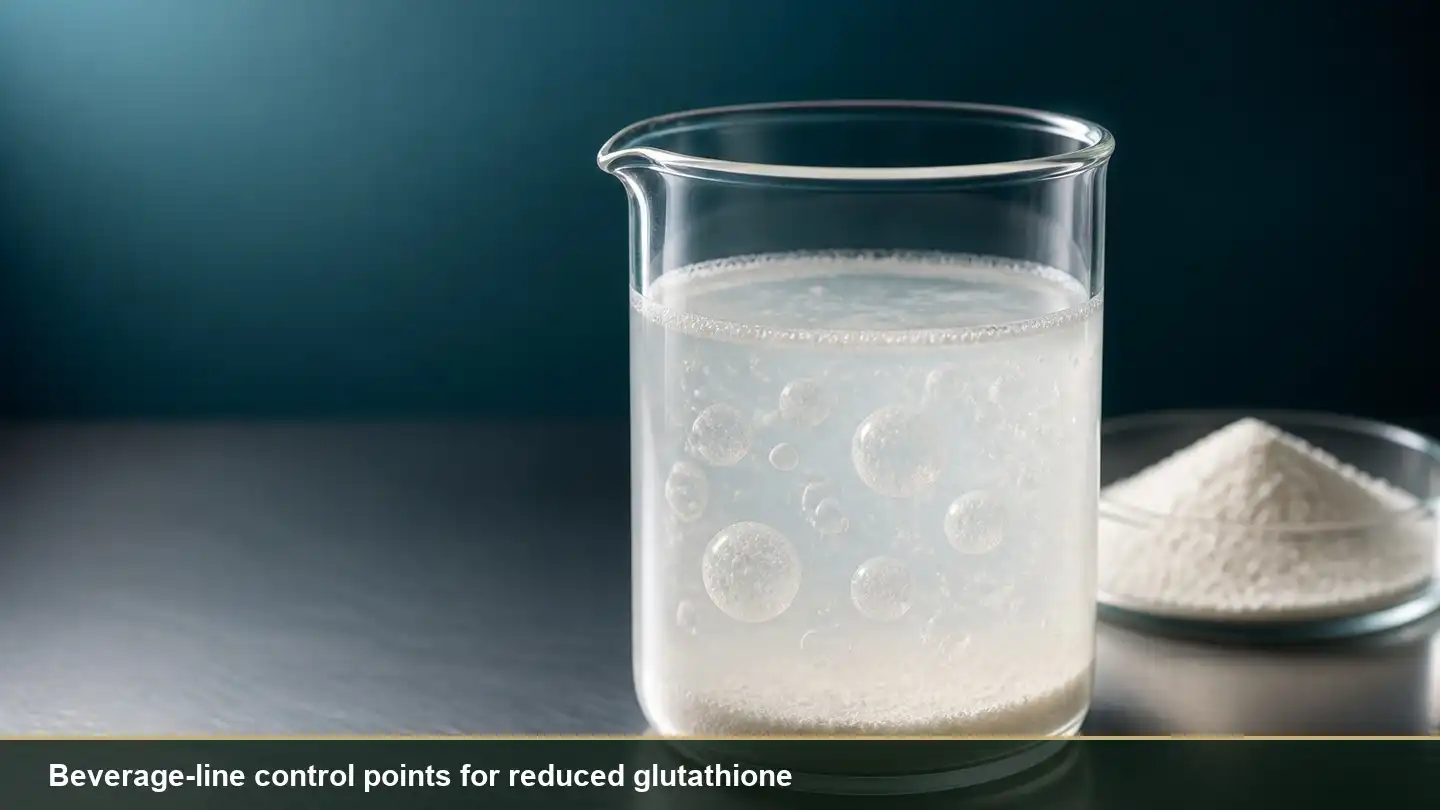
The second heat effect is visual. Vesicle fusion and aggregation during overheating raise the mean particle size, and larger particles scatter more light, so an already opalescent liquid turns noticeably milkier or develops a faint creamed layer after cooling. Where a heat step is unavoidable, compare appearance before and after processing, not only the pre-fill liquid.
The process reasoning for comparable liposomal actives is set out in this companion article on incorporating liposomal powders into functional beverages.
Appearance and Sensory: The Sulfur Note Is the Real Bottleneck
Ask a beverage developer what actually stopped a reduced-glutathione project and the answer is rarely the lab data. It is the smell. Reduced glutathione contains a cysteine thiol, and that thiol carries an intrinsic sulfurous, sometimes yeasty character the human nose detects at very low concentration. In a capsule this is invisible; in a drink it is the whole experience. Sulfur volatiles are recognised in the food literature as character-impact compounds with exceptionally low sensory thresholds, which is why small amounts matter so much.
Why the Note Appears - and Why It Sometimes Gets Worse
Three drivers amplify it. Free or unencapsulated glutathione: any vesicle damage from high shear, overheating or poor hydration releases active into the surrounding water, where its aroma is unshielded. Trace metals: iron and copper catalyse thiol oxidation and are associated with more volatile sulfur species, so a mineral-premix drink can taste worse than the same formula without minerals. Time and temperature: a product acceptable at fill can drift during storage.
Masking Strategies That Actually Work
Masking is a stack, not a single ingredient. Fruit-acid and citrus top notes compete effectively against sulfur; berry and tropical profiles are more forgiving than delicate florals, dairy or tea. Sweetness and acidity balance matters more than absolute sweetness, because a balanced base needs less flavouring. Keeping the encapsulation intact is the most reliable lever, since the note from intact vesicles is far lower than from free active.
| Observation | Likely driver | Action |
|---|---|---|
| Sulfur note right after production | Vesicle damage during mixing | Add the powder last, under low shear |
| Note worsens with added minerals | Metal-catalysed thiol oxidation | Cut trace metals or separate streams |
| Note develops during storage | Oxidative drift and headspace oxygen | Nitrogen purge, oxygen scavenger, higher-barrier pack |
| Note worse at high load | More aroma compound per serve | Use a higher grade so less powder is dosed |
Clean-label positioning also needs checking in sensory terms: see our notes on allergen considerations in liposomal glutathione powders and on what not to mix with liposomal glutathione.
Clarity or Turbidity: Positioning an Opalescent Colloid
The liposomal dispersion is a colloidal system, not a solution. Even at low concentration the vesicles scatter light, so a crystal-clear positioning cannot be delivered and no processing trick changes that. Cloudy bases - juice with pulp, oat and coconut alternatives, protein drinks, kombucha and coffee - absorb the contribution almost invisibly. Clear systems need either a repositioning of the product or acceptance of visible turbidity, which scales with powder load. The aesthetics are covered in our piece on what liposomal products actually look like.
Sedimentation, Separation and Shelf Life
An opalescent colloid is only acceptable if it stays uniform. Sedimentation and creaming depend on particle size distribution, the density difference between vesicles and continuous phase, and base viscosity, so protein, fibre or hydrocolloid systems hold particles far better than a low-viscosity flavoured water. Higher concentration grades deliver the same active with less powder, reducing the driving force for layer formation. DLS particle size is the most useful incoming specification for tracking this, because a shifted distribution settles differently even when the assay value is identical.
Shelf-life claims belong to the finished product, not the raw material. The ingredient carries a 24-month shelf life as sealed powder; the beverage must establish its own data in its own package. Where a matrix looks marginal, the practices in our guide on how to store liposomal glutathione powder effectively apply to handling before the powder reaches the mix tank.
Packaging, Headspace Oxygen and Light
Packaging is an ingredient decision here, because oxygen is the main chemical threat to the reduced form and light accelerates what oxygen starts. Three levers matter. Headspace oxygen at filling: nitrogen purge, oxygen-scavenging closures and minimal foam at the filler shrink the reservoir available over shelf life. Container material: an oxygen-scavenging multilayer structure or a can with an inert liner outperforms standard clear PET, and glass removes the permeability question entirely. Light: an opaque or amber pack removes a whole stressor at no formulation cost.
Production-Line Control Points
Most beverage-side failures happen on the line, not in the formula, and order of addition is the usual culprit. Dissolve water-soluble components first - sugars, acidulants, buffer salts, hydrocolloids and any mineral premix - then add the liposomal powder last, after the base is fully hydrated and every high-shear step is complete. High-shear homogenisation after the active is in the tank is a common cause of a sulfur note that appears only in production and never on the bench.
| Control point | Responsible party | Evidence to retain |
|---|---|---|
| Incoming powder release | Quality assurance | COA with GSH/GSSG ratio, encapsulation efficiency, DLS size, lead, plate count |
| Base and buffer verification | Process development | pH and acidity of the finished base; trace metals in the premix |
| Order of addition | Production | Batch record showing active added after high-shear steps |
| Hydration and mixing | Production | Mixer type, speed and time for the active-addition step |
| Sensory and appearance check | Quality control | Sensory evaluation and turbidity record on the pre-fill sample |
| Fill and oxygen control | Production | Dissolved oxygen at fill, headspace oxygen, purge settings |
| Post-process verification | Quality assurance | Assay and reduced-form retention on the packaged product |
The wider manufacturing framework behind these points is covered in our article on liposomal glutathione powder manufacturing and quality control.
Specification Snapshot for Beverage Development
| Parameter | Specification |
|---|---|
| Appearance | White to off-white, free-flowing fine powder |
| Reduced glutathione content | 10% to 50% across grades; 25% standard grade |
| Reduced (GSH) form retention | 98% or more, by HPLC GSH/GSSG ratio |
| Encapsulation efficiency | 85% to 98% |
| Dispersibility | Disperses in cold water to a stable, milky colloidal suspension |
| Shelf life, sealed powder | 24 months |
| Lead | Below 0.5 ppm |
| Total plate count | Below 1,000 cfu/g |
| Methods | HPLC (GSH/GSSG ratio), DLS, sensory evaluation |
| Certifications | cGMP, ISO 22000, FSSC 22000, HACCP, Kosher, Halal, Non-GMO, Vegan |
What belongs in the documentation accompanying each delivery is set out in our explainer on what a liposomal glutathione powder COA should include.
Sampling, Documentation and Technical Support
Beverage projects move faster when the ingredient and the matrix are developed against the same data set. EmerWell supplies liposomal glutathione powder with a specification sheet, batch COA and technical guidance covering pH and buffer screening, thermal-window assessment, sensory evaluation design and packaging oxygen strategy. For a specification sheet, a representative COA or a pilot sample, write to info@emerwell-bio.com.
References
1. Wu G., Fang Y.-Z., Yang S., et al. "Glutathione metabolism and its implications for health." The Journal of Nutrition, 2004. https://pubmed.ncbi.nlm.nih.gov/14988435/
2. Lin S.-K., Tsai S.-M., Huang J.-C., et al. "Effects of storage time and temperature on the stability of glutathione." Journal of Food and Drug Analysis, 2006. https://www.jfda-online.com/journal/vol14/iss2/7/
3. Molaveisi M., et al. "Effect of temperature processing conditions on the stability of lipid-based nanocarriers in beverage models." Journal of the Science of Food and Agriculture, 2026. https://pubmed.ncbi.nlm.nih.gov/42535294/
4. Zarrabi A., et al. "Nanoliposomes and Tocosomes as Multifunctional Nanocarriers." Molecules, 2020. https://pmc.ncbi.nlm.nih.gov/articles/PMC7037994/
Disclaimer: This article is written for business-to-business ingredient buyers and beverage formulation teams. It describes raw material properties and processing considerations only and is not intended for end consumers. It provides no usage amounts and constitutes no medical, dietary or regulatory advice. Formulators remain responsible for confirming that a finished product meets the requirements of the markets where it is sold.
Online Message