

Oct 13, 2026
How to Select the Right Liposomal Vitamin C Powder Specification for Your Product
Selecting a liposomal vitamin C powder specification is a decision exercise, not a catalogue lookup: the right grade for one product is the wrong one for the next. Two choices drive the rest, made in order. First the format — the finished unit the powder must serve — because it fixes how much powder that unit can carry. Then the concentration grade, which decides how much of the powder is active and how much is carrier. This article works through that sequence for brand owners, product developers and R&D teams, using the graded liposomal vitamin C powder line as reference.
Start With the Format, Not the Concentration Grade
The format is the binding constraint. A hard capsule holds a fixed, small fill volume; a stick pack holds free-flowing powder; a gummy carries powder inside a gel matrix; a ready-to-mix (RTM) sachet dissolves into a beverage; a tablet is compressed from a blend with little room for bulky inputs. Each format imposes its own ceiling on powder mass per unit, so it decides whether a high grade is a convenience or a necessity.
How the format sets the powder load
Work backward from the unit. Estimate the powder mass it can accept and subtract the excipients the format needs; the remainder is the budget for the active-bearing ingredient. A capsule shell, a gummy base and a tablet binder each consume part of it. That remainder — not a label wish — is what the grade must fit into, and once it is known the shortlist narrows to one or two grades.
Turning format constraints into a grade shortlist
A second check, on how the powder behaves in the intended base, stops a grade from failing at fill even when it looks workable on paper. For a format-by-format view of the powder and tablet routes, see this guide to liposomal vitamin C powder versus tablets, and for the capsule side, this comparison of powder versus capsule vitamin C formats.
| Format | What it stresses in the powder | Primary selection questions | Grade fit |
|---|---|---|---|
| Hard capsule | Tight, fixed fill volume; needs free flow | How much fits after the shell; does it pour cleanly? | Favours a high grade so the active fits |
| Stick pack | Bulk powder mass; flow and instant wetting | Does the pack hold the powder; does it disperse without lumps? | Tolerant of lower grades |
| Gummy | Matrix loading; heat during deposition | How much powder the gel carries; behaviour under heat | Balanced grade for load and dispersion |
| Ready-to-mix (RTM) | Cold-water dispersion; no stratification | Does it dissolve instantly; does it stay suspended? | Lower or mid grade for mouthfeel |
| Tablet | Compression; limited space for bulky input | Weight allowance; compressibility of the blend | Favours a higher grade |
The Four Concentration Grades and What Each One Trades
The ingredient is offered at four grades: 10%, 20%, 25% and 50% active. These percentages describe the composition of the raw material, not the finished product, and are the figure most often misread. A 50% grade is not simply a stronger product; half its mass is carrier. A 10% grade is nine parts carrier to one part active. For a fixed active load, a lower grade needs proportionally more powder, which is why grade and format must be chosen together. Read alone, the percentage is only a composition statement; the practical meaning of a grade appears once the format and the blend step are known.
What a high grade buys, and what it costs
A 50% grade roughly halves the powder mass needed for a given active load compared with a 25% grade, which matters when the target is a small capsule or compact tablet. The trade-off is uniformity: with only half the powder active, blending and content-uniformity demands are higher, because every particle must carry its correct share of active.
What a lower grade offers instead
A 10% or 20% grade is more carrier than active. It often flows and wets more readily, and sits more gently in a stick pack or RTM base where mouthfeel matters. The cost is bulk: more powder per unit of active, which a tight capsule or small tablet cannot hold. Lower grades suit formats with generous volume and a dispersion or sensory requirement.
How mixing and process demands shift with grade
Content-uniformity risk rises as the active fraction falls, because a small amount of active is spread through a large mass of carrier. That is a blending question, not a label question, and it belongs in the specification. For how the grades differ, see this explainer on how liposomal vitamin C powder differs from other vitamin C forms, and for background, this primer on liposomal vitamin C powder.
| Grade | Carrier share of the powder | Powder per unit of active | Blend-uniformity demand | Usual fit |
|---|---|---|---|---|
| 10% | About 90% | About 10 : 1 | Low to moderate | Stick packs, RTM where bulk is acceptable |
| 20% | About 80% | About 5 : 1 | Moderate | Stick packs, tablets |
| 25% | About 75% | About 4 : 1 | Moderate to high | Tablets, larger capsules |
| 50% | About 50% | About 2 : 1 | High | Small hard capsules with tight fill volume |
Instant Dispersion and No Stratification for Ready-to-Mix Lines
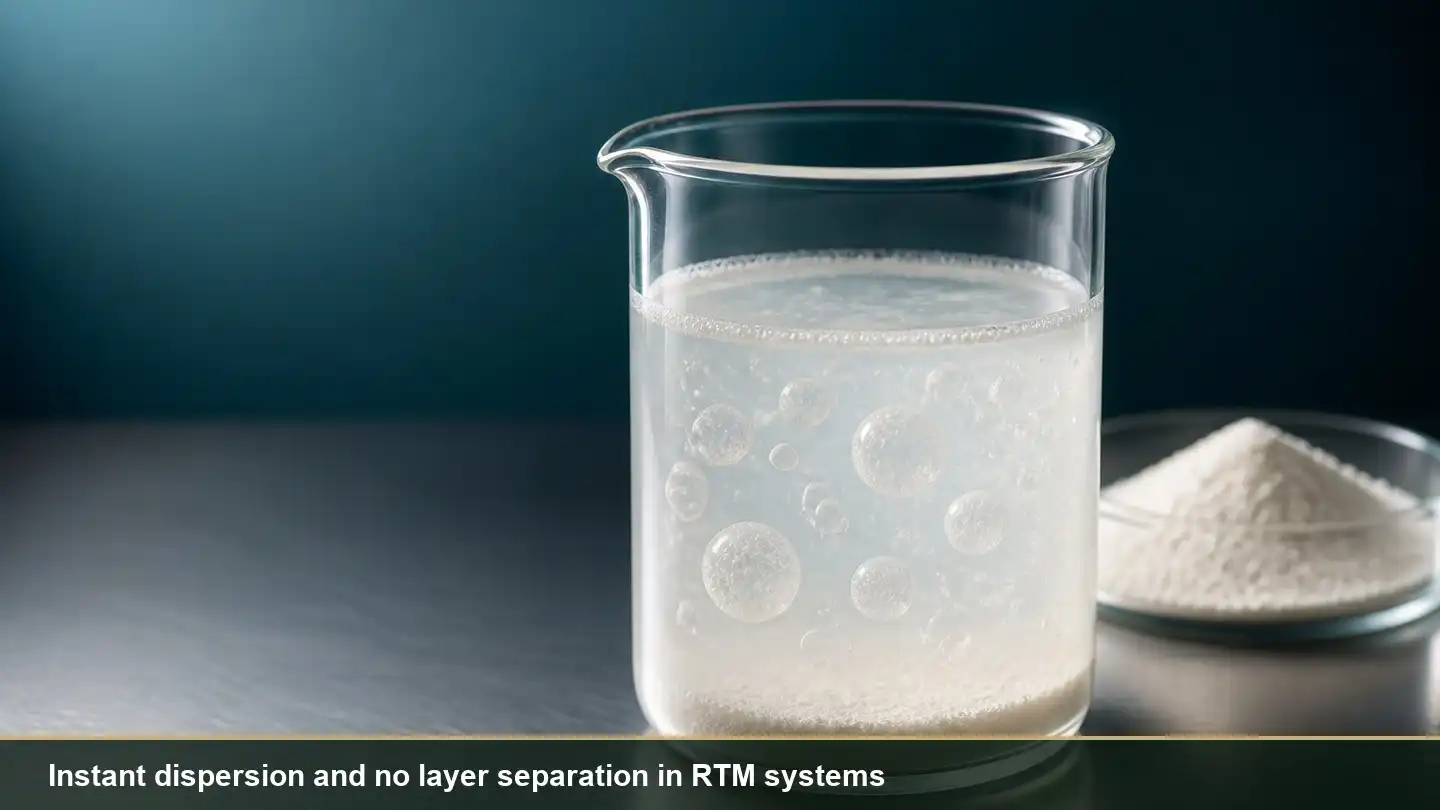
For beverage and RTM formats, two physical behaviours matter more than any label figure: how fast the powder dissolves in cold water, and whether it stays suspended once dissolved. This ingredient is specified as instantly dispersible in cold water with no stratification — no sediment at the bottom and no creaming layer at the top. Those properties decide whether a drink looks the same at first sip and last, or separates in the glass.
Why no stratification is an acceptance point, not a nicety
Sedimentation is the failure that appears after the consumer has judged the product: the drink looks uniform when poured, then a deposit forms. A specification that says only water-dispersible is not enough. The relevant check is whether the reconstituted system stays homogeneous across the drink's expected use window. Ask for dispersion behaviour in the finished base, not in water alone, and set an acceptance test around it. The variables that influence dispersion are set out in this article on the factors that influence the solubility of liposomal vitamin C powder.
Colour and Appearance in Light or Clear Systems
This ingredient presents as a light yellow to off-white free-flowing powder. Inside an opaque capsule, colour is invisible; in a clear RTM drink, a pale gel or a white tablet, it becomes part of the product. A pale yellow cast can read as warm or off-natural against a snow-white base, and the transparency prized in a clear beverage can be broken by even slight turbidity.
The response is procedural. Fix an appearance range and agree a retained reference sample, so lots can be compared against a physical standard rather than a description. Test the ingredient at the intended use level in the real base, because appearance in water is not appearance in a flavoured drink. Where the base is transparent, decide early whether the drink will be clear, hazy or deliberately opaque: that sets the appearance tolerance you can accept. Why appearance is easy to misread is covered in this article on what liposomal products actually look like.
Stability, Shelf Life and the Role of Packaging
Encapsulation is designed to shield the active from light and heat, so the powder tolerates handling and storage better than a non-encapsulated powder and degrades more slowly. Stability is a specification area, not a footnote, because it determines how the ingredient is packed, stored and re-tested over time.
Packaging is part of that specification. Moisture and light are the two stresses that most affect a hygroscopic, light-sensitive powder, so the primary pack — a foil laminate with a moisture, oxygen and light barrier where the format allows — is a stability input rather than a purchasing detail. In-process control matters too: sealing, headspace and in-plant humidity all change how the powder behaves at the filling line. Storage conditions for this category are described in this guide to storing liposomal vitamin C powder. Nothing here states the shelf life or effects of any finished product; those depend on the base, the pack and the storage the brand sets.
Clean-Label Options and the Source Question
Four clean-label attributes are available as options on this ingredient: Gluten-Free, Non-GMO, Vegan-friendly and Soy-Free. They are configuration choices rather than marketing decoration, and simplest to fix at the specification stage, before a label is drafted. The phospholipid source deserves attention: a soy-derived lecithin can pull a soy declaration onto the finished label, while a sunflower-derived source avoids it. Asking the source question early is simpler than changing artwork later. For how these are assessed, see the guide to certifications to look for when buying liposomal vitamin C powder.
What the Specification Sheet Should State
A specification sheet should let a buyer compare offers line by line rather than in adjectives. For a liposomal vitamin C powder it should state the active group and grade; the encapsulation efficiency; the heavy-metal and microbiological limits; the appearance and dispersion behaviour; the analytical methods; the certifications held; and the clean-label options available. The table below summarises what this ingredient declares.
| Parameter | Value or range |
|---|---|
| Concentration grades | 10%, 20%, 25%, 50% |
| Encapsulation efficiency | 85%–95% |
| Lead (Pb) | < 0.5 ppm |
| Total plate count (TPC) | < 1000 cfu/g |
| Appearance | Light yellow to off-white, free-flowing powder |
| Dispersion | Instant in cold water; no stratification |
| Analytical methods | HPLC, DLS, TEM, iodometric titration |
| Certifications | cGMP, ISO 9001:2015, ISO 22000, Kosher, Halal |
| Clean-label options | Gluten-Free, Non-GMO, Vegan-friendly, Soy-Free |
Two evidence points belong beside the sheet. The encapsulation efficiency figure — 85%–95% here — shows how much of the active sits inside the phospholipid vesicle rather than free in the matrix: the number that separates a genuine encapsulate from a blend. A buyer should ask for the batch certificate and the supporting method results, not a summary sentence. How each method is used here is described in this article on quality tests for liposomal vitamin C powder.
Common Selection Mistakes to Avoid
- Reading the raw-material grade as though it were the finished-product content. The 10–50% figure describes the powder, not the label.
- Choosing a grade before the format's powder budget is known, then finding the fill volume cannot take it.
- Ignoring sinking and stratification. Specify no stratification and test it in the intended base.
- Leaving colour and appearance until packaging artwork is signed off.
- Selecting a grade without the encapsulation efficiency and particle data behind it; particle behaviour is the subject of this article on how particle size affects liposomal vitamin C powder performance.
- Handling clean-label options and the phospholipid source as a labelling detail rather than a specification input.
- Comparing grades by active percentage alone, when grade, encapsulation efficiency and format ceiling must be read together.
Working With EmerWell on Liposomal Vitamin C Powder
If you are selecting a grade for a specific format and want to work through these points against a real specification, EmerWell can help. Request the specification sheet, a batch certificate of analysis and a sample from the liposomal vitamin C powder product page, and the technical team can discuss dispersion and format compatibility. Tell us the format and base you have in mind. Email info@emerwell-bio.com to start the conversation.
References
1. U.S. Electronic Code of Federal Regulations, Title 21, Part 111 — Current Good Manufacturing Practice in Manufacturing, Packaging, Labeling, or Holding Operations for Dietary Supplements. https://www.ecfr.gov/current/title-21/chapter-I/subchapter-B/part-111
2. International Council for Harmonisation (ICH), Quality Guidelines, including Q1A(R2) Stability Testing. https://www.ich.org/page/quality-guidelines
3. U.S. Food and Drug Administration, Dietary Supplements. https://www.fda.gov/food/dietary-supplements
Disclaimer: EmerWell supplies liposomal ingredients as raw materials for supplement and food manufacturers. This article is a business-to-business formulation discussion and is not medical, nutritional or label advice, nor does it describe the effects of any finished product. This raw material is not intended for end consumers; any end-product use level and any product claim are determined by the brand under the regulations of its own market and remain the brand's responsibility.
Online Message