

Sep 21, 2026
Why Liposomal Vitamin C Powder Is Gaining Global Attention
Sourcing teams rarely re-specify an ingredient for a single reason. When a brand moves from plain ascorbic acid to EmerWell's liposomal vitamin C powder, the decision is usually settled on the bench and in the document file — cold-water dispersion, label declaration, assay method, batch records — before it reaches a marketing plan. This article covers that sourcing-and-formulation side of the shift: what pushes the powder into a bill of materials and what to verify before qualification.
What Is Driving the Switch Away From Plain Ascorbic Acid
The category has matured on the supply side. Material that once arrived as a liquid dispersion, with the cold-chain and short shelf-life assumptions that implies, now typically arrives as a dry powder that can be stored, sampled, weighed, and re-tested like any other excipient. That change removed most of the practical objections that once kept encapsulated ascorbate out of mainstream projects.
Three pressures explain most of the migration:
- Format freedom. A free-flowing powder can be encapsulated, blended into stick packs, or reconstituted at the filling line without tying the brand to a liquid supply chain.
- Documentable differentiation. Encapsulation efficiency and particle-size data give a technical file that commodity ascorbic acid cannot match.
- Audit fit. Suppliers now issue per-batch certificates of analysis and method summaries in the form retail buyers expect to review.
The published evidence is directional rather than settled: a 2025 scoping review reported higher plasma concentrations for liposomal ascorbate in most trials, but with differing formulations and industry funding, so the figures are category evidence rather than a specification [2,3]. Where the category settles inside a portfolio is a market question, examined separately in this review of liposomal vitamin C's longer-term position. For a formulator the useful question is local: does the powder behave in your process?
Cold-Water Dispersibility and the Format Shortlist
Ask three formulators what they test first and most describe the same trial: a scoop of powder stirred into cold water, watched for clumping and sediment over the next hour. Instant dispersion without layer separation decides whether an encapsulated powder is eligible for a ready-to-mix or beverage brief at all; the physical chemistry behind it is set out in this analysis of what governs liposomal vitamin C powder solubility.
Ready-to-mix sachets and stick packs
These formats reward cold-water instant solubility above almost every other property. The user judges the product within seconds, so clumping or a surface film reads as a defect. Uniform particle size also blends evenly with sweeteners, acidulants, and flavour systems, keeping fill weight and taste consistent from sachet to sachet.
RTD beverages and functional water
Ready-to-drink is the most demanding brief: the powder is reconstituted early, then meets pH, dissolved oxygen, and whatever thermal step the line uses, and sediment or haze is a visible failure. Formulators generally handle the powder as an ingredient to be protected rather than a drop-in, adjusting buffer, chelating agents, and fill temperature around it.
Gummies, chews, and two-piece capsules
Heat, water activity, and low pH during cooking and curing are the constraints in a gummy or chew: a line that cooks the ascorbate into hot syrup will cost encapsulation efficiency, while late addition at the lowest workable temperature retains more vesicle structure. Two-piece capsules are the opposite case — a dry fill at ambient temperature, where flow and bulk density are the practical variables.
Stability, Shelf Life, and the Cost of Oxidation
Ascorbate is a reducing agent, and that is exactly what makes it fragile. In near-neutral aqueous solution it oxidises readily and trace transition metals accelerate the reaction, which is why water quality and packaging atmosphere deserve as much attention as the raw material specification [1]. The practical question is how much ascorbate the phospholipid shell keeps intact through your process and the printed shelf life.
Why liquid systems are harder to control
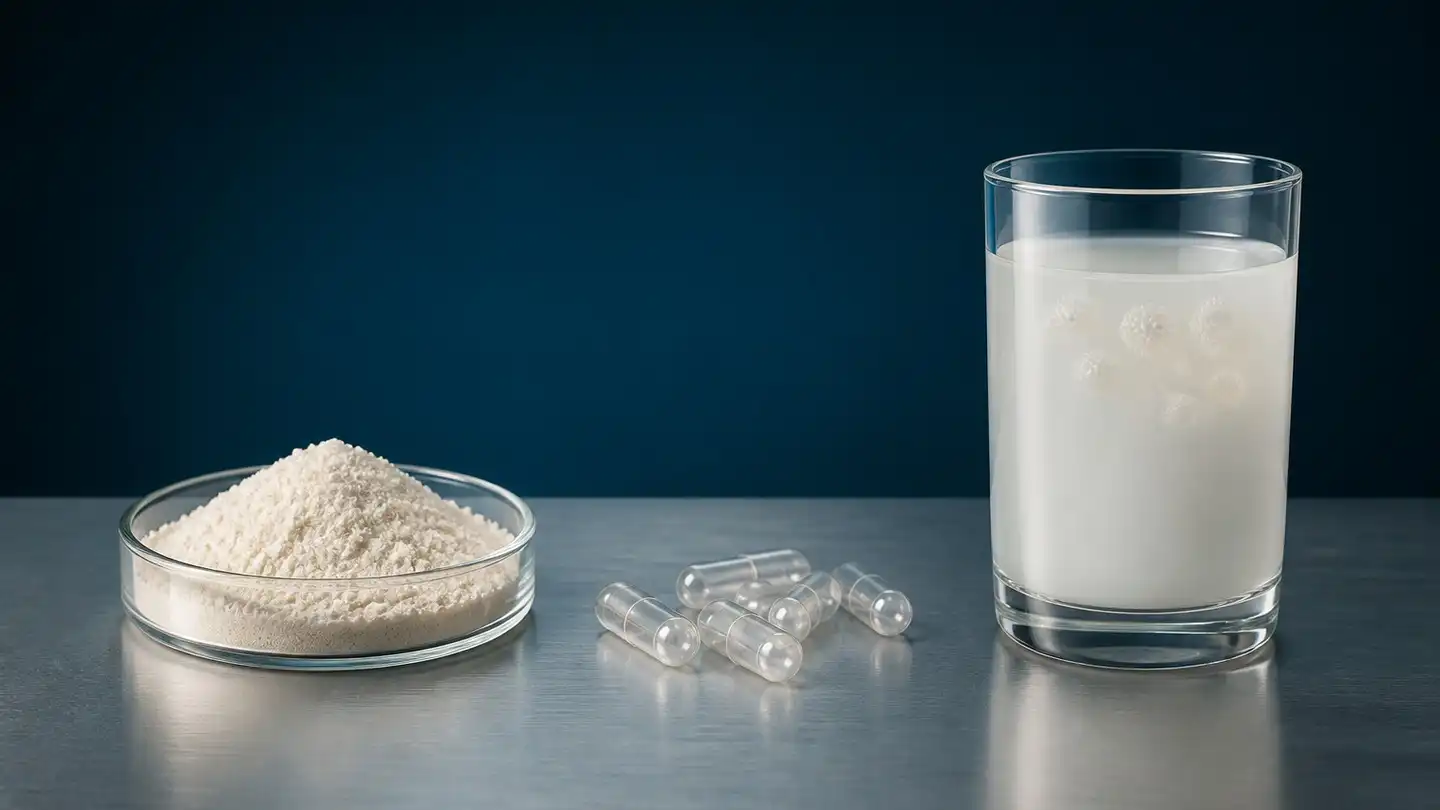
Both manufacturing routes are well established, and the trade-offs are compared in this look at dry and liquid production technology. An aqueous dispersion keeps the vesicles in their native state but leaves the ascorbate in the medium that degrades it, and every handling step introduces oxygen and, potentially, metal ions. Refrigeration slows that loss without removing its cost.
What a powder changes for the supply chain
Drying separates the ascorbate from bulk water, so the oxidation rate that dominates a liquid product no longer governs storage, and no cold chain is needed for that ingredient. The trade-off moves to processing: drying is thermally demanding, and rehydration behaviour must be validated in the finished format rather than assumed.
What to read in a stability report
Ask for assay and encapsulation efficiency at every timepoint, not only the final one, and for the packaging used in the study — results from a laboratory jar do not transfer to a stick pack. Track particle size beside assay: a broadening distribution signals aggregation while total ascorbate still assays within specification.
Finished-Format Compatibility: A Practical Matrix
The matrix below is a starting point for bench triage, not a substitute for a trial in your own matrix.
| Finished format | Main stress on the powder | Where the encapsulated form earns its place | Verify first |
|---|---|---|---|
| Two-piece capsules (HPMC or gelatin) | Moisture pickup in storage | A dry fill with no water activity and no preservative requirement | Moisture uptake over shelf life; fill-weight uniformity |
| Direct-compression tablets | Compaction force and shear | Suits large single-unit formats where press settings can be softened | Encapsulation efficiency before versus after compression |
| Gummies and chews | Heat, low pH, and water activity | Supports a premium position in confectionery-style formats | Assay loss across the cook; masking of residual acidity |
| Stick packs and ready-to-mix sachets | Cold water, short stirring time, no sediment allowed | Dry blend holds both ascorbate and phospholipid stable until use | Dispersion time; particle size after reconstitution |
| RTD beverages and functional water | Thermal load, pH, dissolved oxygen, trace metals | Feasible, but demands the tightest process control of any format | Assay and encapsulation efficiency either side of the thermal step |
| Bulk powder blends | Humidity and oxygen ingress in a part-used pack | Simplifies repacking and private-label filling without reformulation | Barrier performance; moisture pickup at high relative humidity |
Clean Label and the Excipient Review
Clean-label review is where an encapsulated ingredient earns its place in a premium brief or loses it. A phospholipid-based powder declares as lecithin or a named phosphatidylcholine source, so the conversation starts with that lipid and its carrier system.
Allergen and diet positioning
The specification offers gluten-free, non-GMO, vegan-friendly, and soy-free options, which gives room to match a declaration to the brand's own claims. Confirm which option applies to the grade being quoted, and ask for it in writing.
Taste and organoleptic load
Ascorbic acid is sharply acidic and contributes a metallic edge at higher inclusion levels. Encapsulation reduces the free acid in contact with the tongue, but bench work remains: sweetness, acidulant balance, and masking should be tuned against the finished powder.
Specification and Testing: What the Product Page Publishes
Purchasing decisions start with published numbers and end with the batch certificate. Where a parameter has no published numeric criterion, the certificate is the controlling document.
| Parameter | Stated on the product page | Where to confirm |
|---|---|---|
| Appearance | Light yellow to off-white, free-flowing fine powder | Product page; visual check on receipt |
| Concentrations offered | 10%, 20%, 25%, and 50% | Specification sheet; batch certificate |
| Encapsulation efficiency | 85–95% | Batch certificate of analysis |
| Particle size | Uniform particle size distribution by DLS; no numeric criterion published | Batch certificate; request the distribution curve |
| Solubility | Superior cold-water instant solubility | Product page; bench dispersion trial |
| Heavy metals | Pb < 0.5 ppm | Batch certificate of analysis |
| Microbiology | Total plate count < 1000 cfu/g | Batch certificate of analysis |
| Testing methods listed | HPLC, DLS, TEM, iodometric titration | Method summaries from the supplier |
| Clean-label options | Gluten-free, non-GMO, vegan-friendly, soy-free options | Written allergen and diet statement |
Documentation and Certification Files to Request
The document set often decides between two suppliers whose powders assay alike; the full sequence is covered in this guide to what bulk buyers need before ordering. The short version of the file to request is below.
| Document | What it answers |
|---|---|
| Batch certificate of analysis | Assay and encapsulation efficiency of the lot you receive |
| Specification sheet | Which parameters are controlled and to what limits |
| Method summaries | How the assay, particle size, and encapsulation figures were generated |
| Stability data and shelf-life rationale | Whether the powder holds specification in your packaging |
| Allergen and diet statements | Which clean-label option applies to your grade |
| Certification records | Scope, issuing body, and validity of each certificate |
| Packaging and handling documentation | How the material is protected in transit |
Certifications: Read the Specification Table, Not the Brochure
The certificates that matter in a qualification file are those printed against the product you are buying, not the longest list on a supplier's home page. For this material the specification table lists cGMP, ISO 9001:2015, ISO 22000, Kosher, and Halal. Because suppliers often publish a wider portfolio elsewhere on the same site, check scope, issuing body, and validity date for each certificate you rely on. The questions to ask are collected in this checklist of certifications that matter when buying.
Supply-Side Scalability and Batch Consistency
A specification is only useful if it repeats. The questions that predict batch-to-batch consistency are unglamorous: what the release criteria are, whether in-house results are confirmed by a third party, and how homogenisation and drying are controlled in scale-up. Uniform particle size is the parameter to watch, since it drives both fill behaviour and finished-format performance. Packaging belongs in the supply agreement too: nitrogen flushing and multi-layer foil keep oxygen and moisture away from a hygroscopic powder.
Running a Side-by-Side Evaluation
Qualification trials should mirror the finished process:
- Disperse candidate and incumbent in cold water and record dispersion time, sediment, and separation.
- Measure particle size by DLS before and after your process step, not only on the incoming powder.
- Assay ascorbate by HPLC before and after processing and check encapsulation efficiency on the blend.
- Run an accelerated stability study in your own packaging, tracking assay and particle size at each timepoint.
- Review the label declaration with quality or regulatory colleagues before the formula is locked.
Documenting these steps gives the quality team a defensible record if a retailer asks how the ingredient was qualified.
Requesting Samples, COA, and Specification Files
Buyers evaluating this category usually want three things before committing a formulation: the current specification sheet, a certificate of analysis from a representative lot, and a sample to run against their own process. EmerWell supplies all three for its liposomal vitamin C powder, and the technical team can discuss which concentration suits a capsule, gummy, stick pack, or beverage project and which clean-label options apply to the grade quoted. Send your format, process constraints, and documentation requirements to info@emerwell-bio.com to start the technical file and sample request.
References
- Buettner GR, Schafer FQ, et al. Stability of aqueous solutions of ascorbate for basic research and for preclinical testing. Advances in Redox Research, 2023. https://pmc.ncbi.nlm.nih.gov/articles/PMC10552410/
- Carr AC. Do liposomal vitamin C formulations have improved bioavailability? A scoping review identifying future research directions. Basic & Clinical Pharmacology & Toxicology, 2025;137(1):e70067. https://pmc.ncbi.nlm.nih.gov/articles/PMC12163105/
- Dhotre T, Thanawala S, Shah R. Optimizing oral vitamin C supplementation: addressing pharmacokinetic challenges with nutraceutical formulation approaches — a mini review. Pharmaceutics, 2025;17(11):1458. https://pmc.ncbi.nlm.nih.gov/articles/PMC12655283/
- Rahim MA, Zahran HA, et al. Liposomal encapsulation in food systems: a review of formulation, processing, and applications. Food Science & Nutrition, 2025;13(8):e70587. https://pmc.ncbi.nlm.nih.gov/articles/PMC12321603/
- U.S. Electronic Code of Federal Regulations. 21 CFR Part 111 — Current Good Manufacturing Practice in Manufacturing, Packaging, Labeling, or Holding Operations for Dietary Supplements. https://www.ecfr.gov/current/title-21/chapter-I/subchapter-B/part-111
This article is written for formulators and ingredient buyers. It describes ingredient and process characteristics only, is not medical or dietary advice, and should not be read as a claim about the effect of any finished product.
Online Message