Oct 8, 2026
Resveratrol Bioavailability: Why Liposomal Delivery Makes a Difference
Bioavailability is the most repeated word in the resveratrol conversation and the least consistently defined. For a B2B buyer it is not a marketing adjective but a comparison problem: two suppliers can both print “high bioavailability” and mean two very different things. This framework separates what a raw-material supplier can actually measure and document on a liposomal resveratrol powder — encapsulation efficiency, particle-size distribution, dispersion behaviour, trans-isomer purity, photostability and shelf life — from the human absorption outcomes that only a properly designed human study can establish. The reference values used below are those published for our resveratrol ingredient: encapsulation efficiency 85%–92%, trans-isomer purity ≥99%, a 24-month shelf life, heavy metals Pb <0.5 ppm and total plate count <1,000 cfu/g.
What “Bioavailability” Means on a Raw-Material Specification
In pharmacology the word has a precise, in-vivo meaning: the rate and extent to which an active reaches systemic circulation, established by measuring concentrations in blood or plasma over time in human subjects. That measurement cannot be printed on an ingredient specification sheet. What an ingredient supplier controls and certifies is formulation characterisation, not physiology.
What the Ingredient Supplier Controls
Everything the supplier can prove about the material itself falls into a short list: how much active is associated with the lipid vesicles, how large and how uniform that vesicle population is, how the powder disperses and whether it stays suspended, how much of the active is present as the trans isomer, and how stable the system remains through storage. These are material properties. They are measurable, reproducible and auditable, and they belong on a raw-material specification. A complete ingredient guide for supplement brands can describe all of them without ever touching an absorption number.
What Only a Human Study Can Establish
What happens after a dose is swallowed belongs to a different discipline. The fraction of the active that reaches the bloodstream, the shape of the concentration curve over time, and the way the body metabolises the molecule are all measured in people, not in drums. No certificate of analysis can contain them, and no specification should imply otherwise.
Confusing the two is the most common source of avoidable dispute in this category. A supplier can be entirely honest about a 90% encapsulation figure and still be unable to say what fraction of an oral dose reaches the bloodstream. Keeping the materials question and the physiological question separate is what lets a buyer read any resveratrol delivery claim accurately.
The Parameters a Buyer Can Actually Compare
Six characterisation parameters carry most of the decision weight in a solubility and delivery assessment. All six are specified, measured and compared between suppliers; none of them, on its own, is a statement about human absorption.
| Parameter | What it describes | Typical method | How a buyer verifies it |
|---|---|---|---|
| Encapsulation efficiency | Share of active held within the lipid vesicles rather than free in the powder | Separation step, then HPLC assay of the encapsulated fraction | Certificate of analysis; confirm which separation method was used |
| Particle-size distribution | Mean vesicle diameter and the spread around it (polydispersity) | Dynamic light scattering (DLS) | COA values for Z-average and polydispersity index |
| Morphology | Whether intact bilayer vesicles are present rather than lipid fragments | Transmission electron microscopy (TEM) | Technical-file images; request the batch type documented |
| Trans-isomer purity | Proportion of active present as trans-resveratrol and the extent of cis degradation | HPLC | COA; confirm the specification limit and test method |
| Dispersion behaviour | How the powder reconstitutes in cold water and whether it resettles | Visual check plus sizing after reconstitution | In-house bench test on your own sample |
| Carrier stability and shelf life | Lipid degradation over time and time within specification | Peroxide value by iodometric titration; stability protocol | COA and stability report with storage conditions |
Reading Each Parameter in Practice
Encapsulation Efficiency
Encapsulation efficiency is the most quoted and the most loosely reported parameter. A meaningful figure states the separation method — for example ultracentrifugation, dialysis or size-exclusion — before the assay, because the method determines what counts as encapsulated. A result given only as a percentage, with no method and no assay, is not comparable with anything. Our ingredient is specified at 85%–92% encapsulation efficiency, and the value is confirmed per batch rather than assumed; the published typical bioavailability figures should be read as characterisation, not as a physiological result.
Particle Size and Polydispersity
A mean diameter alone tells you little. Two powders can share the same average size while one is a tight, uniform population and the other is a broad mix. The polydispersity index and the width of the distribution matter as much as the mean, because a uniform population is easier to reproduce batch to batch and easier to keep stable. Ask for the Z-average and the polydispersity index together, measured by dynamic light scattering, and for the same figures across several batches.
Dispersion and Suspension Behaviour
Powders are judged in the matrix they will actually enter. A liposomal powder that redisperses cleanly in cold water and holds a stable, translucent suspension is straightforward to work with in a ready-to-mix or stick-pack format; one that settles or separates will cause fill-weight and appearance problems on the line. Cold-water dispersibility that forms a stable suspension without sedimentation is a stated property of our resveratrol powder, but the decisive test is always your own bench trial in the intended vehicle.
Trans-Isomer Purity
Resveratrol exists as trans and cis isomers, and the trans form is the one normally specified. Light, heat and oxygen can drive isomerisation during processing and storage, so the specification should state both the minimum trans content and how cis degradation is monitored. A limit without a monitoring method is a promise without evidence. Our specification is ≥99% trans isomer with zero cis-isomer degradation, checked by HPLC — the same analytical discipline described in our note on how delivery and absorption are studied.
Photostability and Shelf Life
Shelf life is meaningful only with its storage conditions attached. A 24-month figure assumes defined temperature, humidity and light protection; strip those away and the number means nothing. Ask for the stability protocol, the conditions tested and how the end-of-shelf-life result was determined. Packaging, moisture barrier and light protection are part of the claim, not an afterthought.
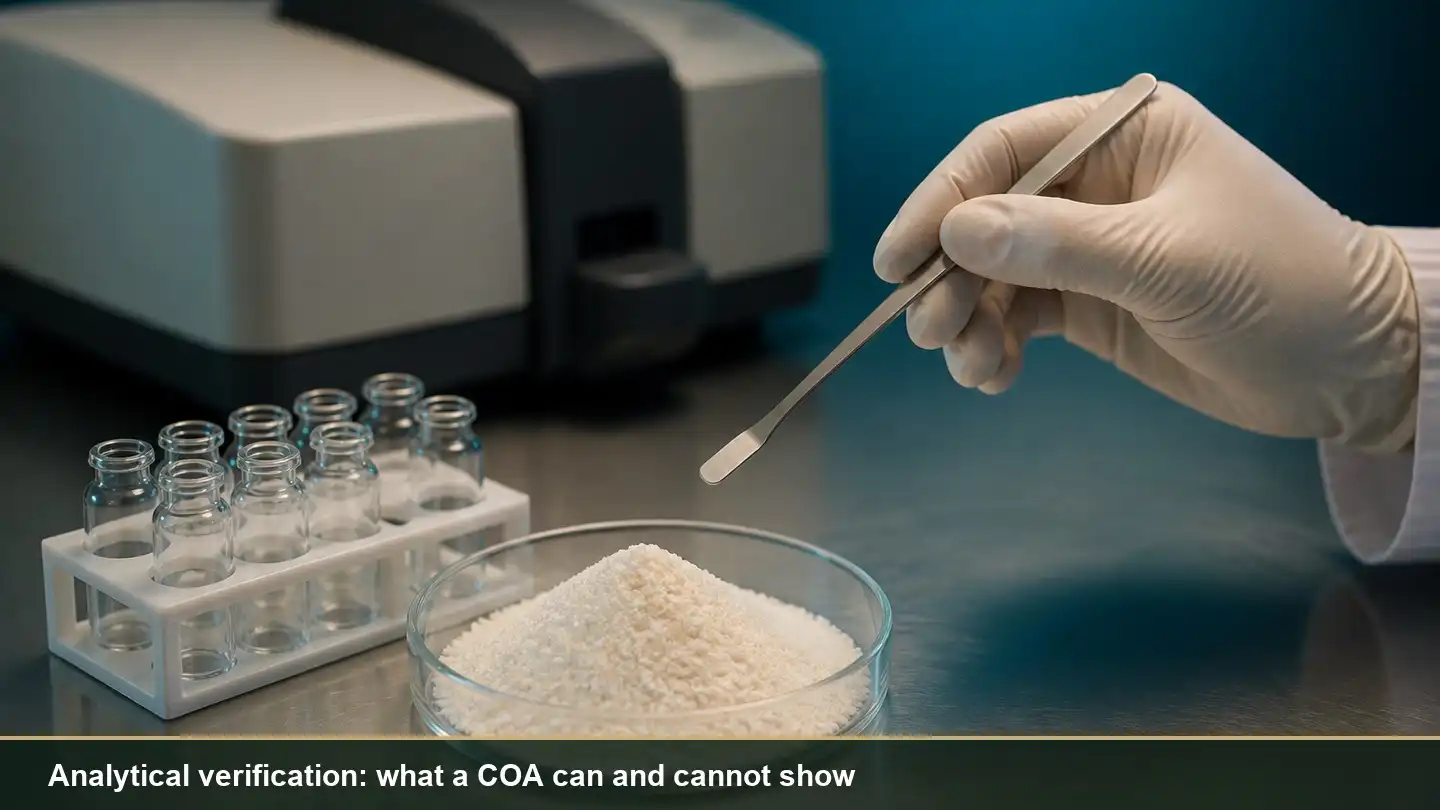
What a COA Can and Cannot Prove
Most disputes come from assuming a certificate of analysis covers more than it does. The table below maps the questions buyers actually ask to where the answer lives.
| Buyer’s question | Answerable from supplier documents? | Evidence to request |
|---|---|---|
| How much active is in the drum? | Yes | Batch assay by HPLC on the certificate of analysis |
| How much is genuinely encapsulated? | Yes, when the method is stated | Encapsulation value plus the separation method |
| Is the vesicle population uniform and intact? | Usually, for the sampled batch | Z-average, polydispersity index and TEM images |
| Does it redisperse cleanly in my matrix? | Only partly | A sample plus the reconstitution protocol; your own test is decisive |
| Is the microbial and heavy-metal profile in range? | Yes | COA limits: Pb <0.5 ppm and total plate count <1,000 cfu/g |
| Will it stay in specification for the stated shelf life? | Yes, if stability data are supplied | Stability study with stated storage conditions |
| Will it be absorbed better in people? | No — outside the scope of a specification | A controlled human study, not a raw-material COA |
Why No Specification Can Promise Human Absorption
Absorption from an oral dose depends on factors the ingredient supplier never sees: gastric transit time, presystemic metabolism, the food and liquid the dose is taken with, the finished formulation, and wide inter-individual differences. Two people can take the same dose and show very different systemic exposure. That variability is why regulatory frameworks define bioavailability as an in-vivo measurement rather than a label property. A raw-material data package can demonstrate a well-characterised vesicle system; it cannot demonstrate what a human body does with it. Readers who want the comparative view can weigh it against our article on what a liposomal format changes at the material level. Any supplier that converts a characterisation figure directly into an absorption promise has crossed from evidence into marketing.
A Buyer’s Verification Checklist
- Confirm the encapsulation efficiency value and the separation method behind it.
- Obtain Z-average and polydispersity index, ideally across several batches.
- Request TEM morphology images, not only particle-size numbers.
- Confirm the trans-isomer specification and the HPLC method used to police it.
- Test redispersion and suspension stability yourself, in the matrix you intend to use.
- Match declared shelf life to the storage conditions and packaging behind it.
- Verify that the certificate is batch-specific, not a generic template.
Questions to Put to a Supplier
These questions separate suppliers who own their characterisation data from those who repeat a category claim; the same logic appears in our guide to choosing a resveratrol ingredient.
- What exactly does your encapsulation efficiency measure, and by which separation method was it obtained?
- Are your DLS and TEM results generated per batch or per production campaign?
- What is the trans-isomer limit, and how is cis-isomer degradation monitored over time?
- Under which storage conditions was the shelf life established, and can I review the stability data?
- Can you show dispersion behaviour in the specific vehicle my formula uses?
- Which documents travel with each batch: specification, COA, safety data sheet and certificates?
- If an enhanced-delivery claim is used anywhere, what study supports it, and was it run on the ingredient or on a finished product?
Certifications and Documentation: Scope, Not Efficacy
Certification tells you something important, but not what many buyers assume. cGMP, ISO 9001, ISO 22000, Kosher and Halal certification speak to facility systems, process control and market suitability. They describe how the material is made and where it may be sold; they do not attest to absorption, and no certificate can. Non-GMO and Vegan appear here as label attributes rather than management-system certifications. When reviewing documentation, separate the facility-level certificates from the batch-level results: “the plant is certified” and “this batch conforms” are two different statements, and both should be verifiable.
Matching the Specification to Your Formulation
Characterisation data become useful only when read against your intended product. An off-white to pale-yellow free-flowing powder with good cold-water dispersibility suits ready-to-mix drinks and stick packs; a higher available concentration, customisable from 10% to 50%, saves carrier space in a capsule. The technical principles behind that flexibility are set out in our overview of liposome delivery technology. Decide which physical behaviour matters most on your line, then ask the supplier to evidence that behaviour specifically rather than to restate general parameters.
Requesting Documentation and Samples
The fastest way to test any of this is against a real sample. EmerWell supplies a full technical package for its resveratrol ingredient — specification, batch certificate of analysis, particle-size and morphology data, and a stability summary — together with technical support on reconstitution and matrix compatibility. Request the documentation, a specification for your target concentration and a sample for your own bench trial through the liposomal resveratrol powder product page, or write to info@emerwell-bio.com.
References
1. Walle, T. (2011). Bioavailability of resveratrol. Annals of the New York Academy of Sciences, 1215, 9–15. pubmed.ncbi.nlm.nih.gov/21261636
2. U.S. Food and Drug Administration. 21 CFR Part 320 — Bioavailability and Bioequivalence Requirements. ecfr.gov
3. International Council for Harmonisation. Q1A(R2) Stability Testing of New Drug Substances and Products — ICH Quality Guidelines. ich.org
4. International Organization for Standardization. ISO 22000 — Food safety management systems. iso.org
Disclaimer: This article is provided for business-to-business technical information only and does not constitute medical or regulatory advice. It describes raw-material characterisation; finished-product claims, labelling and instructions for use remain the responsibility of the brand and must be confirmed against the requirements of each market.
Online Message
YOU MAY LIKE
High quality furniture manufacturer