Sep 8, 2026
How Liposomal Technology Improves Resveratrol Bioavailability
Liposomal resveratrol represents a significant advancement in nutraceutical delivery systems. By encapsulating resveratrol molecules within phospholipid vesicles, this technology protects the active compound from degradation in the digestive tract and enhances cellular uptake. Studies show that liposomal formulations can increase plasma concentration up to tenfold compared to standard resveratrol powders, addressing the longstanding challenge of poor oral bioavailability. This breakthrough enables manufacturers to develop more effective products at lower dosages, reducing costs while delivering superior health outcomes.
Understanding the Bioavailability Challenge of Resveratrol
Why Traditional Resveratrol Falls Short?
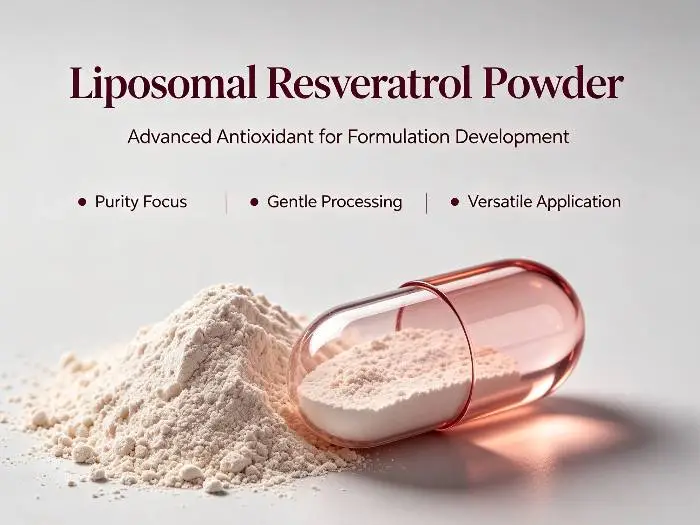
Resveratrol is known as a strong antioxidant with great anti-aging properties, but a lot of people never get to enjoy all of its benefits. Once the molecule is eaten, it faces several problems: strong stomach acids quickly break it down; gut enzymes break it down before it can be absorbed; and liver enzymes quickly turn what little makes it into the bloodstream into inactive metabolites. According to research, less than 1% of standard resveratrol taken by mouth actually gets into the body's systems in the form of active trans-resveratrol.
This bioavailability issue causes more problems than just lost potential. A lot of the time, people have to take huge amounts to get any healing benefit. This can cause stomach problems and make the product more expensive. Many supplement users stop taking resveratrol completely when they don't see any results. This hurts the brand's reputation and makes it harder to keep customers.
The B2B Impact of Poor Absorption
More and more pressure is being put on manufacturers and sellers to make goods that actually work. Bioavailability problems make dosing plans more difficult, which makes it hard to back up health claims or get the same results for all users. Efficacy claims are getting more and more attention from regulators, and goods that can't show they work in the real world risk being turned down by the market.
Bioavailability has a direct effect on your bottom line, not just for compliance reasons. When absorption rates are lower, the cost of the raw materials per effective dose goes up. Customers are also less satisfied, and there are more returns. When B2B clients are looking for resveratrol ingredients, they need options that get around these basic problems while still meeting high quality and price standards.
How Liposomal Technology Enhances Resveratrol Absorption?
The Science Behind Liposomal Encapsulation
Biomimicry at its best, liposomal delivery systems solve the bioavailability puzzle. The diameter of these microscopic spheres is usually between 50nm and 200nm. They are made up of phospholipid bilayers, which are like the membranes of our cells. When resveratrol molecules are enclosed in these structures, they are protected from digestive enzymes and stomach acid and can be absorbed better by the intestines at the same time.
There are several ways that the technology works. The lipid layer keeps resveratrol from breaking down too quickly, which means that more of the active substance gets to the small intestine whole. The phospholipid structure makes it easier for membranes to fuse with intestine epithelial cells, which lets resveratrol get through normal hurdles to absorption. The liposomal structure extends the time the chemical stays in the bloodstream, giving cells more time to take it up before it is broken down by the liver.
Clinical Evidence and Performance Metrics
Several pharmacokinetic studies show that liposomal formulations are better. After comparing different products, it was found that Liposomal trans-resveratrol powder has much higher Cmax (peak plasma concentration) and AUC (area under the curve) numbers. These measurements lead to real-world benefits, such as better support for the heart, more effective antioxidant activity in cells, and measurable anti-inflammatory effects at much lower doses.
It's not just better absorption of liposomal resveratrol that counts; the better stable profile is also important. When stored or eaten, liposome encapsulation keeps the important trans-isomer from changing into the chemically useless cis-form. This keeps the structure of the product intact so that it stays effective throughout its shelf life and maximizes the therapeutic potential per milligram of active ingredient.
Formulation Versatility Across Applications
The technology makes it possible to make many new products that weren't possible with regular resveratrol. Water dispersibility changes a lot of the formulation options. Liposomal resveratrol powder mixes easily into functional drinks and ready-to-drink mixes. It doesn't have the bitter taste, chalky texture, or sediment separate problems that come with other phenolic compounds. Now, drink makers can make resveratrol-containing drinks that are clear or nearly clear, without adding too many sweets or hiding agents.
It can be used for a lot more than just mouth vitamins. In the growing field of nutricosmetics, the amphiphilic nature of liposomal structures makes it easier for them to get through the gut lining and the stratum corneum. Better systemic release to dermal tissues helps beauty-from-within formulas, and better transdermal absorption helps cosmetic serums fight photoaging directly at the skin matrix level.
Procurement Considerations: Choosing the Right Liposomal Resveratrol Suppliers
Essential Quality Certifications and Testing Protocols
When choosing a supplier, you need to do a lot of research that goes beyond just looking at the ingredients. Reliable providers use strict quality control measures that check for both chemical purity and structure stability. High-performance liquid chromatography should be used in analytical tests to measure the amount of trans-resveratrol present, but that's just the beginning.
True liposomal goods need to be tested for encapsulation effectiveness using centrifugation-ultrafiltration techniques that can tell the difference between resveratrol that is really encapsulated and resveratrol that is just mixed in. Dynamic light scattering analysis proves the uniformity and spread of particle sizes, and zeta potential readings predict the long-term stability of colloids. Cryo-transmission electron microscopy shows that the spherical bilayer vesicles are still whole, not broken up lipid pieces.
Strict standards must be met for contamination screening, which includes full microbe testing and inductively coupled plasma mass spectrometry for heavy metals. Gas chromatography analysis of residual solvents makes sure that the amount of ethanol or other processing aids stays below what is acceptable. Testing the phospholipid carrier's oxidative stability stops rancidity problems that hurt both effectiveness and shelf life.
Evaluating Supplier Capabilities and Transparency
In addition to lab certificates, you should also look at business factors that affect the reliability of the supply chain. Does the seller offer different types of the product, like powders, liquids, or capsules, so that you can meet your production needs? Can they help with private labeling and formulating products that fit your brand? Knowing their manufacturing capacity, wait times, and minimum order amounts helps keep things running smoothly and makes it possible to plan your supplies accurately.
Today's clean-label market makes it impossible to avoid being open about where products come from. Check where the phospholipids come from; non-GMO soy or sunflower lecithin is chosen by health-conscious shoppers. Throughout the supply chain, organic approvals, allergen controls, and environmentally friendly buying methods are becoming more and more important in deciding what to buy.
Cost-Benefit Analysis for Strategic Sourcing
Because of the complex processing that goes into making liposomal ingredients, they naturally cost more than regular resveratrol. Instead of focusing on prices per kilogram, smart procurement teams look at costs through the lens of their total value. Figure out how much it really costs per viable dose, taking into account the fact that much smaller amounts are needed to get the same restorative effects.
Total arrival costs are affected by savings for buying in bulk, how the goods are shipped, and how the money is paid for liposomal resveratrol. Some providers offer scientific support and help with formulation, which is very useful in addition to the raw ingredient itself. Building relationships with manufacturers who are dedicated to constant improvement and new ideas will help your business as technology changes.
Safe Use and Dosage Guidelines for Liposomal Resveratrol
Recommended Daily Intake and Administration
Because liposomal formulations are more bioavailable than regular supplements, dosing rules need to be changed. Standard resveratrol products may need 500 mg or more every day to reach therapeutic amounts. Liposomal forms, on the other hand, usually give the same benefits at 100 to 200 mg doses. This lower dose greatly reduces the stomach problems that often happen when high doses of phenolic compounds are taken.
The best time to take it can make the effects stronger, and many experts suggest eating it with healthy fats to help the body absorb it even more. Because they are more stable, liposomal goods stay effective even when stored in a variety of ways. For liquid versions, however, refrigeration after opening extends the shelf life.
Safety Profile and Potential Interactions
When compared to megadosing traditional resveratrol, liposomal transport actually makes it safer. Lower effective doses get better results while lowering the risk of side effects. Clinical data shows that it is well tolerated by a wide range of people, with few side effects reported even during long periods of supplementation.
It is still important to be clear about possible interactions, especially for people who are taking blood-thinning drugs or are planning surgery, since resveratrol has mild blood-thinning qualities. Downstream makers and wholesalers should give end users clear instructions and include these things in the product material to make sure they are used responsibly and reduce liability concerns.
Future Trends and Innovations in Liposomal Resveratrol Delivery
Emerging Technologies on the Horizon
The world of nutraceutical technology is changing very quickly. Nanosomal packaging is the next big thing beyond normal liposomal systems. These even smaller delivery vehicles promise to improve bioavailability even more while keeping safety and stability standards high. Early study on hybrid systems that combine liposomal carriers with cyclodextrin complexation or piperine co-administration is showing results that work well together.
Personalized diet trends are driving the need for formulas that can be changed to fit each person's genetics and health needs. Advanced suppliers are making liposomal platforms that can be easily changed without having to completely redesign the process. As precision health applications get better, this flexibility will become more valuable.
Market Dynamics Shaping Procurement Strategy
The demand for high-tech nutraceutical ingredients keeps growing, especially in markets that value wellness solutions based on evidence. More and more, consumers can tell the difference between basic supplements and high-end goods that are backed by real technology innovation. Brands that talk about the benefits of bioavailability are able to charge higher prices and keep customers coming back.
Structure-function claims and factory quality standards are becoming more tightly regulated around the world. As compliance requirements get stricter, suppliers who invest in strong quality systems, clear documentation, and regulatory knowledge will become preferred partners. Sustainability factors also change how choices are made about where to get ingredients, with carbon-neutral production, recyclable packaging, and ethical ingredient sources becoming more important across all purchase criteria.
Strategic B2B buyers should build relationships with manufacturers that show they are dedicated to constant improvement and quality of liposomal resveratrol. Companies that invest in research, advanced analytical tools, and scalable production systems that keep liposomal integrity across batch sizes today will be at the top of the market tomorrow.
Conclusion
Liposomal technology completely changes resveratrol supplements by fixing the absorption problem that has been holding this powerful substance back. Better stability, better absorption, and a wide range of formulation choices are all big benefits for makers, wholesalers, and end users. As the nutraceutical industry moves toward products that are based on evidence and show measurable results, liposomal delivery systems are becoming both a way to stand out from the competition and a standard for quality. Businesses can be successful in this fast-paced market if they make smart purchasing choices based on seller approvals, analytical testing methods, and total value economics. Brands that embrace new technology while keeping quality standards high will be successful in the future.
FAQ
What makes liposomal resveratrol more effective than regular supplements?
The phospholipid coating keeps the resveratrol molecules from breaking down in the digestive system and makes it easier for them to be absorbed directly through the cell membranes of the intestines. This makes plasma concentrations up to ten times higher than with normal formulations. This means that smaller doses have better therapeutic effects with less stomach pain.
How should I verify a supplier's liposomal quality claims?
Ask for proof that the encapsulation worked well using centrifugation and ultrafiltration, that the particles were the right size (using dynamic light scattering to show a range of 50–200nm), and that the results were visible using cryo-transmission electron microscopy. Legitimate suppliers give out certificates of analysis that include both standard purity tests and these specialized tests.
What dosage adjustments are needed for liposomal formulations?
Because bioavailability is so much better, amounts of 100 to 200 mg per day are usually enough to work, while standard resveratrol pills need 500 mg or more. Product labels should now include these updated suggestions so that people don't consume too much and get the best health benefits.
Can liposomal resveratrol be used in beverage applications?
Absolutely. Liposomal versions are great for functional drinks because they can dissolve in water and hide tastes, unlike regular resveratrol, which makes drinks bitter and causes them to settle. This means that ready-to-drink health drinks, collagen mixes, and mitochondrial support recipes can be made without using too many sweeteners.
Partner with EmerWell for Superior Liposomal Resveratrol Solutions
Our state-of-the-art plant in San Diego, California, is where EmerWell is at the cutting edge of new advanced nutritional ingredients. We are a reliable provider of liposomal resveratrol because we use cutting-edge technology and strict quality standards that go above and beyond what the industry norms are. Our separate lab and warehouse processes allow us to ship quickly and consistently high-quality goods. A group of scientists with PhDs will help you with technical issues as you develop your product, from improving the formulation to following the rules set by regulators. Custom solutions, like private labeling, different shipping forms, and flexible order numbers, are what we do best. Get in touch with us at info@emerwell-bio.com to talk about how our high-quality liposomal formulations can improve your product line and give you real-world benefits in today's tough market.
References
1. Walle T, Hsieh F, DeLegge MH, et al. "High absorption but very low bioavailability of oral resveratrol in humans." Drug Metabolism and Disposition, 2004; 32(12):1377-1382.
2. Faria A, Pestana D, Teixeira D, et al. "Insights into the putative catechin and epicatechin transport across blood-brain barrier." Food & Function, 2011; 2(1):39-44.
3. Sessa M, Balestrieri ML, Ferrari G, et al. "Bioavailability of encapsulated resveratrol into nanoemulsion-based delivery systems." Food Chemistry, 2014; 147:42-50.
4. Kobierski S, Ofori-Kwakye K, Müller RH, Keck CM. "Resveratrol nanosuspensions for dermal application - production, characterization, and physical stability." Pharmazie, 2009; 64(11):741-747.
5. Davidov-Pardo G, McClements DJ. "Nutraceutical delivery systems: Resveratrol encapsulation in biopolymer particles." Food Chemistry, 2015; 167:205-212.
6. Zu Y, Overby H, Ren G, et al. "Resveratrol liposomes and lipid nanocarriers: Comparison of characteristics and inducing browning of white adipocytes." Colloids and Surfaces B: Biointerfaces, 2018; 164:414-423.
Online Message
YOU MAY LIKE
High quality furniture manufacturer
_1776234307158.webp)