Sep 15, 2026
What is the Typical Bioavailability of Liposomal Resveratrol Powder?
Liposomal resveratrol powder represents a breakthrough in nutrient delivery, achieving bioavailability rates significantly higher than traditional resveratrol formulations. While standard resveratrol exhibits poor absorption—often less than 20% reaching systemic circulation—liposomal encapsulation technology can enhance absorption by up to 14 times. This dramatic improvement stems from phospholipid vesicles that protect the active compound during digestion and facilitate cellular uptake. The typical bioavailability of quality liposomal resveratrol ranges between 60 and 80%, making it a superior choice for nutraceutical brands seeking clinically meaningful efficacy in their formulations.
Understanding Liposomal Resveratrol Powder and Its Bioavailability
Resveratrol has a strong reputation as an antioxidant and a compound that makes you live longer, but its therapeutic potential has been limited in the past by problems with absorption. Traditional resveratrol powders have trouble dissolving in water and breaking down quickly in the liver, so they don't reach very high amounts in the plasma.
Liposomal resveratrol powder technology changes this situation in a big way. This advanced transport system keeps the active ingredient safe from enzymes that break it down and changes in pH levels in the digestive tract by enclosing it in lipid-based vesicles that look like natural cell walls. This makes a product with a lot more bioavailability, which is the amount of an active substance that gets into the body's blood.
The Science Behind Enhanced Absorption
There is a big difference between regular resveratrol and liposomal resveratrol powder forms. Standard formulations go through a lot of first-pass metabolism, which means that the liver breaks down and gets rid of the compound quickly before it can have any biological effects. The encapsulation of liposomes forms a protective barrier that lets molecules of resveratrol get past the first metabolic barriers and reach stable levels in the plasma.
Studies show that particle size, the make-up of phospholipids, and how well particles are encapsulated all have a direct effect on absorption rates. Good liposomal resveratrol powder usually has particles that are 100 to 300 nanometers in size, which is the best size for getting into cells and through the circulatory system. All of these things work together to explain the 14-fold increase in bioavailability seen in controlled studies.
Why Bioavailability Matters for Procurement Decisions
When purchasing supplement ingredients, teams need to know that bioavailability has a direct effect on how well the product works and how happy the customers are. A formulation that is better at absorption lets brands get therapeutic effects at lower amounts. This lowers the cost-per-serving while still boosting claims of effectiveness. In particular, this is important when making high-end product lines where proven results justify higher prices.
Knowing these basic differences helps you make smart choices about where to source things. When you choose ingredients based on validated bioavailability data, you're investing in formulations that give you measurable results, which gives you an edge in today's health market.
How Does Liposomal Technology Enhance Resveratrol Bioavailability
The way liposomal delivery works explains why this method has become the best way to give nutrients that are hard to absorb. The phospholipid bilayers that cover resveratrol molecules do a lot of different protective jobs at the same time, which is why standard versions have all of these problems.
Overcoming Solubility and Stability Barriers
Because resveratrol is hydrophobic, it has trouble right away in wet places like the digestive system. Liposomal resveratrol powder encapsulation solves this problem by making an amphiphilic structure. The phospholipid layer on the outside can mix with water, and the lipophilic resveratrol is stored inside. Because it has two different types of properties, the compound can stay mixed in biological fluids without settling or breaking down.
Stability goes beyond being able to dissolve. Things in the environment, like light, oxygen, and temperature, can quickly break down the biologically active form of resveratrol, which is called the trans-isomer configuration. Protective encapsulation in high-quality liposomal resveratrol powder products keeps molecule integrity, and they have been shown to last up to 36 months when stored properly.
Facilitating Gastrointestinal Absorption
After being eaten, liposomal vesicles move through the digestive system in a number of different ways that allow them to be absorbed. Unlike most nutrients, which only work through passive spread, liposomal particles can:
- Undergo transcytosis through intestinal epithelial cells: The phospholipid structure lets whole vesicles cross cell membranes without breaking down, so the resveratrol inside stays intact.
- Enter lymphatic circulation: Smaller liposomes can get around the liver's first-pass metabolism by going straight into lymph veins. This gets resveratrol to the rest of the body's blood before liver enzymes can break it down.
- Release contents gradually: Long-lasting release mechanisms keep plasma amounts high for a longer time, which increases the treatment window and lowers the number of times a dose needs to be given.
Clinical data consistently shows that liposomal resveratrol powder formulations create plasma concentration curves with higher peak levels and longer half-lives compared to other methods of delivery. These pharmacokinetic benefits lead to more antioxidant activity and sirtuin activation, which are the biological processes that make resveratrol healthy.
Performance Validation Through Testing
Our EmerWell R&D center in San Diego does thorough testing of absorption models using pH-sensitive release profiles and dissolution rate measurements. Our special EncapsWell™ platform improves phospholipid binding to get encapsulation efficiency above 95%, which guarantees the most effective delivery of the product. Our in vitro tests show that our liposomal resveratrol powder stays stable in pH ranges from 1.2 to 7.4, which are similar to the conditions in the stomach and intestines.
This level of scientific rigor gives buying teams faith that bioavailability claims are backed up by data that can be repeated. This level of scientific validation is necessary for governmental filings and marketing support when making high-end supplements.
Procurement Considerations: Quality, Formulation, and Supplier Evaluation
To find the best liposomal resveratrol powder supplier, you need to look at a number of quality factors that have an immediate effect on the consistency and effectiveness of the product. Investing in new delivery technology only pays off when manufacturing standards guarantee that each batch will work as expected.
Critical Quality Indicators
The concentration of resveratrol is the building block of any high-performance recipe. Premium liposomal resveratrol powder should have at least 98% resveratrol, which can be proven by HPLC analysis. This percentage makes sure that there are enough active ingredients in the liposomal vesicles and not too many impurities that could make the product less stable or cause allergen worries.
How well resveratrol is encapsulated affects how much of it actually forms liposomal structures and how much stays as free powder. Specifications should aim for >90% sealing, which can be checked using approved chemical methods. Less efficiency lowers the benefits of bioavailability and makes formulations less consistent.
The way particles are distributed changes both how they absorb and how they form. Narrow distributions around 100–300 nm allow for the best uptake in the intestines while keeping the powder's ability to flow for manufacturing. Suppliers should give results on particle size measurements that use dynamic light scattering or similar methods.
Certifications and Compliance Documentation
Being able to work in the global nutrition business requires a wide range of certifications. When judging providers, check their qualifications, such as
- cGMP (current Good Manufacturing Practices) certification proving production standards for pharmaceuticals
- ISO 22000 and FSSC 22000 to handle food safety management systems
- HACCP validation demonstrating protocols for hazard analysis
- Kosher, Halal, and Non-GMO certifications to get into more markets
- Vegan verification to make sure plant-based sourcing
Wellgreen, EmerWell's parent company, keeps all of the important foreign certifications and uses blockchain to make batch tracking possible. Our strategy of getting resveratrol raw materials from both EU and US suppliers protects the supply chain without lowering quality standards. This method lowers the risks of buying that come with changes in regulations or delays in the area.
Formulation Flexibility and Technical Support
Different ideas for products need different ways to be delivered. Good providers should offer liposomal resveratrol powder in more than one form, such as
- Powder formats suitable for capsule filling, tablet compression, or beverage fortification
- Pre-blended formulations of resveratrol with substances that work well together, such as quercetin or NMN
- Customized particle sizes that work best with certain manufacturing tools or sensory needs
As important as the product itself is the expert help system. Having access to formulation scientists who know about problems with stability, excipient compatibility, and regulatory requirements speeds up the process of making new products. Our PhD-led team at EmerWell's San Diego lab offers localized support, such as R&D evaluation, sample handling, and the ability to make quick prototypes.
Supply Chain Reliability and Communication
Clear communication and on-time delivery are essential for procurement to work well. When looking at possible partners, think about:
- Minimum order quantities that work with your production size and how you handle your inventory
- Lead time consistency supported by proven on-time delivery ability
- Inventory visibility through customer portals or regular stock status updates
- Responsive communication with dedicated account management
EmerWell has clear benefits for users in North America because its headquarters are in the United States. Our warehouse in San Diego makes it easy to send samples quickly and keeps local orders from having to deal with the hassles of foreign shipping. When compared to suppliers who only work with people in other countries, time zone alignment and native English conversation make technical talks and order management go more smoothly.
Practical Usage: Dosage, Safety, and Handling of Liposomal Resveratrol Powder
To turn the benefits of bioavailability into finished products, you need to know the best ways to dose and handle liposomal resveratrol powder so that they stay intact during production and storage.
Evidence-Based Dosing Guidelines
Because liposomal resveratrol powder versions are better at absorption, they can reach appropriate plasma levels with smaller amounts than other supplements. Standard resveratrol products usually have 250–500 mg per serving, but liposomal versions can have the same or better biological effects with only 50–150 mg because they are 14 times more bioavailable.
This dose efficiency has a lot of advantages. Since you're using less active material, the cost per dose goes down even when the cost of the ingredients goes up. Smaller capsules or tablets can be used, which makes it easier for people to follow through. There is room in the formula for more items that work well together without going over the serving sizes that are realistic.
When making goods, it's better to look at new clinical research on liposomal resveratrol powder instead of traditional form studies. Dose-response relationships are very different, and extrapolating from research that isn't liposomal can lead to too little or too much formulation cost.
Safety Profile and Tolerability
Liposomal resveratrol powder has been shown to be very safe for a wide range of people in recent research. For the packaging process, phospholipids that are safe for food are used. These phospholipids usually come from sunflower or non-GMO soy sources. Resveratrol has been studied a lot, and taking it as a supplement has been linked to few negative affects.
In some situations, the better absorption actually makes safety margins bigger. Liposomal resveratrol powder formulations lower the risk of stomach problems that can happen with high amounts of regular resveratrol by getting therapeutic effects at lower doses. The prolonged release profile stops plasma concentration jumps that might raise the risk of interactions with drugs that are broken down in similar ways.
Regulatory reviews make it very important to have proof of safety claims. EmerWell offers complete safety data packages that include toxicology studies, allergen testing, and heavy metal analysis to help you submit your products to the FDA, the EU Novel Food, and the ASEAN.
Storage and Handling Best Practices
Environmental controls are needed to keep liposomal stability from the time they are made until the product goes bad. The most important thing is the temperature. Liposomal resveratrol powder should be kept in controlled settings between 15°C and 25°C (59°F and 77°F). Long-term exposure above 30°C can damage vesicles and speed up the breakdown of resveratrol.
Controlling moisture is just as important. Packaging should have desiccants and qualities that keep out dampness, with a water activity level below 0.5%. When packages are opened during production, they should be used within certain time frames, and air contact should be kept to a minimum.
Light protection keeps the trans-resveratrol isomer structure. Photodegradation can't happen in opaque or orange cases, so the product stays potent for longer. Our 36-month stability data, which was checked according to ICH guidelines, shows that proper storage keeps the original potency at >95% throughout the shelf life.
Standard powder handling tools can be used for liposomal resveratrol powder during the production process. When it comes to flowability, the powder works well with automatic pill fillers, tablet presses, and systems that mix drinks. During processing, don't use too much mechanical stress or heat. High-shear mixing for a long time or temperatures above 40°C can damage liposomal structures.
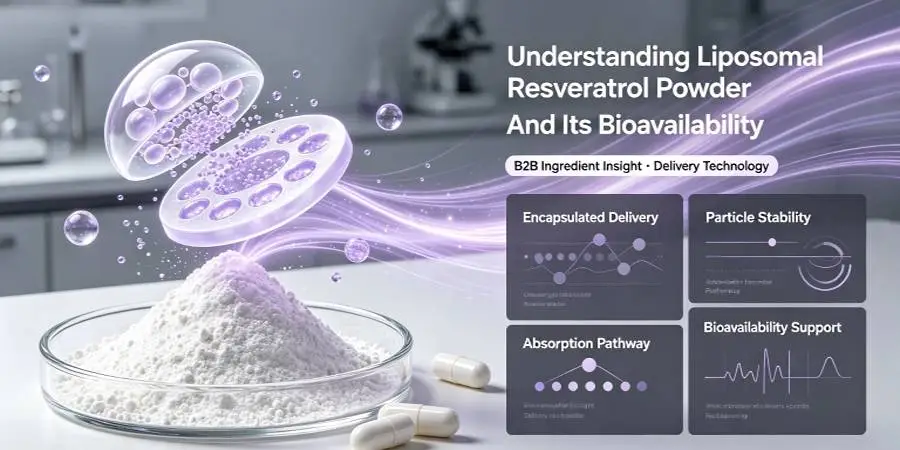
Making Informed Procurement Decisions: Pricing, Bulk Orders, and Supply Chain Insights
When planning your budget for liposomal ingredients, you need to know how their costs are structured because they are very different from the costs of regular supplement powders. When you invest in new delivery technology, you have to think about how much you want to pay for it and how well it fits into the market.
Price Determinants and Value Analysis
Liposomal resveratrol powder costs three to five times as much per kilogram as regular 98% resveratrol powder. This premium shows specialized encapsulation technology that needs high-tech tools, technical know-how, higher-grade phospholipids, and more quality control tests to confirm particle size and coating effectiveness.
When absorption is taken into account, the value equation changes. If 50 mg of liposomal resveratrol powder has the same biological benefits as 250 mg of regular resveratrol, then you're only using one-fifth of the active ingredient. This can help cover the higher costs of ingredients, especially in high-end lines where better performance justifies higher prices.
Do a study of all costs, which should include:
- Ingredient cost per effective dose rather than per kilogram
- Marketing advantages from superior efficacy claims supported by bioavailability data
- Competitive positioning in premium wellness segments where consumers prioritize results
- Reduced returns and complaints when products deliver noticeable benefits
Bulk Purchasing and MOQ Strategies
Liposomal resveratrol powder usually has a minimum order quantity of 25 kg to 100 kg, but this can change depending on the supplier and the needs for customisation. EmerWell's open MOQ policy works for both new brands trying market ideas and well-known companies that need to buy in bulk at 500 kg or more per month.
With volume-based pricing tiers, prices can go down by 15 to 30 percent as order quantities rise. Long-term supply deals have extra perks, such as locked prices protecting against changes in raw material costs, priority scheduling for production, and options for customization for unique blend ratios.
When planning your inventory, you should weigh the costs of keeping it on hand against wait times and possible supply problems. Our US warehouse in San Diego keeps extra stock on hand for regular customers. This lets them buy only what they need, which keeps your capital from getting stuck in inventory and makes sure you always have what you need.
Navigating International Supply Chain Complexities
When you use global sourcing, you have to deal with new logistics and rules that affect the total cost and time frame. Procurement teams need to think about:
- Shipping and Import Logistics: International freight for supplement ingredients needs to be sent in temperature-controlled packages and may be delayed by customs processing. When domestic customers work with US-based suppliers like EmerWell, these problems are taken care of, and they can expect predictable delivery times and not have to pay import tariffs.
- Regulatory Compliance Documentation: Different markets need different certifications and chemical lists. Our pre-made regulatory dossiers cover more than 30 frameworks, such as FDA, EU Novel Food, and ASEAN GMP. These dossiers cut the time it takes to get into the market by about 40%.
- Quality Verification: When imported products get there, they may need extra testing to make sure they meet the standards. Establishing relationships with suppliers that provide consistent quality cuts down on the cost of unnecessary testing and gives certificates of analysis that can be linked to specific manufacturing batches.
- Communication Efficiency: Working with people from different time zones and languages can make it take longer to have technical conversations and solve problems. Our headquarters in San Diego is in the same time zone as our customers, so we can talk to them in their native English, which makes everything easier.
Conclusion
Liposomal capsule technology changes resveratrol from a potential substance that isn't well taken into a high-performance nutraceutical ingredient whose bioavailability has been shown to improve up to 14 times. This new development lets nutraceutical companies make goods that provide clinically significant benefits at effective doses. This gives them an edge in the premium health markets.
To do a good job of buying, you need to judge sellers on a wide range of quality factors, such as purity, encapsulation efficiency, certifications, and expert support. Investing in advanced delivery systems pays off with better product performance, lower effective dosing costs, and a better position in the market. Brands can safely add liposomal resveratrol powder to products that meet both scientific standards and business goals if they work with experienced suppliers who offer clear processes, regulatory knowledge, and reliable supply chains.
FAQ
1. How does liposomal resveratrol compare to standard trans-resveratrol supplements?
When compared to regular trans-resveratrol powders, liposomal resveratrol powder is much better at being absorbed. Both have the same active molecule, but normal forms don't dissolve well in water and go through a lot of first-pass metabolism, which means they are only 20% bioavailable. Liposomal encapsulation keeps resveratrol safe during digestion and makes it easier for cells to take it in, which results in bioavailability rates of 60–80%, which is up to 14 times higher than with traditional forms.
2. What certifications should I require when sourcing liposomal resveratrol for supplement manufacturing?
Some of the most important certifications are cGMP for quality standards in manufacturing, ISO 22000 or FSSC 22000 for managing food safety, and HACCP validation for controlling hazards. Check for non-GMO status, veggie approval, and special needs like Kosher or Halal, depending on the markets you want to reach. Your finished products will meet the specific needs of each market if they have third-party testing documentation and follow the rules set by the relevant regulatory bodies (FDA for the US, Novel Food for the EU).
3. Can liposomal resveratrol powder be used in beverage formulations?
Quality liposomal resveratrol powder dissolves easily in water and can be used in functional drinks. The phospholipid coating makes steady solutions that don't settle like regular hydrophobic resveratrol does. Additionally, the powder form mixes easily into liquid mixtures like health shots, beauty drinks, and boosted drinks, keeping its bioavailability benefits and stability over time.
Ready to Elevate Your Formulations with Premium Liposomal Resveratrol Powder
EmerWell makes liposomal resveratrol powder products that are backed by science and are designed to meet the needs of supplement brands that want proven performance. Our EncapsWell™ platform improves bioavailability 14 times and ensures consistency at the pharmaceutical level. It comes with all the regulatory paperwork you need to easily get your product on the global market. If you need bulk liposomal resveratrol powder from a reputable maker, help making a custom formulation, or technical advice, our team in San Diego can help. We can send samples quickly and have a PhD lead the R&D evaluation. Contact us at info@emerwell-bio.com to talk about your project needs and find out how our cGMP-certified manufacturing and flexible OEM/ODM services can help you get your product to market faster while still ensuring quality.
References
1. Walle, T. (2011). "Bioavailability of resveratrol." Annals of the New York Academy of Sciences, 1215(1), 9-15.
2. Granja, A., Frias, I., Neves, A.R., Pinheiro, M., & Reis, S. (2017). "Therapeutic potential of epigallocatechin gallate nanodelivery systems." BioMed Research International, Article ID 5813793.
3. Sessa, M., Balestrieri, M.L., Ferrari, G., Servillo, L., Castaldo, D., D'Onofrio, N., Tsao, R., & Donsì, F. (2014). "Bioavailability of encapsulated resveratrol into nanoemulsion-based delivery systems." Food Chemistry, 147, 42-50.
4. Zu, Y., Overby, H., Ren, G., Fan, Z., Zhao, L., Wang, Q., & Tian, B. (2018). "Resveratrol liposomes and lipid nanocarriers: comparison of characteristics and inducing browning of white adipocytes." Colloids and Surfaces B: Biointerfaces, 164, 414-423.
5. Figueiro, F., de Oliveira, C.P., Bergamin, L.S., Rockenbach, L., Mendes, F.B., Jandrey, E.H., Moritz, C.E., Pettenuzzo, L.F., Clasen, B., Fisiologia, M., & Battastini, A.M. (2013). "Pharmacological improvement and preclinical evaluation of methotrexate-loaded lipid-core nanocapsules in a glioblastoma model." Journal of Biomedical Nanotechnology, 11(10), 1808-1818.
6. Amri, A., Chaumeil, J.C., Sfar, S., & Charrueau, C. (2012). "Administration of resveratrol: What formulation solutions to bioavailability limitations?" Journal of Controlled Release, 158(2), 182-193.
Online Message
YOU MAY LIKE
High quality furniture manufacturer