

Oct 28, 2026
Liposomal Glutathione Powder vs. Regular Glutathione: What Is the Difference?
When a supplement brand puts a liposomal glutathione powder specification next to one for regular glutathione powder, it is usually comparing two sheets that share an ingredient name, an assay headline and almost nothing else. This article stays inside that narrow frame: the physical form of the material itself. It looks at what each material actually is, how the powder behaves in the warehouse and on the line, what the documents report, and where a useful comparison stops. EmerWell supplies liposomal glutathione powder as a raw material, so the notes below come from the supplier's side of the table.
Two Materials, One Ingredient Name
Glutathione is a tripeptide assembled from three amino acids. Commercially, the substance sold as glutathione is almost always reduced L-glutathione, written GSH. It also exists in an oxidised form, GSSG, in which two GSH molecules are joined by a disulfide bridge. Both grades on the market start from the same reduced molecule; what differs is what surrounds it. A liposomal grade carries that molecule inside phospholipid bilayer vesicles and then dries the system into a powder. A regular grade sells the molecule on its own. The site's own walk-through of standard and liposomal glutathione forms covers the terminology in more depth.
What the Regular, Unencapsulated Material Is
Chemical form and appearance
Unencapsulated reduced glutathione is a white to off-white powder, crystalline to fine in texture. It has no carrier, no shell and no vesicle. Whatever the declared content says, the reactive centre of the molecule is the thiol group, and that group is fully exposed to the environment of the drum.
Behaviour in water
This grade dissolves. It goes into true solution rather than forming a colloid, which is why it is straightforward to blend into a liquid or a ready-to-drink format. The same thiol group that makes the molecule interesting is also its weak point: it reacts with oxygen, and moisture, heat, light and traces of metal ions all accelerate that reaction. Buyers who want to know whether a bulk powder still qualifies as a powder-form glutathione ingredient generally start from exactly this point.
What the Liposomal Grade Is
Liposomal glutathione powder uses the same reduced molecule, enclosed within phospholipid bilayers and then dried. EmerWell's grade is a white to off-white, free-flowing powder with excellent dispersibility in cold water; in water it forms a stable, milky-white colloidal suspension rather than a clear solution. Glutathione content is offered across 10% to 50%, with 25% as the standard grade, and at least 98% of the glutathione is retained in the reduced form. Encapsulation efficiency is specified at 85% to 98%. Because the carrier, not the molecule, is what changes, the choice between the two is often framed as a form selection question for supplement brands rather than a chemistry question.
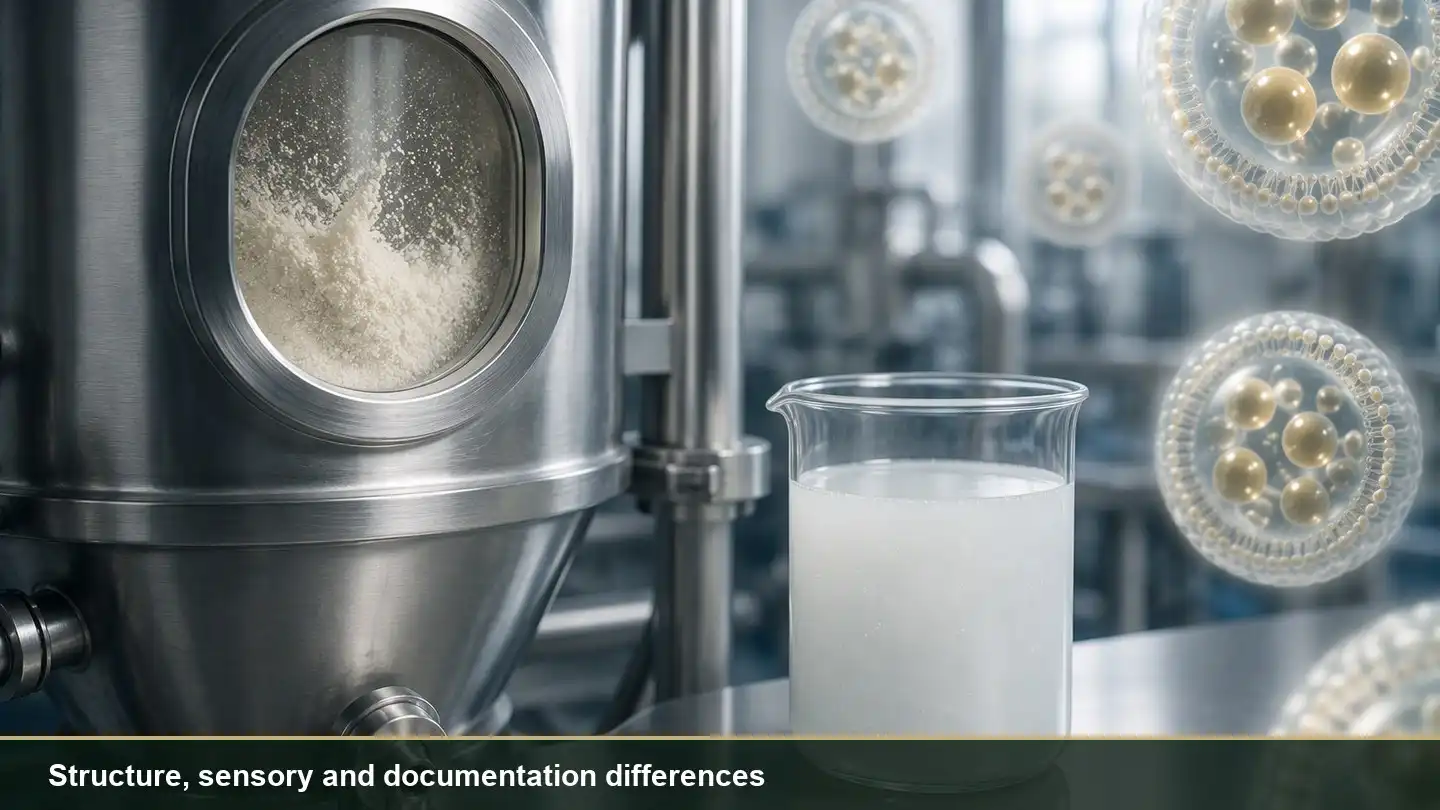
Form and Physical Description Side by Side
The table below compares the two materials at the level of form only. Nothing in it describes behaviour in the body.
| Attribute | Regular reduced glutathione powder | Liposomal glutathione powder |
|---|---|---|
| Carrier structure | None; the molecule is sold as it is | Reduced molecule enclosed in phospholipid bilayer vesicles |
| Size parameter reported | Powder particle size distribution | Vesicle size distribution, measured by dynamic light scattering |
| Appearance | White to off-white, crystalline to fine powder | White to off-white, free-flowing powder |
| Behaviour in cold water | Dissolves, giving a clear solution | Disperses readily, giving a stable milky-white colloidal suspension |
| Declared glutathione content | Grade-dependent, with no carrier allowance | 10% to 50%, with 25% as the standard grade |
| Carrier-specific specification | Not applicable | Encapsulation efficiency 85% to 98% |
Further reading on these physical behaviours is compiled in the site's overview of solubility, stability and formulation considerations.
Same Declared Assay, Different Behaviour
Retaining the reduced fraction
A content figure on its own does not tell you how much of the material is still reduced. Two lots can both declare 50% glutathione and differ in their GSH to GSSG ratio, which is the parameter that describes how much of the molecule remains in the reduced state. The liposomal grade is specified to hold at least 98% of the glutathione in reduced form, and the ratio is reported by HPLC, so the reduced fraction is a number a buyer can check rather than a sentence in a brochure.
Sulfur odour
The thiol group gives glutathione its sulfurous note. In an unencapsulated powder that note is out in the open: it is noticeable in the drum, at the weighing station and in the finished blend. Placing the molecule inside a lipid bilayer changes what the nose meets first, and sensory evaluation is part of the specification for the liposomal grade. Formulators who work with flavoured stick packs and drinks tend to value that difference more than those filling opaque capsules.
Colour
Reduced glutathione is white. Yellowing is a sign that something has changed, and oxidation, moisture pickup and metal contact all push a lot in that direction. Because the bilayer limits direct contact between the molecule and oxygen, light and metal traces, colour tends to hold better across the 24-month shelf life. Colour is also the easiest field check a warehouse can make against a retained sample.
| Parameter | Regular reduced glutathione powder | Liposomal glutathione powder |
|---|---|---|
| Reduced-form share | Not usually specified; depends on storage history | Specified to retain at least 98% as reduced GSH |
| Sulfur odour | Fully exposed at the thiol group | Sheltered by the bilayer; covered by sensory evaluation |
| Colour stability | More prone to yellowing after moisture, metal or heat exposure | Bilayer limits oxygen, light and metal contact |
| Cold-water behaviour | Clear solution | Stable milky-white colloid |
| Caking tendency | Can cake once moisture is picked up | Formulated to stay free-flowing; moisture is still the main risk |
| Processing tolerance | Tolerant of shear; sensitive to heat and oxygen | Sensitive to high shear and high temperature, which can disturb vesicles |
Dispersion, Caking and Processing Tolerance
Cold-water dispersion and lumping
Regular material goes into solution, so a formulator mainly controls dissolution time. Liposomal material forms a colloid, so the control points shift to wetting and mixing energy: powder added too quickly or stirred too gently can leave lumps that take time to break. The liposomal grade is specified for excellent cold-water dispersibility, but a defined addition sequence is still good practice on a powder line.
Caking and moisture
Both materials respond to moisture; they simply fail in different ways. An unencapsulated powder cakes and loses flow. A liposomal powder stays free-flowing by design, but moisture pickup is still the variable that most often shortens usable life, which is why sealed packaging and a cool, dry store are standard advice rather than marketing language — the same logic set out in the guide to storing liposomal glutathione powder effectively.
Shear and heat
Unencapsulated material tolerates mixing and milling well, but its thiol content reacts to heat and oxygen. Liposomal material is the reverse in emphasis: the carrier protects the molecule, yet high-shear and high-temperature steps can disturb vesicle structure, and encapsulation efficiency is the number that moves first when that happens. This is why a specification is only half the story and the process window is the other half, a point covered in more detail in the notes on formulation factors for product developers.
Documentation: What the Liposomal Grade Adds
A regular glutathione sheet normally reports identification, content, microbiological limits, metals and a lot number. A liposomal sheet adds the carrier-dependent parameters, and a buyer should read the method column as carefully as the value column.
| Parameter | Regular grade (typical sheet) | Liposomal grade, EmerWell | Method |
|---|---|---|---|
| Glutathione content | Assay value, grade-dependent | 10% to 50%, with 25% as the standard grade | HPLC |
| Reduced-form share | Rarely specified | At least 98% retained as reduced GSH | HPLC, GSH to GSSG ratio |
| Encapsulation efficiency | Not applicable, no carrier | 85% to 98% | Validated in-house method |
| Size distribution | Powder particle size | Vesicle size distribution | Dynamic light scattering |
| Microbiological limits | Total plate count | Below 1,000 cfu/g | Compendial microbiological methods |
| Heavy metals | Lead limit | Under 0.5 ppm | As stated on the batch certificate of analysis |
| Shelf life | Lot-dependent | 24 months | Stability protocol in the style of ICH Q1A(R2) |
| Odour and appearance | Visual check | Visual and sensory evaluation | Sensory panel against retained sample |
What belongs on such a document is set out in the site's guide to what a glutathione powder COA should include, and the parameter list above follows that structure.
How the Numbers Are Produced
Three methods carry most of the weight. HPLC gives content and the GSH to GSSG ratio; it is also the technique regulators and laboratories use for glutathione identity and impurity work, and published method papers use simultaneous GSH and GSSG measurement as the reference approach for the redox pair. The practical caveat is that glutathione oxidises during sample preparation, so handling, quenching and storage conditions can shift a result before the instrument sees it. Two laboratories can therefore disagree while both being right about their own samples.
Dynamic light scattering reports a vesicle size distribution as an intensity-weighted average, and it is sensitive to dilution and to the medium used. A size figure means little without its dilution protocol, which is why particle size reporting for liposomal powders is discussed on this site as a method question rather than a headline number. Microbiological counts and metals are comparably method-bound. The useful habit for a buyer is to compare method footnotes across two certificates, not just the numbers.
What This Comparison Cannot Show
Nothing in the tables above describes behaviour in the body. This article does not compare in-vivo absorption, bioavailability or any health effect of the two forms, and no figure here should be read as such a comparison. Whether a brand may make a statement about a finished product depends on the ingredient as used, the amount in the finished product and the rules of the market where it is sold; substantiating those statements is the brand's work, not the supplier's. What this comparison does cover is limited and checkable: carrier structure, physical behaviour in water and on the line, and the documents that describe both. Buyers who want the buyer-side version of that checklist can start with what to look for in a liposomal glutathione powder.
Certification and Batch Documentation
The glutathione raw material line holds cGMP, ISO 22000, FSSC 22000, HACCP, Kosher and Halal certification. Beyond the certificates, four documents carry the qualification file for the lot being offered:
- A specification sheet with the grade and the parameters listed above
- The batch certificate of analysis for that lot
- The vesicle size report from dynamic light scattering
- The sensory evaluation record against a retained sample
Where a brand needs a fixed specification across repeat orders, the change-notification route matters as much as the first certificate.
Working With EmerWell on a Glutathione Specification
If you are setting a raw material specification, we can send the technical data package — specification sheet, batch certificate of analysis, vesicle size report, sensory evaluation record and typical microbiological and metals data — together with a sample for your own bench work. Tell us the format you are developing (capsule, stick pack or ready-to-mix powder) and the declared content you need, and we will confirm which grade fits. Start at the liposomal glutathione powder product page or write to info@emerwell-bio.com.
References
- Measurement of Glutathione as a Tool for Oxidative Stress Studies by High Performance Liquid Chromatography, PMC. https://pmc.ncbi.nlm.nih.gov/articles/PMC7571047/
- Pitfalls in the analysis of the physiological antioxidant glutathione (GSH) and its disulfide (GSSG) in biological samples, PMC. https://pmc.ncbi.nlm.nih.gov/articles/PMC4829456/
- Validation of an HPLC-UV method for the analysis of glutathione and its impurities, U.S. Food and Drug Administration, FDA Science Forum. https://www.fda.gov/science-research/fda-science-forum/validation-hplc-uv-method-analysis-glutathione-and-its-impurities
- ICH Harmonised Tripartite Guideline Q1A(R2), Stability Testing of New Drug Substances and Products, International Council for Harmonisation. https://database.ich.org/sites/default/files/Q1A(R2) Guideline.pdf
- Nanotechnology, European Food Safety Authority topic page. https://www.efsa.europa.eu/en/topics/topic/nanotechnology
Disclaimer: this article is published by a dietary supplement ingredient manufacturer for business-to-business technical information. It is not medical advice, and it does not replace the regulatory review that a brand must carry out for its own finished product in its own market.
Online Message