

Oct 29, 2026
Liposomal Glutathione Powder and Oxidative Stress: What Does Research Show?
“Oxidative stress” appears on many glutathione product pages, usually doing the wrong job. This article examines it as a term, not a benefit. EmerWell supplies liposomal glutathione powder as a bulk raw material, and everything below concerns that material: how its redox state is measured, how it changes during storage, and which measurements can be written into a specification. No statement here describes an outcome in a person.
The Term Does Not Transfer From Nutrition Writing to a Specification
Reviewing a glutathione document begins with noticing which kind of sentence is being written. A specification makes claims about a sampled lot; nutrition writing makes claims about a living system. That vocabulary does not survive the move, and this is where much supplier documentation becomes unverifiable.
Why the phrase belongs to a different document type
In its technical sense, oxidative stress describes an imbalance inside a living organism, where reactive oxygen species exceed the capacity of the systems that reduce them. The definition depends on measurement in a subject — blood, tissue or cells — against a reference range, with a sampling time and study design. None of those exist for a powder in a drum. A material has a redox state and an exposure history, not an organism-level balance to lose. That is why the phrase cannot serve as an acceptance criterion.
What a material document can state instead
The fix is to replace the outcome word with a property word: reduced glutathione as a share of total, the GSH/GSSG ratio, encapsulation efficiency, moisture, appearance, dispersibility. Each has a method and can carry a numeric limit. A buyer who asks for “oxidative stress data” receives a marketing paragraph; one who asks for reduced-fraction and ratio data receives something checkable. The distinction is set out in what a glutathione powder COA should include.
The Measurable Substitute: GSH/GSSG Rather Than a Single Number
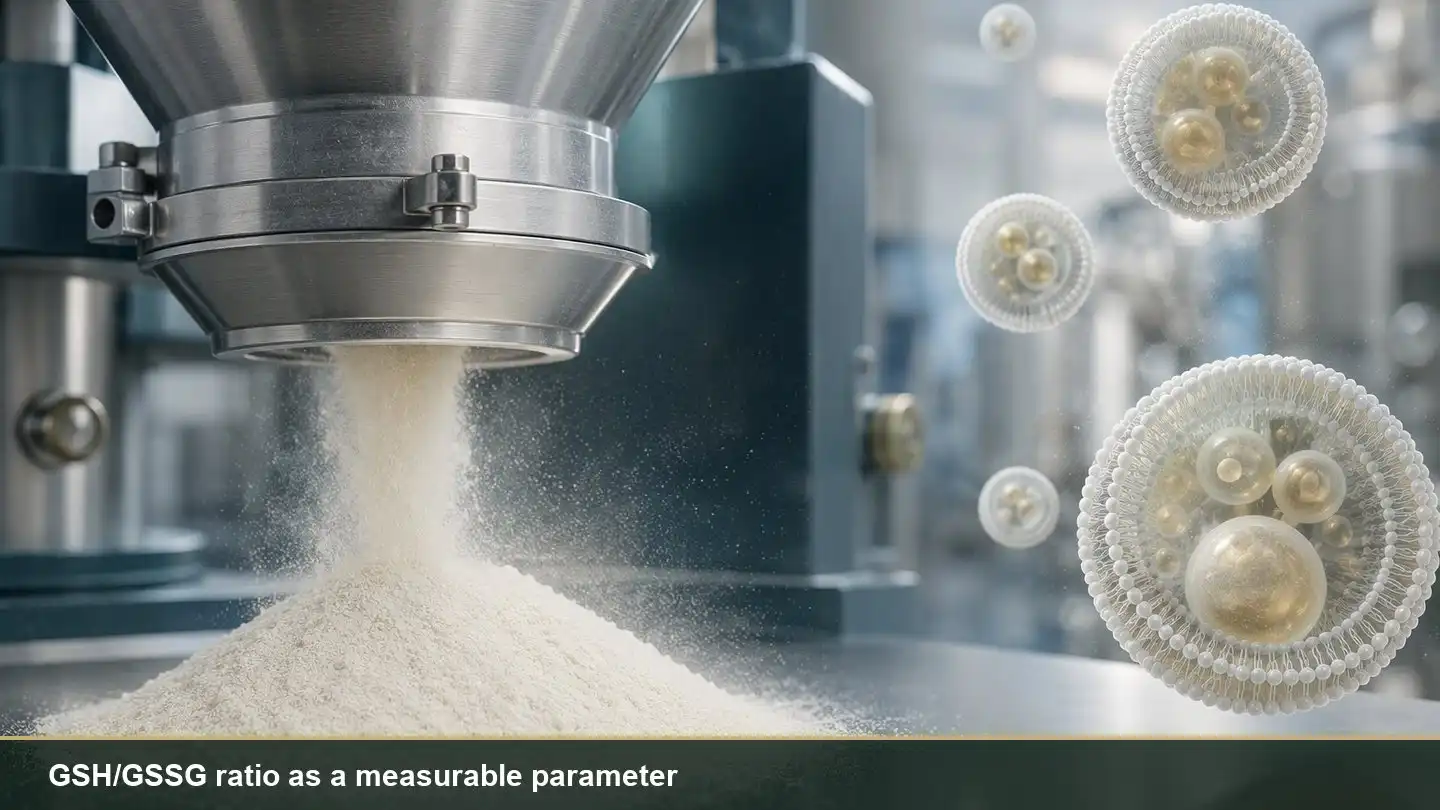
Glutathione is not one substance in a powder. It exists as reduced glutathione (GSH), a thiol, and as glutathione disulfide (GSSG), the dimer formed when two GSH molecules are oxidised and joined. The two form a redox couple, and their proportion is the closest thing this material has to a direct statement about how much oxidation the payload has already undergone. HPLC with separate quantification of both species reports that proportion; a method that reports only a combined total cannot.
| Reported parameter | Method | What the number describes | What it cannot establish |
|---|---|---|---|
| Reduced glutathione as a share of total | HPLC, GSH and GSSG quantified separately | Redox composition of the sampled lot at assay | Whether that composition survives the customer’s process |
| Total glutathione content | HPLC, sum of GSH and GSSG | Total payload present, irrespective of form | How much of it remains reduced |
| Encapsulation efficiency | Separation of free from encapsulated fraction, then assay | Share of payload inside vesicles in that lot | Barrier performance over months of storage |
| Particle size distribution | Dynamic light scattering (DLS) | Mean vesicle size and spread in suspension | Lamellarity, membrane integrity or payload retention |
| Appearance and dispersibility | Sensory evaluation plus dispersion test | Colour, flow and wetting behaviour | Chemical stability of the payload |
Why total content is not the same as reduced fraction
A certificate stating “glutathione 25%” has told you how much glutathione-derived material is present. It has not told you whether that material is reduced, partly oxidised, or a mixture. Two lots can carry identical total content and differ in redox composition, because the total is a sum and the sum is blind to the ratio. The grade looks correct on the specification’s first line and behaves differently in use. A reduced-fraction figure belongs beside the content figure, reported for the same lot. The 10%–50% band, with 25% as the standard grade, describes payload loading, not redox state; the two dimensions must be specified separately.
What “Research” Examines at the Material Level
When a supplier says its glutathione is research-backed, the useful question is: research on what? At the material level the question is narrower than the consumer-facing version. It asks whether the payload survives manufacturing and storage in a form that still matches the specification, and which variables change the rate at which it stops matching.
Oxygen, metal ions, light and heat
Four exposure routes dominate the oxidation of a glutathione payload in a powder. Molecular oxygen attacks the thiol directly, converting GSH to GSSG and, over longer exposure, to further oxidation products. Trace transition metals catalyse that reaction far below any sensory threshold, which is why contact surfaces and raw-material metal content matter. Light drives photodegradation in the phospholipid and the payload, so opaque packaging is a formulation decision. Heat raises reaction rates and alters membrane fluidity, changing bilayer permeability. Each route maps to a control: oxygen-barrier packaging and nitrogen flushing, metal scavenging, light-blocking formats and a defined storage temperature. Process detail is covered in quality control in glutathione powder manufacturing.
What encapsulation changes, and what it does not
Encapsulation is a barrier strategy. Placing the payload inside a phospholipid bilayer separates it from the surrounding aqueous phase and reduces contact with dissolved oxygen and bulk catalysts. That effect is real and measurable, but it is not a seal. Vesicles have a surface area, bilayers have finite permeability, and the payload outside the vesicles is exposed from the first day. An encapsulation efficiency of 85%–98% therefore also states that 2%–15% of the payload sits outside the barrier in that lot. Encapsulation changes the rate of a process; it does not abolish it, and a specification that assumes a permanent shield will be contradicted by its own stability data.
Reading Encapsulation Efficiency Beside Redox Data
Encapsulation efficiency and redox composition answer different questions, and neither substitutes for the other. A lot can be well encapsulated and already partly oxidised at release, or fully reduced at release and poorly encapsulated. The first suggests a process problem upstream; the second suggests that much of the payload will face the environment unprotected.
Why both numbers must come from the same lot
Data from different lots cannot be combined, even when both lots meet their individual limits. A ratio measured on a pilot batch and an efficiency measured on a commercial batch describe two different materials. When such figures arrive in a brochure rather than a certificate, ask for the lot number, assay date and method reference behind each. Storage cannot be separated from release either: a specification describes a starting point, and stability data describes how far it moves. Conditions for keeping it intact are set out in solubility, stability and formulation considerations and, at warehouse level, in how to store liposomal glutathione powder.
Five Questions to Ask About a “Research-Backed” Claim
The phrase carries no information on its own. It becomes useful only when converted into a document request.
- Which document does the claim come from? A study report, an internal stability report and a product page are three levels of evidence; ask which is cited.
- Was the measurement made on the material or on a model system? Buffer trials can be legitimate, but they describe the model, not the lot you will receive.
- Which method was used, and at what sampling point? A ratio without a method and a time point is not reproducible.
- Does the claim describe the ingredient or a finished product? Statements that switch subject mid-paragraph are the most common failure here.
- What result would make the claim false? A claim that cannot fail is not a measurement; it is positioning.
| Statement seen in supplier material | Evidence that would support it | Belongs in a specification or COA? |
|---|---|---|
| “Supports antioxidant defense” | Human study data plus an authorised claim in the destination market | No — it is not a property of the material |
| “Reduces oxidative stress” | Human biomarker data with pre-specified endpoints and a control group | No — same reason, and the subject is a person |
| “At least 98% reduced glutathione” | Lot-specific HPLC data with the method stated | Yes — measurable and repeatable |
| “GSH/GSSG ratio meets specification” | Validated HPLC method, agreed sampling point and limit | Yes — provided method and limit are documented |
| “Stable for 24 months” | Stability protocol with time points, conditions and packaging defined | Yes — only with the conditions attached |
| “Research-backed formula” | Nothing on its own; the underlying report is the evidence | No — ask for the report instead |
Two further checks belong in the same conversation. The first is the full excipient list, since phospholipid sources vary between suppliers and allergen declaration follows the recipe rather than the ingredient name; common allergens in liposomal glutathione powders covers that review. The second is continuity, which decides whether the qualified material is what you will still buy next year; five factors for choosing a glutathione powder supplier sets out the questions that expose gaps early.
Where the Research Boundary Sits
A material study and a human study are not smaller and larger versions of the same thing. They differ in subject, endpoint, design and what they are permitted to conclude. Material work can establish that a payload resists oxidation under defined conditions for a defined period, that a barrier reduces the rate of a reaction, and that a lot meets a numeric limit. It cannot establish what happens after ingestion, and particle characterization does not close that gap.
Human endpoints are a different dataset
If a supplier page moves from particle size to a human outcome without a study in between, the sentence has changed subject, and the reader should regard the second half as unsupported by the first. This is not a criticism of human research; it is a statement about what each dataset can carry. The same principle applies to the buyer’s own materials: a specification describes the ingredient, while consumer-facing wording is a separate exercise governed by the rules of each destination market. Terminal brands own that exercise, and the defensible position for a raw-material supplier is to supply measurements and decline to make the claim on the brand’s behalf.
Writing an Incoming Specification That Uses Defensible Language
The practical output is a specification with four columns: property, method, acceptance criterion and frequency. Under “property”, write reduced glutathione as a share of total and the GSH/GSSG ratio, not an organism-level condition. Under “method”, name HPLC with separate quantification of both species, DLS for particle size, and sensory evaluation for appearance. Under “acceptance criterion”, use the limits you have agreed and state the sampling point. Then cover the physical attributes that decide whether the powder runs on your line: white to off-white free-flowing powder, good cold-water dispersibility, and formation of a stable milky colloidal suspension.
The logic transfers to other oxidation-sensitive actives, though the failure chain differs by chemistry. Vitamin C follows a different route through to colour development, as described in the specification guidance for liposomal vitamin C powder, while oils are tracked with peroxide value rather than a redox couple, as with liposomal omega-3 powder. In each case the principle is identical: replace the outcome word with a number a laboratory can produce twice.
Sourcing and Documentation Support
EmerWell supplies liposomal glutathione powder as a bulk material across a 10%–50% payload range, with 25% as the standard grade, maintaining at least 98% reduced glutathione and an encapsulation efficiency of 85%–98%. The material is a white to off-white free-flowing powder with good cold-water dispersibility, a 24-month shelf life, lead below 0.5 ppm and total plate count below 1,000 cfu/g, released against HPLC with GSH/GSSG quantification, DLS and sensory evaluation. Manufacturing is supported by cGMP, ISO 22000, FSSC 22000, HACCP, Kosher, Halal, Non-GMO and Vegan certification. Buyers can request the glutathione powder specification and sample set or write to info@emerwell-bio.com to discuss which parameters belong in an incoming specification.
References
1. National Center for Biotechnology Information. PubChem Compound Summary: Glutathione, CID 124886. https://pubchem.ncbi.nlm.nih.gov/compound/Glutathione
2. U.S. Food and Drug Administration. Current Good Manufacturing Practice in Manufacturing, Packaging, Labeling, or Holding Operations for Dietary Supplements, 21 CFR Part 111. https://www.ecfr.gov/current/title-21/chapter-I/subchapter-B/part-111
3. International Council for Harmonisation. Q1A(R2) Stability Testing of New Drug Substances and Products. https://database.ich.org/sites/default/files/Q1A%28R2%29%20Guideline.pdf
4. International Organization for Standardization. ISO 22000:2018, Food safety management systems — Requirements for any organization in the food chain. https://www.iso.org/standard/65483.html
5. U.S. Food and Drug Administration. Dietary Supplements. https://www.fda.gov/food/dietary-supplements
Disclaimer: This article concerns a bulk raw material supplied to business-to-business customers and is provided for technical and informational purposes only. EmerWell is a raw-material supplier and does not sell finished consumer products. Nothing here is a statement about human effects, a health claim, or a substitute for regulatory advice; consumer-facing wording, serving information and market-specific labelling remain the responsibility of the brand owner and must be assessed against the rules of the destination market.
Online Message