

Oct 26, 2026
How to Incorporate Liposomal Resveratrol Into Functional Nutrition Products
Bringing liposomal resveratrol powder into a functional nutrition line is an integration decision long before it becomes a label decision. The useful questions are narrow: which format can carry the powder at the intended inclusion level, which unit operations the encapsulated trans-isomer can pass through, how it behaves beside the other actives in the blend, and which documents let a quality team release the finished product with confidence. This article works only on those questions — formulation, processing, packaging and documentation — and it avoids any discussion of what an ingredient does in the human body.
What "Incorporating" Actually Involves
Integration happens in four layers, and a project tends to fail at whichever layer was left unplanned. The vehicle is the format and the matrix the powder has to sit in. The process window is the heat, moisture, shear and pH it meets between dispensing and packing. The packaging and storage envelope has to hold the delivered specification for the whole shelf life. The document set makes the other three verifiable to a customer or an auditor. The material itself is a free-flowing fine powder, off-white to pale yellow, that disperses in cold water into a stable translucent suspension — physical descriptors that drive fill weight, colour match, dispersion behaviour and response to light and heat.
Trans-Isomer Integrity Is the First Integration Risk
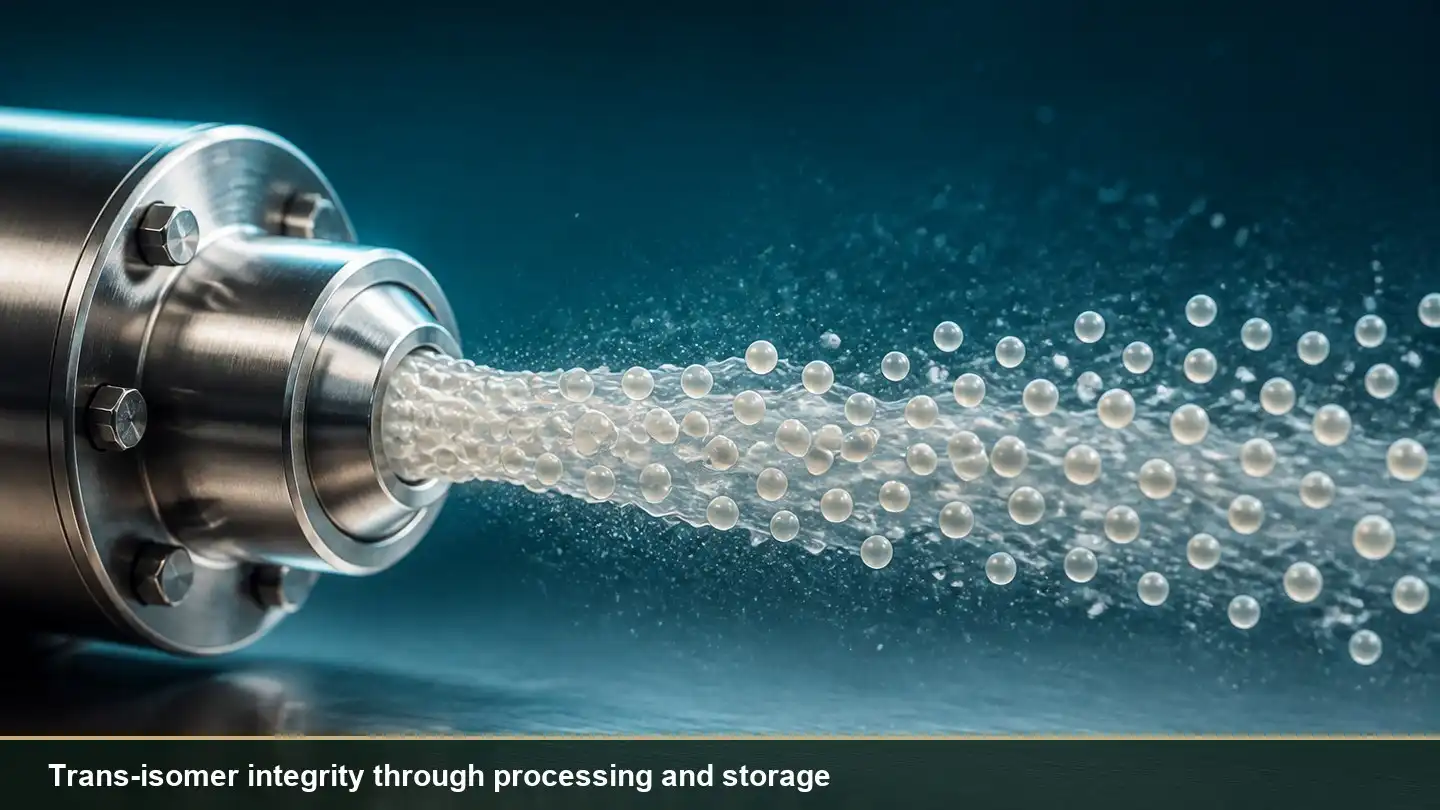
The grade is specified as trans-resveratrol at ≥99% with zero cis degradation across a 24-month shelf life, which is why this raw material cannot be handled like a generic botanical powder. Trans and cis are isomers of the same molecule, and the conversion between them is driven by energy input — heat and light above all — and by time spent in an unfavourable chemical environment. A formulation team therefore tracks two numbers, not one: total resveratrol assay, and the trans-to-cis ratio in the finished matrix at the end of shelf life. A specification reading ≥99% trans describes the raw material as delivered; the project work is keeping that ratio intact after the powder has been through a mixer, a depositor and a warehouse.
Before the first pilot batch, request the isomer report rather than the assay alone, because a supplier offering only a total content figure cannot help you defend the ratio in the finished product. The ingredient criteria buyers in this category commonly apply are worth reading for the same reason (see how to choose a high-quality liposomal resveratrol ingredient).
Where the Trans-Isomer Is Lost on a Line
Three drivers account for most of the loss: cumulative thermal load, light exposure, and time in a hydrated or alkaline state. Each has a control that belongs in the batch record.
| Processing or storage factor | Effect on the isomer profile | Control measure |
|---|---|---|
| Prolonged heat above roughly 70 °C | Accelerates conversion toward the cis form | Dose after the high-heat step; keep hot-hold time short |
| UV and visible light during handling and storage | Photo-induced conversion; erodes the trans share | Dark handling, light-blocking pack, storage away from windows |
| Moisture pick-up and rising water activity | Hydrolytic and oxidative side reactions | Sealed liners, low-humidity blending, desiccant where possible |
| Alkaline pH in an aqueous base | Degradation rate climbs steeply above neutral | Hold formulations acidic to neutral; verify pH before filling |
| Storage temperature and cycling over 24 months | Cumulative loss visible mainly at end of shelf life | Store below 25 °C; validate with accelerated and real-time data |
| Metal ions and residual peroxides from co-actives | Oxidative conditions that add isomer pressure | Screen co-actives; check lipid peroxide value by iodometric titration |
Light Stability and the Packaging Decision
Photostability is a documented property of this grade and has to be translated into packaging. Light damage does not appear as a visible defect; it appears as a lower trans share and an off-trend colour at a stability pull point, which is why the packaging choice is a stability decision rather than a branding one.
Clear formats — glass jars, transparent stick packs, clear ready-to-drink bottles — expose the powder to retail and domestic lighting. An opaque foil laminate, an amber high-density polyethylene container or a full-coverage carton gives the strongest light barrier; a clear high-barrier film keeps the visual and gives up most of the barrier. A chilled chain removes thermal stress but none of the light load, so an opaque or sleeved bottle remains the safer choice for a product on a lit shelf. Suppliers who publish ingredient-level work on liposomal formats, such as this EmerWell ingredient showcase news item, can confirm which photostability data sit behind the grade.
Format Integration Matrix
The matrix below is not a generic format map: for each format it lists the conditions that have to be fixed and the way that format specifically exposes the isomer ratio and the photostability question. Pre-blend order and dispersion steps for a resveratrol project are collected in these liposomal resveratrol formulation tips for OEM and ODM teams.
| Format | Conditions to fix | Isomer exposure | Light exposure | Confirm with supplier |
|---|---|---|---|---|
| Hard-shell capsules | Blend uniformity, fill weight, shell moisture | Low: no heat or water at fill | Set by the bottle; amber or opaque is low risk | Flow and bulk density; excipient mix |
| Tablets | Compression force, die temperature, granulation route | Moderate: local heat, plus water in wet granulation | Blister with opaque or metallised lidding | Compression behaviour; encapsulation efficiency after compression |
| Stick packs and sachets | Flow and fill accuracy, seal integrity, headspace moisture | Low in a humidity-controlled fill room | High if the film is transparent — clarity costs most here | Particle size and flow data; recommended film structure |
| Gummies | Cook temperature and hold time, water activity | Highest of the confectionery formats: heat and water together | Medium; opaque bottle or closed carton | Thermal tolerance window; retention across the cook step |
| Nutrition bars | Water activity, lipid-phase blending, texture | Low to moderate; moisture migration is the main risk | Medium; metallised or opaque wrap | Texture impact at the chosen inclusion level |
| Ready-to-drink | Addition point after heat processing, pH of the base, fill temperature | Moderate to high: the powder stays in water for the shelf life | Highest: a clear bottle sits in light for months | Suspension stability in the base; validated pH window |
Dry-Fill and Confectionery Formats
Capsules and tablets are the easiest to integrate, because the powder meets neither heat nor water at fill, so the work moves to blend uniformity, flow and fill weight. Gummies are the opposite case: cooking brings heat and water into one step, so fix cook temperature and hold time first.
Aqueous Formats
In a ready-to-drink base the powder stays in solution for the whole shelf life, so the variables are the addition point and the pH of the finished base. Adding it after pasteurisation, or in a cold process, keeps the thermal load off the encapsulated material. Because the grade already disperses into a stable translucent suspension, the remaining work is holding that dispersion in the finished base (see this review of resveratrol solubility in liposomal systems).
Colour and Sensory Behaviour
Off-white to pale yellow has to be reconciled with the finished product before flavour work starts. In an opaque or deeply coloured matrix the contribution is invisible. In a white or pastel matrix the powder reads as a warm cast, which the base tint usually absorbs. In a clear or lightly tinted beverage it adds a warm cast and a translucent haze; the haze is the signature of a dispersed liposomal system rather than a defect, so the question is whether the product's clarity claim survives it. Resveratrol sits in the botanical part of the portfolio, and the sensory expectations of that category — including the bitter, chalky notes of raw polyphenol powders — are a useful reference when setting a taste target (see the botanical ingredient range).
Designing the Blending Compatibility Study
Compatibility with co-actives is a process question: does another powder change the physical behaviour, the assay or the isomer ratio. Prepare the premix at the intended ratio with single-ingredient controls under identical conditions, store both at an accelerated condition such as 40 °C and 75% relative humidity with pull points at zero, two, four, eight and twelve weeks, plus a matched set at the intended storage condition as reference. At each pull point record appearance and colour, flow and caking, dispersion time, reconstitution turbidity, HPLC assay for content and the trans-to-cis ratio, particle size and vesicle morphology by DLS and TEM, and lipid peroxide value by iodometric titration. Write the judgement rule before the study starts: pass means no loss beyond the agreed fraction of declared content and no movement in the isomer ratio beyond the agreed window, with those numbers fixed in the specification agreement beforehand. The structure used for shelf-life work on other liposomal powders transfers directly, so the shelf-life factors for liposomal vitamin C powder works as a layout template.
Matching the Grade and Assembling the Documents
Two specification choices shape the rest of the project. Concentration runs from 10% to 50%: a higher grade carries less carrier into a capsule or tablet, while a lower grade adds bulk that changes fill weight, texture in a bar or gummy, and fill accuracy in a stick pack. Encapsulation efficiency is specified at 85%–92% and should be verified on the delivered lot rather than assumed from the grade name. Buyers comparing suppliers on one basis will find the criteria in this guide to choosing a supplier of liposomal resveratrol powder; the architecture of a complete analysis package is set out in this outline of a liposomal NAD powder certificate of analysis.
| Specification item | What to verify | Method or document |
|---|---|---|
| Concentration | Grade matches format and fill weight; consistency lot to lot | Specification sheet and batch COA |
| Encapsulation efficiency | 85%–92% on the delivered lot | Separated-fraction assay by HPLC, with DLS and TEM |
| Isomer profile | Trans ≥99%, zero cis degradation, held across the shelf life | Isomer report by HPLC at release and end of shelf life |
| Shelf life and stability | 24-month claim supported by accelerated and real-time results | Stability protocol and report; photostability data |
| Heavy metals and microbiology | Lead below 0.5 ppm; total plate count below 1,000 cfu/g | COA from an accredited laboratory |
| Appearance and dispersion | Off-white to pale yellow; cold-water dispersion into a stable suspension | Visual and sensory evaluation; dispersion test |
| Certification and clean label | cGMP, ISO 9001, ISO 22000, Kosher, Halal, Non-GMO, Vegan; gluten-free and soy-free options | Certificate copies with current status |
| Retention samples | Retest policy and samples for later isomer verification | Retention procedure and retest request |
Samples, Specifications and Technical Support
An integration project moves fastest when technical questions are answered before commercial ones. Share the target format, the inclusion level, the process steps the powder will pass through and the intended storage condition, and the answer can be matched to the grade rather than to a catalogue number. EmerWell supplies liposomal resveratrol powder with an isomer report, encapsulation efficiency data, photostability and accelerated stability information and retention-sample support, and can discuss clean-label options for gluten-free and soy-free positioning. Request a specification sheet, a batch COA, a pilot sample or a technical review of a specific format at info@emerwell-bio.com.
References
1. Zupančič et al. (2015). Stability and solubility of trans-resveratrol are strongly influenced by pH and temperature. European Journal of Pharmaceutics and Biopharmaceutics. https://pubmed.ncbi.nlm.nih.gov/25864442/
2. Robinson et al. (2015). Pre-formulation studies of resveratrol. Drug Development and Industrial Pharmacy. https://pmc.ncbi.nlm.nih.gov/articles/PMC4427559/
3. Yoshinaga et al. (2024). Photoisomerization pathways of trans-resveratrol. Physical Chemistry Chemical Physics. https://pubmed.ncbi.nlm.nih.gov/39254634/
4. Mattioli et al. (2022). Effect of natural deep eutectic solvents on trans-resveratrol photo-chemical induced isomerization. Molecules. https://pmc.ncbi.nlm.nih.gov/articles/PMC9000676/
Disclaimer: This article is written for ingredient and product-development professionals and describes raw material properties, processing and documentation only. It is not medical advice and does not describe or imply any effect of a finished product on human health. Formulators remain responsible for confirming that their finished products and any statements made about them comply with the regulations of each market where they are sold.
Online Message