

Oct 22, 2026
How Does Liposomal Glutathione Powder Support Antioxidant Defense?
Liposomal glutathione powder is traded as a specification, not as a benefit. Buyers compare loading percentage, encapsulation efficiency, microbial limits and redox state before anything else, and every one of those figures describes the material in the drum rather than a person taking it. This article stays inside that boundary: it covers the oxidation-related properties of the raw material itself — how the tripeptide and the lipid carrier behave during storage, processing and dispersion — and how far a business-to-business document can legitimately describe them. It does not address human antioxidant effects, health outcomes or any structure/function claim, and nothing here should be read as one. For the underlying product data, start with the liposomal glutathione powder specification page.
What “Antioxidant” Means at the Raw-Material Level
The word antioxidant is used in two very different registers, and blurring them is the most common documentation error in this category. In a consumer-facing context it tends to imply something about the person using the finished product. In a supplier’s technical file it can only describe the material’s own behaviour: whether the tripeptide stays in its reduced form, and whether the phospholipid matrix resists oxidation across its shelf life.
Those two registers need different evidence, different wording and different documents. A raw-material manufacturer can measure the second and cannot certify the first. Keeping the register straight is what allows a specification sheet to survive review by a brand’s regulatory team.
| Wording | What it actually describes | Appropriate document | Verifiable by the supplier |
|---|---|---|---|
| Reduced glutathione content ≥98% | Proportion of the tripeptide pool held in the reduced form | Specification sheet / COA | Yes — HPLC |
| Encapsulation efficiency 85%–98% | Share of the active held inside the vesicles | Specification sheet / COA | Yes — method-dependent |
| Oxidation-resistant powder matrix | Physical protection of the molecule inside the product | Technical data sheet, with supporting data | Only with supporting testing |
| Antioxidant benefits for the body | An effect in the person consuming a finished product | Consumer label, brand-owned claim | No |
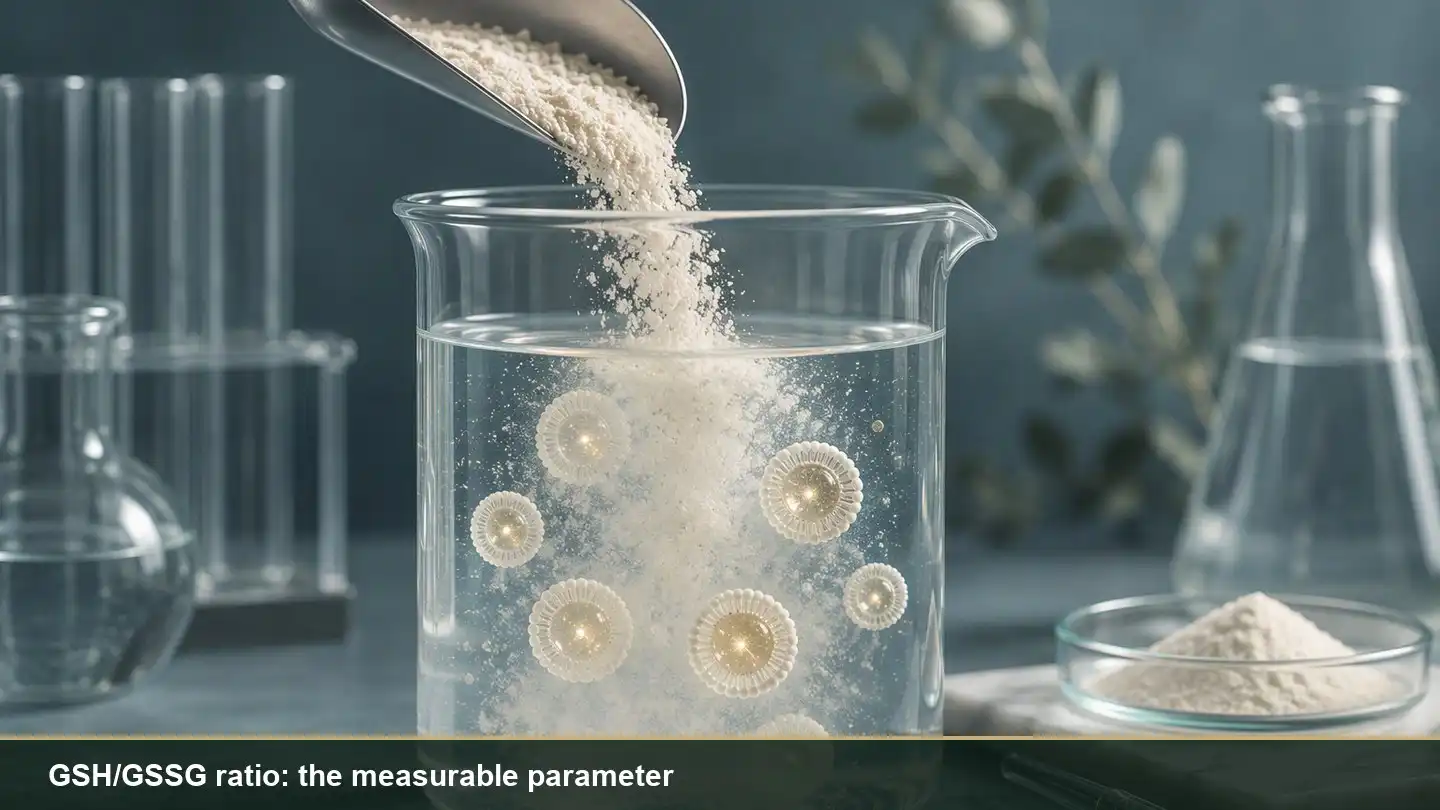
The One Figure That Actually Describes This Category: GSH/GSSG
Glutathione exists as a reduced thiol (GSH) and as an oxidised disulfide dimer (GSSG). When the thiol group donates an electron, two GSH units pair up into GSSG. The relationship between the two is the standard way this molecule’s redox state is expressed in analytical work, and it is the closest thing the category has to a single defensible figure behind the word antioxidant.
What the ratio measures is the molecule’s own tendency to stay reduced. Two lots can both be labelled 25% glutathione and still sit at very different ratios. The concentration figure says how much tripeptide is present; the ratio says how much of it is still in the reduced state.
| Species | What it is | What its level tells a buyer | Typical determination |
|---|---|---|---|
| GSH (reduced) | Tripeptide with a free thiol group | Loading and redox state of the material | HPLC |
| GSSG (oxidised) | Disulfide dimer of two GSH units | How much of the pool has already oxidised | HPLC |
| GSH/GSSG ratio | Molar relationship between the two species | Overall redox balance of the batch | HPLC |
Why a High Percentage Is Not the Same as a High Reduced Fraction
A powder can carry a large total amount of glutathione and still be a poor carrier of reduced GSH. Higher loading increases the proportion of active in contact with the surrounding matrix, and every additional handling, thermal or shear step shifts part of the pool toward GSSG. EmerWell answers this directly in the specification, holding not less than 98% of the tripeptide in the reduced form across the range from 10% to 50% loading, with the 25% grade used as the standard reference point.
Loading Percentage and Reduced Fraction Are Two Different Specifications
Buyers new to this category often read the percentage in the product name as the only meaningful number. In practice three figures have to be read together:
- Loading — how much glutathione the powder carries, from 10% to 50%; higher loading changes how much material a formulator weighs out.
- Reduced fraction — how much of that glutathione remains in the reduced form, held at 98% or higher.
- Encapsulation efficiency — how much of the active sits inside the vesicles rather than in the surrounding powder, specified from 85% to 98%.
A capsule, a sachet and a stick pack will each be specified differently even when they use the same grade, because filler system and moisture exposure differ. The trade-offs between loading and dispersibility are set out in this note on solubility, stability and formulation considerations.
How the Ratio Is Measured, and Why Method Discipline Matters
The reduced and oxidised forms are separated chromatographically and read against standards, which is why HPLC is the method named on the specification rather than a simple colourimetric screen. Sample handling decides the result as much as the instrument does: published work on GSH and GSSG measurement shows that the reduced fraction in a sample falls measurably within minutes when the sample is not quenched, and continues to shift during storage.
Two practical consequences follow. First, a GSH/GSSG figure is comparable between lots only when the same sample preparation, quenching and chromatographic conditions are used. Second, the number belongs on a COA that names the method; a ratio quoted without one cannot be checked. Particle size is characterised separately by dynamic light scattering, while appearance, odour and dispersion are assessed by sensory panel against a retained reference.
What Encapsulation Protects Inside the Product Matrix
Encapsulation is where the antioxidant vocabulary usually gets imported by mistake. The phospholipid bilayer is a physical barrier, and its contribution is easier to state precisely: it limits contact between the tripeptide and the oxygen, trace metals and light that drive oxidation in a stored powder. Review work on liposome stability puts the point plainly — the chemical stability of these systems is governed by peroxidation of the phospholipid components and by pH, while storage temperature and light are the dominant physical drivers.
None of that describes an effect in a person. It describes the rate at which the ingredient deteriorates in its own package.
| Exposure route | Mechanism the carrier limits | Consequence for the material |
|---|---|---|
| Oxygen | Direct contact with the encapsulated fraction | Slower formation of the oxidised species |
| Trace metals | Contact with pro-oxidant ions during storage | Lower oxidation rate across shelf life |
| Light | Barrier over the bilayer structure | Slower peroxidation of the lipid phase |
| Moisture | Matrix chemistry kept within a defined range | Retained dispersibility and appearance |
Variables That Change Oxidation Rate in Storage and Processing
Because the ratio measures oxidation that has already happened, every step that exposes the material to oxygen, light, heat or metal moves it in one direction. The variables worth documenting with a supplier are unglamorous:
- Headspace oxygen in the container, and whether packaging is nitrogen-flushed or a multilayer foil laminate.
- Moisture ingress; caking is usually the first visible signal of moisture uptake.
- Light exposure during storage and sampling, not only during filling.
- Metal contact in mills, screens and transfer lines.
- Shear and temperature history during blending into the finished format.
Storage practice is covered separately in this guide to storing liposomal glutathione powder, and processing exposure in this review of quality control considerations in manufacturing.
Specification Snapshot for Liposomal Glutathione Powder
| Parameter | Specification | Method |
|---|---|---|
| Reduced glutathione (GSH) | 10%–50%; 25% standard grade | HPLC |
| Reduced-form content maintained | ≥98% | HPLC (GSH/GSSG) |
| Encapsulation efficiency | 85%–98% | Method-dependent |
| Appearance | White to off-white, free-flowing powder | Sensory |
| Dispersion behaviour | Good cold-water dispersibility; stable milky colloidal suspension | Sensory / visual |
| Lead (Pb) | <0.5 ppm | Instrumental |
| Total plate count | <1,000 cfu/g | Microbiological |
| Shelf life | 24 months | Stability programme |
| Certification | cGMP, ISO 22000, FSSC 22000, HACCP, Kosher, Halal | Certificate on file |
Particle-size distribution is characterised by dynamic light scattering and reported per batch. The full parameter list, including the items a buyer should insist on, is broken down in this guide to what a glutathione powder COA should contain.
What a Specification Sheet and COA Can and Cannot Say
The dividing line is straightforward once the register is fixed. A technical document may describe, measure and limit the material. It may not describe what happens in a body. In the United States, structure/function statements belong to the finished-product brand, must be substantiated by that firm, require notification to the agency, and must carry the standard disclaimer; disease claims sit on the other side of the line entirely. That boundary is set out in the agency’s guidance and codified in 21 CFR 101.93.
| Acceptable in a specification sheet or COA | Not acceptable |
|---|---|
| Reduced-form content, loading range, encapsulation efficiency | Statements about antioxidant effects in people |
| Lead, microbial limits, particle-size distribution | Free-radical or disease-claim language |
| Storage conditions and the basis of the shelf-life figure | Equivalence claims borrowed from pharmaceutical products |
| Analytical method named for every parameter | Unsupported maximum-potency wording |
Buyers auditing this category often work from a checklist of exactly this kind; the same logic is applied in this guide to what to look for in a good liposomal glutathione powder, while the commercial questions are collected in five factors for choosing a supplier.
Questions Brands Ask About the Wording
Can a specification sheet use the word antioxidant at all?
It can be used as a chemical descriptor of a material property, which is why this article reads it as a measurable parameter rather than a benefit. Once it is attached to a person, the same sentence becomes a claim and migrates to the brand’s label.
Is the powder format a limitation here?
No. Drying to a free-flowing powder lowers water activity and gives the carrier a defined moisture target, which is favourable for the redox state of the tripeptide. The reasons the format is used are set out in this note on liposomal glutathione in powder form.
How does this differ from an unencapsulated raw material?
Mainly in the extra specification layer: encapsulation efficiency and particle-size distribution join the parameter list, alongside the same redox and microbial limits. That comparison is drawn out in this article on standard versus liposomal glutathione forms.
What should a formulator confirm before locking a grade?
Whether the 25% standard grade or a higher loading suits the intended format, which sensory targets matter for the flavoured system, and what dispersion behaviour the process needs. Those questions are collected in this overview of formulation factors for product developers.
Technical Documentation and Samples
EmerWell supplies liposomal glutathione powder with the documentation a technical buyer needs to run its own review: specification sheet, batch COA naming each analytical method, certification records, and retained samples where a project requires them. Requesting a sample is the fastest way to compare grades against your own dispersion and storage conditions. Start from the product page, or write to info@emerwell-bio.com with the grade and finished format you are evaluating.
References
- U.S. Food and Drug Administration. Structure/Function Claims. fda.gov/food/nutrition-food-labeling-and-critical-foods/structurefunction-claims
- Electronic Code of Federal Regulations. 21 CFR 101.93 — Certain types of statements for dietary supplements. ecfr.gov/current/title-21/section-101.93
- Pasarin, D. et al. Coating Materials to Increase the Stability of Liposomes. Polymers, 2023; 15(3):782. pmc.ncbi.nlm.nih.gov/articles/PMC10004256
- Europe PMC. A standardized protocol for comparable analysis of GSH/GSSG (PMID 30445289). europepmc.org/article/med/30445289
Disclaimer: This article is written for ingredient buyers and product developers and describes raw-material specifications and analytical methods only. It is not medical or nutritional advice and does not describe the effects of any finished product. Statements about the effect of a dietary supplement on the structure or function of the body are the responsibility of the brand that markets it.
Online Message