

Nov 25, 2026
What Is Liposomal NAD+ Powder? Uses, Benefits, and Key Facts
Most pages that answer this question answer it commercially. They describe what the ingredient is associated with and leave the buyer to work out the rest. This one does the opposite: it sets out what liposomal NAD+ powder physically is, what a specification sheet states about it, where it fits in a finished format, and where the word benefits stops being a description and becomes a claim. Buyers who need the definition and the documentation in one place will find both here.
What the Material Physically Is
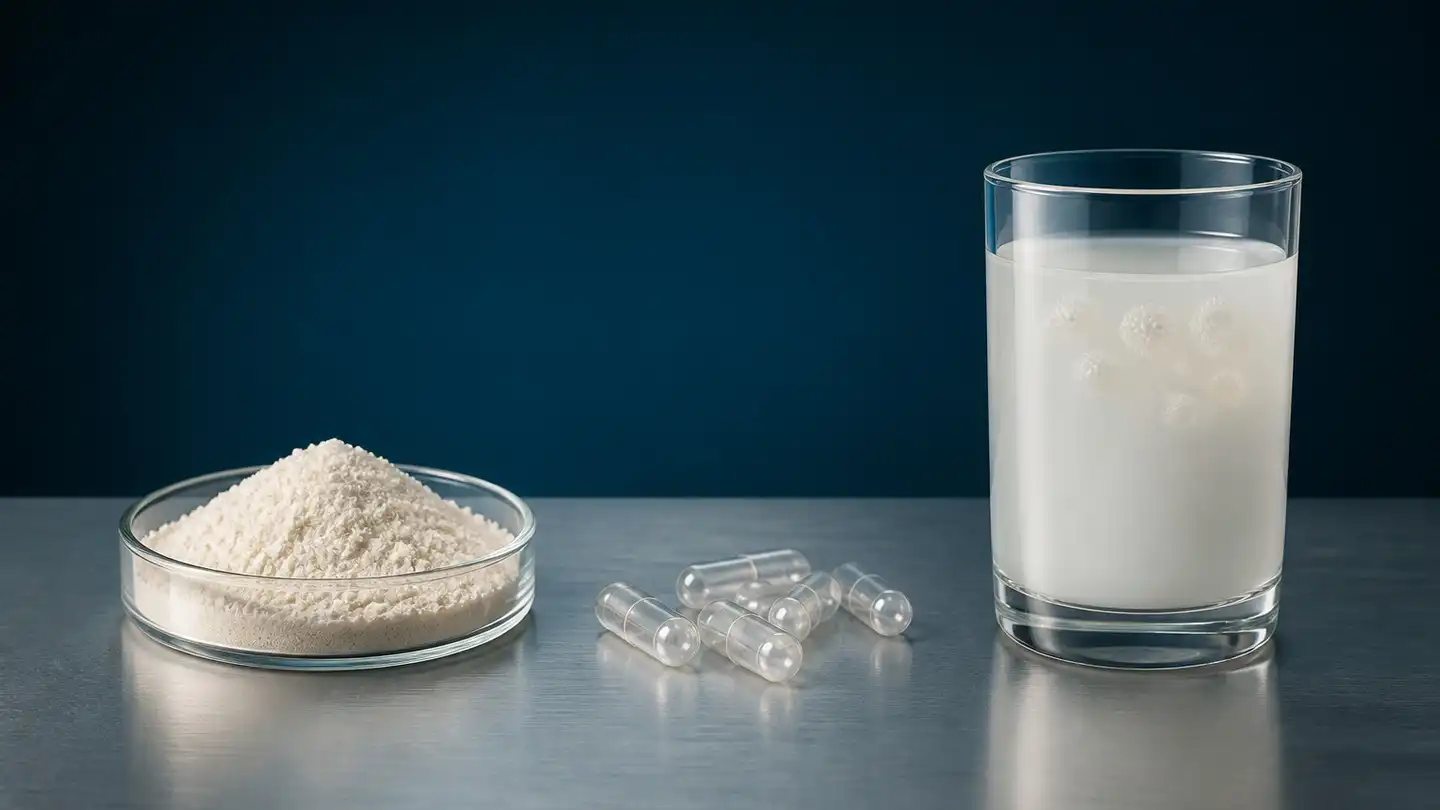
NAD+ is a dinucleotide, and as a raw material it arrives as a hygroscopic solid that is sensitive to moisture and heat. A liposomal grade takes that solid, encapsulates it inside a phospholipid bilayer, and dries the resulting vesicle dispersion onto a carrier so that the output is a free-flowing powder rather than a liquid suspension.
Three components therefore make up the powder, and only one of them is the active. The others are the phospholipid that forms the bilayer and the carrier that keeps the dried particles separated and flowable. A specification that describes only the active is describing a third of the material.
How the Grade Is Produced
Production follows a sequence that is common to liposomal powders generally. A lipid phase is prepared, an aqueous phase containing the active is brought into contact with it, energy is applied until vesicles form, and the dispersion is dried. What distinguishes grades is not the broad sequence but the control applied at each step: the lipid composition, the homogenisation energy, the inlet and outlet temperatures during drying, and the moisture specification of the finished powder.
Those controls are what a buyer is paying for, and they are also what changes when a supplier substitutes a lower-grade lipid or shortens a drying step. The finished certificate may look similar while the delivery properties differ, which is why the process description belongs in the technical file.
What a Specification Sheet States
The reference specification for this grade covers the parameters below. These are the values a buyer should expect to see confirmed on a lot certificate of analysis.
| Parameter | Stated range or method |
|---|---|
| NAD+ content | 10% to 70%, selected to suit the declared amount per serving |
| Encapsulation efficiency | 85% to 95% |
| Appearance | Pale yellow to white, free-flowing powder |
| Dispersibility | Disperses in water to a colloidal suspension |
| Particle size | Measured by dynamic light scattering, with microscopy for confirmation |
| Heavy metals | Lead below 0.1 parts per million |
| Microbiological status | Total plate count below 1,000 colony-forming units per gram |
| Shelf life | 24 months under the stated storage conditions |
Two of those rows do more work than the rest. Encapsulation efficiency describes how much of the active sits inside a vesicle rather than in the surrounding matrix, and particle size describes the population that was produced. A content figure without either is a statement about quantity alone.
Where the Powder Is Used
In B2B terms, "uses" means the formats the material can be built into. The constraint in every case is the mass per serving, because a liposomal grade carries less active per gram than a crystalline solid and therefore requires more material to reach the same declared amount.
| Format | Fit | Dominant constraint |
|---|---|---|
| Two-piece capsule | Good | Volume available once the carrier load is included |
| Stick pack | Good | Dispersion without clumping in a small water volume |
| Powder blend | Good | Segregation during filling; particle size match with other components |
| Ready-to-drink | Possible | Colloidal stability across shelf life; requires a trial |
| Tablet | Poor | Compression force disrupts the vesicle |
| Gummy | Poor | Thermal exposure during cooking |
The last two rows are the ones buyers most often discover too late. Both involve forces that a bilayer does not tolerate well, and neither failure is visible on a certificate. A supplier can support a format decision with a sample and a trial; they cannot certify that a vesicle will survive a cooking step it was never designed for.
What the Word Benefits Can and Cannot Mean
This is the section that most pages of this kind skip. A raw material supplier can document composition, process and the physical properties of the powder. A supplier cannot document what the finished product does for a person, because that requires evidence generated on the finished product.
| Statement type | What supports it | Who owns it |
|---|---|---|
| The powder contains a stated amount of NAD+ | Assay on the lot certificate | Supplier |
| The powder is liposomal | Particle size distribution and encapsulation data | Supplier |
| The powder disperses in cold water | Dispersion test at defined conditions | Supplier |
| The product supports a named body function | Substantiation on the finished product | Brand |
| The product addresses a named condition | Not available for a supplement | Nobody |
The practical consequence is that a buyer should expect two separate conversations. One is about the material and is answered with documents. The other is about the marketed product and is answered with the brand's own evidence. A supplier who offers to resolve the second conversation with a certificate is either confused about the boundary or hoping the buyer is.
The Key Facts, Condensed
For readers who need the summary before the detail, six points carry most of the decision. The material is a dinucleotide encapsulated in a phospholipid bilayer and dried onto a carrier. Content is selectable across a wide range so that a declared amount can be fitted to a format. Encapsulation efficiency sits between 85% and 95% on the reference specification. Particle size is measured by dynamic light scattering and should be reported as a distribution rather than a mean. Heavy metals and microbiological limits are stated with acceptance ranges. Shelf life is 24 months under defined conditions, and the stability data behind that figure should be available on request.
Those six points are enough to write a purchase specification. They are not enough to write a label claim, and the difference is the subject of the section above.
What to Check on the First Certificate
A first lot is the cheapest place to find a problem. Four checks are worth running before the material goes into a batch, and each one has a specific failure mode behind it.
Confirm that the assay method is stated, and that it distinguishes the intact dinucleotide from its degradation products. Confirm that the encapsulation figure is accompanied by an acceptance range rather than presented as a single result. Confirm that the particle size is reported as a distribution with a spread indicator. Confirm that the moisture result sits below the limit on the specification rather than at it.
None of those checks requires equipment a buyer does not already have access to. They require only that the certificate answers the question rather than gesturing at it.
What Changes Between Lots
Even a well-controlled process moves slightly from lot to lot, and the useful question is which parameters are allowed to move. Content is usually held tightly because it is measured every time. Particle size drifts with small changes in homogenisation energy or lipid lot. Moisture drifts with dryer performance and ambient humidity on the day.
The parameters that drift are the ones worth a change-control clause. A clause requiring notification before a change to the lipid source, the carrier or the drying conditions protects the buyer against a silent substitution that leaves the assay unchanged while moving the delivery properties. It is a short paragraph to negotiate and it heads off the most common category of dispute in this material.
How to Compare Two Quotes Written Against the Same Specification
Two suppliers can quote the same content grade and the same encapsulation range and still be offering materially different material. The difference sits in the parameters that are not printed on the headline line, and a short comparison exercise surfaces it.
| Item to compare | Weak answer | Strong answer |
|---|---|---|
| Content grade | A single number | The range available, with the tolerance at filling |
| Encapsulation | A best-case figure | A range with the release criterion attached |
| Particle size | A mean diameter | A distribution with a spread indicator and the method named |
| Moisture | Omitted | A limit stated at release and tracked on stability |
| Lipid source | Lecithin, unspecified | Named source with allergen and origin statements |
| Change control | Not mentioned | A written notification clause before any material change |
The last row separates suppliers more reliably than any single analytical result. A supplier with a change-control process is telling you that substitutions happen and that they intend to tell you first. A supplier without one is not necessarily careless, but the buyer carries the risk of finding out afterwards.
Storage and Handling Once the Powder Arrives
A 24-month shelf life is a claim about a closed pack under defined conditions, not a property of the material in any container. Three practices preserve the figure and three erode it.
The practices that preserve it are straightforward. Keep the powder in its original sealed packaging until the moment of use, and reseal with the desiccant still inside. Store below the temperature stated on the specification and away from light, because both heat and ultraviolet exposure accelerate hydrolysis and oxidation. Record the opening date on the container, so that a partially used drum is not regarded as a fresh one eighteen months later.
The practices that erode it are equally straightforward and more common. Leaving a drum open during weighing exposes a hygroscopic powder to ambient humidity within minutes. Storing in a clear container on a bench exposes it to light continuously. Holding powder in a hopper overnight in a warm room combines both exposures with a large surface area.
For buyers writing a handling procedure, two sentences are usually enough: the material stays in the original pack until dispensed, and any quantity withdrawn is either used within the shift or returned to a sealed container with desiccant. That covers the majority of avoidable losses, and it costs nothing to adopt.
Three Questions That Reveal Whether the Grade Is Understood
Technical conversations separate suppliers quickly. Three questions are enough to tell whether the person answering understands the material or is reading from a catalogue.
The first is what happens to encapsulation efficiency when the content grade changes. A supplier who knows the process will explain that a higher active load leaves less room for the bilayer and the carrier, and that efficiency and flowability both move as a result. A supplier reading from a sheet will give the same efficiency range regardless of the grade being discussed.
The second is which parameter limits the drying step. The informed answer names moisture and the outlet temperature that controls it, and explains that pushing the temperature up to increase throughput is the usual way a powder ends up at the top of its moisture limit. The uninformed answer describes the equipment instead.
The third is what the supplier would recommend if the intended format were a gummy. A supplier who understands the constraint will say that a vesicle-based grade is a poor fit for a cooking step and suggest either a different format or a trial before commitment. A supplier who says yes to every format is telling you that the answer is being generated by the sales conversation rather than by the process.
Documentation, Samples and Technical Review
EmerWell supplies liposomal NAD+ powder with a specification covering content, encapsulation efficiency, particle size, heavy metals and microbiological limits, and with a certificate of analysis that reports each parameter against that specification using named test methods. Buyers can request a lot certificate, a stability summary and a sample sized for a pilot run.
If you are defining a specification for a first order, send the target serving size and the intended format to info@emerwell-bio.com. We will confirm which content grade fits, what the encapsulation figure means for your overage, and which parameters your process will need to control. The stability guidance and the shelf-life factors are worth reading before the pack is chosen, because storage decisions made early are cheaper than reformulation later.
References
1. U.S. Food and Drug Administration. Current Good Manufacturing Practice in Manufacturing, Packaging, Labeling, or Holding Operations for Dietary Supplements (21 CFR Part 111). ecfr.gov
2. U.S. Food and Drug Administration. Guidance documents for the food and dietary supplement industry. fda.gov
3. FAO/WHO Codex Alimentarius Commission. Food labelling and food additive provisions. fao.org
4. European Food Safety Authority. Food additives and nutrient sources added to food. efsa.europa.eu
Disclaimer: This article provides technical and regulatory information for business-to-business ingredient sourcing. It is not medical advice and makes no statement about any health outcome. Finished-product claims remain the responsibility of the brand placing them on the market.
Online Message