

Nov 17, 2026
NAD+ and Cellular Aging: What Role Does Liposomal Delivery Play?
The phrase cellular aging bundles two very different questions, and mixing them is why so many sourcing conversations about liposomal NAD+ powder stall. The first question is biological and belongs to the brand's own substantiation work. The second is physical: what does the delivery system actually do to the molecule between the filling line and the point of dissolution, and how is that verified? Only the second can be answered with a specification, a method and a certificate of analysis. This article works through that second question, because it is the one a buyer can settle before placing an order.
Separating the Two Questions
NAD+ is a dinucleotide that is unstable in aqueous solution and poorly absorbed when presented as a plain powder. Those two facts are the entire commercial rationale for a liposomal format, and they are also the two facts that a specification can address directly. A delivery system that shields the molecule from the gastric environment and keeps it intact through drying is doing mechanical work. That work is measurable: encapsulation efficiency, particle size distribution, moisture content and assay retention across a stability programme. None of those measurements requires a biological assumption.
The biological question is separate, and a raw-material supplier is the wrong party to answer it. What a supplier can do is provide a grade whose physical behaviour is documented well enough that the brand's own studies start from a known baseline rather than from an unknown one. That distinction is worth holding onto throughout this article, because it determines which questions belong in a supplier qualification and which belong in a claim-substantiation file.
Specification Baseline
The figures below describe a liposomal NAD+ grade as supplied. They are the parameters a buyer should see stated with methods before samples are dispatched.
| Parameter | Specification | What it establishes |
|---|---|---|
| NAD+ content | 10%–70%, with 50% a common commercial grade | The serving arithmetic and the loading band available to the formulator |
| Encapsulation efficiency | 85%–95% | The fraction of active held inside the bilayer rather than in the continuous phase |
| Appearance | Pale yellow to white, free-flowing powder | Consistency of the drying step and a baseline for colour trending |
| Dispersibility | Disperses in water to a stable colloidal suspension | Whether the grade suits a stick pack or a beverage rather than a capsule |
| Shelf life | Up to 24 months in the original pack under defined storage | The outer bound for the brand's own stability programme |
| Lead | < 0.1 ppm | A tighter metal limit than most botanical specifications, appropriate for a redox-active molecule |
| Total plate count | < 1,000 cfu/g | Microbial headroom for formats without a preservation step |
| Testing methods | HPLC for assay, DLS for particle size, TEM for morphology | Whether the reported numbers can be reproduced by a third party |
The metal limit deserves a comment. NAD+ participates in redox chemistry, and transition-metal traces catalyse degradation pathways that a specification-compliant but higher-metal grade would still pass. A lead limit below 0.1 ppm is therefore not a marketing refinement; it is a stability input, and it should be read alongside the microbial figures rather than as a separate compliance checkbox.
Three Barriers the Delivery System Has to Address
A liposomal format is doing useful work only if it addresses three distinct barriers in sequence. The first is the gastric environment, where low pH and pepsin activity degrade unprotected dinucleotides. The second is the enzymatic surface of the intestinal epithelium, where nucleotidases remove phosphate groups from the molecule. The third is the diffusion step across the unstirred water layer adjacent to the membrane, which is dominated by particle size rather than by concentration.
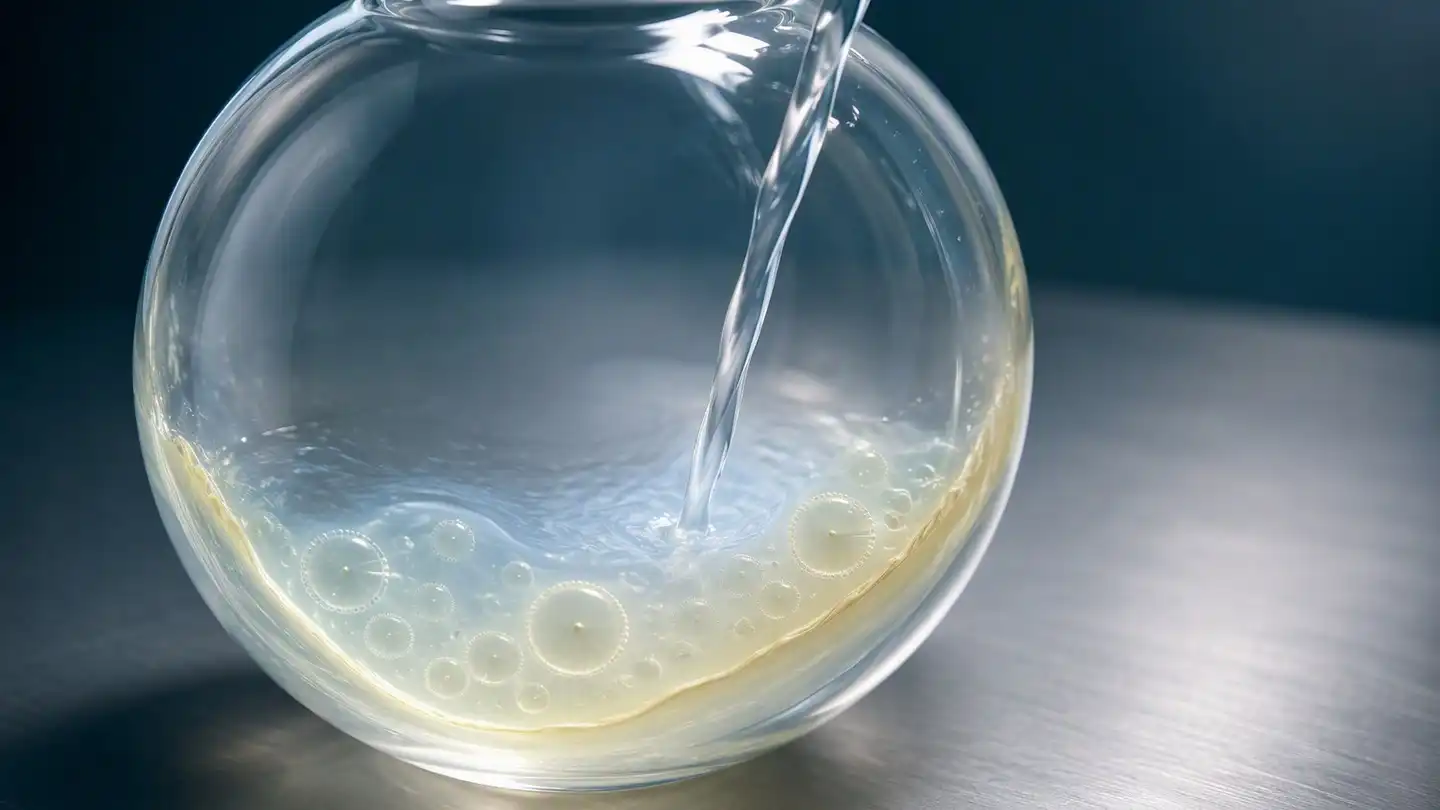
Each barrier maps to a different specification. Gastric protection maps to encapsulation efficiency and to the integrity of the bilayer after drying. Enzymatic exposure maps to the same encapsulation figure, because a molecule outside the vesicle is fully exposed. Diffusion maps to particle size and, critically, to the width of the distribution. A grade with a good mean particle size and a broad distribution will behave worse at the third barrier than a grade with a slightly larger mean and a tight distribution, which is why a single DLS number is insufficient.
What Encapsulation Efficiency Does and Does Not Establish
Encapsulation efficiency is the most quoted and least interrogated figure in this category. It states the proportion of active associated with the vesicle fraction at the point of measurement, and it is only meaningful when the method is named. Two common methods, separation by centrifugation and separation by dialysis, give systematically different results on the same material because they measure different things: the first measures what sediments with the vesicles, the second measures what does not diffuse out over a defined window.
What the figure establishes is the fraction protected from the continuous phase at release. What it does not establish is how much of that protection survives drying, how much survives compression into a tablet, or how much survives eighteen months in a sachet. Those are separate questions answered by process data and stability data. A supplier that reports encapsulation efficiency after drying, and again after a defined storage interval, is telling the buyer something considerably more useful than a single release figure.
Reading a Particle Size Result
Dynamic light scattering returns a distribution, not a number. When a specification says uniform particle size distribution, the buyer should ask for the parameters behind that description: the mean, the polydispersity index, and the measurement conditions including diluent and temperature. A narrow distribution indicates a controlled homogenisation step; a broad one indicates either variable shear or partial aggregation during drying.
For a formulator the practical consequence is about reproducibility. Particles in a tight distribution behave predictably when dispersed, sediment at a consistent rate, and give a consistent mouthfeel in a beverage. A broad distribution produces a product that looks acceptable in the pilot and separates in the finished pack several weeks later, which is a failure that surfaces at the least convenient moment. Asking for the distribution alongside the mean is a small request that removes a large category of downstream surprise.
Stability and the Limits of a Shelf-Life Claim
A stated shelf life of up to 24 months is a statement about the material in its original packaging under defined storage conditions. It is not a statement about the finished product, and the distinction matters because the finished product usually exposes the powder to more air and more handling than the bulk pack does. The brand's own stability programme has to be run on the finished format, and the supplier's data serves as the reference point that tells the formulator which failure mode to watch.
Two modes dominate for NAD+. The first is hydrolytic, driven by moisture, and it shows up as a fall in assay with a rise in related substances. The second is thermal, driven by the drying step and by storage temperature, and it shows up as a change in colour together with a loss of encapsulation. Because the two modes have different sensitivities, a single accelerated condition can mask one behind the other. Running accelerated, intermediate and long-term conditions in parallel is the only way to see which is limiting, and it is worth confirming with a supplier that its own data set did exactly that.
Reconciling the Certificate of Analysis
A certificate of analysis for this grade should let the buyer reconstruct the specification without asking a follow-up question. The table below lists the fields that should be present and the reason each one is not optional.
| Field | Why it must be present |
|---|---|
| Lot number and manufacture date | Links the certificate to the material actually shipped and to a stability timepoint |
| Assay with method | Without a named method, a 50% result cannot be compared with a competitor's 50% |
| Encapsulation efficiency with method | Centrifugation and dialysis results are not interchangeable |
| Particle size with distribution parameters | A mean without a polydispersity index hides aggregation |
| Moisture or loss on drying | The dominant hydrolytic driver, and the first thing to check when assay falls |
| Heavy metals, including lead | Redox-active material is sensitive to traces well below generic limits |
| Microbiology panel | Determines whether a preservation step is needed downstream |
| Storage and retest statement | Defines the conditions under which the shelf-life claim holds |
Where a certificate omits encapsulation or particle size, the omission is usually deliberate: those measurements require equipment and time that a trading intermediary does not have. That is a useful signal in itself, because a specification that cannot be verified at release is not a specification in any operational sense.
Questions That Separate One Grade From Another
Given two quotations with the same headline figures, the following questions produce different answers and are therefore diagnostic. Is the encapsulation figure measured before or after drying? Is the particle size reported with a polydispersity index? Was the stability programme run in the commercial pack? Which change-control commitments apply to the phospholipid source? Is the lead limit supported by a third-party report or by in-house data only?
A supplier working to a documented quality system answers these quickly, because the answers already exist in its files. A supplier assembling material from third parties tends to answer with assurances rather than documents. The difference is not about unit cost or scale; it is about whether the specification has been internalised by the organisation that signs the certificate.
A Note on the Loading Grade Decision
The choice between a 50% grade and a lower loading band is often described as a commercial preference, but it changes the physical behaviour of the finished blend. A higher loading grade means less carrier per unit of active, which reduces the mass a serving has to contain and improves the arithmetic for a capsule. It also concentrates the active in the dried matrix, which raises the local concentration during rehydration and can push the dispersion toward aggregation if the homogenisation step was marginal. A lower grade gives the formulator more distance between particles in the dry state and disperses more forgivingly, at the cost of a larger serving mass. Neither is superior in the abstract. The right answer comes from the format, the serving size and the dispersion conditions the consumer will actually use, which is why the grade should be fixed after the format rather than before it.
Where the Delivery Argument Actually Lands
Stripped of the biological narrative, the case for a liposomal NAD+ grade rests on three verifiable properties: the active is protected at release to a stated efficiency, the particles are small and narrowly distributed enough to disperse and persist, and the material holds its assay and its encapsulation across a defined storage window. Those three properties are testable by any competent laboratory, which is what makes them a sound basis for a purchase decision.
What a brand does with that foundation is its own commercial and regulatory work. The ingredient's contribution is a known starting point. Reading the site's guidance on the testing methods used to verify liposomal NAD+ quality and on what a certificate of analysis should contain gives the buyer the vocabulary to run that verification without relying on the supplier's own summary.
Practical Next Step
For a specification review, contact the formulation team at info@emerwell-bio.com with the intended loading grade, the finished format and the storage conditions the product will face. Samples of the standard grade are available for trial work. Two further references are useful when planning the brand's own programme: the site's technical guide to improving liposomal NAD+ powder stability and its analysis of the factors that affect shelf life. The liposomal NAD+ powder specification sheet provides the baseline figures referenced above.
This article is intended for ingredient buyers, formulators and quality professionals. It describes raw-material specifications, delivery-system physics and analytical practice. It does not address the use of any finished product by an individual, and statements about finished products remain the responsibility of the brand that markets them.
References
- U.S. Food and Drug Administration. Current Good Manufacturing Practice in Manufacturing, Packaging, Labeling, or Holding Operations for Dietary Supplements, 21 CFR Part 111. ecfr.gov
- U.S. Food and Drug Administration. Search for FDA Guidance Documents. fda.gov
- FAO/WHO. Codex Alimentarius Commission. fao.org
- European Food Safety Authority. Food Additives. efsa.europa.eu
Online Message