

Oct 30, 2026
Liposomal Omega-3 Powder Development: From Raw Material to Finished Product
Most liposomal omega-3 powder programmes do not fail because the chemistry is unknown. They fail at the handover between stages: a dispersion that looks perfect in a beaker cakes in a stick pack three weeks later, or a lot that passes its peroxide check on drying day has drifted by packing. The liposomal omega-3 powder specification — 10%–25% active, encapsulation efficiency above 85%, peroxide value below 2 meq/kg — describes the destination, not the route.
This article maps that route as six stage gates. Each gate has an input, control points, an output and the failure modes that appear in review. The production process walkthrough covers the unit operations and mass flow.
Why a Stage-Gate Model Suits an Oxidation-Sensitive Ingredient
Omega-3 oils do not oxidise in one step. Hydroperoxides form first, then decompose into aldehydes and ketones that carry the off-notes consumers call rancid. The process is cumulative, so a defect introduced at drying may surface weeks later in a sealed sachet.
A gate turns that delay into a decision. Each stage carries its own evidence, so a lot that fails at stage four can be traced to stage one. Gates also protect the commercial side: once a specification is printed on a data sheet, every change needs a reason, a version number and customer notification. Teams that skip gates meet this in an audit, with two document versions in circulation.
Stage 1 — Raw Material Oil Selection
Input. A qualified omega-3 oil, marine or algal, with a lot-specific certificate of analysis, a fatty acid profile by gas chromatography, initial peroxide and p-anisidine values, a colour reading and a sensory baseline.
Critical control points. Three numbers matter more than headline omega-3 content. First, the EPA-to-DHA ratio: the standard grade here is DHA 10% / EPA 5% at powder level, so the oil ratio is set with processing losses in mind. Second, initial POV read with p-anisidine, because refining can strip volatile odour compounds while leaving secondary oxidation products behind — a clean smell is not a clean baseline. Third, a recorded odour baseline with coded samples and more than one assessor.
Contaminant capability belongs here too: if the powder must hold Pb below 0.5 ppm, the oil lot should show that margin at intake rather than at re-test. The checks in evaluating liposomal omega-3 powder purity follow the same logic.
Output. An approved oil specification, a nitrogen-stored reference sample, the sensory baseline record and a supplier qualification file.
Common failure. Oil accepted at the top of a broad purchase specification; ratio drift between lots that surfaces later as a label-claim problem; a baseline reconstructed from memory.
Stage 2 — Emulsification and Encapsulation
Input. Released oil, a qualified phospholipid wall material lot, the aqueous phase and equipment with a validated cleaning and parameter history.
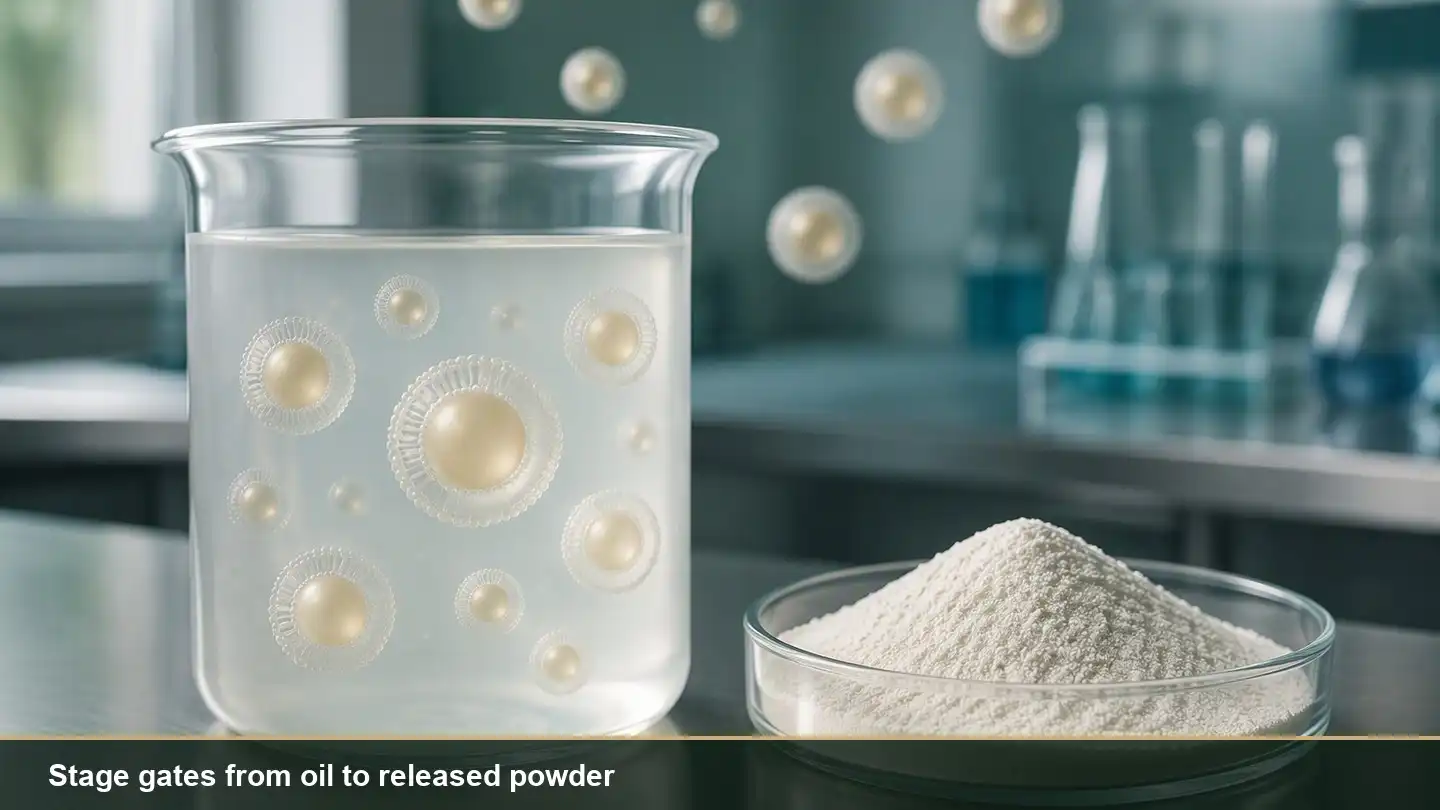
Critical control points. Wall-to-oil ratio, total solids, energy input, the temperature ceiling during homogenisation, and a size distribution reported as D50 with a polydispersity index rather than a single mean. Encapsulation efficiency is the fourth, and the one most often mishandled. Two suppliers can both report 85% and mean different things: free oil removed by solvent extraction and quantified by GC, unencapsulated oil separated by centrifugation, or an indirect calculation. The gate should name the method, sample preparation and calculation, or the number cannot be compared across lots — a point examined in the science behind liposomal omega-3 powder formulation.
Output. A batch record of actual against target parameters, the size distribution, the EE result with its method identifier, and hold-time data between homogenisation and drying.
Common failure. A bimodal distribution hidden behind a mean; over-processing that raises temperature and drives oxidation inside the step meant to protect the oil; EE measured on a diluted sample whose equilibrium no longer reflects the concentrated feed.
Stage 3 — Drying and Powderisation
Input. Emulsion inside its validated hold window, plus qualified carriers and anti-caking aids.
Critical control points. Inlet and outlet temperature, feed rate, atomiser speed and drying-gas dew point. Outlet temperature is the practical proxy for residual moisture and for whether the wall material stayed below its glass transition; exceed it and particles may survive drying but collapse in the sachet.
Output. A dried lot with yield, moisture by loss on drying, bulk and tapped density, a flow index and appearance against a colour reference.
Common failure. Raising inlet temperature to lift throughput, which migrates oil to the particle surface and lifts POV within days; under-drying that leads to caking at the seal; over-drying that creates friable particles, fines and static. The link between moisture and oxidation is set out in stability challenges in liposomal omega-3 powder formulations.
Stage 4 — Powder Characterisation and Release
Input. The dried lot and the reference standard established at the previous gate.
Critical control points. POV re-tested by the same method, in the same laboratory, within a defined window; moisture; dispersibility in cold water at a fixed ratio and agitation, with dispersion time, sediment and layer separation recorded separately; bulk density; colour as L*a*b* against the reference; a repeat EE check; total plate count below 1,000 cfu/g and Pb below 0.5 ppm.
"Disperses well" is not a result: a usable record states the water temperature, powder-to-water ratio, agitation method and observations at one, five and ten minutes.
Output. A draft certificate of analysis, a release decision and a retention sample.
Common failure. Reporting POV from extracted surface oil while assuming the encapsulated core is protected; reading a colour shift as natural variation without a numerical limit; testing dispersion only in warm water, then finding the cold-water claim fails. Colour and odour control are handled together in solving taste and stability issues in liposomal omega-3 powder.
Stage 5 — Finished-Format Fit
Input. A released powder lot and the intended commercial format, decided before this gate.
- Stick packs and sachets. Fill accuracy depends on flow and bulk density; static and caking at the seal decide whether the machine runs at rate; cold-water dispersion decides whether the consumer sees particles.
- Capsules. Bulk density sets the achievable fill weight, while hygroscopicity and water migration towards the shell shape behaviour in storage.
- Powder blends. A density difference against other actives creates segregation, so uniformity is sampled at the top, middle and bottom of the blender.
- Ready-to-drink formats. Dispersion without layer separation, headspace oxygen, thermal processing and primary-pack barrier interact. See using liposomal omega-3 powder in beverage formulation.
Output. A format-specific trial report and a compatibility matrix of what was tested, at what concentration and with what outcome.
Common failure. Choosing the format after specification lock; running sachet trials on a lab filler then moving to a rotary machine without repeating the fill-accuracy work; ignoring odour containment until a panel reports it.
Stage 6 — Scale-Up, Documentation and Specification Lock
Input. The pilot process, the critical quality attributes agreed at earlier gates and a draft specification.
Critical control points. Three consecutive commercial batches inside the same parameter bands, with variation in POV, EE, particle size, moisture and density reported as a range. Change control is the second: substitution of oil source, wall material or carrier must trigger a documented assessment, not a silent adjustment on the floor.
Output. A locked specification sheet with a version number, a certificate of analysis template naming the method for each parameter, the technical and safety data sheets, a stability protocol and a written change-notification clause. Certification scope — cGMP, ISO 9001:2015, ISO 22000, HACCP, Kosher and Halal — is verified here as audit evidence, not a substitute for batch data.
Common failure. Specification creep, where a limit is widened to accommodate a troublesome lot instead of investigating it; a certificate reporting a parameter by another method; two superseded document versions still in circulation. Commercial checks alongside this gate are listed in factors to consider when buying liposomal omega-3 bulk powder.
Gate Review: Outputs and Acceptance Criteria
| Gate | Output that closes the gate | Acceptance criterion | Most common failure |
|---|---|---|---|
| 1. Raw oil | Lot CoA, GC fatty acid profile, POV and p-anisidine, sensory baseline | Ratio on target; initial POV inside the intake limit; baseline recorded | Oil accepted at the purchase-spec ceiling |
| 2. Emulsification | Batch record, size distribution with PDI, EE with method identifier | EE above 85% by the declared method; unimodal distribution | EE reported without method or calculation |
| 3. Drying | In-process record, moisture, bulk density, flow index | Outlet temperature and moisture inside the validated band; free-flowing powder | Throughput lifted by raising temperature |
| 4. Characterisation | Draft CoA, release decision, retention sample | POV below 2 meq/kg; TPC below 1,000 cfu/g; Pb below 0.5 ppm | POV measured on surface oil only |
| 5. Format fit | Trial report and compatibility matrix | Format meets fill, dispersion and odour targets | Format chosen after specification lock |
| 6. Scale-up | Locked spec, CoA template, TDS, SDS, change clause | Three consecutive batches inside the parameter bands | Limit widened instead of investigated |
Reading POV as a Process Signal, Not a Single Number
A peroxide value quoted on a certificate is one reading at one moment, and reading it as a pass-or-fail number hides the trend that matters most: how the value moves across lots, across storage intervals and across the drying step. A development programme should plot the figure rather than tick a box, because the direction of travel tells you whether the oil handling, the emulsification hold time or the packaging is doing the work.
Why a Low Reading Can Mislead
Peroxide value measures primary oxidation products, and it can fall as hydroperoxides break down into aldehydes and ketones. A lot can therefore read below its limit and still carry an off-note, which is why gate review pairs POV with p-anisidine, colour and a sensory panel. The bands below are for triage; they do not replace the specification, and the release limit here is below 2 meq/kg.
| POV (meq/kg) | What it usually indicates | Sensory and process signal | Gate action |
|---|---|---|---|
| Below 2 | Within the release target | Clean baseline odour; no colour drift against reference | Release; trend against previous lots |
| 2 to 5 | Early oxidation, or a method or laboratory difference | Odour may still pass; dispersion unaffected | Investigate before release; check oil intake and drying temperature |
| 5 to 10 | Secondary oxidation likely | Off-note detectable; colour beginning to shift | Hold the lot; root-cause review; rework or reject |
| Above 10 | Advanced oxidation | Clear off-note; caking and colour change probable | Reject; audit upstream gates |
Method Parity Before Comparison
Two practical notes. First, compare POV only when method, sample preparation and laboratory match; an AOCS Cd 8b-90 titration and an in-house method are not interchangeable. Second, a falling POV between two sampling points is not automatically good news: it may mean the hydroperoxides have already decomposed. The freshness story is told in why omega-3s go rancid and how to protect them.
What to Ask Before the First Gate
The cheapest place to find a gap is a conversation, not a pilot run. Before committing material or bench time, a buyer can establish whether the supplier's dossier is built on routine batch testing or on a one-off campaign, and whether the method behind each number is the same method the buyer's own laboratory would use. The questions below are deliberately narrow so that answers can be checked against documents rather than accepted as assurances.
Four Questions That Expose Gaps
Four questions expose most supplier-dossier gaps without a laboratory:
- Which oil lot sits behind the sample, and what were its POV and p-anisidine at intake?
- Which encapsulation efficiency method is used, and can the calculation be shared?
- Which parameters are tested on every batch, and which only by campaign?
- What triggers a change notification, and who receives it?
If you are building a specification for a liposomal omega-3 powder programme, the technical team at EmerWell can share the current product specification, a representative certificate of analysis and a sample for dispersion and sensory trials. Write to info@emerwell-bio.com with your target format.
References
International Council for Harmonisation. Q1A(R2): Stability Testing of New Drug Substances and Products. 2003. https://database.ich.org/sites/default/files/Q1A(R2)%20Guideline.pdf
AOCS. Official Methods and Recommended Practices, including Cd 8b-90 for peroxide value. https://www.aocs.org/attain-lab-services/methods
GOED. Voluntary Monograph and quality standards for omega-3 oils. https://www.goedomega3.com/
Codex Alimentarius Commission. Codex Texts: List of Standards, including CXS 329-2017, Standard for Fish Oils. https://www.fao.org/fao-who-codexalimentarius/codex-texts/list-standards/en/
Disclaimer: This article is written for ingredient buyers and formulators and describes manufacturing and documentation practice only. It is not medical or nutritional advice and states no outcome for any user. Finished-product claims remain the responsibility of the brand owner under the regulations of its market.
Online Message