

Sep 22, 2026
Liposomal NAD+ Powder vs Traditional NAD+ Supplements: Which Form Is Preferred?
Choosing between liposomal NAD+ powder and a conventional NAD+ supplement format is rarely a question of which finished product looks better on a shelf. For a brand owner or a contract manufacturer it is a question of what arrives at the dock, how many unit operations sit between receipt and a filled package, and which finished formats the material can realistically support. Both routes start from the same active, yet they diverge on feed form, compounding sequence, behaviour in the aqueous phase, storage envelope and release documentation. Comparing the published specification for liposomal NAD+ powder with that of an unencapsulated NAD+ material shows that most of the difference is process, not promise.
Where the Two Routes Actually Diverge
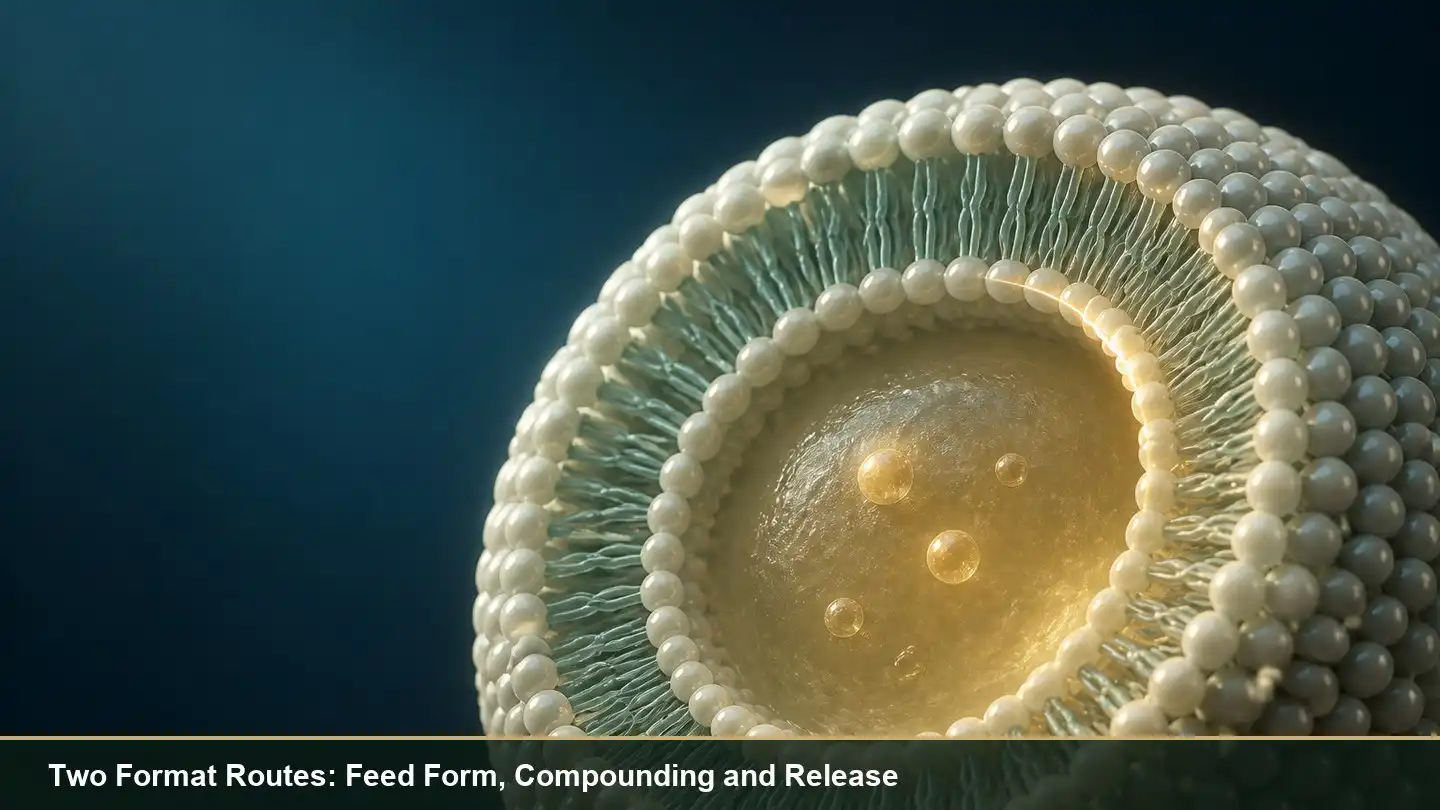
In the encapsulated route the supplier has already built the delivery structure and dried it into a powder. In the conventional route the active arrives unencapsulated, and any structure-building work — granulation, compaction, capsule filling — happens on the buyer's own line. That single shift in where the work sits explains most of the contrasts below, and it is why the two materials should be validated against different criteria rather than one number.
| Parameter | Encapsulated liposomal NAD+ powder | Unencapsulated NAD+ material |
|---|---|---|
| Incoming feed form | Spray-dried, free-flowing powder; NAD+ carried inside a phospholipid bilayer at 10%–70% active content | Crystalline or coarse bulk powder, granulate or pre-blended intermediate |
| First operation after receipt | Cold-water dispersion under controlled shear | Dry blending, screening and de-lumping |
| Aqueous-phase behaviour | Wets and disperses in cold water; forms a stable colloidal suspension | Dissolves as a true solution; hydrolytic loss accelerates once in water |
| Solid-state work at the plant | None required — the powder is already dried and flowable | Wet granulation, drying and milling if a tablet or granule is targeted |
| Fill or compaction step | Direct blending into powder, stick, sachet or suspension bases | Encapsulation, direct compression or roller compaction |
| Storage envelope | Cool, dry and dark in nitrogen-flushed multi-layer aluminium foil; up to 24 months under proper storage | Moisture limit is usually set by flow and compaction behaviour rather than by the active |
| Release documentation | Assay by HPLC, particle size by DLS, morphology by TEM, Pb < 0.1 ppm, total plate count < 1000 cfu/g | Assay and microbiological limits; particle-size and morphology data usually not applicable |
| Best-fit finished formats | Powder blends, stick packs, sachets, cold-filled suspensions and beverage premixes | Capsules, tablets and dry blends where solution behaviour is not required |
What Arrives at the Dock: Incoming Feed Forms
The encapsulated route
A finished liposomal NAD+ powder arrives as a pale yellow to white, free-flowing powder with an active content of 10%–70% and an encapsulation efficiency of 85%–95%. Because it is already dried and cold-water dispersible, receipt handling is closer to a carrier or a pre-blend than to a raw active: weigh, disperse, blend, fill. Appearance, dispersibility and assay are the three attributes worth checking on arrival, since they determine whether the powder will wet out cleanly in the first minutes of the batch or float and clump.
The conventional route
An unencapsulated NAD+ material typically arrives as a bulk powder or a pre-blended intermediate that already contains carriers and glidants, and its particle-size distribution is often wide by design because downstream granulation will re-shape it. The receiving check therefore centres on flow, bulk behaviour and compressibility rather than on dispersion. Two lots that pass the same assay can still behave differently on a tablet press, which is why flow data belongs on the incoming record for this route.
Compounding Steps Side by Side
Dispersing the encapsulated powder
The encapsulated route replaces granulation and drying with one aqueous step. Water is charged first, the powder is added under low-to-moderate shear until the dispersion is uniform, and the batch is held for a fixed, short window before it is either dried again or filled as a liquid. Hold time and shear level are the two variables that matter most, and both are worth locking into the batch record from the first trial rather than after scale-up. A fuller account of the upstream unit operations sits in this walkthrough of how liposomal NAD+ powder is made.
Blending and compacting unencapsulated NAD+
The conventional route keeps the plant's existing train: screening and de-lumping, dry blending with excipients, then encapsulation, direct compression or roller compaction. Nothing here requires new equipment, but the aqueous exposure that follows wet granulation is the point of highest stress for an unencapsulated active, so the granulation hold time, the inlet temperature and the drying endpoint all deserve formal limits instead of operator judgement.
Dissolution and Dispersion Behaviour in the Aqueous Phase
NAD+ is hydrolytically labile in water, and the rate of loss rises with pH and temperature — a 43-day buffer study on nicotinamide cofactors found degradation was fastest under alkaline conditions and that even a mild temperature increase changed the outcome materially. For an unencapsulated NAD+ material, that chemistry is exposed directly to the process water. For an encapsulated powder the phospholipid bilayer sits between the active and the bulk water, and the powder is engineered to disperse in cold water into a stable colloidal suspension rather than to dissolve as a true solution. The practical consequence is a difference in trial design: the encapsulated route is judged on wetting, dispersion uniformity and particle-size distribution; the conventional route on dissolution completeness and hold time.
Processing and Storage Conditions
Moisture and water activity
Sorbed water lowers the glass transition temperature of an amorphous powder matrix, and caking becomes more severe as both water content and temperature rise. For a spray-dried encapsulated powder that means the flowability observed on arrival is a storage outcome, not only a drying outcome: a bag that has taken on moisture in transit may still assay correctly and yet refuse to blend. Setting an internal water-activity limit, and verifying it after any repacking, keeps that risk visible.
Temperature and light
Both routes are best held cool, dry and dark. Stable temperature matters more than a specific figure, because cycling drives condensation inside sealed packaging, and condensation converts an otherwise acceptable lot into a caked one. Light protection should extend from bulk through finished pack on either route.
Barrier packaging and headspace
Oxidative stability of a dried encapsulated powder depends on how it was dried and how it is subsequently packaged, so a nitrogen-flushed headspace inside multi-layer aluminium foil is part of the product definition rather than a shipping detail. Nitrogen slows oxidation and moisture ingress but does not stop them, so the 24-month shelf-life figure for this material is conditional on proper storage and should be re-confirmed against your own packaging format. Technical background on these mechanisms is set out in this technical guide to improving liposomal NAD+ powder stability.
| Process or storage variable | Encapsulated liposomal NAD+ powder | Unencapsulated NAD+ material |
|---|---|---|
| Water activity on receipt | Record and hold against an internal limit; flow is moisture-driven | Record; affects flow, compression and later hydrolytic loss |
| Aqueous hold time | Fix a short maximum between dispersion and the next step | Fix and validate hold time after granulation |
| Temperature control | Avoid cycling; condensation is the main packaging risk | Avoid cycling; the granulation and drying steps are the stress points |
| Light protection | Opaque or amber secondary packaging throughout | Opaque packaging for bulk and finished pack |
| Headspace | Nitrogen-flushed, vacuum-sealed multi-layer foil | Nitrogen flushing applied to bulk drums as well |
| Particle-size drift | Monitor across the shelf life; dispersion behaviour follows it | Not normally a release parameter |
Documentation and Acceptance Criteria
What the specification should fix
For a liposomal raw material the specification has to pin down more than an assay figure. Particle-size distribution, encapsulation efficiency and the amount of free active relative to encapsulated active are the parameters that describe the actual delivery structure, and they are the same family of attributes used in liposome product dossiers. Written without them, a specification describes the NAD+ and says nothing about the material you are buying. The full set of release tests applied to this grade — assay, particle size and morphology — is described alongside the testing methods used to verify liposomal NAD+ powder quality.
Sampling and release logic
Good manufacturing practice for dietary supplement ingredients expects documented receiving, quarantine, sampling and disposition decisions for every lot, which is a useful template for either route. Under it, the two routes simply need different acceptance data attached to the same decision. A practical way to organise that is to split release documentation by what each document actually settles.
| Document | What it settles | Weight by route |
|---|---|---|
| Certificate of analysis per lot | Assay, microbiological limits, heavy metals, appearance | Both routes |
| Particle-size report (DLS) | Whether a dispersion will match earlier batches | Encapsulated route, primary |
| Morphology report (TEM) | Whether intact vesicular structures are present in the lot | Encapsulated route, primary |
| Water activity or loss on drying | Caking and flow risk after transport | Both routes; acute for spray-dried powder |
| Dispersion trial record | Real wetting and suspension behaviour in your own base | Both routes, always run in-house |
| Retained sample | Comparability for future lots and complaint investigation | Both routes |
Which Finished Formats Each Route Fits
The encapsulated route is at its most useful where the finished product is built from a dispersion or a dry blend: stick packs and sachets, powder blends, cold-filled suspensions and beverage premixes, and soft formats handled at ambient temperature. Cold-water dispersibility removes the need to engineer dissolution into the finished formulation, which shortens development for applications for liposomal NAD+ powder in finished products. The conventional route retains an advantage where the target is a conventional capsule or tablet and the existing line is already validated for it — the trade-off is that dispersion, compaction and moisture behaviour all become the buyer's engineering problem, a comparison covered in more detail in this note on NAD+ powder versus capsule formats. If the active is one line in a broader portfolio, the surrounding nutraceutical ingredient range is worth reviewing in the same pass, because formats that share one dispersion routine are cheaper to develop together.
A Selection Checklist for Formulators and Buyers
- Write down the target finished format first, then work backwards to the feed form it needs.
- Decide which plant will do the structure-building work — supplier or your own line.
- Require particle-size and encapsulation data, not assay alone, for any encapsulated material.
- Fix an aqueous hold time and a water-activity limit before the first commercial batch.
- Trial the dispersion or granulation in your own base and keep the record as a release reference.
- Confirm that the storage envelope stated by the supplier matches your packaging and climate.
Request Specifications, COA and Samples
Formulation teams comparing both routes can request the technical specification sheet, a lot-specific COA and a sample of Liposomal NAD+ Powder from EmerWell, together with particle-size and dispersion data generated on the lot in question. Technical support covers specification wording, dispersion and blending trials, and the documentation package needed for your receiving and release records; commercial terms and delivery arrangements are quoted per enquiry at info@emerwell-bio.com.
References
- Wolfe, K. D., et al. Long-Term Stability of Nicotinamide Cofactors in Common Aqueous Buffers. Molecules, 2024. https://pmc.ncbi.nlm.nih.gov/articles/PMC11597533/
- Anantawittayanon, S., Mochizuki, T., Kawai, K. Effects of Water Activity and Temperature on the Caking Properties of Amorphous Carbohydrate Powders. Journal of Applied Glycoscience, 2025. https://pmc.ncbi.nlm.nih.gov/articles/PMC11975220/
- Comparison of physicochemical properties and oxidative stability of microencapsulated perilla oil powder prepared by freeze-drying and spray-drying. Food Science and Biotechnology. https://pmc.ncbi.nlm.nih.gov/articles/PMC10541381/
- U.S. Food and Drug Administration. Liposome Drug Products: Chemistry, Manufacturing, and Controls; Human Pharmacokinetics and Bioavailability; and Labeling Documentation. https://www.fda.gov/regulatory-information/search-fda-guidance-documents/liposome-drug-products-chemistry-manufacturing-and-controls-human-pharmacokinetics-and
- Current Good Manufacturing Practice in Manufacturing, Packaging, Labeling, or Holding Operations for Dietary Supplements, 21 CFR Part 111. Electronic Code of Federal Regulations. https://www.ecfr.gov/current/title-21/chapter-I/subchapter-B/part-111
This article is written from a supplement ingredient and contract manufacturing perspective for B2B technical audiences. It is not medical advice, and nothing here should be read as a statement about the physiological effects of any ingredient.
Online Message