

Nov 11, 2026
Is Liposomal Vitamin C Good for Hair, Skin, and Nails?
A brand that builds a line around appearance positioning usually arrives at the ingredient conversation with a claim already drafted. The formulator's job is narrower and more useful: establish what the raw material can actually be specified to deliver, and what documentation exists to support the language on the pack. Liposomal vitamin C powder sits in a category where appearance language is common and where the gap between what a supplier can evidence and what a marketer would like to say is wide. This article maps that gap and sets out the specification, stability and documentation points that decide whether a hair, skin and nails project survives its first regulatory review.
What the Category Actually Asks of the Ingredient
Appearance-led products ask three things of a raw material. It must carry a declared quantity of the active that survives to end of shelf life, it must not introduce a sensory or colour defect into the finished format, and it must come with documentation that lets the brand substantiate the language it intends to use. None of these is a question about what the ingredient does inside a person. All three are questions a buyer can put to a supplier and get a documentary answer to, which is what makes them useful at the specification stage.
The third point is where most projects lose time. A brand's appearance claims are its own responsibility, and the ingredient supplier's role is to supply the technical file that the brand's regulatory reviewer needs: assay, method, stability, and a clear statement of what the material is. A supplier that offers to help write the claim has usually misunderstood its position; a supplier that provides a clean, auditable file has done the more valuable thing.
Specification Baseline
The numbers below are the ones that matter for an appearance-positioned project. Anything not on this list is unlikely to change a formulation decision, and anything on the list that is missing from a quotation is worth asking for before samples are dispatched.
| Parameter | Typical specification | Relevance to an appearance-positioned line |
|---|---|---|
| Ascorbic acid content | Common loading grades across the 10%–50% band | Determines how much material a serving needs, and therefore the sensory load |
| Encapsulation efficiency | 85%–95% | Indicates how much of the active is shielded from the continuous phase |
| Appearance | White to off-white free-flowing powder | Colour is the first visible sign of oxidation in a finished blend |
| Dispersibility | Disperses in cold water without clumping | Decides whether a stick pack or a capsule is the realistic format |
| Lead | < 0.5 ppm | Metal traces accelerate ascorbic acid oxidation |
| Total plate count | < 1,000 cfu/g | Sets the preservative strategy for liquid formats |
| Testing methods | HPLC for assay, DLS for particle size, iodometric titration for peroxide value | The method must be named, or the number cannot be audited |
Two of these deserve a note. The loading grade is not a quality ranking: a 10% grade and a 50% grade can both be well made, and the right choice depends on how much room the serving size leaves. A 50% grade in a small sachet may deliver the target quantity with less carrier, but it also concentrates the acid load in the matrix, which changes the taste and the pH. The encapsulation figure matters in the same practical way, because it describes how much of the acid is sitting outside the vesicle where it can react with everything else in the blend.
Why Appearance Claims Are a Documentation Problem
The honest position, and the one that keeps a project out of difficulty, is that language about hair, skin and nails belongs to a category of claims that a brand must be able to substantiate on its own evidence. The ingredient supplier's contribution is the material specification and the stability data. It is not a study in the target population, and it is not a substitute for the brand's own substantiation file.
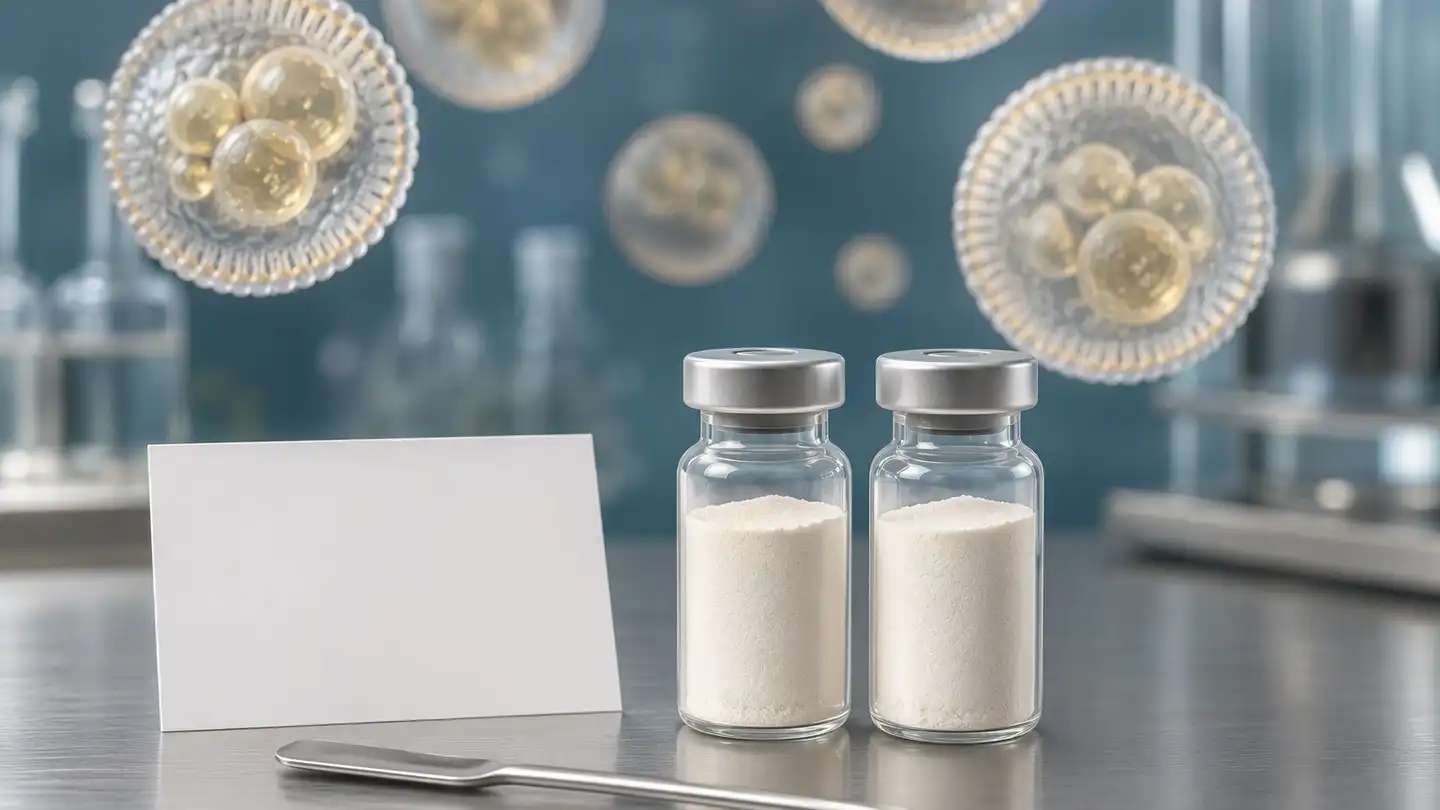
That division has a practical consequence at the quotation stage. A buyer should ask which documents accompany the sample, and should expect the answer to be a certificate of analysis, a specification sheet, a safety data sheet and a stability summary. If the answer includes a claim about appearance outcomes, the supplier has overstepped, and the file will be harder to defend rather than easier. A clean technical file plus a clear boundary is a stronger commercial position than an enthusiastic one.
Oxidation Appears as Colour Before It Appears as Assay
Ascorbic acid degrades through a well-characterised oxidative pathway that ends in brown pigmented products. The practical significance is that the visual change precedes the assay loss: a blend can look noticeably darker while its measured content is still inside specification, and by the time the assay falls the product is unshippable on appearance grounds alone. For a line sold on appearance, that ordering matters, because the consumer sees colour first.
This is why a colour specification belongs in the purchase agreement and not only in the marketing brief. Measured instrumentally, the b-value gives a reproducible number that can be trended across stability timepoints at negligible sample cost. A supplier that can supply a colour trend from its own stability programme is demonstrating control of the drying step; one that reports only assay is reporting half the picture.
pH and Matrix Compatibility
Ascorbic acid is an acidulant as well as an active, so adding it changes the matrix it enters. In a beverage the shift is usually acceptable and sometimes desirable; in a protein-containing powder it can move the system toward the isoelectric region and produce grit or sediment. The formulator's answer is either to buffer the matrix or to choose a buffered salt form, and both choices change the declared quantity arithmetic because the salt carries less acid per gram than the free acid.
Metal traces are the second compatibility issue. Copper and iron catalyse ascorbic acid oxidation at concentrations well below any heavy-metals limit that would fail a specification, and they arrive through excipients, through process water and through contact with unpassivated stainless steel. A combination that passes on paper can fail in a pilot because of a trace source nobody measured. Where a project is sensitive, asking the supplier for the metal-screening results on the specific excipient stream is a reasonable request.
Format Fit
The choice of finished format constrains the loading grade and the encapsulation requirement more than any other decision. The table below sets out how the constraint works in practice.
| Format | Practical constraint | What to specify |
|---|---|---|
| Two-piece capsule | Fill weight limits the dose per capsule; no water involved | Higher loading grade, flowability, low moisture pick-up |
| Stick pack | Dispersed in a small volume, so taste and acidity are concentrated | Buffered grade or flavour masking, fine particle size, rapid dispersion |
| Tablet | Compression heat and pressure stress the bilayer | Encapsulation efficiency plus a compression trial, not a specification alone |
| Gummy | Water activity and cooking temperature both attack the active | Thermal stability data at the process temperature, overage justified by data |
| Ready-to-drink | Long residence in an aqueous phase at ambient temperature | Colour trend, metal screening, packaging oxygen barrier |
The gummy and ready-to-drink formats are where appearance-positioned projects most often fail, because both expose the active to conditions that accelerate the browning pathway. A supplier that has run the format before will have data; one that has not will offer the standard grade and leave the trial to the customer. That difference is worth discovering before the tooling is ordered.
Stability Programme
A single accelerated condition does not describe an ascorbic acid system, because the dominant degradation route changes with water activity. The programme below gives enough structure to set a shelf life and to identify which route dominates.
| Element | Approach | Decision it supports |
|---|---|---|
| Conditions | Accelerated, intermediate and long-term in parallel | Whether moisture or temperature drives the loss |
| Measures | Assay, colour (b-value), moisture, peroxide value where lipids are present | Which indicator fails first and how much margin exists |
| Packaging | Commercial pack, including the oxygen and moisture barrier | Whether the pack, not the powder, is the limiting factor |
| Timepoints | Enough points to fit a trend | Whether degradation is linear or accelerates after a threshold |
| Matrix | Finished blend, not the raw material alone | Whether excipients catalyse or buffer the reaction |
Where the finished format contains lipids, peroxide value belongs in the panel because ascorbic acid and oxidised lipids interact: the acid can act as a pro-oxidant in the presence of free metal and heat, which is the opposite of the assumption most formulators bring to the blend. The site's discussion of vitamin C stability and permeability in liposomal systems sets out the mechanism in more detail, and is worth reading before a lipid-containing matrix is signed off.
What the Supplier Can and Cannot Provide
A well-run supplier can provide the specification, the certificate of analysis with named methods, a stability summary for the grade, a safety data sheet, and a statement of the certifications that apply to the manufacturing site. It can also describe the process controls that hold the specification, including the drying parameters and the in-process checks on encapsulation.
It cannot provide evidence that a finished product will produce an appearance outcome, because that evidence belongs to the brand and depends on the whole formulation, the population studied and the claim wording. Confusing these two roles is the most common source of regulatory difficulty in this category. The clean separation is also commercially useful: it lets a brand move quickly on the technical file while its own substantiation work proceeds in parallel.
What a Complete Technical File Contains
A technical file that can be handed to a regulatory reviewer without further correspondence contains six items. First, a specification sheet that states each parameter with its method and its acceptance range. Second, a certificate of analysis for the actual lot supplied, not a representative example. Third, a stability summary that names the conditions, the timepoints and the measures, and that was generated on the grade being purchased. Fourth, a safety data sheet in the format the destination market requires. Fifth, the certification statements that apply to the manufacturing site, with their scope and expiry. Sixth, a change-control statement describing how the buyer will be notified if any of the above changes. The sixth item is the one most often missing and the one that costs most later, because a silent change to the phospholipid source or the drying conditions invalidates the stability work the brand has already paid for.
Reading the Two Numbers That Decide the Project
If a buyer takes only two figures from this article, they should be the loading grade and the encapsulation efficiency, read together with the format. The loading grade determines the serving arithmetic and the sensory load; the encapsulation efficiency determines how much of the acid is protected from the matrix. Everything else in the specification is a refinement of those two, and a quotation that states neither is not yet a quotation.
The supporting reading list is short. The site's comparison of liposomal and regular vitamin C covers the structural difference that underpins the encapsulation argument; its note on the factors that affect shelf life sets out the environmental variables; and its analysis of particle size effects explains why a DLS figure needs its distribution alongside it.
Next Step
For a specification review against a specific format, contact the formulation team at info@emerwell-bio.com with the target serving size, the intended format and the loading grade under consideration. Samples of the standard grades are available for trial work, and the liposomal vitamin C powder specification sheet provides the baseline figures this article refers to.
This article is intended for ingredient buyers, formulators and quality professionals. It describes raw-material specifications, analytical practice and documentation boundaries, and does not address the use of any finished product by an individual. Appearance-related statements about finished products remain the responsibility of the brand that markets them.
References
- U.S. Food and Drug Administration. Current Good Manufacturing Practice in Manufacturing, Packaging, Labeling, or Holding Operations for Dietary Supplements, 21 CFR Part 111. ecfr.gov
- U.S. Food and Drug Administration. Search for FDA Guidance Documents. fda.gov
- FAO/WHO. Codex Alimentarius Commission. fao.org
- European Food Safety Authority. Food Additives. efsa.europa.eu
Online Message