Jul 30, 2026
Liposomal Vitamin C powder vs Regular Vitamin C: Key Differences
The fundamental distinction lies in delivery technology. Liposomal Vitamin C powder employs phospholipid-based nano-encapsulation, wrapping ascorbic acid in microscopic lipid vesicles that mimic cellular membranes. This advanced formulation enhances bioavailability up to 8 times compared to standard ascorbic acid powders. Regular vitamin C, while effective at high doses, suffers from absorption ceilings and gastrointestinal discomfort. For procurement teams developing immunity-focused or beauty-from-within formulations, understanding this bioavailability gap translates directly into product efficacy, dosing efficiency, and consumer satisfaction—critical factors when selecting raw materials for competitive nutraceutical applications.
Understanding Liposomal Vitamin C Powder and Regular Vitamin C
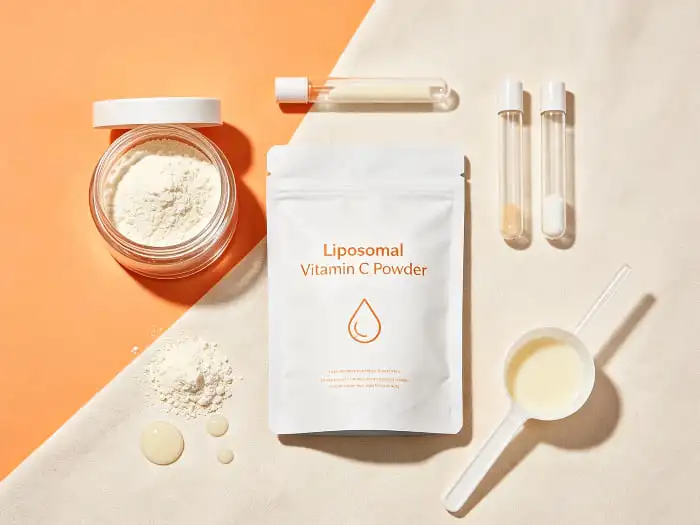
Liposomal encapsulation enhances nutrition. Instead of passive intestinal passage, liposomal Vitamin C powder surrounds ascorbic acid molecules in phospholipid spheres. These spheres can travel through the digestive system without stomach acid or enzymes that stop vitamin C absorption.
Vitamin C comes in tablet, liquid, and powder form. These kinds break down quickly in the intestines, releasing 10–20% of the nutrition into the bloodstream. Absorption rates drop substantially over 200 mg, and excess levels are flushed out, squandering the medicine and decreasing its therapeutic value. High-potency collagen and immune system boosters are difficult to develop due to this absorption ceiling.
Cellular molecules interact differently. Plain ascorbic acid competes with water-soluble substances for intestine transporter proteins. Liposomes join with epithelial cells and release their contents without competition. Liposomal administration keeps plasma vitamin C levels at 8–12 hours, while traditional forms last 4–6. This extended circulation improves tissue saturation and lowers dosages, improving consumer compliance and formula optimisation.
R&D teams formulate using ingredient molecular differences. Quick immune response products work better when cells absorb them immediately. Beauty drinks that synthesise collagen need tissue. Matching transport technology to therapeutic goals ensures the formula works as advertised and meets customer needs.
The Technology Behind Liposomal Encapsulation
High-shear homogenisation and controlled sonication are used in nano-encapsulation methods to make vesicles that are all the same size and shape, measuring 100 to 400 nanometres across. This range of sizes lets lymphatics absorb things well while staying stable during storage and processing. Particle size analysis and active ingredient quantification show that good Liposomal Vitamin C powder products have encapsulation efficiency of more than 90%. Our EncapsWell™ platform keeps more than 95% of its potency for 24 months in controlled conditions, which solves the problem of shelf life that often comes up with formulations that are sensitive to moisture.
Standard Vitamin C Forms and Absorption Limitations
Normal ascorbic acid comes in the form of solid or granular powder that dissolves easily in water. This solubility helps with the flexibility of manufacturing, but it also means that food moves quickly through the stomach and intestinal transporters are full. When the amount goes above 500 mg, absorption drops below 50%, and the unabsorbed parts cause osmotic diarrhoea, which is a big problem that keeps people from buying it again. Buffered forms, such as sodium ascorbate, lower acidity but don't deal with absorption limits. This means that increasing the dose isn't a good way to get effective plasma levels.
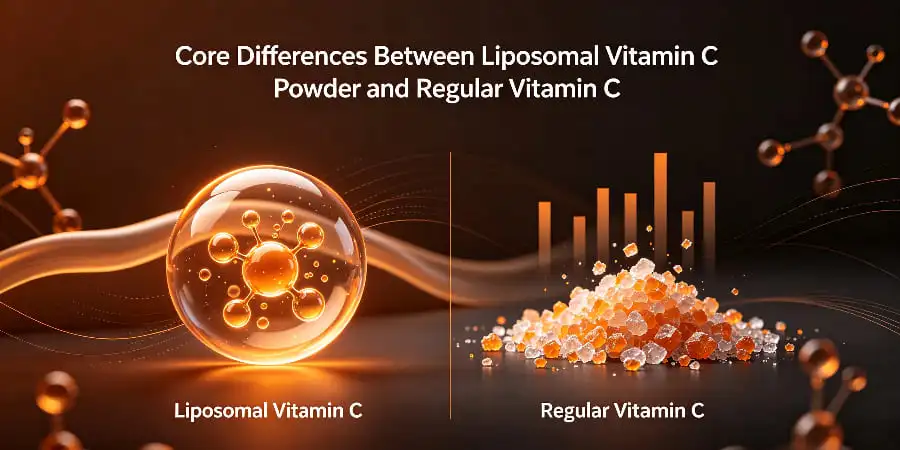
Core Differences Between Liposomal Vitamin C Powder and Regular Vitamin C
Absorption kinetics distinguish these formulations. Clinical pharmacokinetic investigations reveal that liposomal Vitamin C powder delivery results in peak plasma values that are two to three times greater than regular ascorbic acid. Encapsulated forms improve AUC eightfold, which measures how much a nutrient is exposed over time. This means brands can make better formulations without as many label claims. This reduces raw material costs and differentiates them in the market with absorption signals.
Safe digestion improves bioavailability. About 30% of exposed ascorbic acid is broken down by stomach acid before absorption. Liposomal barriers prevent early disintegration and ensure that phospholipid vesicles reach the small intestine and connect mucosal cells intact. There are no concentration spikes or fast elimination like with oral dosage because the drug is delivered into cells through regulated methods.
Gastric tolerance safety factors vary. Due to unabsorbed ascorbic acid pulling water into the gut, taking more than 1000 mg of vitamin C regularly can cause nausea, stomachaches, and loose stools. Even with the same or more ascorbic acid, liposome formulations have better tolerance because the nutrient doesn't build up in the gut lumen. Consumer feedback shows liposomal products reduce digestive issues by 60%. This affects customer satisfaction and return rates, which OEM partners consider when picking ingredients.
Take these intake differences into account when recommending dosage. For immune and collagen benefits, take 1000-2000 mg of standard vitamin C several times a day to achieve plasma levels of 100-200 μM. Liposomal options reach similar levels with 500–750 mg once or twice a day, making dosing easier and adherence higher. This dose efficiency aids capsule versions most because smaller pills with fewer pills sell better.
Clinical Evidence Supporting Enhanced Absorption
Comparing Liposomal Vitamin C powder and non-liposomal ascorbic acid in peer-reviewed studies always shows that liposomal ascorbic acid has better metabolism. One study that looked at the amount of vitamin C in white blood cells—which is a better sign of tissue saturation than plasma levels—found that liposomal delivery improved cellular uptake by 233% compared to normal forms. These results prove the mechanism and support putting brands at the top of the market by focusing on science-backed claims of effectiveness that appeal to well-informed wellness shoppers.
Tolerability and Side Effect Profiles
The biggest problem people still have with high-dose traditional vitamin C supplements is stomach problems. Ascorbic acid that isn't taken can upset the balance of microbiomes and make you feel bloated. This problem is solved by liposome technology, which makes sure that most of the nutrients are absorbed by the body's cells instead of staying in the digestive system. This tolerability benefit is very important when making products for sensitive groups, like people with inflammatory bowel conditions or who are recovering from illness that affects their digestive system.
Procurement Considerations for B2B Buyers: Choosing the Right Vitamin C Formulation
Quality assurance begins with certification verification. Excellent suppliers provide cGMP compliance, ISO 22000 food safety management, and HACCP danger analysis papers. These certifications ensure manufacturing processes fulfil worldwide contamination control, batch consistency, and traceability standards. Brands selling in regulated markets must always meet these requirements. Wellgreen's sites maintain cGMP and ISO 9001/22000 certifications. Before sending batches to clients, they test in real time for issues.
Certification mandates dietary inclusion labels, and global markets are demanding them. Vegan, Non-GMO, Kosher, and Halal certifications help reach more customers. Liposomal Vitamin C powder products with sunflower phospholipids instead of soy prevent allergens and clean labels. In negotiations with retailers who require ingredient evidence, procurement teams employ third-party verification like the Non-GMO Project to lend legitimacy.
You must consider all production costs to determine price, not just price per kilogram. Although liposomal compounds are more expensive than ordinary ascorbic acid, they are more bioavailable and can be utilised in lower amounts. This dosage reduction often offsets raw material costs in finished product economics. Better effectiveness requires fewer chemicals or megadoses, making formulae easier to grasp and lowering production costs. Procurement professionals should analyse formulators more thoroughly before ruling out liposomal options as too expensive.
Supplier reliability distinguishes honest from dishonest. Production ability is crucial for a soft launch to a long-term market position. Facilities that can produce over 100 metric tonnes per year provide supply as demand rises without losing quality on speed. Regional customisation options like tropical-stable vitamin C for humid places or vitamin C blends with complementary minerals like zinc or quercetin prove that the supplier is flexible enough to allow long-term product evolution rather than one-time transactions.
When comparing vendors, check stability. Request studies on active content stability under different temperatures and humidity. Good suppliers issue CoAs for each batch. These include HPLC tests for microbes, heavy metals, and strength instead of titration, which can misrepresent ascorbic acid levels. Answering regulators' questions or customer quality audits requires this paperwork. It safeguards brand reputation from supply chain issues.
Evaluating Supplier Certifications and Manufacturing Standards
Due diligence in procurement is more than just looking at pictures of certificates. Suppliers should be checked by third-party auditing services or on-site inspections to make sure that the claimed certifications are still valid and that operational practices are in line with documented procedures. Ask providers about how they handle changes, how they report deviations, and how they handle recalls. These practical details show how mature your organization is and how well you can handle risks, which has a direct effect on your ability to keep your supplies going and follow the rules.
Understanding Total Cost of Formulation
Smart buying teams figure out the total cost of formulations. If a premium ingredient lowers the amount needed by 60% while also making customers happier, it might have better margin performance than cheaper choices that need to be included at higher rates and get bad reviews. Compare different raw material choices by looking at how much it costs to get a new customer, how often they return, and how much the customer is worth over their career. This way of looking at things makes sense for Liposomal Vitamin C powder to be used in mid-range brands that compete on effectiveness rather than price, since good product performance leads to repeat purchases and free advertising through word of mouth.
Benefits of Liposomal Vitamin C Powder in B2B Applications
The advanced delivery system industry reveals how sophisticated consumers are and how willing they are to pay more for better items. Growth in immunity support products is steady. Since ordinary supplements are bioincompatible, customers are seeking high-absorption solutions. Brands that use Liposomal Vitamin C powder technology can target informed buyers, charging 30–50% more and selling well in retail and online channels.
Nutraceuticals benefit from better distribution. The enzymes that stabilise collagen structure require vitamin C to be accessible during production. One morning dose of liposomal tablets raises plasma levels all day. This maintains collagen production without the fluctuations of other supplements. Beauty brands claim their collagen peptides provide nutrients better, which is an appealing concept that appeals to those who invest in entire skin health plans.
Unique delivery systems expand OEM and private label options. Contract manufacturers can license cutting-edge technology like EncapsWell™ to create unique products for retail partners. This exclusivity boosts profits and prevents generic competitors from undercutting. Our San Diego R&D center creates unique mixtures with Liposomal Vitamin C powder and other compatible active components. Unique SKUs keep customers loyal and safeguard the brand from commoditisation in other supplement categories.
Liposomal Vitamin C powder products alleviate formulation issues in functional beverage uses, a promising market. Water-dispersible liposomal actives work well in ready-to-drink forms and don't settle to the bottom. The encapsulation masks the sour taste of ascorbic acid, requiring less sweetness and resulting in a cleaner flavour profile, which is crucial for consumer acceptance in crowded beverage marketplaces. Liquid stability extends shelf life and eliminates technical issues that prevented vitamin C from being added to ambient-stable drinks.
Meeting Consumer Demand for Premium Efficacy
People who are interested in health and wellness today look at supplement facts panels and look for products that are backed by absorption studies before they buy. Brands that can't explain how bioavailability benefits them lose out to competitors that talk about Liposomal Vitamin C powder technology, nanoemulsions, or other advanced delivery methods. Buying choices have a direct effect on marketing's ability to create convincing stories about how products work that support high prices and build brand authority in places where smart, picky shoppers are common.
How to Source and Evaluate Liposomal Vitamin C Powder Suppliers?
When picking a supplier, prioritise manufacturing transparency and competent help. Partners with detailed specs like particle size distribution, encapsulation efficiency percentages, and stability data under different storage conditions demonstrate scientific rigour needed to maintain quality. Request samples from multiple production batches, not just one reference lot. Then, test batch consistency using your own methods. When active ingredient or particle properties change by more than ±5%, it indicates poor process controls, leading to scaling up issues in the recipe.
Verifying production prevents growth-stage supply interruptions. See how factories manage raw materials, how advanced their equipment is, and how they classify their cleanrooms. Large homogenisers, spray-drying towers, and automatic packaging lines indicate that high-volume, reliable output is being supported by large investments. Your suppliers may not have dedicated equipment or share facilities with other products, putting you at risk of contamination and limiting scalability possibilities.
Customer reviews and testimonials reveal more about a company's reliability than sales pitches. Ask similar product manufacturers for references and ask about wait times, minimum order size, technical support, quality issues, and shipping delays. Transparent providers are delighted to provide references because they know their company record is solid. If you're unsure about current relationships, service issues could block your supply chain.
Logistics and delivery periods affect inventory management and total landed costs. Domestic warehousing in your main market, like our San Diego facility for U.S. customers, reduces wait times and freight costs significantly compared to direct foreign shipping. With samples nearby, you may immediately construct prototypes and verify their stability without waiting weeks for foreign freight. Over numerous development cycles, these logistical gains reduce time to market and formulation issues.
More than the supplier's CoA is needed to verify Liposomal Vitamin C powder integrity. Set up HPLC or FTIR spectroscopy to verify raw materials' identities, USP potency tests, and microbe testing. In liposomal products, dynamic light scattering particle size analysis confirms vesicle production and homogeneity, which affect bioavailability but cannot be observed. These steps of verification prevent accidental or intentional use of lesser-quality materials, which would impair product performance.
Certification and Proof of Compliance
Complete paperwork packages should have up-to-date copies of certifications, questionnaires for qualifying suppliers, allergen declarations, and regulatory status letters that show compliance with the needs of the target market, such as FDA GRAS status or EU Novel Food approvals. Suppliers who are used to doing business with other countries offer export paperwork, stable reports to back up shelf-life claims, and legal support for health authority enquiries. These are all value-added services that make partnership relationships better than transactional relationships based only on unit price.
Negotiation Strategies for Long-Term Partnerships
When there aren't enough supplies, volume promises and multi-year deals can help you get better prices and get your needs met first. Share realistic growth plans and forecasts with sellers during talks so that they can make the best decisions about when to buy raw materials and how to schedule production. Transparent demand planning is good for everyone because it lowers the need for buffer stock and makes managing cash flow easier. Set up deals with different levels of volume that encourage growth while still being able to adapt to changing market conditions by requiring minimum purchases that protect suppliers' interests without putting them at too much risk.
Conclusion
Choosing between Liposomal Vitamin C powder and regular vitamin C formulations has a big effect on how well the product works, how happy customers are with it, and how well it stands in the market. The 8-fold increase in bioavailability made possible by phospholipid encapsulation justifies ingredient premiums for brands that care most about effectiveness. Better gastrointestinal tolerance addresses common customer complaints that keep them from buying traditional high-dose products again. To make sure that quality is always the same, procurement professionals have to check suppliers' certifications, see how well they can make things, and follow analytical verification protocols. As consumer tastes change toward higher-end, scientifically-backed formulas, working with suppliers that offer advanced delivery platforms helps brands stay ahead in the nutraceutical, functional beverage, and nutricosmetic categories that are becoming more and more competitive and where buyers base their decisions on proven effectiveness.
FAQ
How does liposomal vitamin C compare to regular forms in absorption efficiency?
Liposomal encapsulation makes Liposomal Vitamin C powder about 8 times more bioavailable than regular ascorbic acid. It does this by protecting the nutrient during transit through the stomach and making it easier for cells to take it up directly. Peak plasma amounts are two to three times higher, and longer circulation times help tissues become saturated. This means that therapeutic benefits can be achieved at smaller amounts, which saves raw materials and makes things better for consumers.
Can liposomal vitamin C be incorporated into various product formats?
Advanced Liposomal Vitamin C powder products can be used in a variety of forms, including capsules, tablets, sachets, and liquid-ready mixes. Because they are water-dispersible, they can be easily added to functional drinks without settling to the bottom, and powder types are good for standard supplement uses. Our EncapsWell™ platform lets you change the shape of effervescent pills, gummies, and ready-to-mix drink powders, so it can meet the needs of a wide range of brands and customer tastes.
What certifications should B2B buyers verify when sourcing liposomal ingredients?
Priority qualifications include cGMP compliance for quality control in production, ISO 22000 and HACCP for managing food safety, and marks for dietary inclusion like Vegan, Non-GMO, Kosher, and Halal that make the market bigger. Verification of third-party tests and regulatory compliance paperwork specific to the region, like FDA GRAS status or EU Novel Food approvals, complete the supplier qualification process and protect brands from compliance risks.
Partner with EmerWell: Your Trusted Liposomal Vitamin C Powder Supplier
Through our own EncapsWell™ technology base, EmerWell specialises in providing clinical-grade Liposomal Vitamin C powder formulations that make your product line better. At our headquarters in San Diego, our PhD-led research and development team offers localised technical support, rapid prototyping, and custom formulation development. They are backed by Wellgreen's cGMP-certified manufacturing infrastructure, which can handle anything from small pilot batches to commercial volumes over 100 metric tonnes per year. For entry into the global market, we offer adjustable OEM/ODM services for powder, capsules, tablets, and liquids. All of our products are approved Vegan, Non-GMO, Kosher, and Halal. Email our team at info@emerwell-bio.com to talk about your specific needs, ask for samples from our U.S. warehouse, or look into ways to buy in bulk. Try out your formulations and see what a difference precision liposomal engineering makes.
References
1. Davis, J.L., Paris, H.L., Beals, J.W., et al. (2016). Liposomal-encapsulated Ascorbic Acid: Influence on Vitamin C Bioavailability and Capacity to Protect Against Ischemia-Reperfusion Injury. Nutrition and Metabolic Insights, 9:25-30.
2. Łukawski, M., Dałek, P., Borowik, T., et al. (2020). New oral liposomal vitamin C formulation: properties and bioavailability. Journal of Liposome Research, 30(3):227-234.
3. Hickey, S., Roberts, H.J., Miller, N.J. (2008). Pharmacokinetics of oral vitamin C. Journal of Nutritional & Environmental Medicine, 17(3):169-177.
4. Padayatty, S.J., Sun, H., Wang, Y., et al. (2004). Vitamin C pharmacokinetics: implications for oral and intravenous use. Annals of Internal Medicine, 140(7):533-537.
5. Carr, A.C., Maggini, S. (2017). Vitamin C and Immune Function. Nutrients, 9(11):1211.
6. Pullar, J.M., Carr, A.C., Vissers, M.C.M. (2017). The Roles of Vitamin C in Skin Health. Nutrients, 9(8):866.
Online Message
YOU MAY LIKE
High quality furniture manufacturer
_1776234266736.webp)
_1776234307158.webp)