Sep 20, 2026
How to Evaluate the Purity of Liposomal Vitamin C Powder Before Purchasing
Purity failures in liposomal vitamin C powder are usually found twice: once in the qualification sample, and again on the warehouse floor. The second discovery is the expensive one. This guide is for buyers who have shortlisted an ingredient such as EmerWell’s liposomal vitamin C powder and now need a repeatable way to prove, lot by lot, that what arrives matches what was quoted: document verification, written acceptance criteria, receiving inspection, traceability, and a deviation process that closes.
What “Purity” Has to Mean in a Purchase Specification
Two obligations hide inside the word. The first is strength: ascorbic acid content has to sit inside the concentration band you ordered. The second is the absence of what you did not ask for — elemental impurities, microbial counts, residual moisture, and oxidation products carried through from the phospholipid phase.
“High purity” satisfies neither, because it cannot be measured at the loading dock. The workable version is a list of parameters, each with a limit, a method and a decision rule. Liposomal formats need more attention here, because the bilayer phospholipid is sensitive to heat, light and moisture, and because encapsulation quality is a process outcome rather than a property of the starting material. Two lots of one grade can differ in how much ascorbic acid sits inside a vesicle and how much lipid oxidation drying introduced.
The Document Package to Hold Before the First Purchase Order
Batch-Specific Certificate of Analysis
The certificate you accept must belong to the lot that will arrive. It should name the lot and batch number and list appearance, assay, encapsulation efficiency, particle size and the method behind it, elemental impurities, microbiological counts, moisture, the testing laboratory, the release signature and the date. A certificate with no lot number tells you nothing about the material in the drum.
Specification Sheet, Safety Data Sheet and Process Description
The specification sheet is what you convert into acceptance limits, so it must state maxima rather than tendencies. The safety data sheet must state storage and handling conditions your warehouse can genuinely meet. The process description is the document buyers skip and later regret: how the bilayer is formed, where drying sits, which controls are in-process and which are end-of-batch only, and how packaging protects the material after filling.
Document Set Checklist
| Document | Minimum content | Verification step | Red flag |
|---|---|---|---|
| Batch certificate of analysis | Lot number, assay, encapsulation efficiency, particle size method, elemental impurities, microbiology, moisture, laboratory identity | Match the lot number to the container label and the batch record | Certificate carrying no lot number |
| Specification sheet | Grades, encapsulation range, solubility, size statement, impurity limits, test methods, certifications | Confirm every line converts into a measurable limit | Typical values with no maximum |
| Safety data sheet | Handling, storage temperature, light and moisture protection, packaging | Confirm you can meet the stated storage conditions | No storage statement |
| Process description | Encapsulation step, drying route, phospholipid sourcing, nitrogen handling and packaging | Ask which steps are controlled in-process | No explanation of bilayer formation |
| Certification scope | cGMP, ISO 9001:2015, ISO 22000, Kosher and Halal, with scope and validity dates | Check the certificate covers the producing site | Certificate for another site, or expired |
| Stability summary | Conditions tested, duration, parameters monitored, packaging used | Compare tested conditions with your own storage | Shorter than the shelf life you plan to declare |
Converting the Specification Into Written Acceptance Criteria
Acceptance criteria belong before the first purchase order, not after the first complaint. Convert each specification line into a limit you can act on, then pre-agree in writing the sampling plan, the methods you will accept, the retest rule and the disposition options. Methods matter as much as numbers: an assay by HPLC, a size distribution by dynamic light scattering and an iodometric titration of the active answer different questions, and a result is comparable with a specification only when the technique matches. This overview of the quality tests used for liposomal vitamin C powder sets out what each method measures and where it stops being informative.
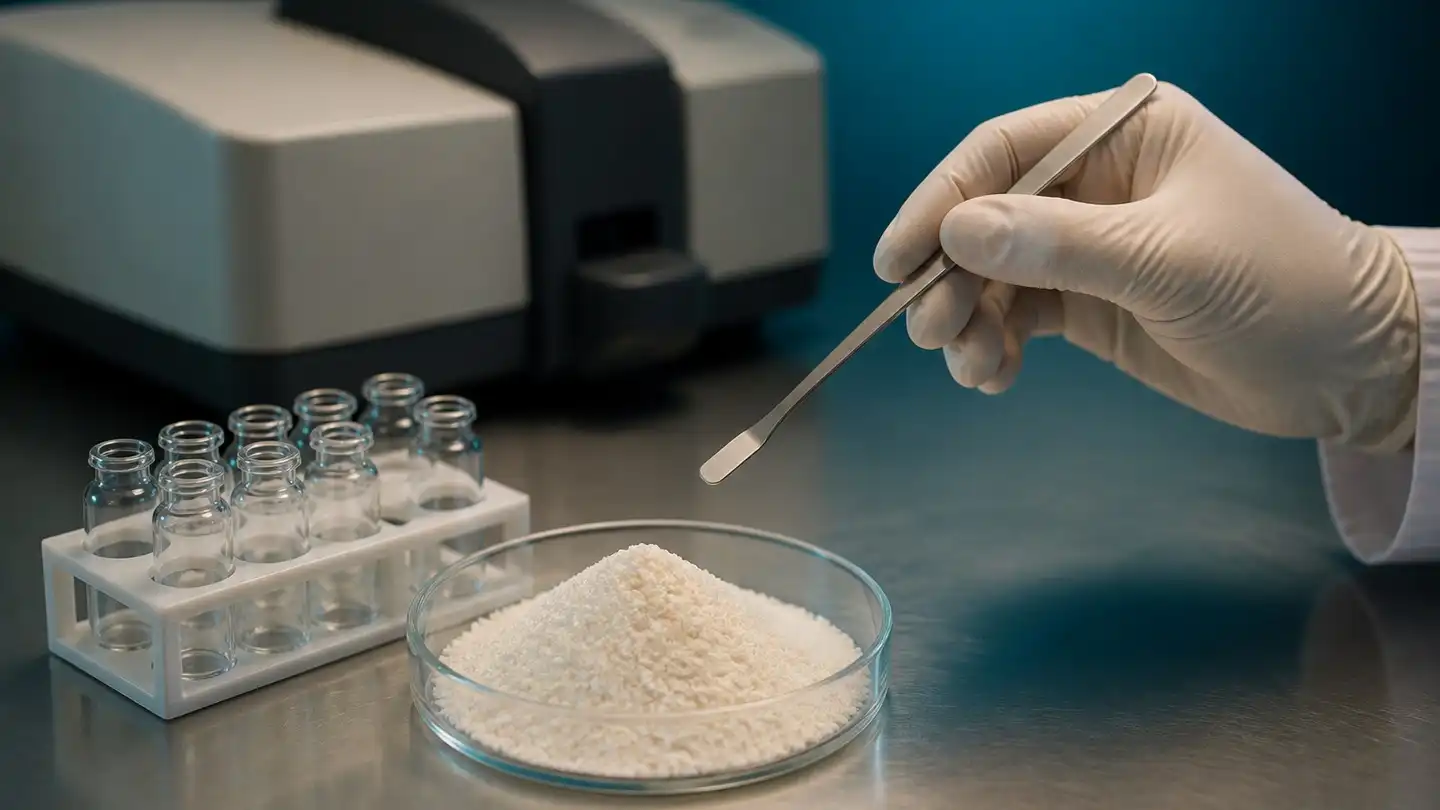
| Parameter | Listed specification | Receiving action | Disposition if outside the limit |
|---|---|---|---|
| Appearance | Light yellow to off-white, free-flowing fine powder | Inspect every container for colour shift, caking or surface moisture | Hold and request a documented position |
| Grade | 10%, 20%, 25% and 50% | Confirm the grade delivered matches the grade ordered | Reject or return |
| Encapsulation efficiency | 85–95% | Check the certificate; confirm by split sample on a new supplier | Retest under the agreed rule, then reject |
| Particle size (DLS) | Uniform particle size distribution | Read the distribution width on the batch report | Query a bimodal or skewed population |
| Solubility | Superior cold-water instant solubility | Disperse a sample in cold water and record the result | Hold for laboratory review |
| Elemental impurities | Pb <0.5 ppm | Confirm the panel and method behind the figure | Reject the lot |
| Microbiology | Total plate count <1000 cfu/g | Confirm count, method and incubation details | Quarantine and escalate |
| Certifications | cGMP, ISO 9001:2015, ISO 22000, Kosher, Halal | Verify scope and validity for the producing site | Hold release until documents are current |
| Clean-label options | Gluten-free, non-GMO, vegan-friendly, soy-free options | Match the option ordered against the lot documents | Correct documentation before release |
Receiving Inspection Actions on Arrival
Inspection on arrival is a short step that decides whether a lot enters your inventory or waits, so keep it scripted.
Container, Label and Powder Checks
Before opening anything, check seal integrity, the inner liner and signs of rough transit, heat or direct light. Reconcile the lot number and quantity with the packing list and certificate. Once open, assess the powder against the expected appearance band and note odour, clumping or free moisture; powder that took on moisture in transit behaves differently in your process even when the certificate looks clean.
Sampling, Retain Samples and Split Samples
Draw a representative sample using a documented pattern rather than the top of the first container, and label each sample with lot number, date and sampler. Keep a retain sample for the full period you are prepared to defend in an audit; a later complaint about a finished batch is usually answered with the retained powder. Where supplier data is your only evidence, send a split sample to an independent laboratory and file the result.
Cold-Water Dispersion as a Fast Screen
Dispersion in cold water is the quickest field check available: a well-encapsulated, properly dried lot disperses readily and holds a stable suspension without layer separation, while an agglomerated or moisture-affected lot often settles visibly. It is not a measurement of encapsulation efficiency and not a release test, but it efficiently triggers laboratory work on a container you were about to accept.
Traceability: the Chain You Must Be Able to Reconstruct
Traceability is tested by one question: if a finished batch is questioned two years from now, can this powder lot be tied back to its inputs and its release decision? Request a batch record extract, confirm the certificate number maps to the batch record number, and check that the phospholipid and ascorbic acid inputs are identified by lot as well. Ask to be notified before the phospholipid source, grade, drying route or packaging changes, since any of those can shift the size distribution of the next lot. The controls behind this are described in this explanation of manufacturing standards for quality liposomal vitamin C powder.
Deviations and Non-Conformance: a Closed-Loop Workflow
Triage the Deviation Before Touching the Material
Quarantine the lot first and classify the deviation second, because the class decides the disposition. Three levels cover most cases. Documentation deviations, such as a missing page or unsigned certificate, are correctable on paper. Analytical deviations, where a value sits outside the limit but inside the method’s uncertainty, follow the retest rule agreed in advance and only that rule. Material deviations, where assay, encapsulation efficiency, elemental impurities or microbiological counts fall outside the limit, end the discussion. Do not blend a marginal lot into a compliant one.
Closing the Loop
A deviation closes only when the cause is identified, a corrective action is agreed and evidence is filed. Record root cause, action taken, verification date and the supplier response in the same file as the lot record. Repeated documentation deviations from one supplier are a scorecard signal even when every lot was accepted, and a second material deviation in a rolling period normally triggers re-qualification rather than negotiation.
After Acceptance: Retain Samples and Storage Discipline
Acceptance is a decision about one point in time; the lot still has to survive your warehouse. Store the powder as the safety data sheet instructs, away from light and heat, and reserve part of the retain sample for periodic review. Re-examine colour, flow and dispersion at intervals: a retain sample that drifts faster than the stability summary predicted is early evidence that either the storage instruction or the supplier’s stability data needs revisiting. The drivers behind that drift are discussed in this review of the factors affecting shelf life of liposomal vitamin C powder.
Certifications: Read the Specification Table, Not the Brochure
Take certifications from the specification table of the product you are buying, and ask for the scope and validity date behind each one. This product page lists cGMP, ISO 9001:2015, ISO 22000, Kosher and Halal. Confirm that the certificate covers the manufacturing site that produced your lot. This certification checklist for liposomal vitamin C powder buyers covers how to file scope, site and validity.
Questions to Put to a Supplier Before You Commit
Most verification failures trace back to questions that were never asked. Put these in writing and keep the answers with the specification.
- Will the certificate of analysis be issued for my lot, naming the lot number and the testing laboratory?
- Which method produced the encapsulation efficiency figure, and what range applies to my grade?
- Will I be told before a change of phospholipid source, grade, drying route or packaging?
- How long are reserve samples held, and can a split sample go to my laboratory?
The commercial shape of the order decides which questions matter most, since a sample request, a pilot quantity and a recurring supply agreement carry different documentation expectations. That comparison sits in this guide to bulk purchasing options for liposomal vitamin C powder.
Requesting Certificates, Specification Files and Samples from EmerWell
EmerWell supplies liposomal vitamin C powder produced on the EncapsWell™ platform, with listed grades of 10%, 20%, 25% and 50%, encapsulation efficiency of 85–95%, Pb <0.5 ppm, total plate count <1000 cfu/g, and testing methods that include HPLC, DLS, TEM and iodometric titration. The specification table also names cGMP, ISO 9001:2015, ISO 22000, Kosher and Halal, plus clean-label options that include gluten-free, non-GMO, vegan-friendly and soy-free. Request a batch certificate of analysis, the specification sheet, a safety data sheet or a sample by writing to info@emerwell-bio.com, or open the liposomal vitamin C powder product page to review the listed specifications first. Our technical team can walk your quality group through the documentation package behind each lot; commercial terms are agreed case by case.
References
- U.S. Electronic Code of Federal Regulations. 21 CFR Part 111 — Current Good Manufacturing Practice in Manufacturing, Packaging, Labeling, or Holding Operations for Dietary Supplements. https://www.ecfr.gov/current/title-21/chapter-I/subchapter-B/part-111
- Danaei M, Dehghankhold M, Ataei S, et al. Impact of particle size and polydispersity index on the clinical applications of lipidic nanocarrier systems. Pharmaceutics, 2018;10(2):57. https://pmc.ncbi.nlm.nih.gov/articles/PMC6027495/
- Rahim MA, Zahran HA, et al. Liposomal encapsulation in food systems: a review of formulation, processing, and applications. Food Science & Nutrition, 2025;13(8):e70587. https://pmc.ncbi.nlm.nih.gov/articles/PMC12321603/
- Buettner GR, Schafer FQ, et al. Stability of aqueous solutions of ascorbate for basic research and for intravenous administration. Advances in Redox Research, 2023. https://pmc.ncbi.nlm.nih.gov/articles/PMC10552410/
- Dhotre T, Thanawala S, Shah R. Optimizing oral vitamin C supplementation: addressing pharmacokinetic challenges with nutraceutical formulation approaches — a mini review. Pharmaceutics, 2025;17(11):1458. https://pmc.ncbi.nlm.nih.gov/articles/PMC12655283/
This article is written for ingredient buyers and quality teams. It describes documentation, specification and process characteristics only, is not medical or dietary advice, and should not be read as a claim about the effect of any finished product.
Online Message
YOU MAY LIKE
High quality furniture manufacturer
_1776234266736.webp)